
 Print this page
The Multiple Bischke Plot  Analysis
 : A Simple and Powerful Graphic
Tool for Integrated Stratigraphic Studies*
: A Simple and Powerful Graphic
Tool for Integrated Stratigraphic Studies*
By
J-Y. Chatellier1 and C. Porras2
Search and Discovery Article #40110 (2004)
*Adapted from a poster-session presentation at the 2001 AAPG Annual Convention, Denver, Colorado, June, 2001, together with a revision presented at the 2003 CSPG Annual convention. The individual posters in PDF format may be viewed separately.
1PDVSA Oriente, Estudios Integrados Pirital, Puerto La Cruz, Venezuela; present address: Tecto Sedi Integrated, 271 Arbour Lake Way NW, Calgary, T3G 3Z7 Canada (email: [email protected])
2PDVSA Oriente, Estudios Integrados Pirital, Puerto La Cruz, Venezuela
Abstract
Establishing the correct stratigraphy is not always a
simple task, especially when dealing with tectonically complex areas or where
tectonics had locally controlled the sedimentation. Bischke (1994) introduced a
simple technique to compare the gradual change in thicknesses in two wells, the
difference being plotted against the reference well’s depth. The MBPA (Multiple
Bischke Plot Analysis), derived from the original method, allows a very quick
and objective review of the stratigraphy, whether it is done conventionally or
using sequence stratigraphy.
The MBPA invokes many wells at the same time; thus,
the problem well and the problem zone can be readily identified as the anomaly
shows-up in all paired well comparisons. One of the interests of the method is
that it does not matter how many faults or folds are present between the wells
under study, as only disturbance within the wells will show-up in the analysis.
Stacking several Bischke plots on the same diagram gives a different view of the coherency of the stratigraphy and of the structure. Thus, trend-similarity is more obvious than in the MBPA, whereas local anomalies are less readily apparent.
The power and limitations of both methods are
demonstrated through a review of case examples from various parts of the world.
Thus, the MBPA allows one to quickly identify anomalies and to distinguish
between faults of various types, unconformity, or wrong correlation. The method
does not solve the problem but allows geoscientists to focus their attention on
the real problem, be it a marker, a well, or a geographic area.
Complex sedimentology and active tectonism can be seen in a different way through the MBPA, especially when displaying the various Bischke plots on a map.
|
|
Bischke Plots
The original method was first published by Bischke in 1994 as the D/d plot. It was geared at understanding growth sedimentation patterns. A Bischke Plot allows you to check quickly and efficiently your correlation. The example in Figure 1.1 shows very well that the Bischke Plot gives full support to the interpreted faults in well 422, with well 593 supposedly being unfaulted. Faulted tops as well as drag folds are readily identifiable. Other faults of lesser magnitude could be proposed but would need extra support.
Brief Review of MBPA History
The Multiple Bischke Plot
A Bischke Plot: How Does It Work?--Graphical Explanation of the Method A "Bischke Plot," also called Dd/d diagram, is a graphical display of differences in depth of the various markers found in two wells (Y axis), plotted against the depth of the same markers in the reference well (X axis); all depths being true vertical depths (TVD). Alignment of points in a Bischke Plot indicates that the markers involved belong to series of rock with a similar and regular sedimentation pattern. The interest of the method is the opportunity given to graphically visualize existing breaks in the pattern. An apparent break in trend in a Bischke Plot can be attributed to many factors; these include:
All of these are possible in either well 1 or well 2 (Figures 2.1, 2.2, 2.3, and 2.4). A single Bischke Plot does not indicate in which well the problem lies.
Note that changes in dip associated with
Stratal dip
alone will not be reflected in a Bischke Plot if it stays constant (Figure
2.1).
Figure 2.1 also shows that faults
not intersecting a well will have no direct influence on a Bischke Plot.
If a well is sufficiently close to a
Where a well is intersected by a normal
Where a
Poster 3 Figures
Recognition of general folding: From a single Bischke Plot and a Few
Bischke plots to a Multiple Bischke Plot
Figures 3.1 and
3.2 illustrate the usefulness of a single
Bischke Plot in the study of a
A Multiple Bischke Plot
Poster 4 Figures
Coherency of Various Interpretations Validated by the MBPAWithin a common zone of interest in selected wells from Santa Barbara Field, Venezuela, 12 markers were used for interpretation 1 (with conventional stratigraphy) and 18 markers were used for interpretation 2 (within the framework of sequence stratigraphy) (Figures 4.1, 4.2, and 4.3). More layers do not mean more reliable stratigraphy. Further, sequence stratigraphy does not automatically mean correctness. Another example of coherency of correlation, with use of a Bischke Plot, is shown in Figure 4.4, from Maracaibo, Venezuela. The MBPA allows one to analyze objectively the relative coherency of various interpretations. It is better to be approximately right than precisely wrong.
Poster 5 Figures
VLA-31 Case Study: Block 1 Lake Maracaibo
· Unsuccessful injection scheme. · Seismic indicates reverse faults. · Not a single repetition recognized in any of the wells.
Second step:
Multiple Bischke Plot
|




|
|
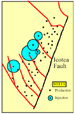
Figure 6.1. A map
display of various Bischke plots, representing the early stages in
the investigation of |
|
|
|
|
|


Power and Limitation of the MBPA: Examples from the Western Canada Basin
MBPA in Very Complex Part of Western Canada Basin
When the area under study is very complex, a map display of the various Bischke plots can be very useful. Thus the tectonic activity of the faults can be assessed in terms of timing and intensity. Figure 6.1 represents a “first glance” at a new area. The findings from MBPA have been corroborated by seismic. In Figure 6.1, maximum tectonic activity was at the time that the red marker was deposited. In the western part of the area, earlier tectonic activity is indicated by the green marker moving away from the trend expressed by the underlying units. The angle between the observed trends is indicative of how strong the tectonic activity was at the time represented by the red marker.
MBPA Expression of Clinoform in Banff Formation of Alberta Central Plains
Figure 6.2 is a representation of a clinoform exceptionally well expressed by an outstanding gamma-ray kick. This is the best clinoform example within the Banff Formation ever seen by the authors. This example shows that it is sometimes vital to have a sedimentological understanding of the units involved and to have sufficiently dense geographical coverage. If the wells had been sparse, the MBPA would have given no definite solutions.
Lower Mississippian Progradation in Alberta Central Plains
The MBPA was performed on the example in Figure 6.3 in order to understand the expression of a prograding system in a series of Bischke plots. The previous example (Figure 6.2) had the same aim but within a single formation. These two examples show the need to have a geological/sedimentological understanding in order to properly interpret some of the Bischke plots. These two examples (of progradation and clinoform) are taken and modified from the first author’s Ph.D. work, which was presented in a different form at the 1990 meeting of the British Sedimentological Research Group in Reading (UK).
Poster 7 Figures


Stacked and Inverted Stacked Bischke Plots
In a stacked Bischke Plot the vertical axis corresponds to the difference of TVDs between each marker in various wells against the same markers in the reference well (Figure 7.1). Having all of these in a single diagram (different method from the normal MBPA) allows one to compare thickness changes due to folding, such as illustrated in Figure 7.2, or to growth faulting. A traditional MBPA is more directed towards the identification of problematic correlation or of sedimentary sequences.
Use of Inverted Stacked Bischke Plots
In an inverted stacked Bischke Plot the
vertical axis corresponds to the TVDs of the reference well (Figure
7.3). This version of an MBPA allows a comparison of the
stratigraphic anomalies in a more conventional way in that it is like a
stratigraphic section, where the x value corresponds to the difference
in depth with respect to the reference well. Well W-18 has been used in
both diagrams in Figure 7.3 to make an easy
comparison. Two diagrams were necessary in order to individualize all of
the wells under study. Figure 7.4 shows the
detachment in cross-section. Figure 7.5
shows how the RFT data complements the analysis.


Observations to Keep in Mind
It is vital to integrate and understand well deviation and bed dips; this is especially true when interpreting stacked Bischke plots for which a correction for the well deviation is necessary in order to compare isochores.
A nice linear trend seen in a Bischke Plot does not necessarily means that the stratigraphy is correct, thus:
-
A forced layer cake stratigraphy could appear perfect using a Bischke Plot or any of the modified Multiple Bischke Plot
Analysis. -
In all cases isopach, paleogeographic, and net-to-gross maps need to be used in order to validate the MBPA findings.
-
Any conclusion from a Multiple Bischke Plot
Analysis needs to be corroborated by other lines
of evidence, especially dipmeter or pressure data.
Conclusions
The Multiple Bischke Plot Analysis is a very
powerful tool:
-
To objectively validate or review any existing geological or seismic correlation consisting of at least 10 markers.
-
To identify or confirm unconformities, sequence boundaries, wrong correlations, or low-angle
fault planes -
To help understand large folded complex structures in the absence of dipmeter data.
-
However, it will not do the correlation for you nor will it give a solution if the correlation is completely wrong. It will help identify zones which need revisions or help define limits between areas of coherent stratigraphic correlation. The MBPA helps focus on the real problem, saving time and money.
References
Bischke, R.E., 1994, Interpreting sedimentary growth structures from well log and seismic data (with examples): AAPG Bulletin, vol. 78, p. 873-892.
Bischke, R.E., Finley, W., and
Tearpock, D.J., 1999, Growth Analysis (Dd/d): Case histories of the resolution of correlation
problems as encountered while mapping around salt: GCAGS Transactions,
Vol. XLIX, p. 102-110.
Chatellier, J-Y., de Sifontes, R., Mijares, O., and Muñoz, P., 1999, Geological and production problems solved by recognizing the strike slip component on reverse faults, VLA-31, Lake Maracaibo, Venezuela: SPE Annual Technical Conference, Houston, SPE No. 56558.
Chatellier, J-Y., Hernandez,
P., Porras C., Olave, S., and Rueda M., 2001,
Recognition of fault bend folding, detachment and decapitation in wells,
seismic and cores from Norte Monagas, Venezuela: Search and
Discovery (www.searchanddiscovery.com),
AAPG, Tulsa, Oklahoma, USA, Article #40031.
Sanchez, R., Chatellier, J-Y.,
de Sifontes, R., Parra, N., and Muñoz P., 1997, Multiple Bischke Plots
Analysis , a powerful method to distinguish between tectonic or
sedimentary complexity and miscorrelations; methodology and examples
from Venezuelan oil fields: Memorias del Primero Congreso
Latinoamericano de Sedimentologia, Soc. Venezolana de Geologo, Tomo II,
Noviembre 1997, p.257-264.
, a powerful method to distinguish between tectonic or
sedimentary complexity and miscorrelations; methodology and examples
from Venezuelan oil fields: Memorias del Primero Congreso
Latinoamericano de Sedimentologia, Soc. Venezolana de Geologo, Tomo II,
Noviembre 1997, p.257-264.
Acknowledgments
Thanks are given to Shell and to PDVSA, especially Carlos Porras for allocating time to the author for investigating and revising the method originally proposed by Dr Bischke. More particularly, we would like to thank Rick Carter, Taco van der Haart, and Richard Bischke for their contribution to our understanding of the subject. Some of the diagrams have been created using a spreadsheet designed by Taco van der Haart.