
 Print this page
PSAnalysis
of Low Permeability Intervals in a Heavy-Oil Braided Stream Deposit Using a
Combination of  Core
Core and Log Analysis, Kern River field, California
By
Larry C. Knauer1, Robert Horton2, and Allen Britton3
Search and Discovery Article #50004 (2003)
*Adapted for online presentation from poster session presented at the AAPG Convention, Salt Lake City, Utah, May, 2003.
1ChevronTexaco, Bakersfield, CA ([email protected])
2California State University, Bakersfield, CA
3Core
Laboratories, Bakersfield, CA
Editorial Note: This article, which is highly graphic (or visual) in design, is presented as: (1) three posters, each represented by a PDF image, which contains the usual enlargement capabilities; and (2) searchable HTML text with figure captions linked to corresponding illustrations with descriptions.
Users without high-speed internet access to this article may experience significant delay in downloading some of the PDF files due to their sizes.
Click on individual poster below, to view it in PDF format.
|
|

The
Kern River field is located in Kern County, California, immediately adjacent to
the city of Bakersfield (Figure 1). This super-giant
oil field has produced over 1.5 billion barrels of 12-degree-API gravity crude
during the last 103 years from a Mio-Pleistocene braided stream deposit (the
Kern River alluvial fan) (Figures 2,
3, and 4). Estimated
reserves are still substantial. Production of over 100,000 BOPD places this
field in the top five producing fields in the country. Zones of reduced
reservoir quality due to poorly sorted sand, siltstones, and minor amounts of
clay are resulting in unproduced pockets of the reservoir rock with residual oil
saturations 10-30 saturation units higher than the adjacent rock with higher
permeability. Some of the lower quality reservoir rock is already heated to 220
degrees (F) or greater and shows no sign of draining. Other areas have been
noted with high oil saturation which appear not to be draining and are at lower
temperatures than the surrounding rock. A study is underway to determine if the lower
permeability (rock quality) is the sole reason for the pockets of high residual
oil. 70 cores taken over the last 30 years are being reviewed, along with core
photographs, wireline logs, and 3D models to determine the character of the
targets and their extent. Two examples (Toltec lease and Mitchell lease) of
by-passed oil are reviewed here.
|
|
Toltec LeaseChanges in
reservoir development and associated changes in oil saturation are shown
by means of a cross-section of part of the Kern River Formation (KRF) (Figure
5). Reservoir quality is determined by
Thin-sections reveal poorly sorted, angular arenite with significant
biotite. Calcite and kaolinite may be the result of Integration of these multiple data sets correlates very well with each other and demonstrate the heterogeneity of KRF (Figure 7). Results of the steamflood analysis demonstrate the relationship between original water saturation of the reservoir and fractional oil recovery following steamflood. Residual oil saturations following steamflood range from 17.8% to 25.9% (Figure 8). Comparison to residual oil saturations measured from logs indicates that the potential for additional recovery may be limited in this area with current production methods.
Mitchell LeaseChanges in oil saturation and in reservoir development are shown by means of a cross-section of part of the Kern River Formation (KRF) (Figure 9). Reservoir quality is determined by log, thin-section, particle-size, and capillary-pressure analyses (Figures 10 and 11).
Thin-section analysis indicates a poorly sorted, angular-grained arenite
(Figure 11A). The sands do not show any
Results of the steamflood analysis indicate fluid recovery values ranging from 28.1 to 54.4% of the original oil in place (Figure 12).
Conclusion
In
comparing the two leases presented here, from the Kern River Field, with
production history that has extended across three centuries (Figure
13), we found that the reservoir rock on the Toltec lease exhibited |
 Figure
1. Index map, with location of Kern River field.
Figure
1. Index map, with location of Kern River field.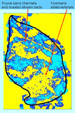 Figure
2. A horizontal slice through a 3D cube of resistivity data consisting
of 9000+ log traces.
Figure
2. A horizontal slice through a 3D cube of resistivity data consisting
of 9000+ log traces. Figure
3. A-D. Outcrops of Kern River Formation, showing typical examples of
the fluvial deposits of the Kern River alluvial fan.
Figure
3. A-D. Outcrops of Kern River Formation, showing typical examples of
the fluvial deposits of the Kern River alluvial fan. Figure
4. 3D model of the KRF showing lithology, oil saturation, and reservoir
temperature. This type of modeling is done routinely on a field-wide
level down to the individual well level.
Figure
4. 3D model of the KRF showing lithology, oil saturation, and reservoir
temperature. This type of modeling is done routinely on a field-wide
level down to the individual well level. Figure
5. Stratigraphic cross-section, TOLTEC Lease, of KRF reservoirs, showing
changes in oil saturation, as well as changes in their development.
Figure
5. Stratigraphic cross-section, TOLTEC Lease, of KRF reservoirs, showing
changes in oil saturation, as well as changes in their development. Figure
6. Well log (A), cored section (B), thin-sections (C), particle-size
analysis (D), and capillary-pressure data (E) of KRF in TOL004-XTO. C.1.
Calcite ‘grains’ in poorly sorted porous coarse sand. Calcite grains
formed through leaching and crushing of coarse crystalline calcite
cement. Scale bar is 1 mm.
Figure
6. Well log (A), cored section (B), thin-sections (C), particle-size
analysis (D), and capillary-pressure data (E) of KRF in TOL004-XTO. C.1.
Calcite ‘grains’ in poorly sorted porous coarse sand. Calcite grains
formed through leaching and crushing of coarse crystalline calcite
cement. Scale bar is 1 mm.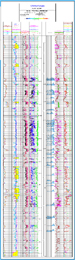 Figure
7. Log suite, including plots of reservoir parameters of KRF in
TOL004-XTO (courtesy of Paul Harness, formation evaluation specialist).
Figure
7. Log suite, including plots of reservoir parameters of KRF in
TOL004-XTO (courtesy of Paul Harness, formation evaluation specialist). Figure
8. Steamflood analysis. Residual oil saturations following steamflood
range from 17.8% to 25.9%.
Figure
8. Steamflood analysis. Residual oil saturations following steamflood
range from 17.8% to 25.9%.  Figure
9. Stratigraphic cross-section, Mitchell Lease, of KRF reservoirs,
showing changes in oil saturation, as well as changes in their
distribution.
Figure
9. Stratigraphic cross-section, Mitchell Lease, of KRF reservoirs,
showing changes in oil saturation, as well as changes in their
distribution. Figure
10. Lithologic and interpretive log suite of KRF reservoirs in MIT0020
(courtesy of Paul Harness, formation evaluation specialist). From left
to right, the log shows the lithology (sandstone and siltstone), a
resistivity curve, and a heat-corrected permeability curve based on the
conductivity measurement.
Figure
10. Lithologic and interpretive log suite of KRF reservoirs in MIT0020
(courtesy of Paul Harness, formation evaluation specialist). From left
to right, the log shows the lithology (sandstone and siltstone), a
resistivity curve, and a heat-corrected permeability curve based on the
conductivity measurement. Figure
11. Photomicrographs of samples of KRF in MIT0020 (A), corresponding
particle-size analyses (B), and capillary-pressure data (C). A.1. Poorly
sorted sand exhibiting variable porosity. Many of the fine sand grains
formed through leaching and crushing of plagioclase. Leaching of
plagioclase was accompanied by precipitation of kaolinite cement (red
arrow). Scale bar is 1 mm. A.2. Poorly sorted coarse sand containing
abundant biotite with long axes aligned parallel to bedding. Scale bar
is 1 mm. A.3. Poorly sorted granule conglomerate exhibiting crushed
plagioclase and fractured quartz. Prior to fracturing/crushing this sand
was probably well sorted. Scale bar is 1 mm. B. Laser particle-size
analysis shows unimodal distributions for all three samples and a
fining-upward sequence. C. Capillary-pressure data indicate that the Swir
values for the rocks approached 12% (88% So).
Figure
11. Photomicrographs of samples of KRF in MIT0020 (A), corresponding
particle-size analyses (B), and capillary-pressure data (C). A.1. Poorly
sorted sand exhibiting variable porosity. Many of the fine sand grains
formed through leaching and crushing of plagioclase. Leaching of
plagioclase was accompanied by precipitation of kaolinite cement (red
arrow). Scale bar is 1 mm. A.2. Poorly sorted coarse sand containing
abundant biotite with long axes aligned parallel to bedding. Scale bar
is 1 mm. A.3. Poorly sorted granule conglomerate exhibiting crushed
plagioclase and fractured quartz. Prior to fracturing/crushing this sand
was probably well sorted. Scale bar is 1 mm. B. Laser particle-size
analysis shows unimodal distributions for all three samples and a
fining-upward sequence. C. Capillary-pressure data indicate that the Swir
values for the rocks approached 12% (88% So).  Figure
12. Steamflood analysis. Results of the steamflood analysis indicate
fluid recovery values ranging from 28.1 to 54.4% of the original oil in
place.
Figure
12. Steamflood analysis. Results of the steamflood analysis indicate
fluid recovery values ranging from 28.1 to 54.4% of the original oil in
place. Figure
13. Photograph of Kern River field in 1899.
Figure
13. Photograph of Kern River field in 1899.