Print this page
  Click to view page images in PDF format.
Microporosity
in Arab  Formation
 Carbonates, Saudi Arabia*
By
Dave L. Cantrell1 and Royal M. Hagerty2
Search and Discovery Article #30008 (2002)
*Adapted for online presentation from article with the same title by the same authors published in GeoArabia, Vol. 4, No. 2, 1999, Gulf PetroLink, Bahrain (www.gulfpetrolink.com.bh). Appreciation is extended to the authors and to Moujahed Al-Husseini, Gulf Petrolink, Editor-in-Chief of GeoArabia ([email protected]).
1Saudi Aramco, Dhahran, Saudi Arabia ([email protected]).
2previously Exxon Production Research Company.
Microporosity
occurs throughout Arab Formation carbonates of Saudi Arabia, and affects the log
response, fluid flow properties and ultimate recovery of hydrocarbons in these
reservoirs. Qualitative examination of Arab samples indicates that microporosity
occurs as four major types: (1) microporous grains, (2) microporous matrix, (3)
microporous fibrous to bladed cements, and (4) microporous equant cements.
Quantitative estimation of microporosity abundance was measured in two ways: (1)
thin section point counts, and (2) pore throat size distributions derived from
capillary pressure data. Point count data shows that microporosity can vary
widely from sample to sample, ranging from 0% to 100% of the total measured
porosity of a sample. Capillary pressure data confirms the volumetric
significance of pore throats that are 10 microns or less in size. Variations in
microporosity abundance and type appear to be controlled by depositional
texture, grain mineralogy and grain microstructure. We suggest that
microporosity in Arab Formation carbonates formed diagenetically, via three
mechanisms: (1) leaching and incomplete reprecipitation of metastable carbonate,
(2) crystal growth contact inhibition, and (3) (locally) endolithic borings of grains.
|
tCrystal growth contact inhibition
tCrystal growth contact inhibition
tCrystal growth contact inhibition
tCrystal growth contact inhibition
tCrystal growth contact inhibition
tCrystal growth contact inhibition
tCrystal growth contact inhibition
tCrystal growth contact inhibition
tCrystal growth contact inhibition
tCrystal growth contact inhibition
tCrystal growth contact inhibition
tCrystal growth contact inhibition
tCrystal growth contact inhibition
tCrystal growth contact inhibition
|
FIGURE/TABLE CAPTIONS (** in abbreviated form)
**Complete caption appears with full-sized image and after References.
Microporosity
occurs in both sandstone and This study
documents the occurrence, distribution, abundance and origin of
significant amounts of microporosity in Arab This study uses
a three-part approach: (1) microporosity is examined qualitatively
throughout the Arab
The Upper
Jurassic Arab Many different definitions for microporosity have been proposed in the literature. Choquette and Pray (1970) defined a micropore as a pore that is less than 62.5 microns in average diameter. Pittman (1971) proposed that only pores less than one micron in diameter in at least one direction be termed micropores. For this study, however, we felt that neither of these definitions were appropriate, since we wanted to develop a microporosity definition that could be used primarily for petrographic characterization. Many petrographically visible pores are less than 62.5 microns in size, yet no pores in the one-micron range are optically resolvable with a standard petrographic microscope. For this study,
we have defined microporosity to be all pores that are approximately 10
microns in diameter or smaller. This definition is empirical and is
based on the idea that microporosity is the difference between total
measured
QUALITATIVE EXAMINATION OF MICROPOROSITY The first steps
in understanding microporosity were to catalogue variations in types of
microporosity and to document their occurrence. This study recognizes
four major types of microporosity, namely: microporous grains,
microporous matrix, microporous fibrous to bladed cements and
microporous equant cements. Figure 2 schematically illustrates these
four important micropore types. Of these, microporous grains and
microporous matrix are the most volumetrically significant micropore
types in the Arab
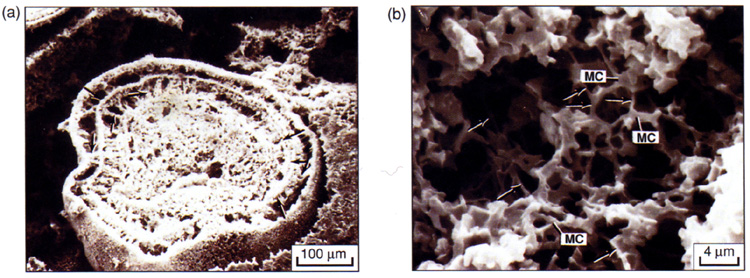
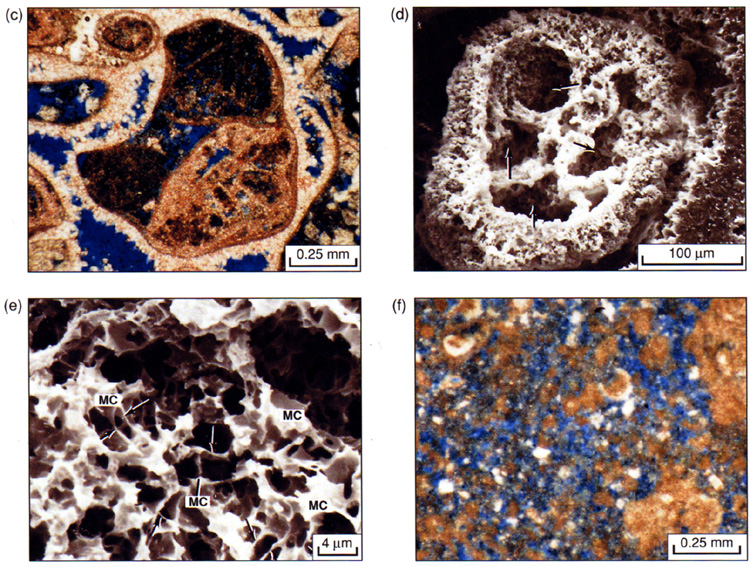
Microporous grains are common throughout the Arab carbonates (Figure 3) and constitute the most volumetrically significant microporosity type. SEM examination of pore casts and fractured rock surfaces reveals that a variety of skeletal and non-skeletal grain types are microporous. The microporosity-forming process transforms different grain types into grains that are similar with respect to their internal fabrics. Micritized grains (Figure 3), foraminifera (Figures 4a, 4c to 4f), ooids (Figures 4b; 5a and 5b) and composite grains (Figures 5c, 5d and 5e) can all be readily distinguished from each other both with a petrographic microscope and at low magnifications with the SEM. However, at higher magnification with the SEM, all four grain types have similar internal fabrics. This similarity suggests that the process is ultimately controlled by original grain mineralogy and microstructure, not by grain type. The internal fabric of microporous grains consists of uniform-sized, subhedral crystals of micrite ranging from 1 to 4 microns. SEM examination of pore casts of microporous grains shows that microporosity occurs as pores that are typically 0.3 to 3.0 microns in size between these micrite crystals (Figures 3c and 3d; 4d, 4e and 4f; 5a, 5b, 5d and 5e). Microporosity thus consists of a network of highly interconnected, uniform-sized straight tubular to laminar pore throats that intersect with less elongate, more equant (often tetrahedral-shaped) pores (Figures 3d; 4f; 5b and 5e). In many cases, the amount of microporosity within microporous grains is so high that the grains resemble sponges (Figure 3e). SEM examination is not always necessary to recognize microporous grains, since both a blue hazy appearance in thin section and complete grain micritization usually indicate the presence of microporosity (Figures 3a; 4a and 4b; 5c). This blue hazy appearance in thin section results from the infiltration of blue-dyed epoxy into micropores in grains and matrix (lime-mud or micrite). Also, since microporous grains are composed of micrite crystals, complete grain micritization usually reflects the presence of microporosity (for example, compare the non-micritized and non-microporous cement crystal with the microporous micritized grain in Figure 3f). Microporous matrix consists of 1 to 10 micron, subhedral calcite crystals that are randomly packed to yield a continuous network of micropores that are connected by smaller (1 micron maximum) pore throats. These micropores are found between crystals of lime-mud matrix (micrite or microspar) (Figures 5f; 6a to 6d). SEM examination of pore casts shows that the pore geometry of microporous matrix is similar to that of microporous grains. Pore throats tend to be laminar and tortuous, while micropores are generally subequant.
Microporous Fibrous to Bladed Cements Microporous
fibrous to bladed cements are common in Arab grainstones that contain
significant amounts of early marine, isopachous calcite cement. The
crystals of calcite cement are approximately 30 to 40 microns long and 5
to 10 microns wide (Figures 6e and 6f). SEM examination of epoxy pore
casts of these cements reveals thin (0.1 to 1.0 micron in diameter)
straight, tubular-shaped micropores occurring between cement crystals (Figures 7a and
7b). These “intercrystalline” pores apparently
result from the inhibition of further crystal growth and Although these “intercrystalline” pores are volumetrically insignificant in the Arab-D, they are important in that they provide a pathway connecting microporous grains to one another and to macropores. These cements isopachously coat and connect microporous grains, and separate microporous grains from larger interparticle pores. Micropores in these cements thus could play an important role in communication between microporous grains and macropores.
Microporous
equant cements are less common than the microporous fibrous to bladed
cements described above, primarily because sparry equant calcite cement
itself is not as common in Arab-D reservoir rocks in Eastern Saudi
Arabia. Equant cements are composed of subhedral to anhedral crystals of
calcite approximately 30 to 40 microns in size (Figure
7c). These
micropores occur between cement crystals; similar to the microporous
fibrous to bladed cements discussed previously, they probably result
from the contact inhibition of adjacent growing crystals (Wardlaw,
1976). Pore throats are flat, platy to laminar in shape and up to 3
microns thick, and intersect to form tetrahedral-shaped pores 2 to 6
microns in diameter (Figures 7d to 7f). Pore throat diameters are
extremely uniform in size. Where equant cement occurs in interparticle
pores, these micropores serve as possible pathways connecting
microporous grains to one another and to interparticle
QUANTITATIVE ASPECTS OF MICROPOROSITY The next aspect of this study was to quantitatively evaluate the abundance of microporosity, and this was accomplished in two ways. First, thin section point counts were used to determine microporosity abundance and variability; and second, mercury injection capillary pressure analysis allowed the resolution of greater details in the quantitative analysis of microporosity abundance and distribution in Arab-D samples. Petrographic Thin Sections Point Counts Petrographic
thin sections were point counted to determine optically visible
Figure 8
illustrates the relationship between measured and point count Overall, the
petrographic data indicate that microporosity occurs almost universally
throughout the Arab While some microporosity typically occurs in all studied samples, the type and amount of microporosity varies systematically. The petrographic data allowed us to identify the three major factors that exercise some control over variations in microporosity abundance and variability: (1) depositional texture, (2) original mineralogy, and (3) grain microstructure.
The primary control over microporosity in a rock sample as a whole is depositional texture. This relationship between depositional texture and microporosity abundance (Figure 10) occurs principally because the overall proportion of microporous components (including microporous grains and microporous matrix) increases as depositional texture becomes muddier. For example,
grainstones and mud-lean packstones consist predominantly of grains
(which are usually microporous) and large macropores; relatively minor
microporous matrix is present. In these rocks, then, microporosity is
limited to microporous grains. Some microporous cements and matrix may
be present, but they generally do not contribute much quantitatively to
overall microporosity. Consequently, microporosity in these rock types
is relatively low, averaging 19.8% and 37.6% of the total In general,
then, the proportion of total
Microporosity occurs only in grains originally composed of metastable aragonite or high magnesium calcite, whereas grains originally composed of low magnesium calcite are solid and non-microporous. Table 1 summarizes the interpreted primary mineralogies of common grains and cements in the Arab-D. This occurs without regard as to whether grains are skeletal or non-skeletal in origin. Different grain types with different original internal fabrics (e.g., ooids versus foraminifera) may be transformed into microporous grains with similar end-member fabrics (Figures 4a to 4e; 5a to 5e; 11a to 11c). Aragonite and
high magnesium calcite are less stable than low magnesium calcite at
conditions typical of the earth’s crust (Bathurst, 1975). This
difference in stability is responsible for the
One factor that
seems to modify the effect of primary mineralogy on microporosity
While the role
of microstructure is not completely understood, large, single-crystal
grains (e.g., echinoderms) are probably more stable and less susceptible
to dissolution and microporosity
Capillary
pressure data was also used to quantitatively evaluate microporosity in
Arab Mercury injection data is a measure of pore entry size (diameter), not actual pore size. The pore entry size calculations were made using the equation: D = 0.58(s)(cosq) where: D = Pore entry diameter in microns P = Capillary pressure (mercury injection pressure) in psi s = Interfacial tension, dynes/cm (s = 485 dynes/cm for air/mercury system) q = Contact angle in degrees (q = 130° for air/mercury)
The pore entry size distribution functions were calculated by: F(D) = V x 104/DD where: F(D) = Distribution function (as a function of diameter) V = Incremental volume of mercury injected (fraction of total pore volume) DD = Incremental change in diameter over which V was determined While the percent of microporosity derived from capillary pressure data is not strictly comparable with microporosity determinations from thin section point counts, the capillary pressure data does allow a qualitative comparison of microporosity determined by two very different techniques. Results from some of the capillary pressure analyses are shown in Figures 12 and 13, and illustrate the complex pore systems present in the Arab-D. Figure 12 is a suite of cumulative pore-size distribution curves for six representative Arab-D samples and reveals that microporosity (as previously defined, all pores 10 microns or less in size) accounts for a significant proportion (from about 50% to over 90% in these samples) of total pore volume. Figure 13 is a series of pore throat size distribution plots which illustrate the range and distribution of pore throats in three Arab-D samples. These pore throat size distribution plots all reveal that Arab carbonates contain a broad range of pore throat sizes and that even relatively mud-free samples have pore throats down into the 0.01 micron range. In general, we interpret pore throats between 0.05 to 0.3 microns to represent microporosity and, while these pore throat sizes are considerably smaller than those identified from the petrographic work, they do compare well with the pore networks observed in SEM and probably connect up to form larger micropores. Pore throats greater than about 5 to 10 microns probably form the larger macropore system. Figure 13 also
illustrates how microporosity – and total In general, the capillary pressure data allows us to resolve quantitatively the actual size range and distribution of microporosity. While the pore throats revealed by capillary pressure are generally much smaller than the petrographically-identified micropores, they do confirm the volumetric significance of pores and pore throats less than 10 microns in size. Capillary pressure data also suggest that a significant amount of the pore volume of these samples can only be accessed by very small pore throats (0.03 to 0.3 microns in size) and that microporosity becomes more significant – and conversely that macroporosity becomes less significant - as matrix content increases and depositional texture becomes muddier. Given the limits of resolution of the petrographic microscope, we feel these results generally agree with the observations and conclusions from petrographic data.
This study has
shown how microporosity was identified in Arab It is important to recognize that microporosity can have a significant impact on the fluid flow properties and log response of a reservoir. Typically, water is thought to be the wetting phase in a rock and, consequently, capillary forces tend to draw water up into the very small pores (micropores). Water held in these micropores by capillary attraction tends to be “bound” (immobile) and may not be producible. Wireline logs record total fluid content of a rock - including bound water in the micropores - thus the resulting calculated water saturations do not reflect the true producible fluid saturations that occur in the macropore system. When no microporosity is present, wireline logs yield fluid saturations that occur in the macropore system and are much more indicative of the true producibility of the reservoir. Zones with significant water-filled microporosity may contain (and produce) water-free hydrocarbons from the macropore system, even though the logs may indicate the zone to be apparently wet. Changes in rock wettability and pore geometry may affect some of these generalizations. Microporosity
can also have a significant impact on a reservoir performance model, for
two reasons. First, the actual effective This study has
shown how significant microporosity is, how it varies, and what are some
of the controls over its occurrence in Arab
As Pittman (1971) observed, it is unlikely that any microporosity in ancient rocks can be termed primary, as any primary microporosity associated with metastable aragonite or high magnesium calcite phases must be modified substantially (if not destroyed) during inversion to low magnesium calcite. In a similar manner, most micropores in the Arab-D are probably diagenetic in origin, or at least have been modified somewhat by diagenesis. As previously
noted, microporosity occurs in a variety of forms or types in the
Arab-D, implying that several mechanisms are responsible for the
Three mechanisms
are responsible for the majority of microporosity in the Arab-D: (1)
leaching and incomplete reprecipitation of metastable
Leaching and Incomplete
Reprecipitation of Metastable Post-depositional
leaching of metastable CaCO3 minerals and
incomplete reprecipitation of low magnesium calcite is probably
responsible for microporosity in micritized microporous grains and
matrix. Although grain micritization by boring endolithic algae and
fungi is recognized as a significant grain-altering process in
modern-day shallow water First, complete micritization is mineralogy-selective in the Arab-D, occurring only in originally metastable components (Figures 11a to 11c). Boring endolithic organisms, however, would not be expected to display any preference in mineralogy of the host grains. Also, the extent of grain micritization is too pervasive in Arab carbonates to be attributed solely to algal or fungal activity. Although some micrite envelopes and borings of algal or fungal origin do occur, they are readily distinguishable from the completely micritized and microporous grains that are so common in these rocks (Figure 11c). Finally, the habit of Recent micropores of algal or fungal origin are significantly different from those seen in the Arab-D (Figures 11d to 11f). It appears that the pervasive micritization and microporosity development results from partial post-depositional solution of metastable CaCO3 minerals. Since the
stabilization of metastable There are several diagenetic processes under which the dissolution-incomplete reprecipitation process responsible for most Arab-D microporosity may have occurred. These include: (1) evaporite diagenesis, (2) leaching by carbon dioxide-charged fluids formed during the maturation and migration of hydrocarbons, (3) marine diagenesis, (4) fresh water vadose diagenesis, (5) fresh water phreatic diagenesis, and (6) mixing zone diagenesis. As we will explore in this section, we feel that evaporite diagenesis is probably the most likely process responsible for forming most of the microporosity in the Arab-D.
The presence of a thick evaporite sequence immediately overlying the Arab-D Reservoir influences the diagenesis of Arab-D carbonates. Previous workers (Broomhall and Allan, 1985; Wilson, 1985) have suggested a direct relationship between some of the Arab dolomites and the evaporites. Fluids expelled during the compaction of evaporites or during the transformation of gypsum to anhydrite with burial are usually undersaturated with respect to Ca+2 (Shearman, 1978). Other workers have shown that such fluids typically have high Mg+2/Ca+2 ratios and are capable of dolomitizing limestones (Butler, 1969; Clark, 1980; Moore and Druckman, 1981). Also, these fluids become fairly acidic (pH<5.5) at shallow burial depths (Butler, 1969). Other workers
concerned with the diagenesis of evaporite-
Carbon Dioxide-Charged Subsurface Waters Carbonic acid
may be generated in pore waters through the addition of carbon dioxide
derived from the thermal maturation of organic matter during burial
diagenesis. Tissot et al. (1974) showed that, with increasing pressure
and temperature, the diagenetic transformation of organic matter results
initially in the expulsion of water and carbon dioxide and culminates
with the generation of oil and/or gas. Schmidt and McDonald (1979)
postulated that most secondary
Diagenesis in
the marine environment is a common process in many shallow-marine
It seems likely
that local small islands could have developed upon subaerially exposed,
grain-rich, shoaling sands that reached sea-level during deposition of
the Arab-D. This is commonly seen in many regressive
Fresh Water Phreatic Diagenesis The geometry and
extent of the fresh water phreatic zone is normally a function of
topography, rainfall and the distribution of permeable pathways. In
light of the probable low topography and arid climate that prevailed
during Arab
This zone is a
narrow zone that marks a diffuse boundary between the fresh water
(meteoric) phreatic and marine phreatic diagenetic zones. While Runnels
(1969) has shown that the mixing of two chemically dissimilar pore
waters can result in a mixture undersaturated with respect to calcium
Crystal Growth Contact Inhibition Micropores in
microporous cements probably result from the persistence of a thin film
of water at crystal interfaces during crystal growth (Wardlaw, 1976).
During crystallization, CaCO3 precipitates from
interstitial waters; as adjacent crystals grow toward each other, a thin
film of water is preserved along crystal faces. Contact between adjacent
crystals is actually inhibited by this thin water film, and in this
manner, thin “intercrystalline” micropores are developed between
cement crystals. Since the vast majority of all diagenetic modifications
of Although micropores of this type are volumetrically minor, they are significant in that they provide a passage between microporous grains and each other, and to larger macropores. These intercrystalline micropores commonly rim microporous grains, and occur as straight, tubular or laminar pores leading from microporous grains to other microporous grains, or open out into the larger macropore system.
As previously noted, endolithic algae and fungi produce relatively little microporosity in the Arab-D. Although micrite envelopes and borings are locally common, the microporosity formed in these envelopes is insignificant relative to that developed in micritized grains or matrix. Grain alteration and micritization is common in Recent sedimentary environments (Bathurst, 1975). In Recent environments, grain micritization ranges from single micrite-filled borings within grains to complete grain micritization. Although such completely micritized grains superficially appear similar to Arab-D micritized grains, detailed examination of micropore sizes and habit reveals them to be very different (Figures 11d to 11f). Micropores in Arab-D grains typically are straight tubular to laminar pores usually less than 1 micron in diameter; micropores in Recent micritized grains, however, are larger and more equi-dimensional in habit (Figure 11f). Such differences in habit are to be expected, since micropores in Recent sediments occur between micrite crystals of metastable mineralogy and would be extensively altered (if preserved at all) by diagenesis.
Microporosity
occurs almost universally throughout Arab Capillary pressure data, while not strictly analogous to the point count data, also suggest that microporosity comprises a significant portion of the total pore volume in Arab-D samples and that pore throats 0.03 to 0.3 microns in size probably connect up to form the micropore system. Pore throats greater than about 5 to 10 microns in size probably form the larger macropore system. We suggest that
microporosity in the Arab-D formed via three mechanisms: (1) leaching
and incomplete reprecipitation of metastable
Appreciation is given to Saudi Aramco and the Ministry of Petroleum and Minerals, Saudi Arabia, for permission to publish this article. We also extend our thanks to Chris Kendall, who reviewed an earlier version of this manuscript, the two anonymous reviewers, and to the GeoArabia staff for their assistance with editing and redesigning the graphics for this paper.
Al-Husseini, M.I. 1997. Jurassic Sequence Stratigraphy of the Western and Southern Arabian Gulf. GeoArabia, v. 2, no. 4, p. 361-380. Bathurst, R.G.C. 1964. The Replacement of Aragonite by Calcite in the Molluscan Shell Wall. In J. Imbrie and N.D. Newell (Eds.), Approaches to Paleoecology. Wiley, New York, p. 357-376. Bathurst,
R.G.C.
1975. Bray, R.D. 1997. The Arab-D Reservoir Exposed: Evidence for Vadose Diagenesis in Ghawar Field, Saudi Arabia. Abstract. GeoArabia, v. 2, no. 4, p. 481-482. Bricker,
O.P.
1971. Broomhall, R.W. and J.R. Allan 1985. Regional Caprock-Destroying Dolomite on the Middle Jurassic to Early Cretaceous Arabian Shelf. Society of Petroleum Engineers, v. 13697, p. 157-160. Budd, D.A. 1989. Micro-Rhombic Calcite and Microporosity in Limestones: A Geochemical Study of the Lower Cretaceous Thamama Group, UAE. Sedimentary Geology, v. 63, p. 293-311. Butler, G.P. 1969. Modern Evaporite Deposition and Geochemistry of Coexisting Brines, the Sabkha, Trucia Coast, Arabian Gulf. Journal of Sedimentary Petrology, v. 39, p. 70-81. Cayeux, L. 1935. Les Roches Sedimentares de France. Roches Carbonatees Masson, Paris, 463 p. Chave, K. 1964.
Skeletal Durability and Choquette,
P.W.
and L.C. Pray 1970. Geological Nomenclature and Classification of
Clark,
D.N.
1980. The Diagenesis of Zechstein Cloud, P.E.
1962. Environment of Calcium Folk, R.L. 1965. Some Aspects of Recrystallization in Ancient Limestones. In L.C. Pray and R.C. Murray (Eds.), Dolomitization and Limestone Diagenesis: A Symposium. Society of Economic Paleontologists and Mineralogists, Special publication no. 13, p. 14-48. Fyfe, W.S. and J.L. Bischoff 1965. The Calcite-Aragonite Problem. In L.C. Pray and R.C. Murray (Eds.), Dolomitization and Limestone Diagenesis: A Symposium. Society of Economic Paleontologists and Mineralogists, Special Publication no. 13, p. 3-13. Halley, R.B. and P.M. Harris 1979. Fresh Water Cementation of a 1,000 Year-Old Oolite. Journal of Sedimentary Petrology, v. 49, p. 969-988. Hanshaw, B.C., W. Back and R.G. Deike 1971. A Geochemical Hypothesis for Dolomitization by Groundwater. Economic Geology, v. 66, p. 710-724. Harris, P.M. 1979. Facies Anatomy and Diagenesis of a Bahamian Ooid Shoal-Sedimenta VII. University of Miami, Rosenstiel School of Marine and Atmospheric Science, Miami, 163 p. Illing, L.V. 1954. Bahamian Calcareous Sands. American Association of Petroleum Geologists Bulletin, v. 38, p. 1-95. Johnson, J.H. 1971. An Introduction to the Study of Organic Limestones. Quarterly of the Colorado School of Mines, v. 66, no. 2, 185 p. Keith,
B.D. and
E.D. Pittman 1983. Bimodal Kieke,
E.M. and
D.J. Hartmann 1974. Detecting Microporosity to Improve Kobluk,
D.R. and
M.J. Risk 1977. Micritization and Land, L.S. 1973. Contemporaneous Dolomitization of Middle Pleistocene Reefs by Meteoric Water, North Jamaica. Bulletin of Marine Science, v. 23, p. 64-92. Logan,
B.W.
1974. Inventory of Diagenesis in Holocene-Recent Longman,
M.W.
1980. Loreau, J.-P. and B.H. Pursur 1973. Distribution and Ultrastructure of Holocene Ooids in the Persian Gulf. In B.H. Purser (Ed.), The Shallow Epicontinental Sea. Springer, Berlin, p. 279-328. Lowenstam, H.A. 1963. Biologic Problems Relating to the Composition and Diagenesis of Sediments. In T.W. Donnell (Ed.), The Earth Sciences - Problems and Progress in Current Research. University of Chicago Press, Chicago, p. 137-195. MacClintock, C. 1967. Shell Structure of the Patteloid and Bellerophontoid Gastropods (Mollusca). Peabody Museum, Natural History, Yale University, Bulletin 22, p. 1-140. Majewske, O.P. 1969. Recognition of Invertebrate Fossil Fragments in Rocks and Thin Sections. Brill, Leiden, 101 p. Melim, L.A. and P.K. Swart 1998. Recognizing Marine-Burial Diagenesis: Criteria and Examples from Quaternary to Neogene Platform to Slope Carbonates, Bahamas and Florida. Presented at the 1998 Annual American Association of Petroleum Geologists Meeting. American Association of Petroleum Geologists Annual Meeting (Program with Abstracts). Meyer, F.O. and R.C. Price 1992. A New Arab-D Depositional Model, Ghawar Field, Saudi Arabia. Society of Petroleum Engineers Paper No. 25576, p. 1-10. Meyers, J. and K.C. Lohmann 1978. Microdolomite-Rich Syntaxial Cements: Proposed Meteoric – Marine Mixing Zone Phreatic Cements from Mississippian Limestones, New Mexico. Journal of Sedimentary Petrology, v. 48, p. 475-488. McGill, M.M. and K.R. Walker 1982. Diagenetic Study of the Holston Limestone: Paragenesis of Cements and Evaluation of Geochemistry. Presented at 1982 Annual Meeting Geological Society of America Southeast and Northeast Sections. Geological Society of America Southeast and Northeast Annual Meeting (Program with Abstracts). Mitchell, J.C., P.J. Lehmann, D.L. Cantrell, I.A. Al-Jallal and M.A.R. Al-Thagafy 1988. Lithofacies, Diagenesis and Depositional Sequence; Arab-D Member, Ghawar Field, Saudi Arabia. In A.J. Lomando and P.M. Harris (Eds.), Giant Oil and Gas Fields - A Core Workshop. Society of Economic Paleontologists and Mineralogists, Core Workshop no. 12, p. 459-514. Moore,
C.M. and
Y. Druckman 1981. Burial Diagenesis and Moshier, S.O. 1989. Development of Microporosity in a Micritic Limestone Reservoir, Lower Cretaceous, Middle East. Sedimentary Geology, v. 63, p. 217-240. Newell, N.D., E.G. Purdy and J. Imbrie 1960. Bahamian Oolitic Sand. Journal of Geology, v. 68, p. 481-497. Newell, N.D. and
J.K. Rigby 1957. Geological Studies on the Great Bahama Bank. In
R.J. LeBlanc and J.G. Breeding (Eds.), Regional Aspects of Oldershaw,
A.E.
1972. Microporosity Control in Microcrystalline Palmer, T.J., J.D. Hudson and M.A. Wilson 1988. Palaeoecological Evidence for Early Aragonite Dissolution in Ancient Calcite Seas. Nature, v. 335, p. 809-810. Pittman,
E.D.
1971. Microporosity in Purser, B.H. 1969. Syn-Sedimentary Marine Lithification of Middle Jurassic Limestones in the Paris Basin. Sedimentology, v. 12, p. 205-230. Runnels, D.D. 1969. Diagenesis, Chemical Sediments, and the Mixing of Natural Waters. Journal of Sedimentary Petrology, v. 39, p. 1188-1201. Sandberg, P.A.
1975. New Interpretation of Great Salt Lake Ooids and of Ancient
Non-Skeletal Sandberg, P.A.
1983. An Oscillating Trend in Phanerozoic Non-Skeletal Sarg, J.R. 1982. Off-Reef Salina Deposition (Silurian), Southern Michigan Basin, Implications for Reef Genesis. In Handford et al. (Eds.), Depositional and Diagenetic Spectra of Evaporites - A Core Workshop. Society of Economic Paleontologists and Mineralogists, Core Workshop no. 3, p. 354-383. Schmidt, V. and
D.A. McDonald 1979. The Role of Secondary Schreiber, B.C.,
D.J. Kinsman and R.D. Nurmi 1976. Development of Shearman, D.J. 1978. Evaporites of Coastal Sabkhas. In W.E. Dean and B.C. Schreiber (Eds.), Marine Evaporites. Society of Economic Paleontologists and Mineralogists, Short Course No. 4, p. 6-42. Stockman, K.W., R.N. Ginsburg and E.A. Shinn 1967. The Production of Lime Mud by Algae in South Florida. Journal of Sedimentary Petrology, v. 37, p. 633-648. Taft,
W.H., F.
Arrington, A. Haimovitz, C. MacDonald and C. Woolheater 1968.
Lithification of Modern Tissot, B., B.
Dunard, J. Espitalic and A. Combay 1974. Influences of Nature and
Diagenesis of Organic Matter in Wardlaw, N.C.
1976. Pore Geometry of Wigley,
T.M.L.
and L.N. Plummer 1976. Mixing of Wilkinson,
B.H., R.M. Owen and A.R. Carroll 1985. Submarine Hydrothermal Weathering,
Global Eustasy, and Wilson, A.O.
1985. Depositional and Diagenetic Facies in the Jurassic Arab-C and -D
Reservoirs, Qatif Field, Saudi Arabia. In P.O. Roehl and P.W.
Choquette (Eds.), Wilson,
J.L.
1975. Wray, J.L. 1977. Calcareous Algae (Developments in Paleontology and Stratigraphy No. 4). Elsevier, New York, 185 p.
Complete Captions for Figures 3,4,5,6,7, & 11) Figure 3
a,b,c.d. Microporosity
in Arab (a)
Thin
section photomicrograph of skeletal-oolitic grainstone. Interparticle
(BP) and moldic (MO) macropores are abundant. Microporosity (MC) occurs
within micritized grains and foraminifera (F). Isopachous fringing
calcite cement (arrows) coats most grains in this sample
(plane-polarized light, Saudi Arabia, Abqaiq field, Arab-D). (b) SEM
photograph of epoxy pore cast of sample shown above. Figure 3 e,f. (e) Epoxy pore cast of microporous grain (M). Density of microporosity is so high that the grain resembles a sponge (SEM image, Saudi Arabia, Berri field, Arab-C). (f) SEM image of fractured rock surface of ooid-skeletal mud-lean packstone. Large sparry calcite cement crystal (C) is nonmicroporous and distinct in appearance from surrounding micritized and microporous grains (Saudi Arabia, Khursaniyah field, Arab-D). Figure 4 a,b.
Microporous grains in Arab Figure 4 c,d.
(c) SEM image of fractured rock chip showing internal fabric of a
microporous foraminifer (F). Foraminifer consists of subhedral crystals
of micrite ranging from 1 to 10 microns in size. Foraminifer is
recognizable by a distinctive chambered pattern of intraparticle
Figure 4 e,f. (e) SEM image of epoxy pore cast of microporous foraminifer (F). Intraparticle (WP) pores within the foraminifer are partially occluded by microporous cements (arrows). Interparticle (BP) macropores are common (Saudi Arabia, Ghawar field, Arab-D). (f) Higher magnification view of foraminifer shown in previous example. Network of highly interconnected micropores usually 1 micron or less in diameter is visible in foraminifer test wall. Figure 5 a,b. Microporous
grains and microporous matrix in Arab Figure 5 c,d,e,f. (c) Thin section photomicrograph of microporous composite grain (plane-polarized light, Saudi Arabia, Qatif field, Arab-C). (d) Epoxy pore cast of microporous composite grain (planepolarized light, Saudi Arabia, Berri field, Arab-A). (e) Higher magnification view of epoxy pore cast of same microporous composite grain shown in (d) above. Microporosity consists of a maze of highly interconnected pore throats (arrows) and larger, more equant micropores (MC). Note similarity between microporous network of composite grain and foraminifer (Figure 4f), ooid (Figure 5b) and micritized grain (Figure 3e). (f) Thin section photomicrograph of microporous micritized grains in microporous matrix (plane-polarized light, unspecified Mesozoic reservoir, Middle East). Figure 6.
Microporous matrix and microporous cements in Arab Figure 7 a,b.
Microporous cements in Arab Figure 7
c,d,e,f. (c) Thin
section photomicrograph of grainstone with abundant equant calcite
cement (arrows). This cement fills interparticle Figure 11
a,b,c,d. Microporous
grains in the Jurassic and in the Recent. Figure 11 e,f.
(e) SEM photograph of epoxy pore cast of large Recent microporous
peloid (P). Solid components (arrows) within the microporous peloid, as
well as other solid grains (SG), were etched away during sample
preparation. Interparticle (BP)
ABOUT THE AUTHORS
|
 Figure 1a
 Figure 1b
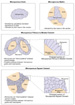 Figure 2
 **Figure 3
a,b,c,d.
**Figure 3
a,b,c,d. **Figure 3
e,f
**Figure 3
e,f **Figure 4
a,b
**Figure 4
a,b **Figure 4
c,d
**Figure 4
c,d **Figure 4
e,f
**Figure 4
e,f **Figure 5
a,b
**Figure 5
a,b **Figure 5
c,d,e,f
**Figure 5
c,d,e,f **Figure 6
 **Figure 7
a,b
**Figure 7
a,b **Figure 7
c,d,e,f
**Figure 7
c,d,e,f Figure 8
 Figure 9
 Figure 10
 **Figure 11
e,f
**Figure 11
e,f Figure 12
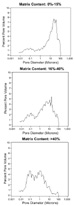 Figure 13
 Table 1
 Dave L.
Cantrell
Dave L.
Cantrell  Royal M. Hagerty