Print this page
 Click to view article in PDF format.
Three-Dimensional Seismic Imaging and Reservoir Modeling of an Upper Paleozoic “Reefal” Buildup, Reinecke Field, West Texas, United States*
By
Arthur H. Saller1, Skip Walden1, Steve Robertson2, Robert Nims2, Joe Schwab2, Hiroshi Hagiwara3, and Shigeharu Mizohata4
Search and Discovery Article 20044 (2006)
Posted December 20, 2006
*Adapted from article published in AAPG Memoir 81, Seismic Imaging of Carbonate Reservoirs and Systems, edited by Gregor P. Eberli, Jose Luis Masaferro, and J. F. Rick Sarg. This publication may be purchased from AAPG Bookstore.
1Unocal Corporation, Sugar Land, Texas, U.S.A. Currently, Chevron, Houston, Texas ([email protected])
2Pure Resources, Midland, Texas, U.S.A.
3Japan Oil Development Company, Abu Dhabi, United Arab Emirates; formerly, Japan National Oil Company, Chiba, Japan.
4Japan National Oil Company, Chiba, Japan
Abstract
Reinecke field is an upper Pennsylvanian to lowest Permian carbonate buildup in
the southern part of the Horseshoe Atoll, west Texas, United States. The field
and surrounding areas have been imaged with three  3-D
3-D seismic surveys and
penetrated by many wells. Although Reinecke is commonly referred to as a reefal
reservoir, deposition occurred in stratified sequences, 50-100 ft (15-30 m)
thick, dominated by wackestones, packstones, and grainstones. Boundstones
(mainly rich in phylloid algae) constitute only 16% of the buildup. Seismic
reflectors within the buildup parallel sequence boundaries and are truncated at
the margins of the buildup. Three-dimensional seismic surveys show that the top
of the Reinecke buildup is highly irregular with more than 470 ft (143 m) of
relief. Deep-marine shales overlie the reservoir and act as a seal for this
stratigraphic trap. Reinecke's irregular, mounded morphology is the result of
localized carbonate growth and erosional truncation. Much of the erosional
truncation probably occurred in a deep-marine environment.
seismic surveys and
penetrated by many wells. Although Reinecke is commonly referred to as a reefal
reservoir, deposition occurred in stratified sequences, 50-100 ft (15-30 m)
thick, dominated by wackestones, packstones, and grainstones. Boundstones
(mainly rich in phylloid algae) constitute only 16% of the buildup. Seismic
reflectors within the buildup parallel sequence boundaries and are truncated at
the margins of the buildup. Three-dimensional seismic surveys show that the top
of the Reinecke buildup is highly irregular with more than 470 ft (143 m) of
relief. Deep-marine shales overlie the reservoir and act as a seal for this
stratigraphic trap. Reinecke's irregular, mounded morphology is the result of
localized carbonate growth and erosional truncation. Much of the erosional
truncation probably occurred in a deep-marine environment.
Reinecke's south dome acts a single continuous reservoir dominated by limestone (70%) with 25% dolomite. Limestone porosity is generally 5-18% (average of 11.2%) and permeability is 1-1000 md (average of 166 md). Dolomite porosity is lower (average of 8.3%), but permeability is higher (average of 894 md). Discontinuous low-permeability layers parallel to stratification serve as low-permeability baffles; however, patchy replacive dolomites cut through stratification and act as high-permeability vertical conduits. Good reservoir continuity, low-permeability baffles, and artificially enhanced bottom-water drive helped to recover more than 50% of the original oil in place. Excellent vertical reservoir continuity has allowed implementation of a crestal CO2 flood at Reinecke field. CO2 is being injected into the top of the structure, displacing
residual and bypassed mobile oil downward for recovery in lower parts
of the reservoir. |
uAbstractuIntroductionuFigures 1-3uTextuSeismic datauFigures 4-7uTextuFacies/stratigraphyuFigures 8-9uTextuDepositional historyuFigure 10uTextuPorosity, permuFigure 11-12uTextuProduction historyuFigures 13-15uTextuConclusionsuReferencesuAcknowledgments
uAbstractuIntroductionuFigures 1-3uTextuSeismic datauFigures 4-7uTextuFacies/stratigraphyuFigures 8-9uTextuDepositional historyuFigure 10uTextuPorosity, permuFigure 11-12uTextuProduction historyuFigures 13-15uTextuConclusionsuReferencesuAcknowledgments
uAbstractuIntroductionuFigures 1-3uTextuSeismic datauFigures 4-7uTextuFacies/stratigraphyuFigures 8-9uTextuDepositional historyuFigure 10uTextuPorosity, permuFigure 11-12uTextuProduction historyuFigures 13-15uTextuConclusionsuReferencesuAcknowledgments
uAbstractuIntroductionuFigures 1-3uTextuSeismic datauFigures 4-7uTextuFacies/stratigraphyuFigures 8-9uTextuDepositional historyuFigure 10uTextuPorosity, permuFigure 11-12uTextuProduction historyuFigures 13-15uTextuConclusionsuReferencesuAcknowledgments
uAbstractuIntroductionuFigures 1-3uTextuSeismic datauFigures 4-7uTextuFacies/stratigraphyuFigures 8-9uTextuDepositional historyuFigure 10uTextuPorosity, permuFigure 11-12uTextuProduction historyuFigures 13-15uTextuConclusionsuReferencesuAcknowledgments
uAbstractuIntroductionuFigures 1-3uTextuSeismic datauFigures 4-7uTextuFacies/stratigraphyuFigures 8-9uTextuDepositional historyuFigure 10uTextuPorosity, permuFigure 11-12uTextuProduction historyuFigures 13-15uTextuConclusionsuReferencesuAcknowledgments
uAbstractuIntroductionuFigures 1-3uTextuSeismic datauFigures 4-7uTextuFacies/stratigraphyuFigures 8-9uTextuDepositional historyuFigure 10uTextuPorosity, permuFigure 11-12uTextuProduction historyuFigures 13-15uTextuConclusionsuReferencesuAcknowledgments
uAbstractuIntroductionuFigures 1-3uTextuSeismic datauFigures 4-7uTextuFacies/stratigraphyuFigures 8-9uTextuDepositional historyuFigure 10uTextuPorosity, permuFigure 11-12uTextuProduction historyuFigures 13-15uTextuConclusionsuReferencesuAcknowledgments
uAbstractuIntroductionuFigures 1-3uTextuSeismic datauFigures 4-7uTextuFacies/stratigraphyuFigures 8-9uTextuDepositional historyuFigure 10uTextuPorosity, permuFigure 11-12uTextuProduction historyuFigures 13-15uTextuConclusionsuReferencesuAcknowledgments
|
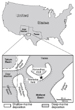
Reinecke field is a stratigraphic trap for oil in a “reefal” buildup. Reinecke field is part of the Horseshoe Atoll, a northward-opening arc of upper Pennsylvanian carbonate buildups in the Midland Basin of west Texas, United States (Figures 1and 2). Horseshoe Atoll fields are a series of stratigraphic traps that have produced more than 2 billion bbl of oil and are characterized by high permeability and high recovery efficiencies (near 50% of original oil in place [OOIP] after waterflooding) (Galloway et al., 1983). Fields on the eastern side of the Horseshoe Atoll have stratified porosity with permeability barriers to vertical flow. Reinecke and other fields on the south and west sides of the Horseshoe Atoll have vertical permeability pathways that allow the top of the reservoir to be in pressure communication with the underlying aquifer (i.e., they produce like reefal reservoirs) (Crawford et al., 1984; Saller et al., 1999). Approximately 83 million bbl of oil have been produced from Reinecke field (approximately 3 mi2 [8 km2]; Figure 3) since its discovery in 1950. The south dome of Reinecke field (approximately 1 mi2 [2.6 km2]), the focus of this chapter, has produced 46 million bbl of oil. The carbonate reservoir at the south dome of Reinecke field has approximately 470 ft (143 m) of depositional and erosional relief above its original oil-water contact at -4600 ft (-1400 m) subsea. The area has no significant tectonic deformation. The shallow-marine carbonate thins laterally and is overlain by a deep-marine shale that acts as a vertical and lateral seal. Deep-marine shales of Pennsylvanian and Early Permian age are generally assumed to be the source for the Reinecke oil. This joint Unocal-Japan National Oil Company
reservoir characterization project helped to better understand the south
dome at Reinecke field to implement a crestal CO2 flood.
Major parts of the project included (1) deepening and coring of many
wells that initially only penetrated the uppermost part of the
reservoir, (2) acquisition and interpretation of multiple
three-dimensional ( Reservoir characterization included several
important steps. Key stratigraphic surfaces were identified in core and
then extrapolated across the rest of the field using wire-line logs.
Reservoir porosity and permeability were initially measured on core
material. Porosity measured in core was used to calibrate wire-line
logs. Wire-line porosity logs (mainly neutron and density logs) were
then used to estimate porosity in uncored wells. Permeability in uncored
wells was calculated using core-derived transforms for porosity vs.
permeability. Stratigraphic tops from wells were merged with seismic
surfaces in EarthVision to create stratigraphic surfaces used in the
geocellular model. Porosity and permeability were extrapolated between
wells by ordinary kriging and then gridded in EarthVision. A model with
35 layers was built. A RESCUE export format was used as an interface
between the EarthVision geocellular model and the Eclipse flow
simulator. In this chapter, we will focus on (1) describing the
three-dimensional reservoir characteristics of a “reefal” buildup, i.e.,
the south dome of Reinecke field, (2) showing how a Three-Dimensional Seismic Data
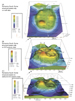
Three The top of the Reinecke carbonate is shown
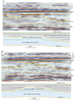
regionally by the 1993 Two main factors have made lateral variations in reservoir characteristics (porosity, permeability, and lithology) difficult to image with the Reinecke seismic data. (1) The top of carbonate is a very irregular surface having a very large impedance contrast with the overlying shale (Figure 6). This resulted in a very high amplitude seismic response at the top of the Reinecke reservoir and an uneven penetration of seismic waves into the reservoir carbonate. Most of the reservoir is less than a seismic wavelet below the top of carbonate, resulting in most of the reservoir being in the seismic zone dominated by the shale-limestone contact. (2) Variations in limestone and dolomite give seismic impedance responses that are similar to variations in porosity within a pure limestone or pure dolomite. Because limestone-dolomite variations and porosity variations are scattered throughout the reservoir, it is very difficult to separate the two. Depositional Facies and Stratigraphy
The main reservoir at Reinecke field is an upper Pennsylvanian to lowest Permian carbonate, which is overlain and sealed by siliciclastic and carbonate mud of Early Permian age. The reservoir at Reinecke field is mainly limestone (70%) with substantial dolomite (25%) and minor amounts of mixed limestone-dolomite (20-80% dolomite; 5% of reservoir). Shale is present in trace amounts (<1%). Most of the Reinecke reservoir occurs in three main sequences (between sequence boundaries 100 and 400) that are stratified and typically 15-30 m thick (Figures 8 and 9). Those three sequences are Virgilian (late Pennsylvanian) in age (G. Wilde, personal communication, 1997), and hence part of the Cisco Formation. Cores show fractures, root traces, caliches, and brecciation immediately below sequence boundaries 100, 200, 300, and 400. Small amounts of oil also occur in Wolfcampian (Lower Permian) pinnacles (above the 100 marker) and in the Canyon Formation (Missourian; below the 400 marker, but above the oil-water contact). Deposition of these sequences occurred during “ice-house” times, and hence were subjected to high-amplitude sea level fluctuations (Veevers and Powell, 1987). Sequences typically have a thin basal part, a thick middle part, and upper part with variable thickness (Figures 8 and 9). Basal parts generally contain thin shale and/or bioclastic packstone-grainstone. The middle of sequences is dominated by fossiliferous wackestone (commonly phylloid algal wackestone) and phylloid algal boundstone. Grainstone is common in the upper part of sequences (Figures 8 and 9). Crinoidal grainstone occurs in the upper part of the two uppermost Pennsylvanian sequences. Oolitic grainstone is also common in the upper part of the two lower sequences (Figure 9). Nine main carbonate depositional facies are present, and boundstone comprises only 16% of this “reefal” buildup (Table 1). Carbonates above horizon 100 are highly variable in thickness and have a sharp upper contact with the overlying shale. Wells near the edge of the south dome have none of this Wolfcamp interval present (Figure 9). Thin accumulations of fossiliferous packstone and grainstone occur immediately above horizon 100, and fossiliferous wackestone dominates the rest of the interval. Crinoids and phylloid algae are common. Many fractures and vugs filled with coarse, fibrous to prismatic cement are also present above horizon 100. In the #277 well, the uppermost Wolfcamp carbonate is a dark lime mudstone that is overlain by a thin spiculitic chert and then dark shale that acts as the seal for the Reinecke reservoir (Figure 8). Interpretation of Depositional History
Although the south dome of Reinecke field has a mounded or “reefal” morphology, it is composed of fairly stratiform sequences that apparently formed in response to variations in relative and probably eustatic sea level. Sequence boundaries are identified by soil- and exposure-related features (fractures, root traces, caliches, and brecciation) observed in core. Abrupt decreases in bulk-rock stable carbon and oxygen-isotope ratios below those surfaces support subaerial exposure (Figure 8). A depositional model for typical sequences is shown in Figure 10. The uppermost carbonate (lower Wolfcampian; above “100” marker) in the Reinecke buildup contains a no petrographic, cathodoluminescent, or stable isotopic evidence of freshwater diagenesis or subaerial exposure (J.A.D. Dickson, personal communication, 1999), suggesting that the last stage of erosion was not associated with subaerial exposure. Relief on the Reinecke carbonate structure is
probably the result of differential carbonate growth, subaerial
karstification, and deep-marine erosion following deposition and
drowning of the Reinecke buildup. As the Distribution of Porosity, Dolomite, and PermeabilityMost porosity at Reinecke occurs in sequences subjected to subaerial exposure and meteoric diagenesis. Meteoric diagenesis associated with subaerial exposure apparently helped preserve intergranular porosity and microporosity in micrite by creating a lithified framework that resisted compaction during subsequent burial. Porosity is widespread in carbonates below sequence boundary 100 (Figure 8). Most carbonates above sequence boundary 100 are not porous. Calcite cements are volumetrically minor throughout the Reinecke buildup. Many pores (molds, vugs, fractures) in the Reinecke reservoir were created by leaching of biotic constituents and dolomitization (Crawford et al., 1984). Excluding lime mudstones, depositional facies that are still limestone have similar average porosities (9.3-12.9%; Table 1). Permeability is highly variable depending on pore types within facies. Phylloid algal boundstone generally has the highest permeability. Lime wackestone and packstone with intercrystalline microporosity have lower average permeabilities (Table 1). Bioclastic grainstone with significant intergranular porosity has moderate permeability. Dolomite is a later diagenetic phase that replaced parts of many different depositional facies during moderately deep burial (J.A.D. Dickson, personal communication, 1989). Dolomite has generally lower porosity (average of 8.3%) and higher permeability (average horizontal and vertical permeabilities of 894 and 334 md, respectively) than limestones (average porosity of 11.2%; average horizontal and vertical permeabilities of 165 and 11 md, respectively) (Table 2; Figure 10). Dolomites with substantial vuggy and coarse intercrystalline porosity have very high permeability (>500 md). Shale is present in small amounts (<1%); however, it is locally important as a barrier to vertical fluid flow. Although porosity and
permeability are variable, reservoir-grade porosity (>4%) and
permeability (>1 md) are fairly continuous laterally and vertically. No
field-wide barriers to vertical or horizontal flow have been recognized
in the main part of the reservoir; however, dense carbonate mudstone and
shale have formed local permeability barriers or baffles. Lack of
field-wide permeability barriers is, in part, because of a lack of
laterally extensive tidal flat wackestone-packstones or evaporites that
effectively stratify fluid flow in many shelfal carbonates.
High-permeability dolomites cut across sequences and greatly enhance
vertical fluid flow. Therefore, reservoir fluids flow vertically and
laterally through the Reinecke reservoir. As
Figure 11 and
Tables 1 and
2 show, permeability is related to reservoir rock type (limestone
vs. dolomite). The
Production History
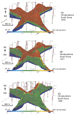
Reinecke field was discovered in 1950 at depths of approximately 6700 ft (-4300 ft, 1310 m subsea). The oil was 42o API with a gas-oil ratio of 1266 ft3/bbl. Coning of bottom water was recognized as a problem early in the development of the field. Consequently, most wells were completed open hole after penetrating only a few feet of porosity in the upper part of the reservoir. Original 40-ac spaced wells in Reinecke field flowed for almost 20 yr under a natural water and solution gas drive. Primary production rates at Reinecke were limited by the Texas Railroad Commission. Reinecke field produced at its top allowable rate until 1968 (Figure 13). Between 1950 and 1970, reservoir pressure fell from 3162 to 1984 psia, just below the reservoir's bubble point of 2000 psia. Water injection into the underlying aquifer began in the late 1960s as part of a pressure-maintenance program. The field was unitized in 1972, and a fieldwide pressure-maintenance program was started. Production rates and reservoir pressure climbed as water was injected below the oil-water contact (Figure 13). In the early 1970s, the Texas Railroad Commission raised allowable production rates, and production rose to approximately 11,000 bbl/day. In 1977, pumps were put on producing wells and water production increased significantly. Since 1980, water production has been increasing as oil production decreased. Drilling of 20-ac infill wells in the middle to late 1980s provided a brief increase in oil production (Figure 13). Primary, secondary, and infill production have produced more than 83 million bbl or 46% of the OOIP. In the south dome, approximately 52% of the OOIP has been produced. This reservoir shows a classic “reefal” reservoir response to a weak bottom-water drive that was artificially enhanced. Figure 14A shows simulated hydrocarbon saturation as of 1970 with a relatively horizontal oil-water contact that had been moving up in response to production from the top of the reservoir. Between 1970 and 1977 (Figure 14B), the artificially enhanced bottom-water drive pushed much of the mobile oil to the well perforations at the top of the reservoir. By 1996 (Figure 14C), mobile water was to the top of reservoir resulting in oil being less than 2% of the fluid produced (i.e., >98% water cut). As the model in
Figure 14C shows, much ConclusionsThe reservoir at Reinecke field is a
carbonate buildup that was deposited during the late Pennsylvanian and
earliest Permian. Three-dimensional seismic surveys show its morphology
in detail that would be impossible with well control alone. The final
geometry of Reinecke's reservoir was the product of localized carbonate
growth, karstification, and deep-marine erosion after the buildup was
drowned. Deep marine erosion was apparently responsible for much of the
very irregular top of the Reinecke carbonate. Although reefal in its
morphology, the Reinecke reservoir is composed of stratiform sequences
with only minor boundstone. Porosity and permeability are continuous
through the Reinecke reservoir, and hence the south dome acts as a
single container. Reinecke production is typical of “reefal” -type
reservoirs with water from an underlying aquifer pushing oil up into
perforations at the top of the reservoir. This mechanism was so
efficient that 50% of the OOIP was produced by primary recovery and
injection of water below the oil-water contact. A crestal CO2
flood is currently underway and is feasible because of Reinecke's
excellent reservoir continuity. The main value of the References CitedCrawford, G.A., G.E. Moore, and W. Simpson, 1984, Depositional and diagenetic controls on reservoir development in a Pennsylvanian algal complex: Reinecke field, Horseshoe Atoll, west Texas: West Texas Geological Society Transactions, Southwest Section AAPG, West Texas Geological Society Publication 84-78, p. 81-90. Galloway, W.E., T.E. Ewing, C. M. Garrett, N. Tyler, and D. G. Bebout, 1983, Atlas of major Texas oil reservoirs: Texas Bureau of Economic Geology, 139p. Saller, A.H., A.W. Walden, S. Robertson, M. Steckel, J. Schwab, H. Hagiwara, and S. Mizohata, 1999, Reservoir characterization of a reefal carbonate for a crestal CO2 flood, Reinecke field, west Texas, in T.F. Hentz, ed., Advanced reservoir characterization for the 21st century: Gulf Coast Section, SEPM Foundation, Nineteenth Annual Research Conference, p. 259-268. Veevers, J.J., and C.McA. Powell, 1987, Late Paleozoic glacial episodes in Gondwanaland reflected in transgressive-regressive depositional systems in Euramerica: Geological Society of America Bulletin, v. 98, p. 475-487. Vest, E.L., 1970, Oil fields of Pennsylvanian-Permian, Horseshoe Atoll, west Texas, in M.T. Halbouty, ed., Geology of giant petroleum fields: AAPG Memoir 14, p.185-203. AcknowledgmentsThis chapter describes part of the results of a joint Unocal-Japan National Oil Company reservoir characterization project. Many people from both companies helped in this work, including Merle Steckel, Brian Ball, Stan Frost, John Gogas, Phil Johnston, and Tim Anderson. Constructive reviews by Steve Bachtel, Charlie Kerans, and Jose Luis Masaferro greatly improved this manuscript. We thank Japan National Oil Company and Unocal for the permission to publish this chapter. |