Print this page
 Click
to article in PDF format.
Click
to article in PDF format.
Handbook on Static Pressures*
By
D. E. Powley1
Search and Discovery Article #60007 (2006)
Posted May 1, 2006
*Amoco Production Company Research Department Report F87-G-19, August 3, 1987
1Amoco Production Company, retired, Tulsa, Oklahoma 74136
Introduction
This report was prepared to fulfill the dual objectives of (1) being used as Section 15 in the Amoco training manual “Advanced Formation Evaluation” currently undergoing extensive revisions, and (2) being a report of part of the investigation conducted pursuant to Geological Research Proposal 86-7 “Develop Methods for Estimating Volumes of Sand Bodies and Heights of Hydrocarbon Columns within Overpressured Fluid Compartments.” The format of the report follows the requirements of the Amoco Training Center in Houston. The succession of topics progresses from basic to complex to allow for terminations of training courses anywhere within the text. The report should provide office engineers and operations geologists who are inexperienced in the use of subsurface fluid pressures with a jump-start into semiprofessional level interpretations of static; i.e., nontransient, pressures data. This report will be followed by a companion report which will deal with techniques used mainly by specialists in the interpretation of regional static pressures.
|
uRecognition of abnormal pressures uFigs. 15-13 - 15-20, Table 15-1 uPressures interpretations of water uPressures interpretations of petroleum
uInterpretations
of
uRecognition of abnormal pressures uFigs. 15-13 - 15-20, Table 15-1 uPressures interpretations of water uPressures interpretations of petroleum
uInterpretations
of
uRecognition of abnormal pressures uFigs. 15-13 - 15-20, Table 15-1 uPressures interpretations of water uPressures interpretations of petroleum
uInterpretations
of
uRecognition of abnormal pressures uFigs. 15-13 - 15-20, Table 15-1 uPressures interpretations of water uPressures interpretations of petroleum
uInterpretations
of
uRecognition of abnormal pressures uFigs. 15-13 - 15-20, Table 15-1 uPressures interpretations of water uPressures interpretations of petroleum
uInterpretations
of
uRecognition of abnormal pressures uFigs. 15-13 - 15-20, Table 15-1 uPressures interpretations of water uPressures interpretations of petroleum
uInterpretations
of
uRecognition of abnormal pressures uFigs. 15-13 - 15-20, Table 15-1 uPressures interpretations of water uPressures interpretations of petroleum
uInterpretations
of
uRecognition of abnormal pressures uFigs. 15-13 - 15-20, Table 15-1 uPressures interpretations of water uPressures interpretations of petroleum
uInterpretations
of
uRecognition of abnormal pressures uFigs. 15-13 - 15-20, Table 15-1 uPressures interpretations of water uPressures interpretations of petroleum
uInterpretations
of
uRecognition of abnormal pressures uFigs. 15-13 - 15-20, Table 15-1 uPressures interpretations of water uPressures interpretations of petroleum
uInterpretations
of
uRecognition of abnormal pressures uFigs. 15-13 - 15-20, Table 15-1 uPressures interpretations of water uPressures interpretations of petroleum
uInterpretations
of
uRecognition of abnormal pressures uFigs. 15-13 - 15-20, Table 15-1 uPressures interpretations of water uPressures interpretations of petroleum
uInterpretations
of
uRecognition of abnormal pressures uFigs. 15-13 - 15-20, Table 15-1 uPressures interpretations of water uPressures interpretations of petroleum
uInterpretations
of
uRecognition of abnormal pressures uFigs. 15-13 - 15-20, Table 15-1 uPressures interpretations of water uPressures interpretations of petroleum
uInterpretations
of
uRecognition of abnormal pressures uFigs. 15-13 - 15-20, Table 15-1 uPressures interpretations of water uPressures interpretations of petroleum
uInterpretations
of
uRecognition of abnormal pressures uFigs. 15-13 - 15-20, Table 15-1 uPressures interpretations of water uPressures interpretations of petroleum
uInterpretations
of
uRecognition of abnormal pressures uFigs. 15-13 - 15-20, Table 15-1 uPressures interpretations of water uPressures interpretations of petroleum
uInterpretations
of
uRecognition of abnormal pressures uFigs. 15-13 - 15-20, Table 15-1 uPressures interpretations of water uPressures interpretations of petroleum
uInterpretations
of
uRecognition of abnormal pressures uFigs. 15-13 - 15-20, Table 15-1 uPressures interpretations of water uPressures interpretations of petroleum
uInterpretations
of
uRecognition of abnormal pressures uFigs. 15-13 - 15-20, Table 15-1 uPressures interpretations of water uPressures interpretations of petroleum
uInterpretations
of
uRecognition of abnormal pressures uFigs. 15-13 - 15-20, Table 15-1 uPressures interpretations of water uPressures interpretations of petroleum
uInterpretations
of
uRecognition of abnormal pressures uFigs. 15-13 - 15-20, Table 15-1 uPressures interpretations of water uPressures interpretations of petroleum
uInterpretations
of
uRecognition of abnormal pressures uFigs. 15-13 - 15-20, Table 15-1 uPressures interpretations of water uPressures interpretations of petroleum
uInterpretations
of
uRecognition of abnormal pressures uFigs. 15-13 - 15-20, Table 15-1 uPressures interpretations of water uPressures interpretations of petroleum
uInterpretations
of
uRecognition of abnormal pressures uFigs. 15-13 - 15-20, Table 15-1 uPressures interpretations of water uPressures interpretations of petroleum
uInterpretations
of
uRecognition of abnormal pressures uFigs. 15-13 - 15-20, Table 15-1 uPressures interpretations of water uPressures interpretations of petroleum
uInterpretations
of
uRecognition of abnormal pressures uFigs. 15-13 - 15-20, Table 15-1 uPressures interpretations of water uPressures interpretations of petroleum
uInterpretations
of
uRecognition of abnormal pressures uFigs. 15-13 - 15-20, Table 15-1 uPressures interpretations of water uPressures interpretations of petroleum
uInterpretations
of
uRecognition of abnormal pressures uFigs. 15-13 - 15-20, Table 15-1 uPressures interpretations of water uPressures interpretations of petroleum
uInterpretations
of
uRecognition of abnormal pressures uFigs. 15-13 - 15-20, Table 15-1 uPressures interpretations of water uPressures interpretations of petroleum
uInterpretations
of
uRecognition of abnormal pressures uFigs. 15-13 - 15-20, Table 15-1 uPressures interpretations of water uPressures interpretations of petroleum
uInterpretations
of
uRecognition of abnormal pressures uFigs. 15-13 - 15-20, Table 15-1 uPressures interpretations of water uPressures interpretations of petroleum
uInterpretations
of
|
Fluid Pressures - General
Text
Pressure is the force per unit area which In the earth, the datum water surface usually cannot be seen. However, pressure calculations commonly indicate that the rock pores are fluid-filled and interconnected from the top of the free water in the soil down to at least intermediate depths. Inasmuch as the soil water surface is usually only a few inches to a few feet below the topographic surface, it has become common practice to consider the free water surface and the topographic surface to be the same. In marine areas, the free water surface is considered to be mean sea level. The hydrostatic pressure is that caused by the weight of a freestanding fluid column without any external pressure being applied. If any external pressure is applied to any confined static fluid, the pressure at every point within the fluid is increased by the amount of the external pressure. This statement is known as Pascal's Principle, after the French philosopher who first clearly expressed it. An example of a confined static fluid is the fluid below a piston in a closed cylinder. The pressure in the fluid increases as external pressure is applied and returns to normal when the pressure is removed. Within the confined static fluid, the rate of increase in pressure downward; i.e., the interval pressure gradient, is the same with or without an external pressure (Figure 15-3). In
geology, the counterpart to the piston and cylinder walls of
Figure 15-3 are any combination of rock
layers, faults, and interfaces which completely enclose a body of
fluid-bearing rock in a low-permeability envelope. The low-permeability
envelope is usually referred to as a seal. A seal is usually thin with
respect to both thickness and lateral extent of the enclosed rock body.
An abnormally pressured rock body is like a huge bottle (Figure
15-4). It has a thin, essentially impermeable outer seal and an
internal volume which exhibits effective internal hydraulic
communication. The interval rate of increase in pressure with increasing
depth within the internal volume is in direct accordance with the
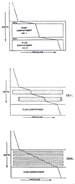
density of the internal The Keyes Field in northwestern Oklahoma is illustrative of the case in which the rock matrix at the base of each of the two seals bears the entire weight of the overburden, so the fluid pressures start from zero at these levels. All of the fluid pressures are markedly less than the normal 45+/- psi per 100 feet from the surface, so the pressures in the Keyes Field, except those in the shallow beds above the uppermost seal, are termed underpressures(Figure 15-7). The
Carpathian Basin in Hungary is an example of rock load being partially
borne by the Pressures which are less than can be attributed to a freestanding water column to the surface were termed underpressures during the discussion of the Keyes field. Likewise, pressures which are greater than can be attributed to a freestanding water column to the surface are termed overpressures. Underpressures and overpressures together compromise the well-known classification, abnormal pressures (Figure 15-9).
Geology of Abnormal PressuresFigures 15-10 to 15-12
TextIn most deep basins in the world there is a layered arrangement of at least two superimposed hydraulic systems (Figure 15-10). The shallowest hydraulic system can extend to great depths; however, in many basins it extends from the surface down to about 10,000 feet, greatest historical depth of burial, in normal geothermal gradient basins and to slightly greater depths in cool basins. There are a few remarkable deviations, like the central North Sea Basin, the South Papua Basin, the outer Gulf of Mexico, and the Canadian Arctic Basin where the base of the shallow system has apparently never been buried more than about 4000 to 6000 feet. The shallow hydraulic systems are basinwide in extent and exhibit normal pressures. The pore water apparently is free to migrate; however, the usual rate of movement, below the uppermost few hundred feet, is so slow that motion is surmised rather than detected. Stable isotope ratios of dissolved solids and gases appear to indicate widespread invasion of the shallow hydraulic system by meteoric water in only a few basins. The deeper hydraulic systems usually are not basinwide in extent and exhibit abnormal pressures. They generally consist of a layer of individual fluid compartments which are sealed off from each other and from the overlying system. In some basins, mainly in the onshore U.S., there is an even deeper, near normally pressured, noncompartmented section (Figure 15-11). The compartmented layer in those basins generally is in the sequence of rocks which were deposited during the period of most rapid deposition. The underlying noncompartmented layer, where present, usually is in pre-basin shelf deposits and basement rock. The uppermost noncompartmented layer usually is in rocks which were deposited during the slowing rate of deposition in late stage in basin filling. Recognition of the layered arrangement of hydraulic systems generally is quite easy. Only a few widely spaced, well-documented deep wells with several tests run over perforated intervals or several pressure readings from repeat formation testers in scattered wells generally are sufficient to outline the overall arrangement of hydraulic systems in each basin. However, in some young, foreign basins and in the Copper River Basin in Alaska, fluidized rock material, mainly shale, and high pressure water with minor hydrocarbons are being locally ejected upward from subsurface overpressured compartments, through overlying normally pressured rocks and venting at the surface. Mud volcanoes may be built up at the vent sites. The rising, high-pressured mixture may pressure-up any shallow, permeable beds encountered, thereby locally complicating recognition of the layered arrangement of hydraulic systems. The
individual compartments in the compartmented layer may be very
extensive, as in some of the Rocky Mountains basins, or may be only a
few miles across, as in the Gulf Coast Basin. The pressures within the
compartments are overpressured or underpressured relative to the
pressures in both the shallower and deeper hydraulic systems. The
compartmented hydraulic systems in currently sinking basins are almost
universally overpressured and are underpressured in many onshore basins
undergoing erosion. The principal source of overpressures appears to be
thermal expansion of confined In those basins with three layers of hydraulic systems, the seal between the middle compartmented layer and the underlying noncompartmented layer usually follows a single stratigraphic horizon. For instance, the basal seal of the compartmented section in the central Powder River Basin appears everywhere to be within the thin Cretaceous Fuson shale. However, in many basins, the top seal of the compartmented layer is more complicated. It (1) tends to follow an irregular sands-over-massive-shale boundary in the Gulf Coast and Niger Delta basins, (2) it is within thin evaporites in many onshore European and southwestern U.S. basins, and (3) occurs as horizontal or gently dipping planes which cut indiscriminately across structures, facies, formations, and geological time horizons in the Alaska North Slope Basin, in the northern Cook Inlet Basin, in the Alberta Basin, in the Anadarko Basin, in the North Sea Basin, and in many Rocky Mountains basins (Figure 15-11). Those top seals which do not follow a specific stratigraphic horizon generally are restricted to clastics dominated sections. The planar-topped, compartmented sections are almost universally in basins which are older than the basins in which the compartmented sections exhibit much top surface irregularity. Thus, it appears that there is some process in nature whereby the top seals of compartments in clastics-dominated sections can smooth themselves over time. The leveling process may be quite rapid because the tops of the two principal fluid compartments in the central North Sea Basin are horizontal over distances in excess of 100 miles despite the recent salt-induced structure development in the area. Planar seals may occur within, as well as on the top of the compartmented layer. For instance, the shallowest seal in the Mill Creek graben in southern Oklahoma is everywhere within the thin Marmaton shale; the next deeper seal is horizontal (-10,400 to -11,500 feet elevation), cuts through many Paleozoic formations across the graben and even extends, at the same elevation, across the adjacent Ardmore Basin. No deeper seals have yet been encountered in wells in the graben or in the Ardmore Basin. Earlier in this chapter it was pointed out that the individual compartments in the compartmented layer are like huge bottles with thin bounding seals and huge fluid-communicating internal volumes. Seals are particularly annoying to work with because they do not have consistent lithologic properties other than extremely low across-the-seal permeability. In the absence of unique lithologic properties, recognition must be accomplished from indirect evidence, such as well log indicators, measured pressures in local reservoirs encased in seal rock and often only from the requirement that they must be there separating reservoirs which, from measured pressure data, are obviously hydraulically separated from each other. Seals may have thin internal permeable rock layers (like bubbles in the glass of glass bottles), which may contain oil and gas pools. The transition of pressures across the total thickness of top seals in clastic rocks is linear with increasing depth wherever data have been obtained (Figure 15-12). Too few data have been accumulated to determine the patterns of pressures within lateral seals or within basal seals. The overall rate of pressure change across seals in shale have been observed to be as great as 15 psi/foot and 25 psi/foot in seals in sandstone. In some areas, seals may be recognized by calcite and/or silica mineralization within the seals or in the lower pressured rocks exterior to the seals, probably resultant from dissolved minerals being precipitated as water seeps through the seals. The mineral infill of porosity and fractures may be so readily recognizable that it becomes an identifier of present or past seals. For instance, calcite infill is so ubiquitous within seals and in adjacent beds in southwestern Louisiana that it has been given the name “Al's Cap,” named for Al Boatman, a local geologist, who first publicly drew attention to the phenomenon there. Silica infill may be recognizable on the basis of drastically reduced rates of drilling penetration across a seal. For instance, it took 24 hours to cut a 60-foot core in a silica-enriched seal in chalk in the Shell-Esso 30/6-2 well in the North Sea. Chalk normally cores very rapidly, unless the bit becomes clogged. Top seals in clastics dominated sections range in thickness from 150 feet to over 3000 feet; however, the majority are uniformly near 600 feet. Seals in carbonate-evaporite sections are generally somewhat thinner; in fact, some salt and anhydrite beds as thin as 10 feet form effective seals. An example of the latter is the Devonian Davidson evaporite which, except for a small area in central Saskatchewan, is about 20 feet thick but forms a regional seal over almost the entire extent of the Williston Basin. Lateral seals appear to be generally vertical or very nearly vertical. They range in thickness from less than 1/8 of a mile (within the distance between wells on 10 acre spacing) to about six miles, with the majority being 1/8 of a mile or less in width. They tend to be quite straight, which suggests that they may tend to follow fault trends. There has not been any satisfactory suggested geochemical mechanism which could create impermeable walls over thousands of feet of vertical extent through rocks of many lithologies. Where wells have penetrated lateral seals, the rocks have generally been found to be slightly fractured and the fractures infilled with calcite and/or silica. In a few localities, some of the fractures are locally open and can yield limited oil and gas production. While lateral seals are almost always nearly vertical, continuous planes, there are a few remarkable cases of breaks in seal continuity where individual permeable rock layers extend in hydraulic continuity from a compartment into a neighboring compartment. Those tongues are of particular interest to exploration geologists because they frequently contain oil and gas pools. The
rocks in the internal volumes within the compartments, like the seals,
do not have a unique lithology. The most unique property is the
pervasiveness of fractures observed in cores and indirectly indicated by
the apparent hydraulic continuity; i.e., The
fractures in the internal volume are, in a few areas, open enough to
permit commercial-rate extraction of oil and gas even in the absence of
significant matrix porosity and permeability. However, the distribution
of open fractures is generally not uniform enough to allow field
development without a substantial proportion of dry holes unless the
fracture porosity is augmented with matrix porosity and permeability
within the internal volume rocks. The matrix rocks, in different areas,
may exhibit remarkably different porosity values. For instance,
sandstone porosities are in the 20-35% range in the overpressured
Cretaceous Tuscaloosa sandstone
Recognition and Indirect Quantification of Abnormal PressuresFigures 15-13 to 15-20, Table 15-1
Text
Overpressures have been known and studied in the Gulf Coast Basin for
many years. Most of the techniques to drill and complete wells safely in
overpressured formations now in use worldwide were developed in the Gulf
Coast. One of the most significant techniques is the use of well logs to
identify and quantify overpressures. The techniques now in use are
modified from those introduced in a paper presented by Hottman and
Johnson in 1965. They reported the coincidence of high fluid pressures
in sands and lower-than-normal electrical resistivities and acoustic
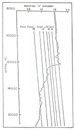
velocities in adjacent shales (Figure 15-13).
The technique using electrical logs involves an empirical relationship
between the resistivity of shales adjacent to sands with An example calculation utilizing Figures 15-15, 15-16, 15-17, and 15-18 should be made at this point to ensure that the technique is understood. This example calculation is somewhat misleading inasmuch as the accuracy obtained is better than that which can be routinely derived from average quality well logs. The importance of the foregoing well-log interpretation technique is that it is possible to construct pressure-depth profiles for overpressured sections without requiring downhole pressure measurements.Geologists and engineers are now able to know more about the pressures in overpressured rocks than they generally know about normally pressured or underpressured rocks provided the shales have uniform characteristics. The shales in the Gulf Coast Basin are very uniform, probably resulting from their hundreds to thousands of miles transport and mixing in rivers before deposition. Shales derived from nearby sources, as in many Rocky Mountain Tertiary formations, tend to be too nonuniform for pressure analyses by electrical log techniques. A similar technique, also introduced by Hottman and Johnson (1965), involving interval sonic velocities derived from sonic logs has been used widely. The sonic log is fundamentally different than the resistivity log inasmuch as sonic velocities are affected by fluid pressures across the whole possible pressure/depth range; i.e., there is no onset value in sonic velocities. Therefore, in overpressured sections, the sonic log will start to respond at the first increase in pressure/depth ratio, but the electrical log will not respond until an onset value of 61 psi/l00 feet depth is encountered. Sonic logs have great utility in underpressured sections, but all underpressured sections have a pressure/depth value below the onset value for electrical logs, so electrical logs do not respond to underpressures. It has been the author's experience that sonic log data are excellent for picking the tops and bases of both overpressures and underpressures and tops and bottoms of fluid compartment seals but deriving actual pressure values is very uncertain because so many lithology effects and rock porosity effects are involved in the interval velocities in shales. In some Rocky Mountains and Alaska basins, sonic logs provide the only reliable log indicators of pressures because the lithology effects and water salinity effects tend to overwhelm resistivity logs. In west Texas, sonic logs are difficult to work with because it is hard to find a “valid” shale. Most shale travel time/depth plots as received from logging companies use a logarithmic Dt scale. Interpretations are feasible using logarithmic scales in low velocity shales; however, the logarithmic scale frequently is not as usable as a linear time scale in high velocity shales. Several authors have noted that high pressures are frequently accompanied by higher-than-normal geothermal gradient values. Interval geothermal gradients in overpressured rocks in which pressure/depth ratios are greater than 75 psi/l00 vertical feet of burial depth usually are about 1.4 to 1.5 times as great as the geothermal gradient values in rocks/of similar lithology in which the pressure/depth ratios are less than 75 psi/l00 vertical feet (Figure 15-19). Geothermal gradients are much more difficult to work with than electrical logs because there usually are only a few temperature measurements in each well. Despite the frustrations of basing interpretations on skimpy temperature data, pressure/depth graphs derived from a combination of electrical log data, sonic log data, and temperature data can be quite accurate in overpressured sections. Hottman and Johnson (1965) contended that porosity in shale is abnormally high relative to its depth if the fluid pressure is abnormally high. That statement led to a flood of measurements of porosity and density of Gulf Coast shales. In 1966 Rogers described how profiles of the density of shales were then being used by some oil companies to identify overpressured shales in wells in the Gulf Coast Basin. He contended that the magnitudes of pressures may be determined by measuring the deviations of the densities of shales in overpressured rocks from a normal compaction trend. In the rush of enthusiasm for a new technique, porosities and densities were measured in shales from thousands of wells by many of the companies operating in the Gulf Coast Basin. Amoco measured those properties in shale from 4000 wells during that period. Each of the companies developed its own compaction (density-porosity) comparison standards. Within a few years the technique was generally abandoned because drillers had developed more reliable indicators of overpressures in drilling wells and because it was discovered that overpressures occur in association with both normally compacted and undercompacted shales. Undercompacted shales were found to be universally overpressured, but normally compacted shales can be overpressured, normally pressured, or underpressured. Geological Research Department Report No. F~2-G-23 deals more extensively with the relation between pressures and shale compaction in the Gulf Coast Basin. The compaction-pressure technique continues to be applicable in southern Texas where there is a high degree of correlation between the degrees of compaction and pressures. Bob Hix of the Houston Region is the company log analyst most familiar with those techniques; so it would be advisable for geologists and engineers working with overpressured wells in South Texas to contact Bob directly.
Drilling rate is a function of weight on the bit, rotary speed (rpm),
bit type and size, hydraulics, drilling fluid, pore pressures, rock
stresses, and rock characteristics. Under controlled conditions of
constant bit weight, rotary speed, bit type and hydraulics, the drilling
penetration rate in shales decreases uniformly with depth in normally
pressured formations. This is due mainly to progressive loss of
porosity; i.e., compaction, in all rocks with depth. However, in
overpressured formations the penetration rate generally increases
because some of those intervals are not as well compacted, the rock in
overpressured compartments may be fractured, and because the
differential pressures between wall rock Penetration rate should be plotted in 5 to 10 feet increments in slow-drilling formations or in 30 to 50 feet increments in fast-drilling intervals. However, plotting such data points should not lag more than twice the plotted depth increment behind the well drilling depth. Drilling rate recorders are available which automatically plot feet per hour vs depth. Regardless of how the rate of penetration is recorded, a normal drilling rate trend should be established while drilling shales in normal pressure environments for comparison with faster drilling overpressured shales. Complications can arise due to bit dulling, which may mask any penetration rate change due to overpressures. The penetration rate even may decrease if the rotary torque fluctuates and if the drilling bit action on the bottom of the borehole becomes erratic. Since it is not always possible and/or feasible to maintain bit weight and rotary speed constant, an improved method has been developed which allows plotting of a normalized penetration rate (d-exponent) vs depth.
Normalized drilling rate correlations take into account the rotating
speed of the bit, the mud weight, the weight on the bit, the bit size,
and the actual penetration rate to detect the entrance into an
abnormally pressured zone. These relationships are used to determine the
weight of mud to hold the The normalized drilling model is defined by:
Log R/(60 N) = Log K + b Log (12 W) /dB (1)
where: R = bit penetration rate, ft/hr
N = rotary speed, rpm
W = bit weight, M lbs
dB = bit diameter, inches
b = bit weight exponent = Log R/(60 NK) Log (12 W)/ dB
K = formation drillability constant
In 1966, Jorden and Shirley proposed simplifying the normalized drilling model to normalize penetration rate data for the effect of changes in weight on bit, rotary speed and bit diameter through the calculation of a “d-exponent” defined by:
d = Log R/(60 N) (2) Log (12 W)/ (1000 dB)
Equation (2) is not a rigorous solution for the “d-exponent” of Equation (1) in that: (1) the formation drillability constant, K, was assigned a value of unity, and (2) scaling constants were introduced. Jorden and Shirley (1966) felt that this simplification would be permissible in the Gulf Coast area for a single rock type since in this area there are “few significant variations in rock properties other than variations due to increased compaction with depth.” The “d” of Jorden and Shirley replaces the exponent “b” in the normalized drilling model. In 1971, Rehm and McClendon proposed modifying the “d-exponent” to correct for the effect of drilling fluid density changes as well as changes in weight on bit, bit diameter and rotary speed. After an empirical study, Rehm and McClendon computed a “modified d-exponent” using the following equation:
d = d Gpn / Gcd (3)
where: dc = “corrected or modified d-exponent”
d = “d-exponent” defined by Equation (2)
Gpn = normal pore pressure gradient for the area, expressed as equivalent drilling fluid density, lb/gal
Gcd = equivalent drilling fluid circulating density at the bit while drilling, lb/gal
Figure 15-20 is a plot of the calculated modified “d-exponent” values vs depth. Also, overprinted on this plot is a calibration overlay used to measure the abnormal pressure in terms of equivalent mud weight (the straight lines on Figure 15-20) in the Gulf Coast Basin. Similar calibration overlays must be developed for each geological province and/or geological period. The overlay and “d” equation plot is probably the most accurate method available to on-site drilling engineers to use for the determination of bottomho1e pressure from drilling rates in regions with an abundance of soft shale. It is limited, however, to good data collection facilities and to consistently good drilling practices. Its effective use is also limited to wells which are drilled nearly in balance, particularly in soft shale formations. Artificially induced pore pressures from excess mud weight can be transmitted into the rocks being drilled, making most drilling responses, including drilling exponent, unreliable indicators of country rock pore pressures. The ability to correlate drilling rates with lithology and pore pressures to establish a standard for drilling rates is the key to accurate interpretations. The
reader should note that most of the techniques to indirectly quantify
pressures in underground reservoirs involve making observations or
measurements in adjacent water-shale. This is based on a commonly
accepted assumption that there is a close coupling of pressures from
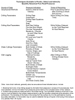
There are many indirect pressure indicators not discussed in this chapter. Table 15-1 lists most of those methods, several of which are specialized techniques applicable to on-site drilling engineers. The material discussed in this chapter is considered to be the minimum level of knowledge about indirect quantification of pressures required by exploitation geologists and office engineers dealing with records of wells drilled into abnormally pressured formations.
Direct Quantification of Pressures
Figures 15-21 to 15-24
TextNone of
the foregoing indirect indicators of abnormal pressures or the pressures
calculated from indirect indicators are as reliable as a few measured
pressures. Until the mid-1970's, the only measured pressures available
in overpressured soft rock sections in most wells were pressures
measured during initial production tests run after the wells were
drilled, cased, and perforated. Open hole drillstem tests have been
routinely run in normally pressured and underpressured firm rock
sections since 1935; however, the reported shut-in pressures tended to
be unreliable because the mud (hydraulic) pressures in the wellbores
usually exceeded formation fluid pressures with possible consequent
distortions in measurements (supercharging) of shut-in formation fluid
pressures prior to opening the tool. The more common problem was that a
measurement of static pressure made after the test was completed was
distorted by drawdown of pressures during testing (Figure
15-21). There is nothing basically wrong with drillstem test tools
or gauges for pressure measurements; the shortcoming is that the usual
purposes for using the tool do not include a serious attempt to measure
the static pressure in the rock interval being investigated. The usual
purposes for using the tool are to determine the type of formation fluid
present, to indicate a short term production rate, to record sufficient
transient (not static) pressures data to provide a basis for estimating
average The commercialization of wireline repeatable formation testers in 1974 ushered in a whole new era in well control and well data interpretation. They can record an unlimited number of pressure measurements during a single trip into a wellbore. Two independent formation fluid samples can also be taken on the same trip. Those test tools are reliable, rugged, and very sensitive to minor differences in pressures. They withdraw such a tiny amount of fluid from the formation being tested that drawdown of pressures is not a problem. Pressures measured with repeat formation testers, like pressures measured with drillstem testers, are subject to distortion by supercharging of low permeability rocks by the pressures in the wellbore mud column. Figure 15-22 portrays the pressures measured with a wireline repeatable formation tester in a field in the North Sea. Note that the fluid compartments portrayed in Figures 15-23 and 15-24 have very small but consistent pressure differences from compartment to compartment. Neither production tests or drillstem tests could have provided pressure data of similar reliability. The only real limitations to the use of wireline repeatable formation testers are (1) that the tester works well only in soft formations, and (2) the tester run must be preceded by some porosity indicator log, such as an electrical log to select the depths at which pressures are to be measured. The pressure values from repeat formation tests should be corrected for temperature effects on the quartz gauges in the test tools. The corrections are supplied by the testing contractors. It is suggested that up to 30 pressure measurements be made in water-bearing porous zones over a depth interval of up to 300 feet above and below each zone of interest to establish a water base line if there is any indication that the zone of interest in a new well is either overpressured or underpressured. Usually, it is also prudent to make several pressure measurements within pay zones to provide data for estimations of drawdown and buildup permeability at precise depths.
Pressures Interpretations of Water in Open Hydraulic Systems
Figures 15-25 to 15-36
Text
Exploration geologists and well planning engineers have similar problems
regarding locating, sorting, and assembling pressure data. Both are
required to make interpretations regarding specific sites or specific
areas using whatever data are available. Both groups work primarily with
water dominated Engineers drawing up the operating specifications for wildcat wells are frequently faced with the necessity of anticipating static fluid pressures in underground formations in regions where industry practice has been to run only about one drillstem test somewhere in each well. At first glance, it may seem to be impossible to assemble enough data to do an adequate job of anticipating the pattern of pressures to be encountered by the planned well. Pressures measured in drillstem tests have been labeled “unreliable” earlier in this report; however, large files of unreliable drillstem test data may be used to identify overpressured and underpressured fluid compartments. Amoco's Well Data I and Well Data II computer files contain an enormous quantity of pressures data derived from drillstem tests. When such data from many wells are plotted onto pressure/depth charts, the overall patterns may yield very reliable indications of static pressures. Those patterns can indicate whether abnormal pressures should be anticipated, whether those abnormal pressures are overpressures or underpressures, and the approximate depths at which mud weight control likely will be required. Inasmuch as those data files contain both virgin pressures and pressures drawndown by production, it seems prudent to attempt to avoid being misled by local drawndown pressures. Figure 15-25 illustrates the recorded pressures measured at various times through the life of two fields. Note that the pressures at discovery (the highest pressures), are significant if a wildcat well is being planned and the lower pressures have no significance unless the planned well is to be drilled in, or adjacent to, the field. Figures 15-26, 15-27, 15-28, 15-29, 15-30, 15-31, and 15-32 illustrate the kinds of fluid compartment implications which can be derived from critical examination of large masses of pressure data, even though every data point may be somewhat unreliable. Pressure/depth or pressure/elevation profiles may be constructed on an area basis (Figures 15-25 through 15-30) or on a formation-by-formation basis (Figures 15-31 and 15-32). Duplication of the mud program used in nearby old wells may be sufficient to select an acceptable mud program in a new well; however, mud programs in a few old wells usually cannot be reliably converted into subsurface static pressures in abnormally pressured fluid compartments. Use of mud data from a few old wells is subject to considerable bias ranging from the operator's state of knowledge about pressures at the time the old wells were drilled to how safe-from-blowout the operators of the wells wished to drill their wells. Figure 15-33 illustrates how large files of mud density data from well log headers, converted to equivalent bottomhole pressures, plotted onto pressure/depth charts may be indicative of both the regional top of the top seal (the first kink in the data profile) and the base of the top seal (the second kink in the data profile) in overpressured fluid compartments. A hydrostatic interval pressure/depth gradient line drawn downward from the base of the top seal provides a reasonably reliable indicator of static fluid pressures in deeper rocks within the compartment. The use of large files of mud density data reduces the biases inherent in using mud data from single wells. Some
operators drill wells with slightly underbalanced mud columns to attain
increased drilling penetration rates. Drilling kicks in such wells may
provide accurate indicators of the formation The foregoing discussions regarding the use of inaccurate data presumed that the inadequacies are resident in the original data. However, there can be a large error factor introduced by human carelessness all along the line from recording of wellsite data to data introduction into computer files. Transposed numbers; i.e., numbers copied out of sequence, are an ever present menace when making interpretations of subsurface pressures. Figure 15-35 illustrates a typical case of probable transposition of numbers. Transposition of numbers is particularly common in data files which were accumulated from scout check sources, such as Amoco's Well Data I and Well Data II. The interpreter must be willing to ignore suspect data with the consequent hazard that accurate data may be discarded. Some data sources are much more reliable than others. The author has found the data submitted in sworn-to submissions of data in public hearings before the various state and provincial industry regulatory bodies to be a consistently reliable source of data and highly recommends its use where applicable. Figure 15-36 is an example of the data derived from submissions to the Oklahoma Corporation Commission. Note that the data exhibits little scatter, so the inclusion of transposed numbers or guesses instead of real measurements seems to be unlikely.
Pressures Interpretations of Petroleum in Open Hydraulic Systems
Figures 15-37 to 15-68
TextAll
prior discussions in this report dealt with water dominated
Petroleum reservoirs almost invariably contain or abut some water; so
the first step in pressure interpretations of petroleum is construction
of a surface to total depth pressure/depth profile and a short interval
of interest pressure/depth profile, both using water pressures only. The
author has found that a vertical (depth) scale of 1 inch equals 2000
feet matched with a horizontal scale of 1 inch equals 2000 psi works
quite well for the surface to total depth profile. One inch equals 100
feet vertical scale matched with 1 inch equals 100 psi horizontal scale
works well for most detailed work. It is also important to consistently
use the same depth-pressure scale proportions to be able to readily
recognize various Usually, the average water density for a whole basin or basin sector is accurate enough to establish the slope of a surface to total depth pressure/depth profile, but the investigator should be prepared to accept what his data (rather than his instincts) tell him about local, restricted depth range water densities. For example, many geologists find it difficult to accept that quite fresh water may exist at great depths in deep marine origin rocks. Figure 15-37 illustrates a well in which the well logs warned of low salinities, which were later verified by the rate of change in pressures measured with a wireline repeatable formation tester. Note that the in-situ water density in this well is less than the density of fresh water under surface conditions due to the effect of thermal expansion of water in a high temperature environment being greater than the combined effects of the salt in the water and of the compressibility of water. Figure 15-38 demonstrates the prominent reduction in brine densities which occur with increasing temperatures in constant salinity sodium chloride solutions. Note that the rate of reduction of density is essentially the same across the whole salinity range from fresh water to saturated brines. In nature, brine salinities do not remain constant with increasing depth. Salinities generally increase downward at a rate which exactly offsets the effects of temperature and water compressibility, with the result that brines exhibit a constant density value; i.e., a constant pressure/depth ratio, from near the surface to great depths in most basins. The usual purposes of surface to total depth pressure/depth profiles are (1) to recognize and outline abnormally pressured fluid compartments for drilling well control purposes, (2) to better understand seismic velocities, (3) to map fluid compartment seals in pursuit of stratigraphic traps, and (4) to provide water pressure/depth baseline profiles for more detailed investigations of oil and gas columns. The
last purpose involves the differences in densities of oil, gas, and
brines. Figure 15-39 presents a graphical
representation of the pressures in a hydrocarbon column vs the pressures
to be expected in laterally adjacent water-bearing rocks in the same
fluid system. It is important to note that the adjacent water-bearing
beds may be normally pressured, overpressured, or underpressured. Oil
and gas columns in permeable zones within seals require special
handling; so the ensuing discussions will first deal with mixed fluid
systems in normally pressured rocks and in the internal volumes of fluid
compartments. Please refer to the discussion of The
divergence of the oil or gas column pressure/depth profile from the
water pressure/depth profile is due entirely to the differences in
density between petroleum and water. The petroleum and adjacent caprock
water are pressures-separated by a capillary membrane of mixed petroleum
and water in the rock pores with very fine pore throats along the
interface between the petroleum and the water. It is important to note
that the capillary membrane seal is developed only where petroleum abuts
water; i.e., there is no membrane separation of water from water.
Therefore, the water around the petroleum column is assumed to be
pressure connected to the adjacent interconnected water system. The
Operations geologists and office engineers frequently are called upon to estimate the greatest potential vertical height of an oil or gas column over bottom water after oil or gas without water has been recovered in a well test. The updip limit of a hydrocarbon column cannot be determined from pressures data alone; however, the pressure at the top of the petroleum column cannot exceed the local fracture gradient. If the test recovered oil, there is no reliable method to determine if a gas cap is present somewhere above the tested interval. Projecting the vertical height of a hydrocarbon column downward from a test which recovered gas is subject to uncertainties about whether there is a downdip oil leg. If an estimate of a hydrocarbon column below the test is to be made on the assumption that the density of the petroleum recovered in the test is representative of the hydrocarbons throughout the whole column below the tested interval a simple mathematical analysis probably will suffice.
(pp – pw) / (Dw-Dp) = vertical height of the hydrocarbon column in feet
where:
pp is a recorded pressure within the petroleum column stated in psi.
pw is the regional pressure in water-bearing rocks at the same depth stated in psi.
Dw is the density of the regional water stated in pounds per square inch per foot.
Dp
is the density of the petroleum at per square inch per foot.
Example: a
normally pressured Gulf Coast oil pp = 4800 psi pw = 4650 psi Dw = 0.465 psi/foot Dp = 0.331 psi/foot (4800 - 4650) / (0.465 - 0.331) = 1112 feet of column below the test
The
densities of gas, condensate, and oil are highly sensitive to
hydrocarbon composition, temperature, and pressure; so selection of
appropriate hydrocarbon density values applicable to
Construction of a pressure/depth profile of a petroleum column is much
simpler after several pressures have been recorded because the profile
of recorded pressures directly indicates the density of the petroleum.
Figure 15-45 illustrates the pressure/depth
profiles within two separate gas columns where the bottom water is
normally pressured. Figure 15-46 illustrates
an essentially identical construction in a gas pool where the bottom
water is overpressured. In both cases, the local pressure/depth profile
of the bottom water must be precisely determined from overlying and
underlying water-bearing rocks. Where there are errors in determining
the water pressure in fluid compartments, the errors tend toward the
deviations from normal pressure being greater than recognized. Thus, in
an overpressured fluid compartment, the likely error would be that the
full extent of overpressuring in the bottom water might not be
recognized and a recorded pressure in a newly discovered oil or gas
column would look like a greater Figure 15-47 illustrates the importance of accurate determinations of the pressures in the bottom water. The pressures data shown were in Amoco's files in 1955 when there was an opportunity to acquire an interest in additional acreage downdip from the newly discovered Pembina (Cardium) oil pool in Alberta. The prevailing hydrogeological concept at that time was that the pressures in any permeable bed are essentially independent of the pressures in shallower and deeper permeable beds. Therefore, the recorded pressures in the shallower (Belly River) sands were believed to have no bearing on the pressures in the oil column in the Cardium sand. The Cardium pressure exceeded the expected water pressure/depth value of 44 psi/100 feet from the surface by about 550 psi; so an approximate 5000 feet downdip oil column was anticipated. If the determination of the water pressure/depth value had utilized the recorded pressures in the shallower beds, a 1100 psi over bottom water differential pressure would have been anticipated with a consequent recognition that the Cardium continuous oil column extends about 10,000 feet downdip. The “mistake” would not be made now because fluid compartments and their patterns of internal pressures are better understood now.
In all cases previously discussed in this report, it was assumed that there is no internal compartmentalization within apparently continuous oil and gas pools. Several of the large pools discovered in recent years, particularly in low permeability sand reservoirs, display evidence of through-going seals dividing large pools into subpools. Determinations of the heights of petroleum columns have been fraught with confusion as interpreters attempted to “push” their data into single petroleum column interpretations. Figure 15-48 displays a subpool (multicompartment) system in an ostensibly continuous large gas pool producing from a single sand. Similar subpools have been noted in the tight gas sand areas in the Rocky Mountains and Alberta and in the downdip Wilcox fields in South Texas. Figure 15-49 illustrates the pressure/depth profiles in several gas pools offshore Britain. The pressure/depth differentials from pool-to-pool are about the same as at Wattenberg, but there are large nonproductive areas between the pools; so the interpreter should be cautious in suggesting that subpools in a continuously productive area have been discovered when the only evidence is that the pressure/depth differentials from petroleum test to petroleum test are not very great. Nearly all development geologists and office engineers will, at some time, encounter at least one petroleum pool with one or more ponds of formation water located well above the base of the petroleum column. Those occurrences of ponded water; i.e., water which was not forced out when petroleum moved into the trap, were called perched water in old geological and engineering literature. Figure 15-50 illustrates the pressures measured in a gas column in northeastern British Columbia, Canada. One test recovered salty water more than 1000 feet above the deepest gas recovery. The ponded water displays a pressure which is being imposed by the adjacent gas. The water probably occupies a local lens of porosity which was not swept of its water when gas entered the field trap. Bottom water has not yet been encountered in the field. The
Recluse to Bell Creek cross-section, shown in
Figure 15-51, demonstrates a simple examination of alternative
techniques to determine if a continuous static petroleum column extends
from one discovery to another, even in the presence of water ponds. The
highest oil in the area is at the gas/oil interface in the Bell Creek
field, and the lowest oil is at the oil/water interface in the downdip
Recluse field. The pressure differential is 2262-1180 = 1082 psi across
3700-430 = 3270 feet, which calculates to 1082 psi/3270 ft = 33.1 psi/100
feet. That indicated density of a static pressure conducting medium
corresponds with the density of the The
discovery pressures (Figure 15-53) in three
old fields producing from a buried river valley sand Figures 15-55, 15-56, and 15-57 deal with an area of more historical significance to Amoco. Figure 15-55 illustrates the pressure/depth data available in the mid 1960's in an area in southeastern New Mexico. Six oil “pools” had been discovered, and Amoco had acquired an acreage block in southern Roosevelt County. Amoco drilled a wildcat well, Amoco State “DO” No.1, which tested the objective formation and recovered oil and gas cut mud and a large quantity of salty water. The well was in a structurally low position; so the well and lease were sold to a Midland junk dealer. The buyer, rather than salvaging the tubular goods as anticipated, installed a large pump and started pumping water with an increasing oil cut. The well eventually stopped producing water and became a commercial oil well. The well apparently had encountered a closed structural low which had retained a local water pond (Figure 15-57) when oil migrated into the trap. The six oil “pools” eventually/became one large continuous oil field, as the 33.6 psi/100 feet pressure/depth “pool” to “pool” ratio had indicated. Figure 15-58, taken from a training slide used in the petrophysics training program, illustrates how ponds of water trapped in structural roll-overs between petroleum pools and sealing faults may exhibit the pressure profiles of the abutting petroleum. Figure 15-59 portrays a well offshore Trinidad which encountered water pond in several sands adjacent to a sealing fault. The pressure/depth profile in the water exactly matches the pressure/depth profile in the adjacent Poui field. If the well had been drilled prior to the discovery of the field, the pressures in the water ponds could have led to further drilling and eventually discovery of the field. Up to now, we have been dealing with fluid compartments and normally pressured rocks as if the seals have always been there and have always been intact. There are several recognized compartments in which the bounding seals have been permanently ruptured by erosion or faulting or were breached by natural hydraulic fracturing without subsequent healing. The remaining seal segments apparently are still as impervious to gas, oil, and water as they were when the seals were complete; therefore, recognition of seal segments is very important in petroleum exploration.
Pressures within a newly ruptured compartment will progressively change
toward equilibrium with the pressures in the external water through
fluid leakage into or out of the compartment at the point of rupture.
When pressure equilibrium is reached at the elevation of the rupture,
there is no pressure differential to move The giant Medrano oil and gas pool on the Cement anticline in Oklahoma occupies an underpressured fluid compartment which leaks at its updip terminus into adjacent normally pressured rocks (Leak A, Figure 15-60). The gas pressure at the updip end of the pool coincides with the adjacent normal pressures (Figure 15-61). The pool probably has leaked as erosion has progressively removed cover, and thereby reduced the external normal pressures. Note that the compartment is normally pressured at its updip terminus, but because gas and oil are less dense than the external water, the pool is underpressured relative to the external water in its full downdip extent. The leakage plume over this field has been extensively used by promoters of geological and geophysical techniques which sense the chemical changes in rocks due to the continued presence of seepage gas. The
giant Milk River gas field in Alberta fills an underpressured fluid
compartment which, like the Medrano pool, is pressure equalized near its
updip terminus with exterior There are several gas-filled fluid compartments with updip pressure equalization into water-filled fluid compartments in the deep basin area of Alberta. Figures 15-63 and 15-64 show two of those pressure/depth profiles. In the Gulf Coast Basin, there are cases of updip pressure equalization across a leak with overpressured water in an adjacent fluid compartment. Figures 15-65 and 15-66 take another look at the Bough “C” compartment within a compartment previously shown (Figures 15-55, 15-56, and 15-57). The pressure/depth profile in the filled internal compartment crosses the pressure/depth profile of the large, mainly water-filled surrounding compartment at about -5400 feet elevation. Thus, if there is a leak between the compartments, it must be near that elevation (Leak B, Figure 15-60). Figure 15-67 illustrates the pressure/depth profiles relative to the regional water gradient to be expected within a fluid compartment with a pressure-equalizing leak at each of the three locations shown in Figure 15-60. It should be noted that the pressure equalization through a leak in the seal explanation may not be correct. Some or all of the cases could be coincidences; however, there are so many cases of pressures in oil and gas columns being equal to water pressures in immediately adjacent fluid compartments that coincidences seem to be very unlikely. During the discussion of leaky seals, it was tacitly assumed that the pressures within the leaky compartments had reached stability. Figure 15-68 demonstrates that the pressure/depth profiles shown on Figure 15-67 could be point-in-time transient conditions in a continuing blowdown of a leaky petroleum-bearing fluid compartment. Operation geologists should become familiar with pressure/depth profiles in petroleum-filled fluid compartments because such familiarity may lead to development of petroleum columns further downdip than usual petroleum overlying normally pressured bottom water interpretations would allow. For example, Figure 15-50 could be interpreted as a gas column overlying normally pressured bottom water a few feet downdip from the deepest gas recovery or, alternatively, it could be interpreted as a fluid compartment with extension of the petroleum column downdip possibly as far as the downdip limit of the compartment. The downdip limit of the petroleum column could be thousands of feet below the petroleum/bottom water contact anticipated by the usual petroleum over normally pressured water interpretation. A fluid compartment interpretation probably is the more likely if there are other fluid compartments in the area because fluid compartments rarely occur singly.
Pressures
Interpretations of
|