Print this page
 Click to view article in PDF format.
GCAzimuth and Offset in Design of Successful 3-D Survey*
By
Stuart Wright1
Search and Discovery Article #40121 (2004)
*Adapted for online presentation from the Geophysical Corner columns in AAPG Explorer, June and August, 2003, prepared by the author and entitled, respectively, “Is the 3-D Survey 'Good Enough?'” and “Extra Azimuths Will Cost You” (derived from the author’s titles of “Azimuth and Offset: A 3-D Survey Design Perspective” and "Which Direction is Your 3-D Survey Looking?,” respectively). .Appreciation is expressed to the author, to R. Randy Ray, Chairman of the AAPG Geophysical Integration Committee, and to Larry Nation, AAPG Communications Director, for their support of this online version.
1Manager of geophysics, Dawson Geophysical, Denver, Colorado ([email protected]).
Even
though the first 3-D seismic survey was acquired almost 40 years ago, it has
been in only the last 15 years that 3-D has evolved from an R&D project for
major oil companies to a "commodity" tool that is almost ubiquitous.
Accompanying that evolution has been an improvement in the hardware and software
necessary to design, acquire, process and interpret the resulting 3-D  data
data as
efficiently as possible.
as
efficiently as possible.
Despite the broad
acceptance of 3-D seismic, no clear standard for survey design has emerged. Nor
should one be expected. The best survey is always a function of the geology that
needs to be imaged. As long as the subsurface of the earth is not
"standardized," there can be no "standard design." Furthermore, most users are
not just interested in the best data quality possible; they want the best
overall survey. The difference between the two is that the best survey must also
consider economic and surface issues.
Ultimately, a
successful 3-D survey is one that gathers "good enough" data -- good enough,
that is, to meet the economic demands of our industry. However, in any endeavor
that lacks standardization, there are bound to be a few eight tracks and
BetaMaxes. Therefore, it is worthwhile to take a look at some of the more common
misconceptions that can impact the success of a 3-D survey.
|
uIntroductionuFigure captionsuWide azimuthuThree designsuOffset distributionuDesign comparisonuOffset distributionuShallow folduConclusionsuAcknowledgments
uIntroductionuFigure captionsuWide azimuthuThree designsuOffset distributionuDesign comparisonuOffset distributionuShallow folduConclusionsuAcknowledgments
uIntroductionuFigure captionsuWide azimuthuThree designsuOffset distributionuDesign comparisonuOffset distributionuShallow folduConclusionsuAcknowledgments
uIntroductionuFigure captionsuWide azimuthuThree designsuOffset distributionuDesign comparisonuOffset distributionuShallow folduConclusionsuAcknowledgments
uIntroductionuFigure captionsuWide azimuthuThree designsuOffset distributionuDesign comparisonuOffset distributionuShallow folduConclusionsuAcknowledgments
uIntroductionuFigure captionsuWide azimuthuThree designsuOffset distributionuDesign comparisonuOffset distributionuShallow folduConclusionsuAcknowledgments
|
Wide Azimuth 3-D Equals 'True' 3-D?
There is
no short and simple answer to the question of optimum source-to-detector
azimuth. Intuitively, a wide-azimuth survey that collects long offset
However,
most of these early surveys were "good enough" to be considered
successful, or if they were not, it probably was not the lack of azimuth
that caused them to fail. For deep geologic objectives, equipment
limitations can still exist. Achieving long offsets in the cross-line
direction requires either very widely Before choosing a wide-azimuth design, a
question that must be asked is how will these different azimuths be
used? If pre-stack, azimuthally dependent analysis of the
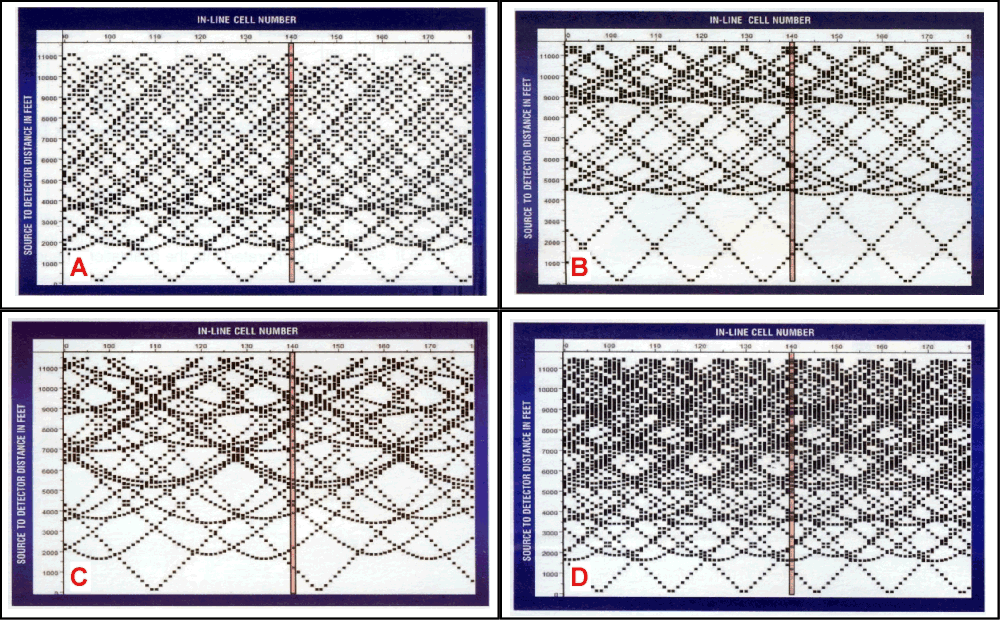
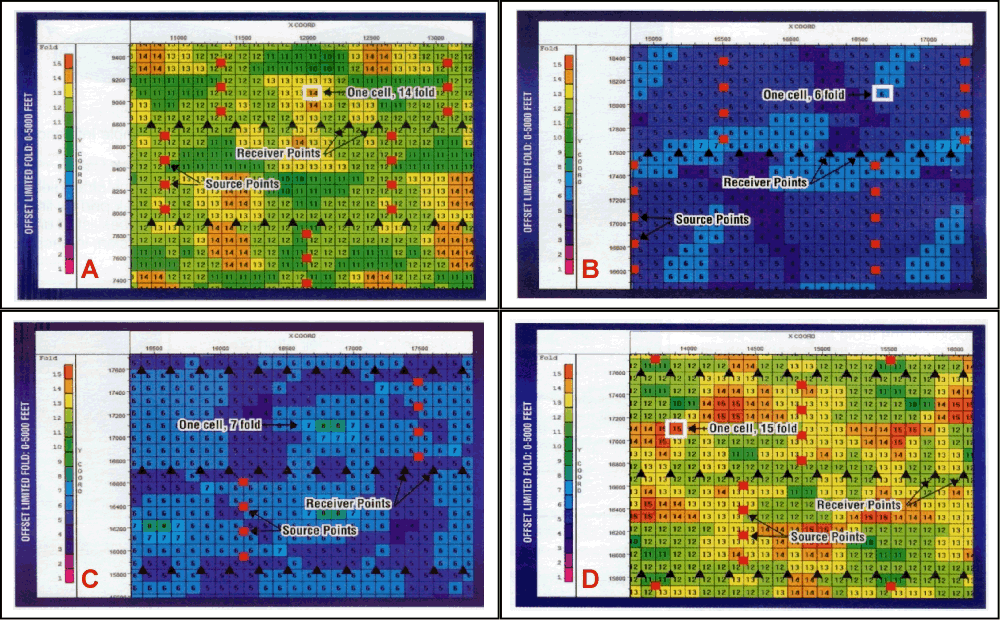
Three Different Wide-Azimuth DesignsTo help understand the implications of wide-azimuth shooting, comparison is made of offset-distribution plots from a standard narrow-azimuth geometry (Figure 1, Design A) to three different wide-azimuth designs (B, C, and D). However, before doing that, a careful look at each of the four different acquisition strategies should be made. For all four surveys we will assume a maximum usable offset of 10-11,000 feet. Other key design parameters are listed in Tables 1 and 2. In particular, notice the "Maximum Cross-Line Offset" values listed in Table 2. As shown in Figure 2, wide-azimuth design B has greater cross-line offset than narrow-azimuth design A (Figure 1), despite having the same number of receiver lines, channels, and fold. It does this by using a receiver line spacing that is more than twice the spacing used for design A. Design C (Figure 3), on the other hand, has the same receiver line spacing as A (the narrow design), but uses 24 lines in its patch geometry to achieve the added width. However, to keep the fold (and cost) about the same as that of the narrow design, source line spacing for C has more than doubled. Finally, there is design D -- the "best" of the wide designs. It uses the same source and receiver line spacing as the narrow plan. The major design difference is in its recording patch -- 24 lines of 96 channels versus only 10 lines for A. As a result, the fold produced by design D will be more than twice that of the other surveys. There is one other difference between these two designs: relative cost. Design D will cost more to acquire, because significantly more recording equipment will be needed. The Importance of Offset Distribution
For any
particular 3-D survey design, a wide range of attribute plots can be
easily produced and examined. However, for any given fold, the attribute
that will have the most impact on
These problems might include (but limited to) the following processing related issues:
Certainly,
not all surveys with poor offset distribution will be ruined by problems
such as these, but it is better to address them during the design phase
than after the
Design ComparisonOffset Distribution
Given the
importance of source-to-detector offset distribution for each individual
cell, for any given fold and bin size, offset distribution is the single
most important design attribute, especially when it comes to processing
and interpreting the final
|