
 Print this page
Click to view the posters in PDF
PS Seal
Seal Character and Variability Within Deep-Marine Depositional Systems: Seal
Quantification and Prediction
Character and Variability Within Deep-Marine Depositional Systems: Seal
Quantification and Prediction
By
William R. Almon1 and William C. Dawson1
Search and Discovery Article #40125 (2004)
*Adapted from poster presentation
at AAPG Annual Meeting, Dallas, Texas, April 18-21, 2004. closely related
poster/article, prepared and presented by the authors and S.J. Johansen, is
entitled “Seal and Reservoir Characterization of Upper Slope Fan
Lithofacies:Example of High-Frequency Variability,” (Search and Discovery
Article #40124).
1ChevronTexaco, Bellaire, TX ([email protected]; [email protected])
Abstract
Seals are a key
element of petroleum systems, yet they have received limited systematic study.
Textural and compositional variations permit the recognition of six shale
lithofacies in Tertiary, deep-marine, depositional settings. Each shale type
end-member has distinctive textures and fabrics, which record variations in
depositional conditions. Textural and compositional variations of shales,
considered within the context of sequence stratigraphy, provide a basis for seal
risk assessment. As determined from mercury injection capillary pressure (MICP)
analysis, the pressure required to attain critical seal pressure (10%
non-wetting saturation) varies over a considerable range (15 to 20,000 psia).
Tertiary shales from offshore Brazil have consistently low critical seal
pressures relative to age-equivalent shales from offshore West Africa. Tertiary
shales from wells in the Gulf of Mexico have intermediate MICP values (mean:
4,700 psia). The organization of shale facies within a sequence stratigraphic
framework reveals systematic variations in seal character. Silt-poor shales from
uppermost transgressive systems tracts, and some condensed shales, have good to
excellent seal potential. In contrast, silt-rich shales from highstand and
lowstand systems tracts have moderate to low sealing capacities. Seal quality
generally increases as total clay and carbonate content increase; other
compositional variables have limited predictive relationship with seal
character. Likewise, log-derived parameters lack significant potential to
accurately predict critical nonwetting saturation values. Additional seal
variability factors include changes in the rate of deposition, early marine
cementation, and depositional fabric. Available data provide a compelling
argument for textural control of seal character induced by high-frequency
stratigraphic cycles.
|
uAbstract
uClay
composition & log
uAbstract
uClay
composition & log
uAbstract
uClay
composition & log
uAbstract
uClay
composition & log
uAbstract
uClay
composition & log
uAbstract
uClay
composition & log
uAbstract
uClay
composition & log
uAbstract
uClay
composition & log
|
Introduction(Figures 1,2-1, 1,2-2, 1,2-3, and 1,2-4)
Analyses of Tertiary-aged shales from
deepwater depositional settings (e.g., offshore West Africa, Brazil, and
The shale samples, MICP of which are
illustrated in Figure 1,2-2, have very good to excellent membrane seals.
Shapes of injection profile curves indicate that there are three pore
structure families in this data set, which can be related to total clay
content and shale fabric. Samples are color-coded by shale type. Type 2
shales (red) have a mean critical injection pressure of 6938 psia. Type
3 shales (red) have a mean critical value of 6809 psia. Type 6 shales
(red) exhibit a mean critical injection pressure of 11,027 psia
indicating exceptional
Clay Composition and Log
|




|
|
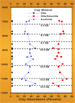
Figure 4-1. Discriminant function
|
|
|
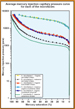
Figure 4-2. Distal marine (TST) shales
(microfacies 1 and 4) exhibit the “best” |
|
|
|
|
|
Figure 4-4. A strong correlation
between subsurface and outcrop samples, along with evidence of
comparable burial history (Tmax data), suggests that other factors
(e.g., diagenetic processes) are responsible for differences in
|
|
|
Table 4-1. Summary of attributes of Cretaceous Lewis Shale microfacies. |



Shale microfacies are recognizable in closely
spaced shale samples from outcrops (Cretaceous, Wyoming). Each shale
end-member type has distinctive fabrics, MICP character, and
composition. Seal character varies in a predictable manner within a
sequence stratigraphic framework. Well laminated, clay- and organic-rich
shales from uppermost transgressive units exhibit excellent seal
potential.
High-resolution sequence stratigraphy reveals that this group of samples in this data set represent three of the six shale types that typify deepwater marine depositional settings. Shale type 2 occurs with 3rd- and 4th-order condensed sections and basal parts of transgressive stratal packages. Shale type 3 occurs mainly with silt- and sand-rich 4th-order lowstand units. Type 6 shales represent the most distal shale facies and record pelagic sedimentation with minimal bioturbation and slow sedimentation.
MICP values and porosity are reduced significantly in the upper TST interval relative to all parts of the HST interval. The reduced porosity in clay-rich TST shales is attributed to improved organization of particles (well-developed laminar fabrics) as well as the precipitation of Fe-carbonate cements during early submarine diagenesis.
Additionally, there is a major difference in the permeability of TST and HST shales. Within the Lewis HST there is a weak trend of upward increasing permeability; this trend appears to correlate with a vertical increase in the content of detrital silt.
Angola Seal Data
(Figures 5-1, 5-2, 5-3, 5-4, 5-5, 5-6, 5-7, and 5-8)
|
|
Figure 5-1. Composition of three shale types in offshore Angola. |
|
|
|
|
|
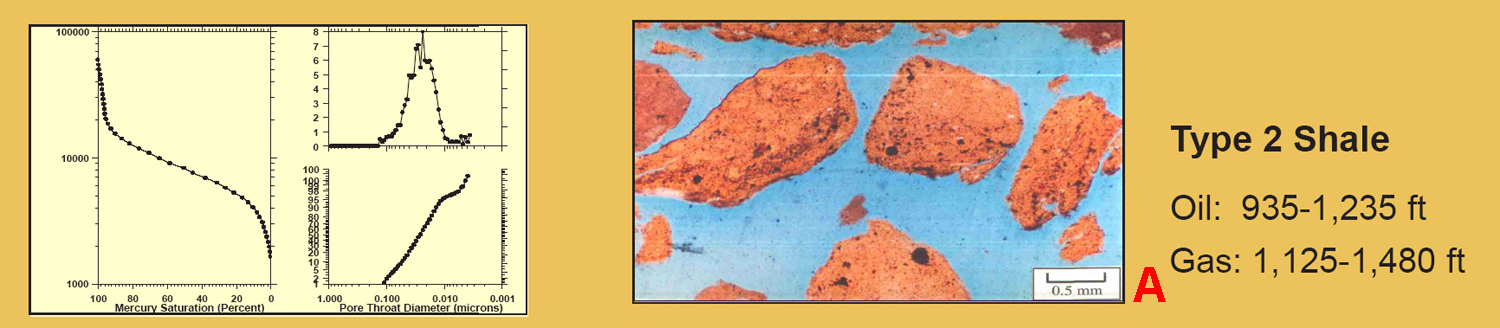
A. Shale type 2,
B. Shale type 3,
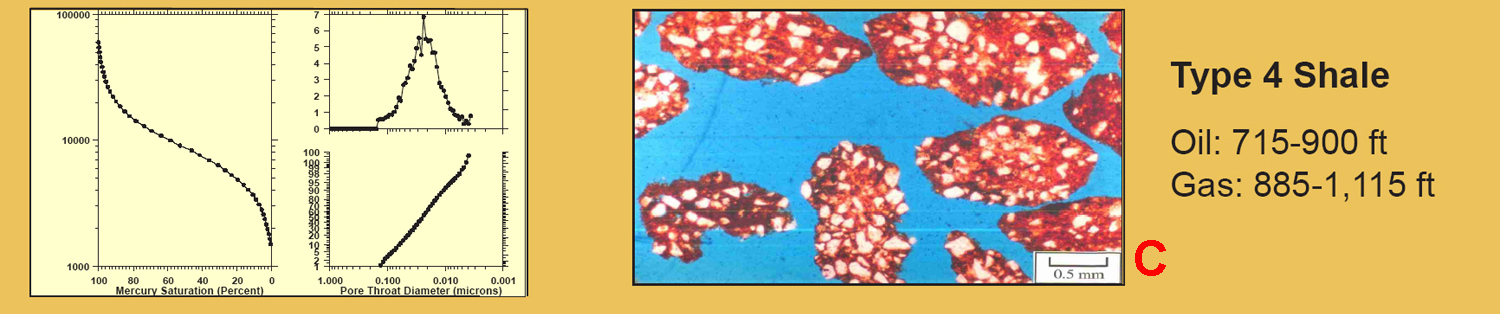
C. Shale type 4, |
|
|
|
|
|
Figure 5-5. Frequency distribution
showing maximum sealing potential (10 percent nonwetting phase
saturation) of Tertiary mudstones, offshore Angola. These samples
(yellow) fit within the range of other |
|
|
|
|
|
|
|
|
Figure 5-8. Frequency distribution
showing maximum sealing potential (10 percent nonwetting phase
saturation) of Tertiary mudstones, offshore Angola.
Mudstone types
2 and 3 (yellow) exhibit a mean value that exceeds the mean value
of the other |


Three distinctive mudstone lithotypes are present in offshore Angola samples based on differences in composition and fabric: silt-rich claystones and argillaceous siltstones; calcareous shales claystones; and silt-poor sideritic claystones.
Shapes of mercury-injection curves (MICP
analysis) allow the recognition of three classes of pore structure
(i.e., seal types). Silt-rich samples (type 4) have relatively low
injection pressures. In contrast, carbonate-cemented silt-poor samples
(type 2) have injection pressures that exceed 1,000 psia. Type 3 samples
have intermediate injection pressures.
Each shale type occupies a particular stratigraphic position. Type 2 shales represent upper transgressive and condensed intervals. Type 3 shales occur in middle to lower parts of transgressive units, and very silty (type 4) shales represent lowstand and highstand stratal packages.
Seal Stratigraphy


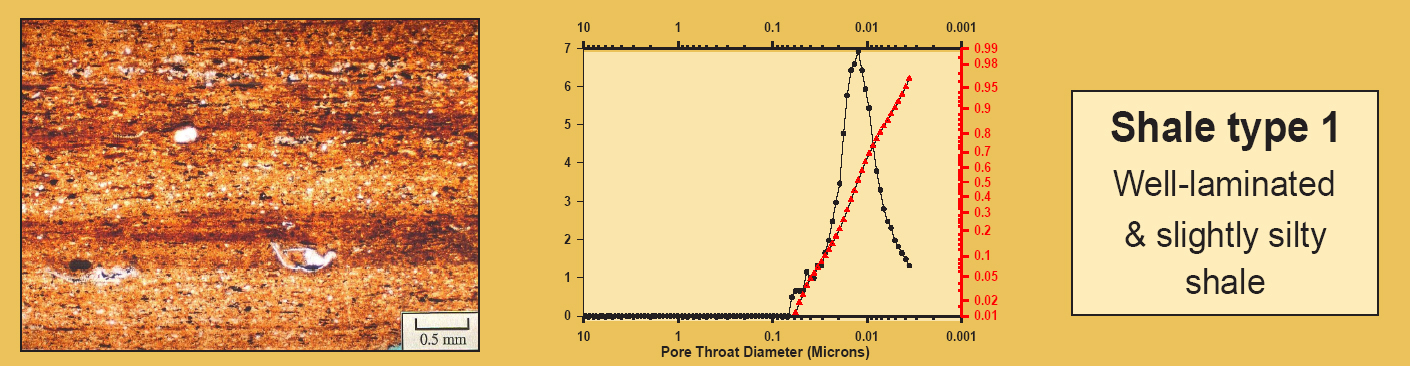
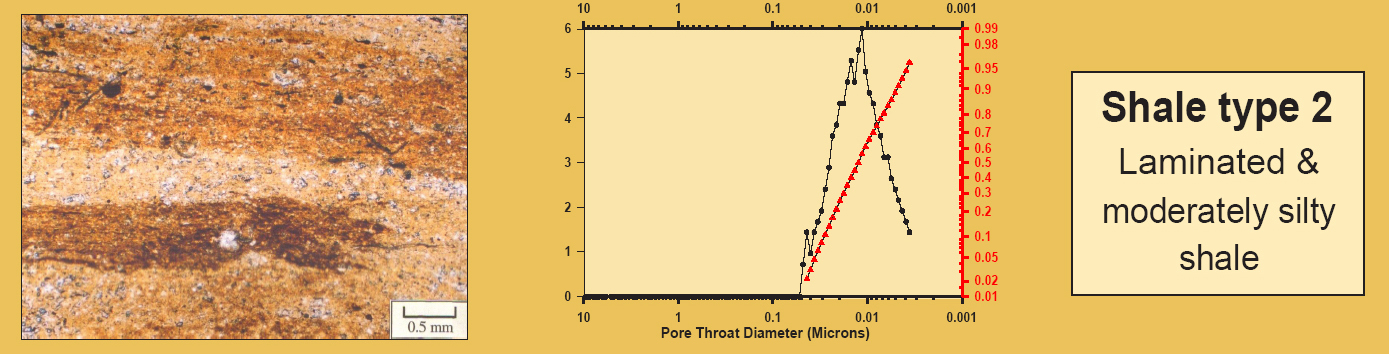
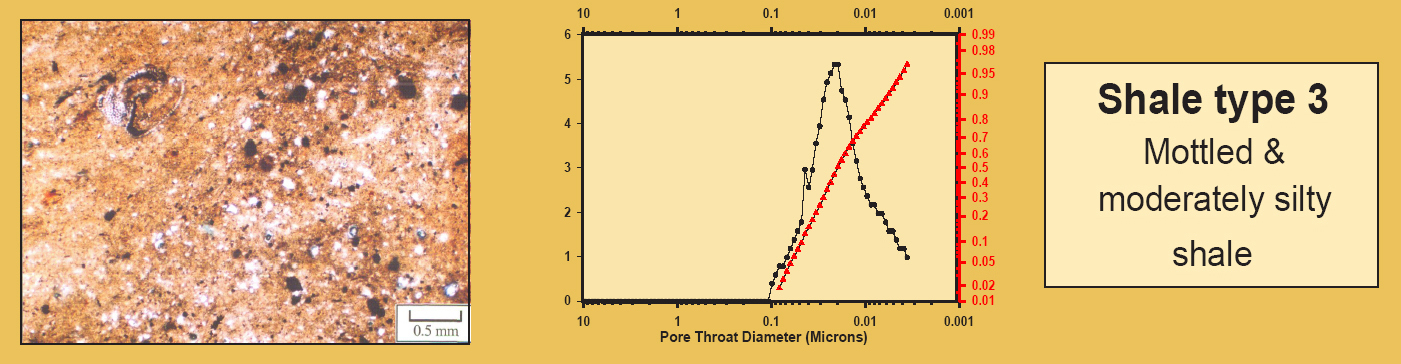
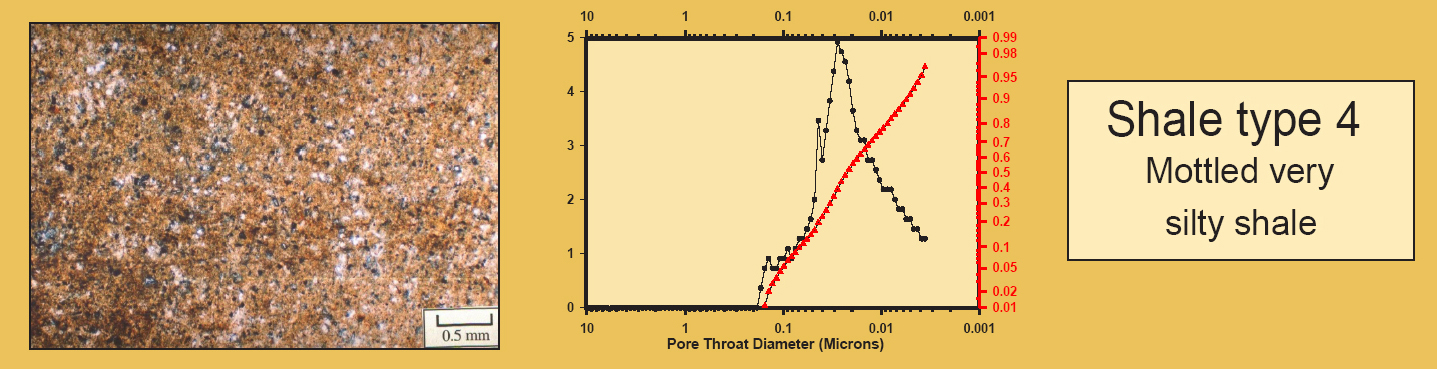
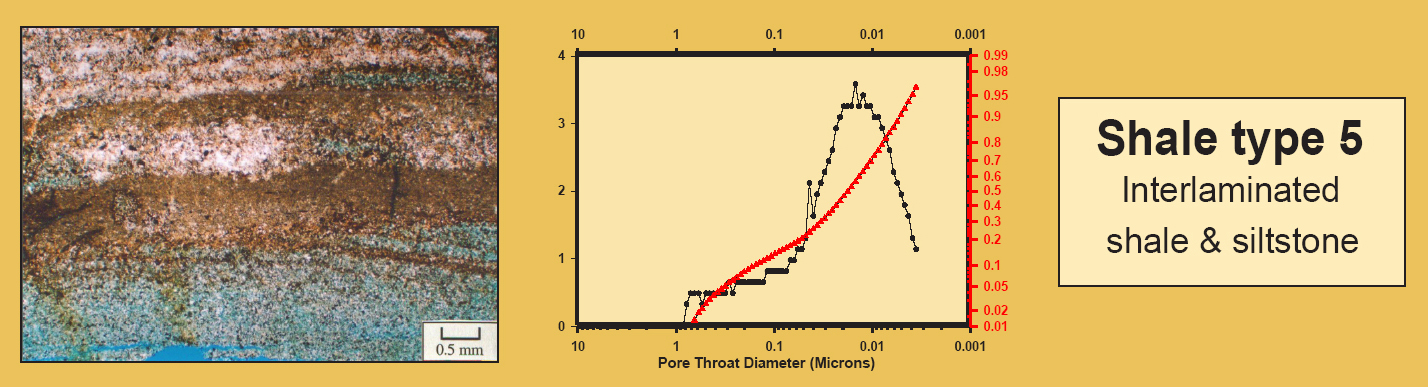
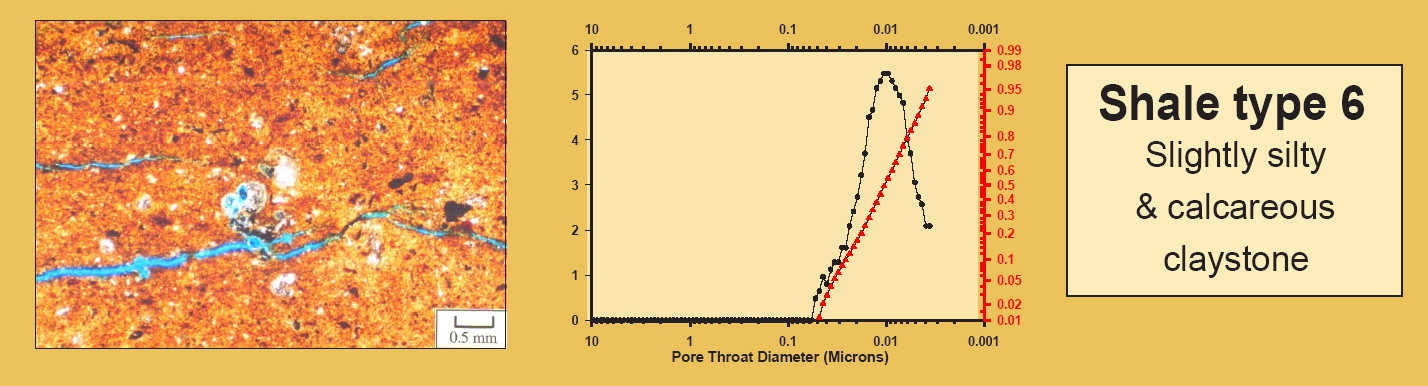

Each shale facies occupies a limited stratigraphic range where considered within a high-resolution (wire-line log scale) sequence stratigraphic framework. Enhanced membrane (top) sealing capacity occurs consistently within the upper parts of shale-dominated transgressive units. Lower sealing capacities are characteristic of silty shales from highstand, lowstand and lower parts of transgressive stratal packages.
Summary and Conclusions
Six shale types are recognizable within deepwater marine depositional settings (based on differences in shale fabric and MICP analyses). These shale types appear to correspond with high-frequency (wire-line log scale) stratigraphic fluctuations.
Clay-rich shale types 1 and 2 consistently
have excellent seal potential. Silt-rich mudstones (shale types 3, 4 and
5) have relatively low seal capacities. There is a strong positive
correlation between total clay content and critical seal pressure (10%
non-wetting phase saturation). Carbonate-cemented mudstones (shale type
6) can have excellent to exceptional membrane seal capacity, but they
are brittle and tend to fracture.
Variations in depositional fabric strongly
influence seal character. In particular, the presence of laminar fabric,
low (<10%) content of detrital silt (siliciclastic and/or bioclastic),
and elevated content (> 70%) of detrital clay matrix appear to enhance
seal potential of marine shales.
Excellent to very good seal capacity is found
in shales from uppermost 3rd- and 4th-order transgressive units and some
condensed intervals. Shales from silt-rich parts of highstand and
lowstand stratal packages have markedly reduced seal capacities. Both
silt content and the organization of silt (laminae and mottles)
influence seal character.
Wire-line log derived parameters appear to
have reasonable ability to estimate critical seal pressure in these
samples. The entire set of critical injection pressures can be predicted
from log-derived bulk density values. Seal capacity for shale type 6 can
be predicted from GR-log data.
References
Almon, W.R., Dawson, Wm. C., Sutton, S.J., Ethridge, F.G., and Castelblanco, B., 2002, Sequence stratigraphy, facies variation and petrophysical properties in deepwater shales, Upper Cretaceous Lewis Shale, south-central Wyoming: GCAGS Transactions, v. 52, p. 1041-1053.
Berg, R.R., 1975, Capillary pressures in stratigraphic traps: AAPG Bulletin, v. 59, p. 939-956.
Dawson, Wm. C., 2000, Shale microfacies: Eagle Ford Group (Cenomanian-Turonian) north-central Texas outcrops and subsurface equivalents: GCAGS Transactions, v. 50, p. 607-621.
Dawson, Wm. C., and Almon,
W.R., 2002, Top seal potential of Tertiary deep-water Gulf of Mexico
shales: GCAGS Transactions, v. 52, p. 167-176.
Dewhurst, D.Y., Yang, Y., and Aplin, A.C., 1999, Permeability and flow in natural mudstones, in Aplin, A.C. et al., eds., Muds and Mudstones, Geological Society London Special Publication 38, p. 23-43.
Downey, M. W., 1984, Evaluating seals for hydrocarbon accumulations: AAPG Bulletin, v. 68, p. 1752-1763.
Jennings, J.J., 1987, Capillary pressure techniques: application to exploration and development geology: AAPG Bulletin, v. 71 (10), p. 1196-1209.
Krushin, J.T., 1987, Seal
capacity of non-smectite shales, in R. C. Surdam, ed., Seals,
Traps, and the Petroleum System: AAPG Bulletin, v. 67, p. 31-67.
Schieber, J., 1999, Distribution of mudstone facies in Upper Devonian Sonyea Group of New York: Journal Sedimentary Research, v. 69, p. 909-925.
Showalter, T.T., 1979, Mechanics of secondary hydrocarbon migration and entrapment: AAPG Bulletin, 63, p. 723-760.
Sutton, S.J., Ethridge, F.G., Almon, W.R., and Dawson, Wm. C., 2004, Variable controlling sealing capacity of Lower and Upper Cretaceous shales, Denver Basin, Colorado: AAPG Bulletin – accepted for publication.
Watts, N.L., 1987,
Theoretical aspects of cap-rock and fault seals for single- and
two-phase hydrocarbon columns: Marine and Petroleum Geology, v. 4, p.
274-307.
seals for single- and
two-phase hydrocarbon columns: Marine and Petroleum Geology, v. 4, p.
274-307.
Acknowledgements
We thank ChevronTexaco for granting permission to present these data and interpretations. W.T. Lawrence prepared thin sections and assisted with photography. E. Donovan and J.L. Jones provided SEM images, and D.K. McCarty completed XRD analyses. R. Lytton offered paleontological data and biostratigraphic interpretations. Poro-Technology, Houston, TX, conducted MICP analyses. Graphic design by L.K. Lovell.