

 Print this page
  Click to view page images in PDF format.
Use of Georeferenced Maps in Exploration
By
Jingyao Gong1 and Larry D. Gerken2
Search and Discovery Article #40039 (2002)
1AAPG, Tulsa, Ok 74101 ([email protected])
2Newfield Exploration Mid-Continent, Tulsa, OK 74102 ([email protected])
Spatial information, which is the core of data essential to petroleum geoscientists, now can be efficiently arranged and managed by use of geographic information system (GIS), such as ESRI’s ArcView and ERDAS’ Imagine. One of the functions of GIS software is to georeference maps, and thereby allow direct comparison of a suite of maps with different scales and projection. Once maps are scanned, or vectorized, and georeferenced, they are easily arranged in a desired order for viewing and analysis.
|
|
Maps are generally scanned with resolution of 300 dpi and
are saved in tif format. The scanned 1. Go to the “Raster” menu and choose “Geometric corrections”; a dialogue box of “Set Geometric Model” opens. 2. Choose “Polynomial” and click OK; the “Polynomial
Model Properties” window opens; the scanned 3. Choose “Vector Layer” option and click “OK” button. 4. A selection window is opened for users to select a
vectorized 5. Find and click the corresponding points in pairs in the
two views, such as the marks of latitude/longitude, if they are present,
selected geographic boundaries, etc. on the scanned 6. Click on the Resample icon in the “Geo Correction
Tools” window that has been automatically opened at the top of the
computer screen. The resample option dialogue box will be displayed.
Choose tif format in the “Output File” drop-down menu, select a folder
and name the 7. Open a blank project in ArcView and add the newly
generated Presented herein is an atlas of selected georeferenced maps of the Middle East derived from AAPG publications. The vectorized maps of Sedimentary Provinces of the World (St. John, Bally, and Klemme, 1984) and fields of the Arabian Plate (Beydoun, 1991) are the bases for the following georeferenced maps: 1.
Structure 2.
3. Bouguer gravity anomaly mmap of southern Iran and contiguous area 4.
Structure 5. Structure and isopach maps of Bu Hasa oil field Two
databases and illustrations of Bu Hasa features are linked to the
structure
Figures 1, 2, 3, and 4 show several aspects of the rich hydrocarbon Arabian province--its areal extent, fields, foredeep nature, and the extent and thickness of one of the important sequences of source rocks. The
gravity Bu Hasa Field, United Arab Emirates U.A.E. on the eastern shelf of the Arabian platform contains northeast-southwest folds at the Cretaceous Thamama level (Figure 6). Major fields are present on two prominent structure-highs (Shah-Asab on the east and Huwaila - Bu Hasa axis on the west. Bu Hasa field (Figure 7) is an north-trending anticline, about 22 mi (35 km) long. The anticline, shaped as a tear drop, tapers in width to the south. The structural relief of about 800 ft (250 m) and an areal closure is about 205 mi2 (535 km2) at the top of the Cretaceous Shuaiba carbonate (Alsharhan, 1993). The multiple pays are Upper Cretaceous limestones. Its estimated reserves, as of 1993, was 20 billion bbl of oil. The
isopach ArcView®
can link a feature (oil/gas field, fault, anticline, well, seismic line,
etc.) on a Alsharhan, A.S., 1993, Bu Hasa Field--United Arab Emirates, Rub al Khali Basin, Abu Dhabi in AAPG Treatise: Structural Traps VIII, p. 99-127. Alexander, R. G., 1986, California and Saudi Arabia Geologic Contrasts in AAPG Memoir 40: Future Petroleum Provinces of the World, p. 291 –315 Beydoun, Z. R., 1991, The Arabian Plate Hydrocarbon Geology and Potential--A Plate Tectonic Approach: AAPG Studies in Geology No. 33, 77p. Bushara, Mohamed N., 1995, Subsurface Structure of the Eastern edge of the Zagros Basin as Inferred from Gravity and Satellite data: AAPG Bulletin, p. 1259-1273. St.
John, Bill, A.W. Bally, and H.D. Klemme, 1984, Sedimentary Provinces of
the World--Hydrocarbon Productive and Nonproductive: |
 Figure 1. Vectorized
 Figure
2. Vectorized
Figure
2. Vectorized  Figure
3. Georeferenced structure
Figure
3. Georeferenced structure  Figure
4. Georeferenced
Figure
4. Georeferenced  Figure
5. Georeferenced bouguer gravity anomaly
Figure
5. Georeferenced bouguer gravity anomaly  Figure
6. Georeferenced structure
Figure
6. Georeferenced structure  Figure
7. Georeferenced structure
Figure
7. Georeferenced structure 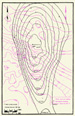 Figure
8. Georeferenced isopach
Figure
8. Georeferenced isopach  Figure 9. Databases and illustrations of Bu Hasa features, linked to
structure
Figure 9. Databases and illustrations of Bu Hasa features, linked to
structure 