Print this page
 Inversion
 - Interpreting the Deformation Path - Why Does it Matter?*
By
A.D. Gibbs1
Search and Discovery Article # 40034 (2001)
*Adapted for online presentation from poster session by the author at the AAPG Convention, Denver, CO, June, 2001.
1Midland Valley Exploration Ltd, Glasgow, UK. (www.mve.com) ([email protected])
* Editorial Note: This article, which is highly graphic (or visual) in design, is presented as: (1) three posters, with (a) each represented in JPG by a small, low-resolution image map of the original; each illustration or section of text on each poster is accessible for viewing at screen scale (higher resolution) by locating the cursor over the part of interest before clicking; and (b) each represented by a PDF image, which contains the usual enlargement capabilities; and (2) searchable HTML text with figure captions linked to corresponding illustrations with descriptions.
Users without high-speed internet access to this article may experience significant delay in downloading some illustrations due to their sizes.
First Poster
Second Poster
Third Poster
Fourth Poster
Fifth Poster
Most
models for inversion focus on understanding the 2D structural development of
extension then compression, or occasionally compression then extension. Coupled
with this are broad based models that account for the stacking of depositional
and erosional packages. These are driven directly by the structural inversion.
Inversion is dominantly a 3D process, whether it is driven by the extension -
compression cycle, transtension or halokinetic movement. When modeled in 3D it
becomes apparent that the 2D cross-sectional view under plays the importance of
these systems. Many key commercial basins in Europe and elsewhere contain, or
are dominated by, long lived inversion components. Therefore an understanding of
the effect of these evolving geometries should be a vital concern. This poster
illustrates, through a variety of inversion situations, some key influences on
stratigraphy, hydrocarbon systems, and structural control of the deformation
path. Key examples are illustrated by some simple 3D models. These highlight the
impact of the inversion cycle but in particular the commercial impact of these
situations is emphasized.
|
u
u
u
u
u
u
u
u
|
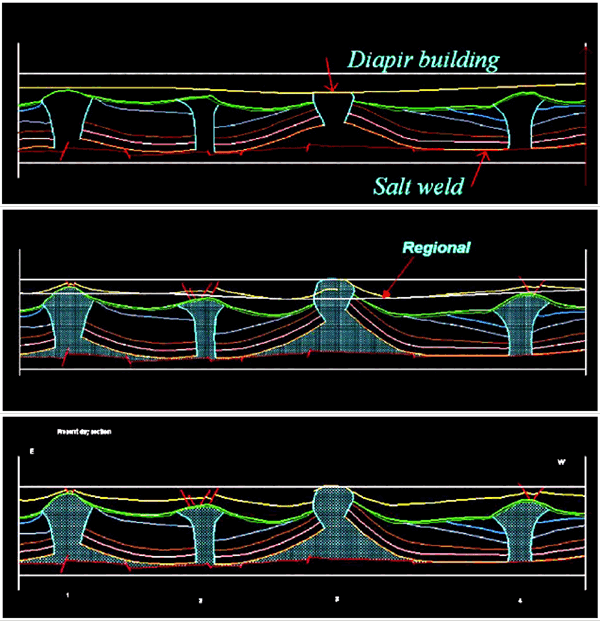
Click here for sequence of cross sections.
These concepts are derived from 2D interpretations of regional systems where a change in regional stress can be demonstrated or inferred. Figure 1.2 is a cartoon of an inverted extension fault. Depocentres in synfault sequences are inverted, leading to a classic pattern of growth wedges controlled by fault bends. Fold hinges and onlap/offlap geometries are pinned to fault bends in the footwall unless modified by footwall deformation.
These
2D cases represent very simple strain histories and the resulting geometries can
be readily modeled in 2D. However, in many areas a 2D analysis can be
misleading. In addition, the assumption that In
many cases oblique faulting, salt displacement and regional changes are combined
resulting in mixed
Click here for sequence of A, B, and C.
Click here for sequence of A and B.
Dip
slip The
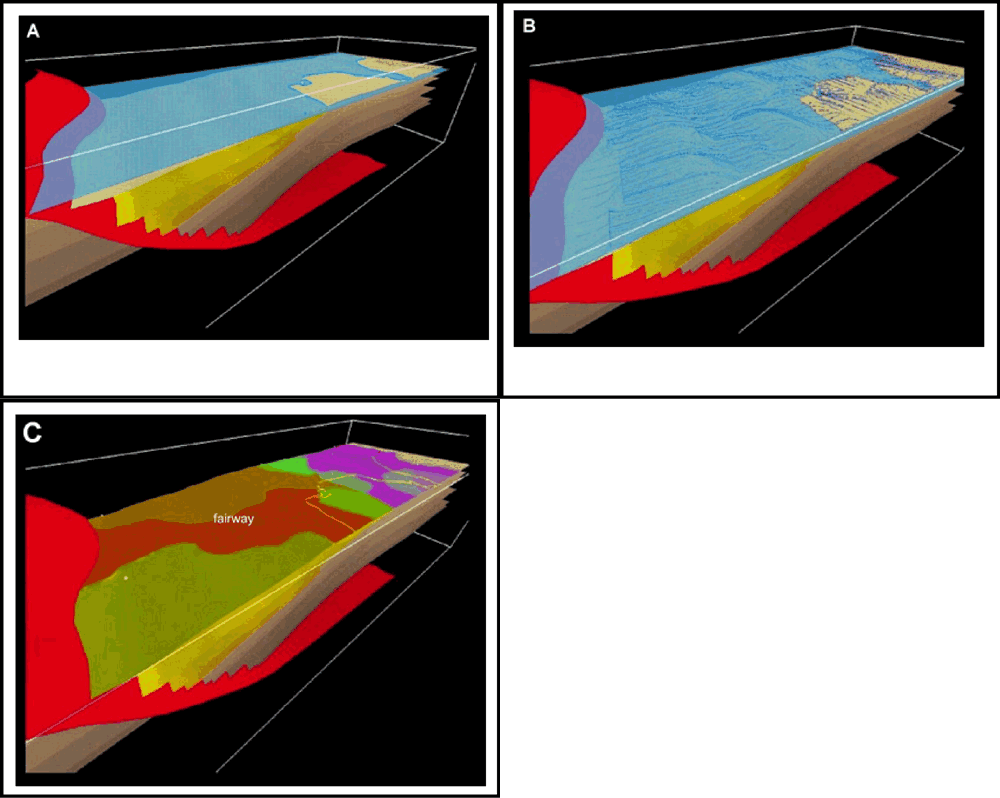
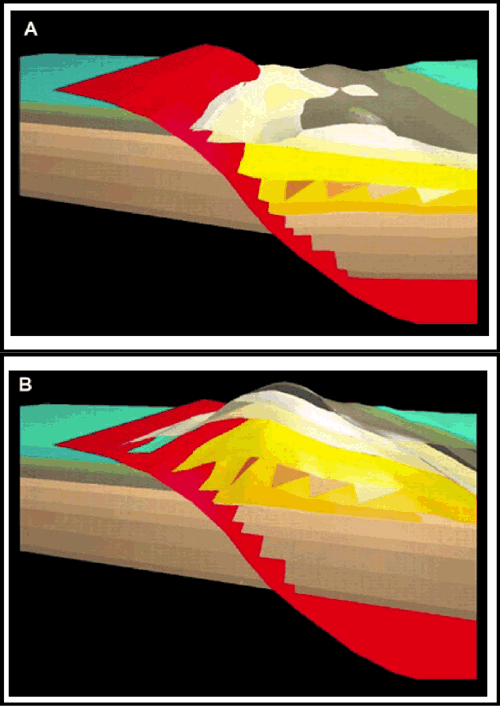
model in Figures 2.1, 2.2,
and 2.3 is a 3D equivalent of the simple cartoon shown in
Figure 1.2. Even small strike changes in the controlling fault introduce
significant variation to map geometry and volume distributions. The object of
this modelling is to identify the relationship of depositional packages to fault
geometry (architecture) and During extension (Figure 2.2A, 2.2B, 2.2C), fault geometry controls development of accommodation space. Ray tracing on the developing highs and lows allows sediment transfer systems to the depocentres to be identified. Identifying the sediment catchment areas and depocentre lows provides the geometric framework to interpret the 3D distribution of sediments and aids the production of gross depositional environment maps. In the model, sand fairway (shown in brown, Figure 2.2C) is realized, running oblique to the basin margin. Dip
slip As
shortening continues all of the depocentres become inverted (Figure
2.3B). With
this model using only dip-slip extension followed by
Click here for sequence of Figure 3.1A and B.
Click here for sequence of Figures 4.1A and 4.2A.
Changes
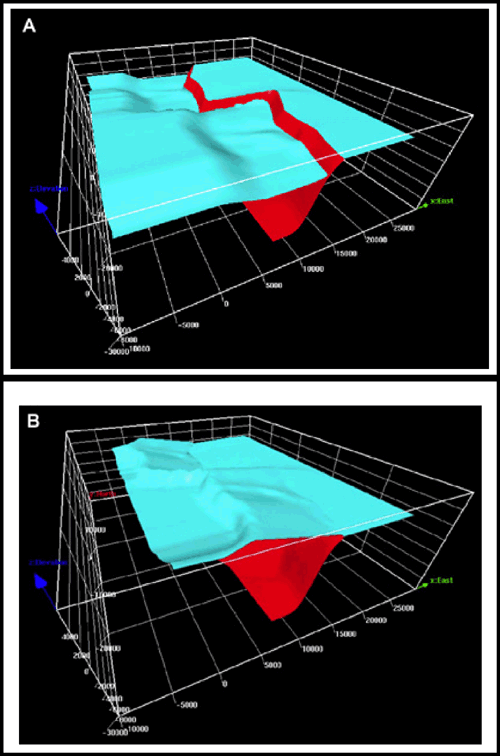
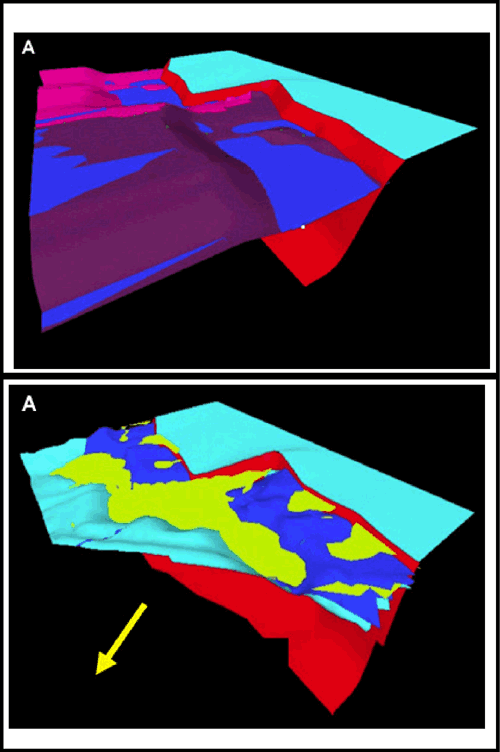
to fault geometry in 3D results in additional complexity in the inverted system.
In Figure 3.1 the boundary fault has been modelled with a hard linked transfer.
Positioning
of the transfer or relay relative to the slip direction effects the separation
of depocentres (dark blue) both in the extension and contraction phases (Figure
3.2). Inverting on both the extension and the lateral fault component generates
tight Using
the same model the effect of changing slip direction during Amplitude
of the Extension on oblique transfer controls sediment catchment areas and accommodation space development. In this model (Figure 4.1), accommodation space may be widely separated with different sediment catchment areas and sediment transfer routes. As the basin inverts, the highs may evolve in positions which are starved of the target sediments. The
3D architecture of the sediment packages during
Click here for sequence of Figure 5.1B and C.
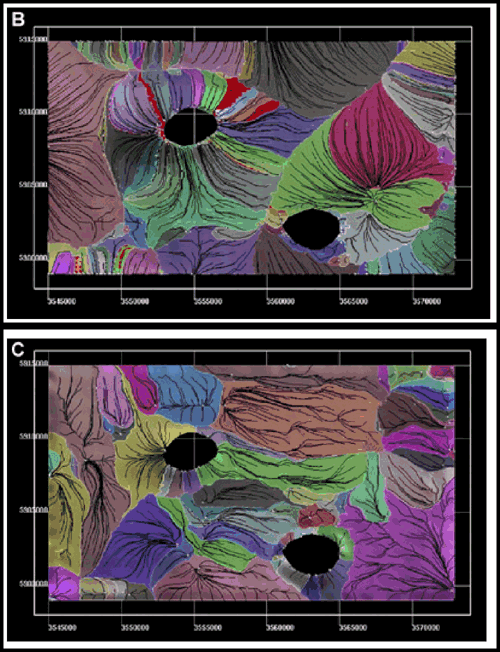
2D models assume that salt is drawn and remains within the section; i. e., flow is radial into a dome or salt wall. This model from onshore Germany (Figure 5.1) was used to develop constraints on these assumptions in 3D. The area is composed of two downbuilt diapirs with cross section geometry similar to those shown in Figure 1.3. 3D balanced and restored models for the top salt are shown at two time stages (Figure 5.1B, C). These models show the salt catchment areas and flowage pathways for the salt at each of these time steps. Different coloured areas represent flow packages within the salt. Between
the two stages the pattern of catchment areas changes with capture of the cells
as the domes grow. As the salt flow pattern changes, there are time equivalent
changes in the sediment accommodation space, and
Baldschuhn, R., U .Frisch, and F. Kockel, 1996, Section 37, in Tectonic Atlas of NW Germany: BGR, Hannover. The author wishes to thank the numerous colleagues and clients who have contributed to the development of this approach. The salt data is from Digitaler Geotektonischer Atlas von Nordwestdeutschland with analysis by Midland Valley. Stephen Calvert assisted in preparing the poster. |


 Figure
2.1. Map view of hangingwall depocentres in extension. Note the non-depositional
highs and trends both parallel and orthogonal to the bounding fault.
Figure
2.1. Map view of hangingwall depocentres in extension. Note the non-depositional
highs and trends both parallel and orthogonal to the bounding fault. Figure
2.2. Cross-section panel shows simple listric growth wedge.
Figure
2.2. Cross-section panel shows simple listric growth wedge. Figure
2.3. Two stages of dip slip
Figure
2.3. Two stages of dip slip 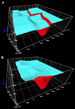 Figure 3.1. Boundary fault with hard linked transfer with
reference surface in extension (A) and after
Figure 3.1. Boundary fault with hard linked transfer with
reference surface in extension (A) and after  Figure 3.2. Position of transfer effects the separation of
depocenters in extension (A) and contraction (B).
Figure 3.2. Position of transfer effects the separation of
depocenters in extension (A) and contraction (B). Figure 3.3. Same model as in
 Figure 3.4. Amplitude of
 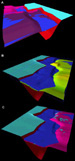 Figure 4.1. Control of sediment catchment areas and
accommodation space by extension on oblique transfer (A). B, C. Positions of
highs evolve as basin inverts.
Figure 4.1. Control of sediment catchment areas and
accommodation space by extension on oblique transfer (A). B, C. Positions of
highs evolve as basin inverts.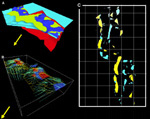 Figure 4.2. Different traps, migration fairways, and
catchment areas form with time during
Figure 4.2. Different traps, migration fairways, and
catchment areas form with time during 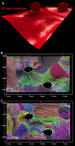 Figure
5.1. 3D salt
Figure
5.1. 3D salt