Print this page
 Click to view presentation in PDF format.
A Geologic Review of the Mahogany  Subsalt
 Discovery: A Well That Proved a Play*
(The Mahogany Subsalt Discovery: A Unique Hydrocarbon Play, Offshore Louisiana**)
Holly Harrison1, Dwight ‘Clint’ Moore2, and Peggy Hodgkins3
Search and Discovery Article #60049 (2010)
Posted April 28, 2010
*Adapted from presentation at AAPG Annual Convention, 1995, and from **extended abstract prepared for presentation at GCSSEPM Foundation 16th Annual Research Conference, “Salt, Sediment and Hydrocarbons,” December 3-6, 1995.
Extended abstract used with permission of GCSSEPM Foundation whose permission is required for further use.
Appreciation is expressed to GCSSEPM Foundation, and to Dr. Norman C. Rosen, Executive Director, for permission to use it in this adaptation.
1 Phillips Petroleum Company, Bellaire, TX; currently BP, Houston, TX ([email protected])
2 Anadarko Petroleum Corporation, Houston, TX; currently ION Geophysical Corporation, Houston, TX ([email protected])
3 Amoco Production Research, Tulsa, OK; currently Veritas Hampson-Russell, Calgary, AB ([email protected])
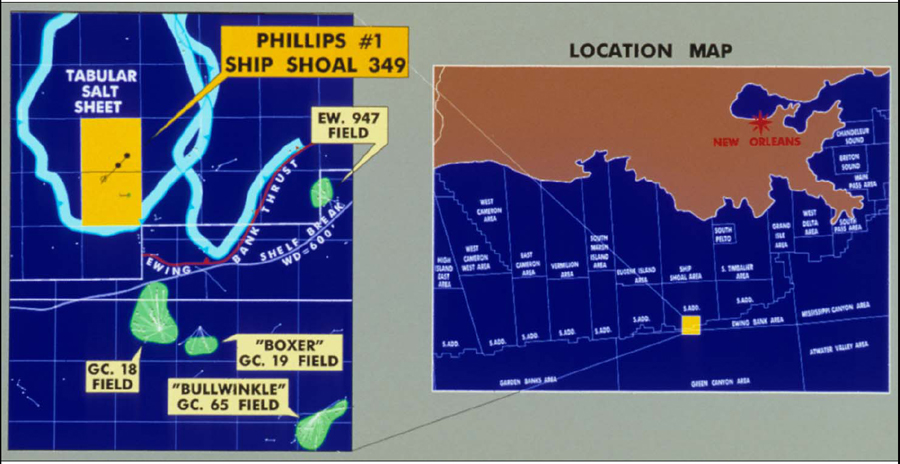
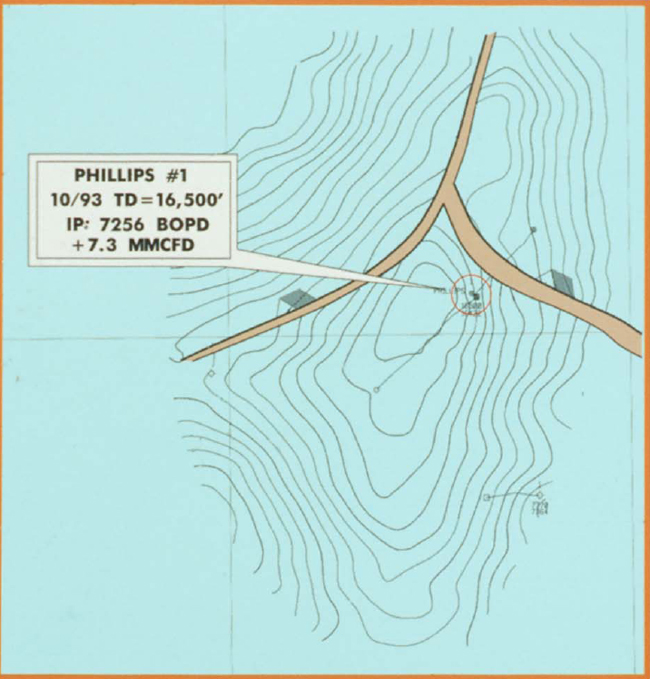
The Mahogany subsalt discovery of Phillips Petroleum Company, in partnership with Anadarko Petroleum Corporation and Amoco Production Company, is the petroleum industry's first commercial subsalt oil development in the Gulf of Mexico. Located 80 miles offshore Louisiana on Ship Shoal Blocks 349 and 359, the Mahogany #1 (OCS-G-12008) was drilled in 375 ft of water to a depth of 16,500 ft and tested both oil and gas below an allochthonous salt sheet. The discovery well tested 7256 BOPD and 7.3 MMCFD on a 32/64" choke at 7063 PSI flowing tubing pressure (FTP). The #2 delineation well (OCS-G-12008) was drilled from the same surface location to a depth of 19,101 ft MD (18,572 ft TVD). A different zone in this well was tested in July, 1994, and flowed 4366 BO and 5.315 MMCFD on a 20/64” choke at 6287 PSI FTP. These flow rates suggest that high sustainable production rates can be expected, and they are confirmed by rock property studies and detailed well log analysis. A third well (OCS-G-12010 #2) was spud in
September, 1994.
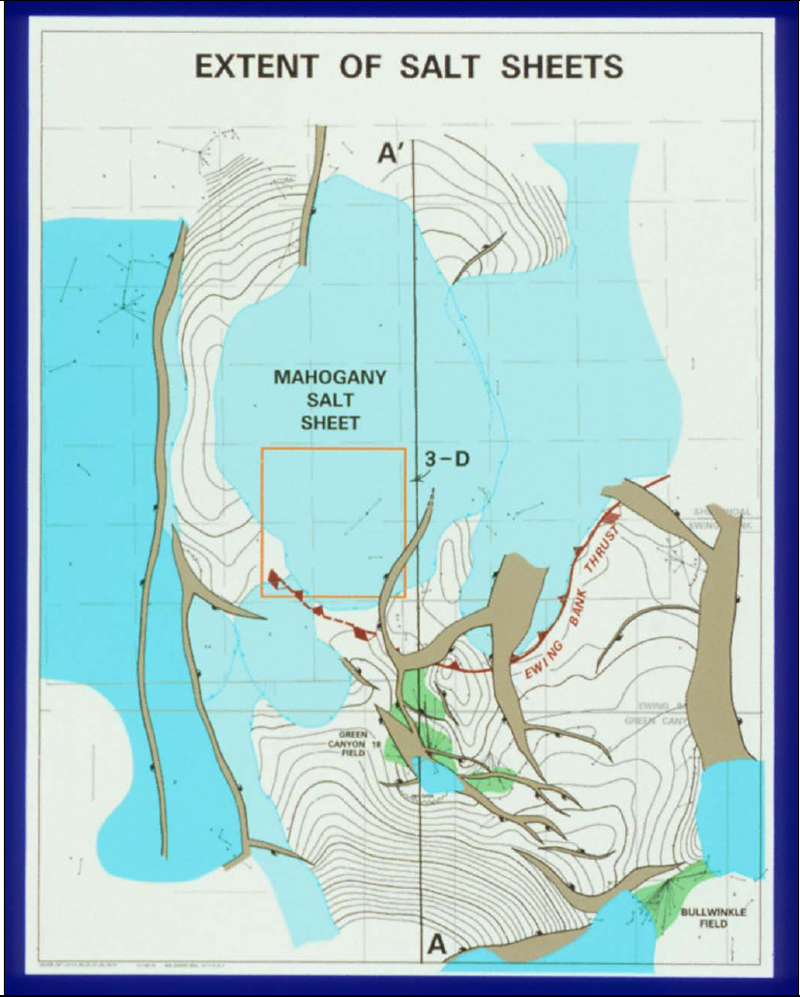
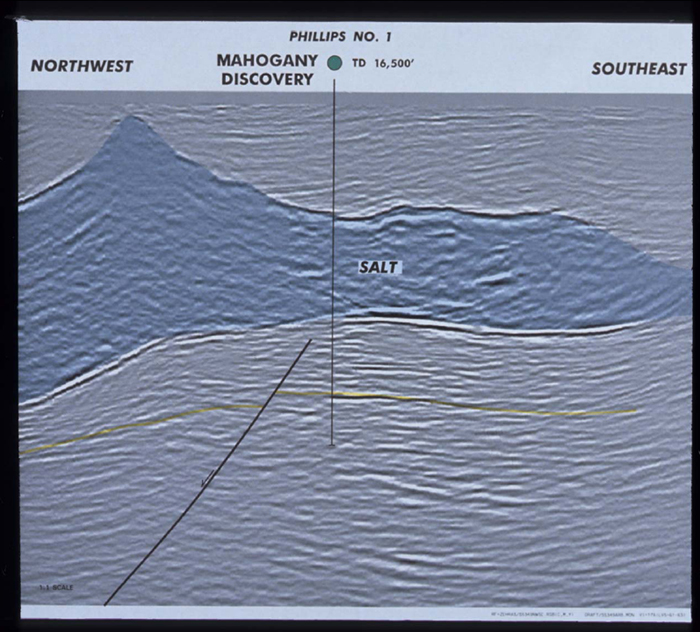
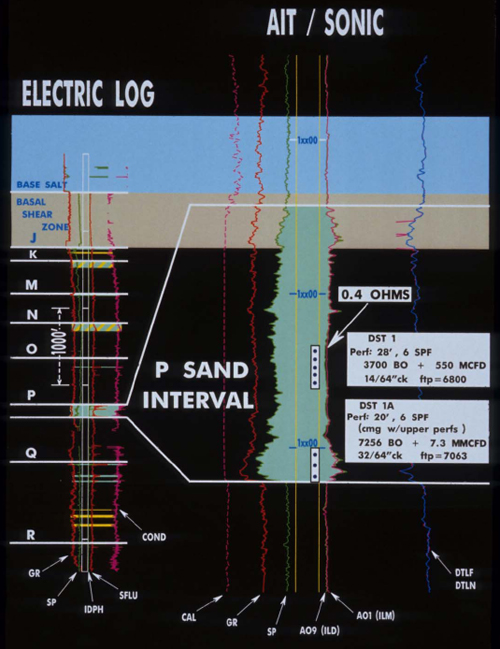
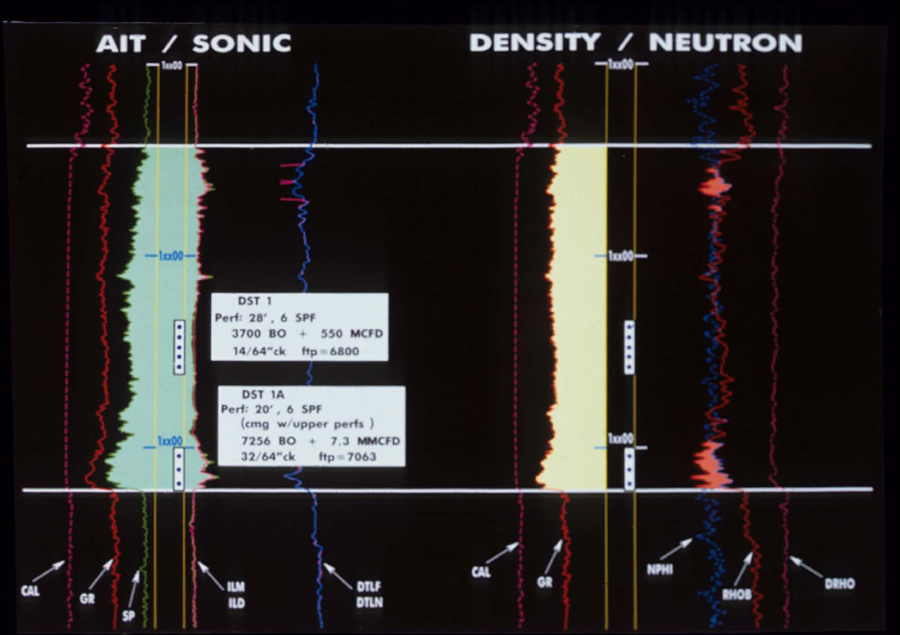
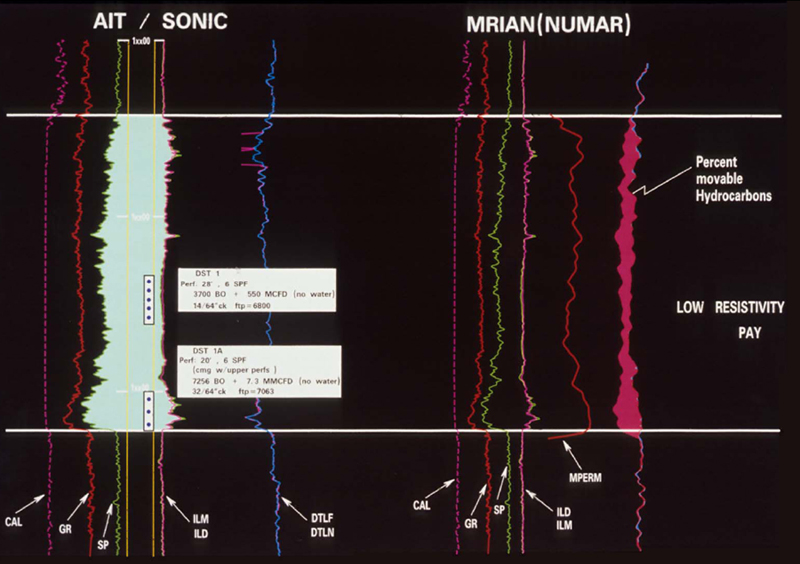
The primary subsalt reservoir is a high-pressured oil sand with high permeability and porosity and has tremendous deliverability. The field is located 80 miles offshore Louisiana on Ship Shoal South Additions blocks 349/359. The structure is interpreted as a faulted anticline overlain by allochthonous salt. Prestack depth-migrated 3-D seismic data was integrated into a regional geologic model that was based on 2-D time-migrated data. Regionally, the area is characterized by multiple salt sheets, which form a salt canopy sutured east of Mahogany, and several older and deeper sheets are also identified. Structural and rheological aspects of the thick salt sill have been addressed using selected examples of rotary sidewall cores and data on an anomalous "gumbo" shale immediately below the salt which contributes to the understanding of lateral variations at the base of the allochthonous salt.
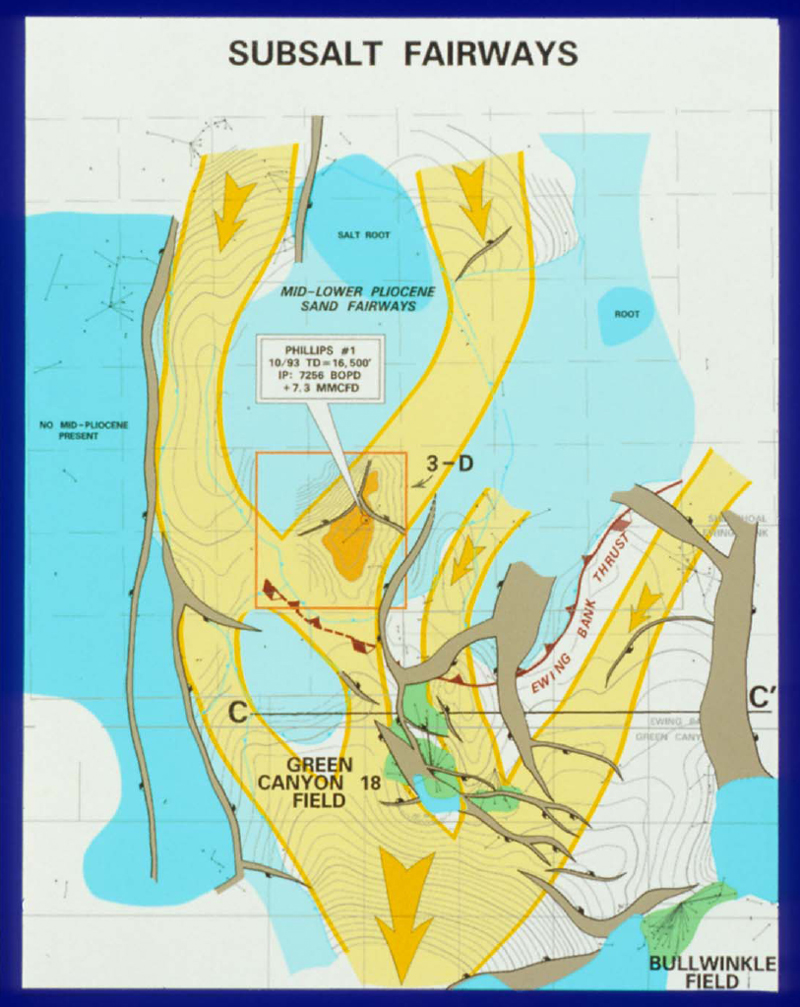
Subsalt depositional fairways can be approximated by mapping relative salt-induced paleo-bathymetry. Deepwater sand fairways are closely related to salt movements and extend under the salt sheets. Depositional environments and reservoir parameters in productive sandstone intervals have been defined using whole core and well log imaging.
|
|
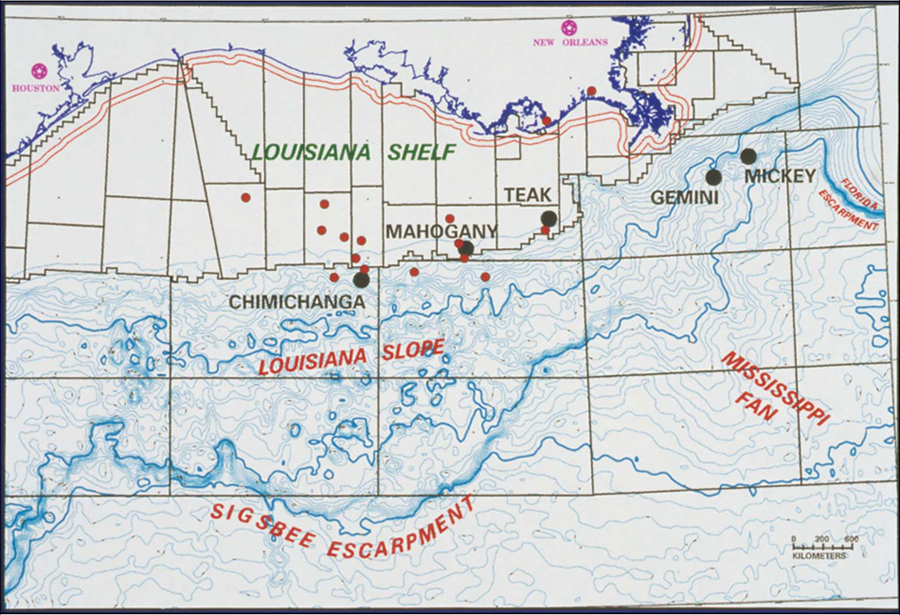
Exploration for hydrocarbons below salt in the
In 1990, Exxon announced a
This article discusses the regional geologic setting of the
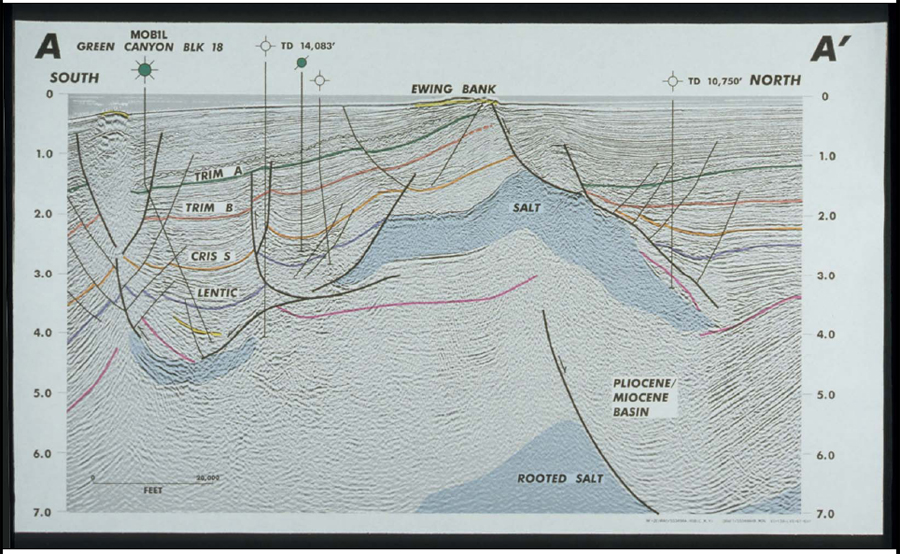
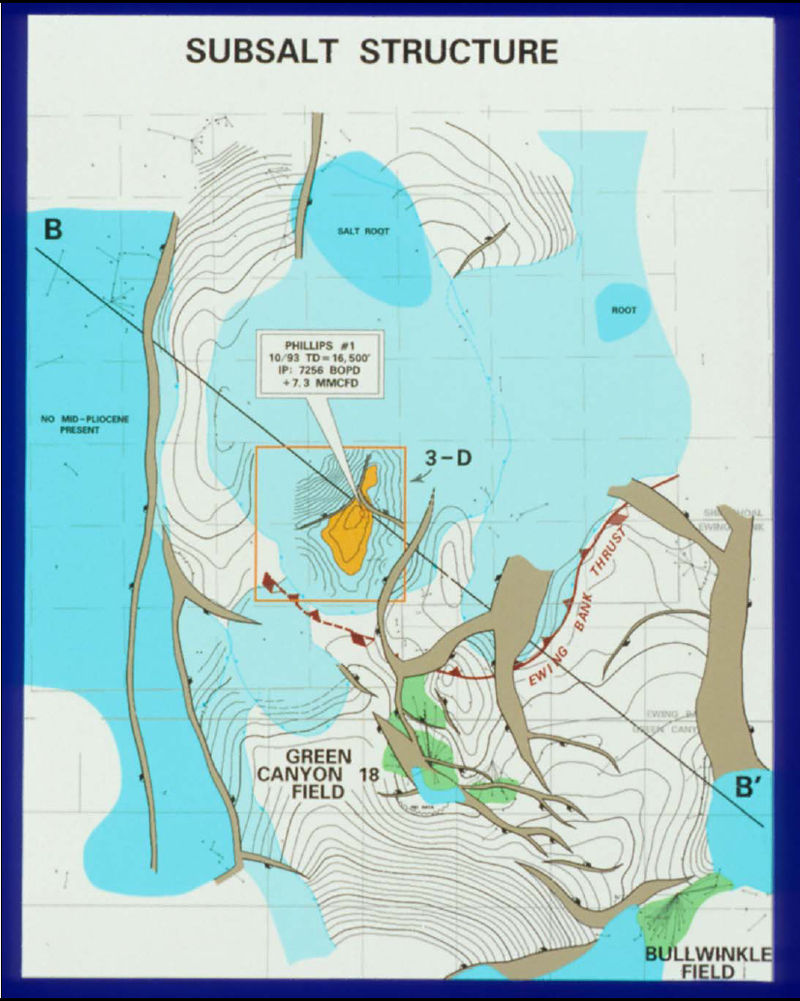
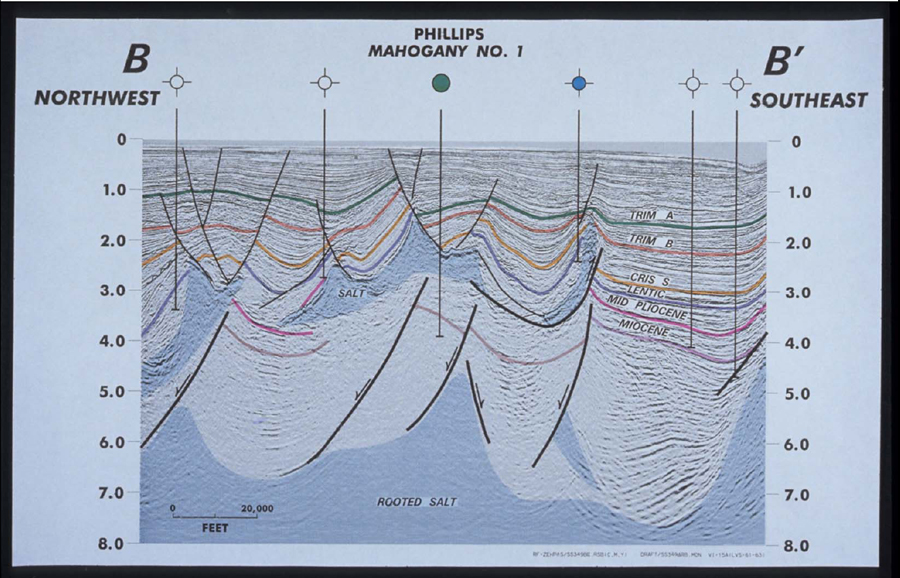
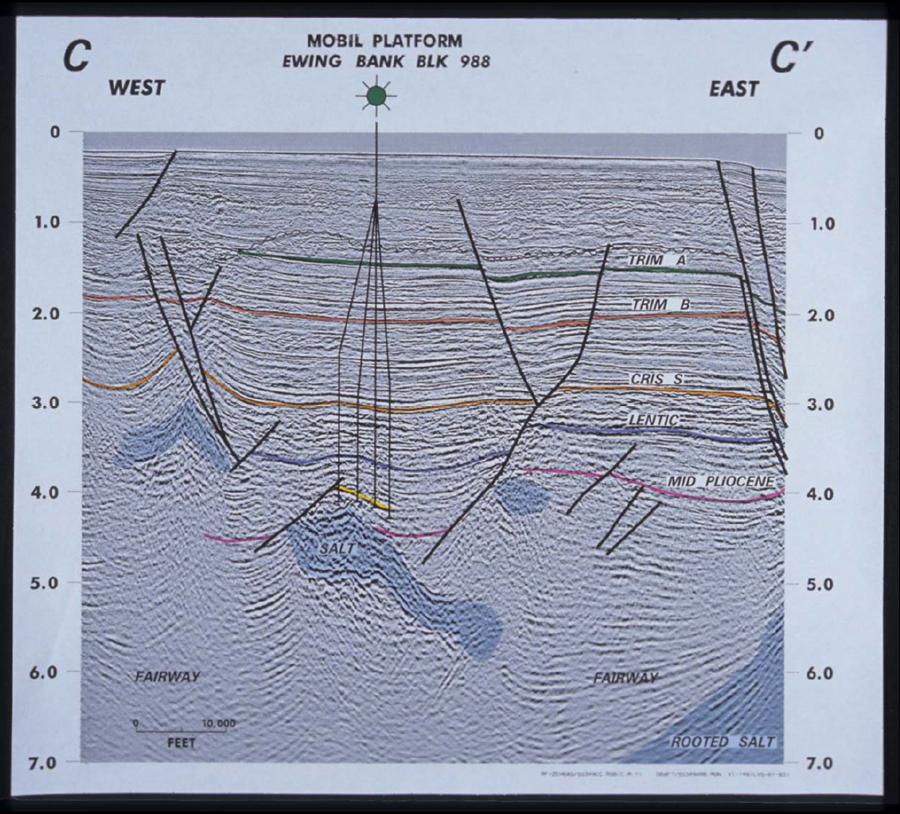
Mahogany is on trend with Bullwinkle, Boxer, and Green Canyon 18 fields near the edge of the shelf/slope break (Figure 2). The field is below a large tabular salt sheet that converges with another salt sheet farther to the east at approximately equivalent depths. The Ewing Bank Thrust (Figure 2) is located along the leading edge of the eastern salt sheet and is one of the first thrust faults to be documented in the Prior to the emplacement of the allochthonous salt sheets, the deep salt roots that ultimately fed the shallow salt sheets probably had local bathymetric relief updip (north) of the Mahogany area. Seismic data show that there may be several generations of salt sheets at different levels within the sedimentary column near Mahogany. For example, Green Canyon 18 field (Figures 7 and 8) is located south of the Mahogany field in a depositional fairway which loaded and deformed a salt sheet that is now buried much deeper than the Mahogany salt sheet. Geologic models of salt sheet emplacement (Fletcher et al., 1995; Wu et al., 1990) and biostratigraphic data in the study area demonstrate that the Mahogany allochthonous salt sheet probably formed within the lower bathyal to abyssal environment. Sand fairways in slope environments are primarily controlled by local and regional bathymetric variations. Basin depocenters were also variable as multiple generations of salt sheets impacted sand fairway distributions. At Mahogany, it was possible to map the older depositional fairways and extend them under the salt sheets once the deeper salt features were identified. The strike orientation of salt and basin distribution is critical to fairway prediction. After sand deposition, allochthonous salt flow at shallow depths below the sea floor was triggered and spread laterally about 8-12 miles downslope, blanketing the area.
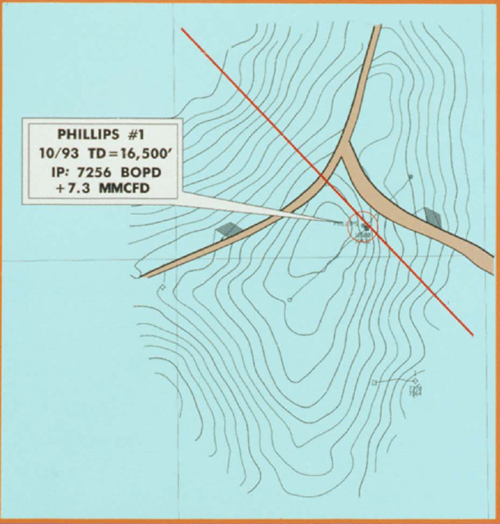
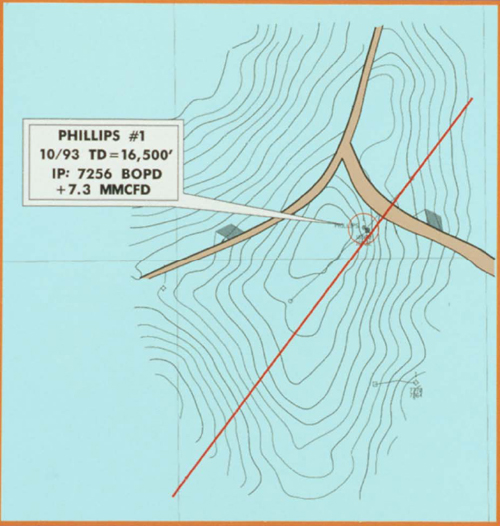
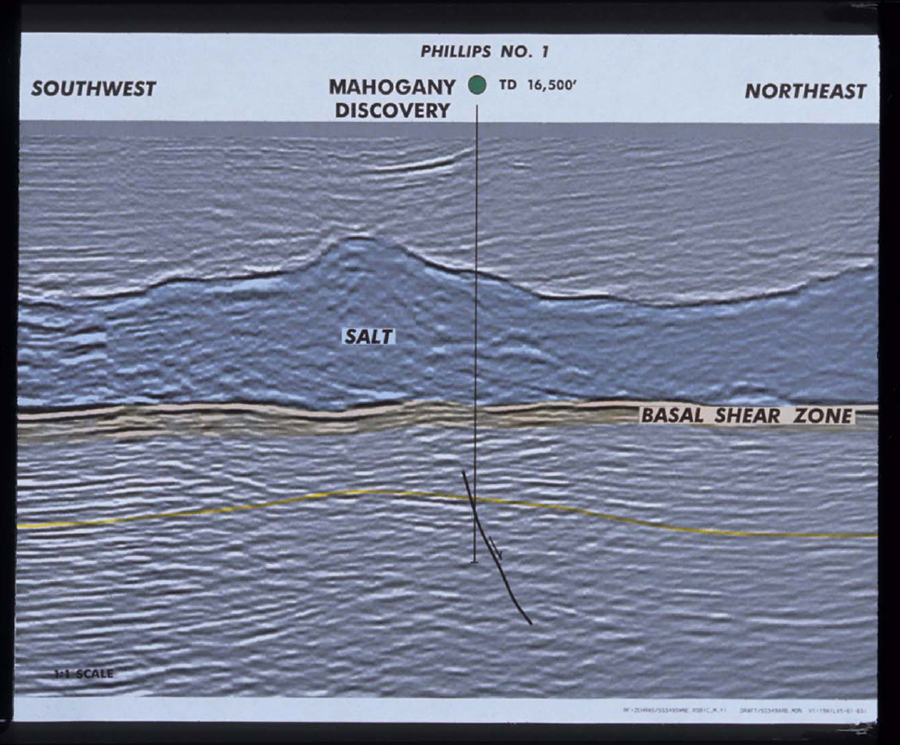
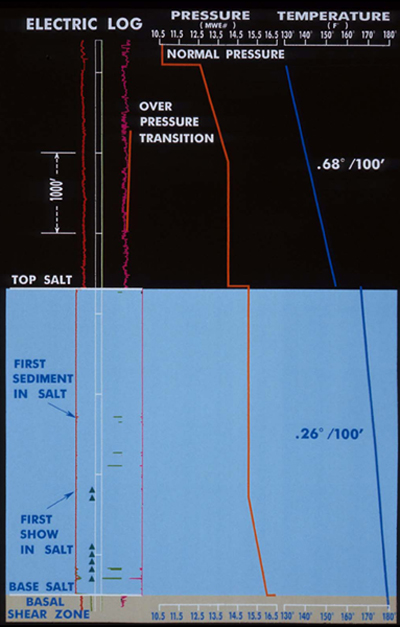
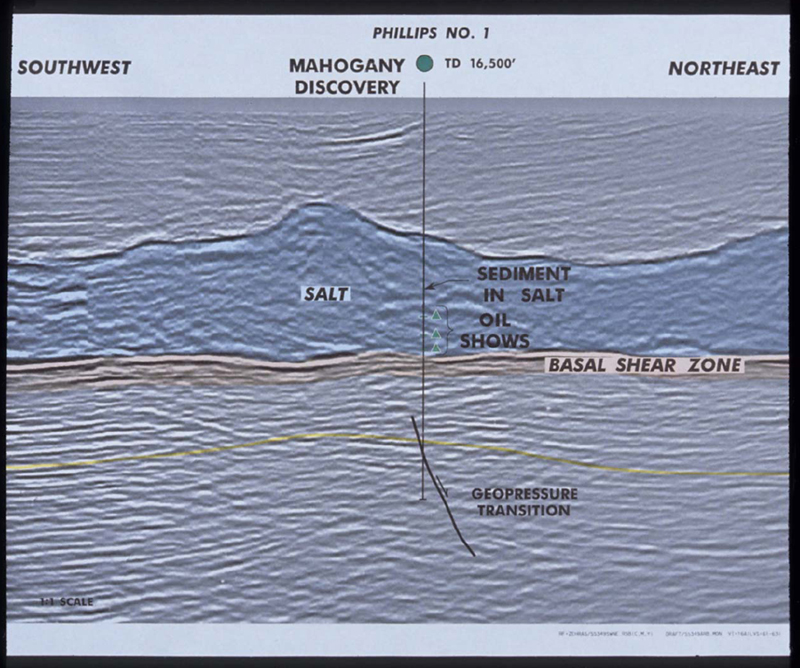
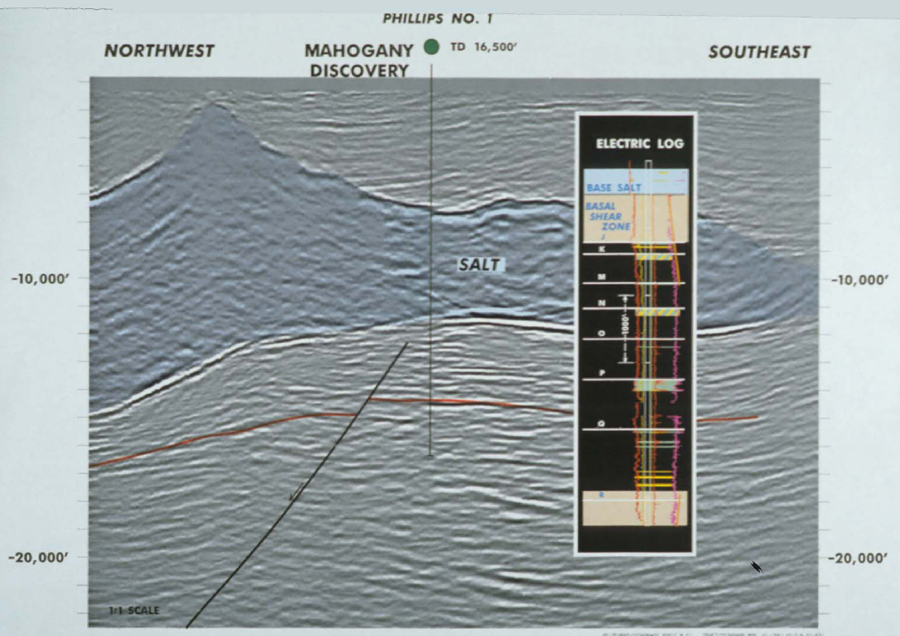
The structure at Mahogany is interpreted as a 3-way dipping anticline (Figures 9, 10, 11, 12, and 13). The closure on the northwest flank may be due to faulting. Further seismic processing will aid in resolving this portion of the structure. Smaller faults have been identified in the wells which complicate the structure. The discovery well drilled in Ship Shoal 349 encountered very little sand above the salt and had suprasalt temperatures and pressures typical for the area (Figure 14). The well drilled a continuous salt section over 3500-ft thick which contained minor sedimentary inclusions, several of which exhibited oil and gas shows (Figures 14 and 15). Rotary sidewall cores were taken in the salt and analyzed for viscosity and strain rates. These data were used to help engineer casing designs and evaluate salt creep.
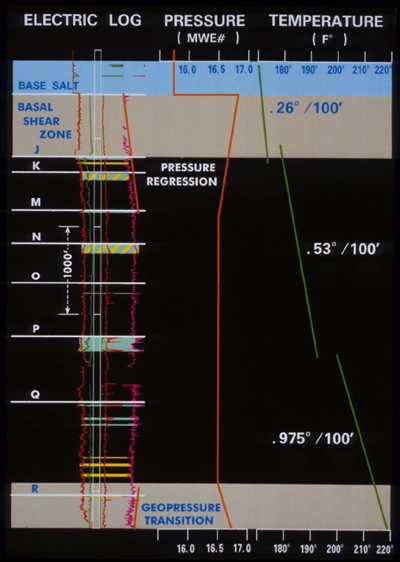
Although salt is an incompressible rock and therefore pore pressures are constant, the mud weight during drilling was increased in the salt interval to control the gas liberated from the sediment inclusions and also in anticipation of drilling higher pressures below the base of salt. The sedimentary section immediately below salt is a high-pressured "gumbo" with pore pressures that may exceed 17 pounds per gallon mud-weight pressure gradients (0.88 PSI/ft). The pressure gradient in this
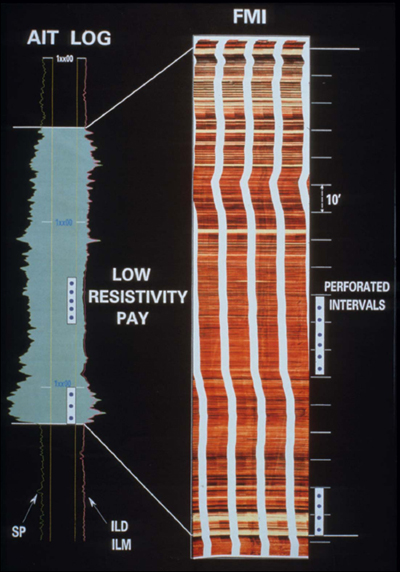
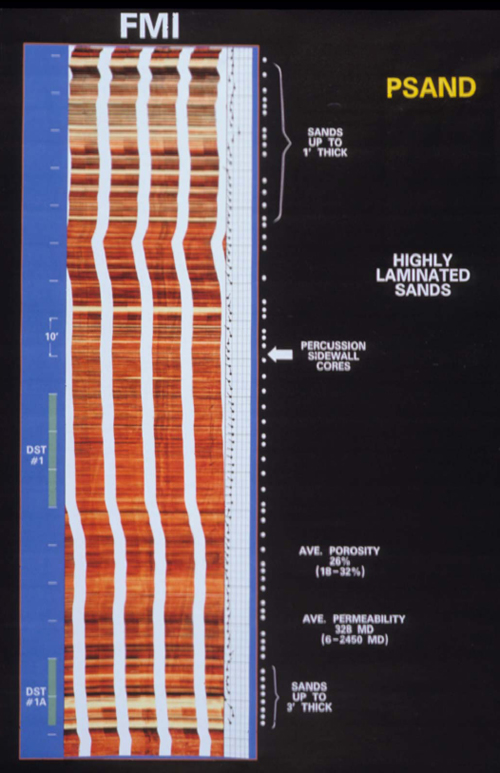
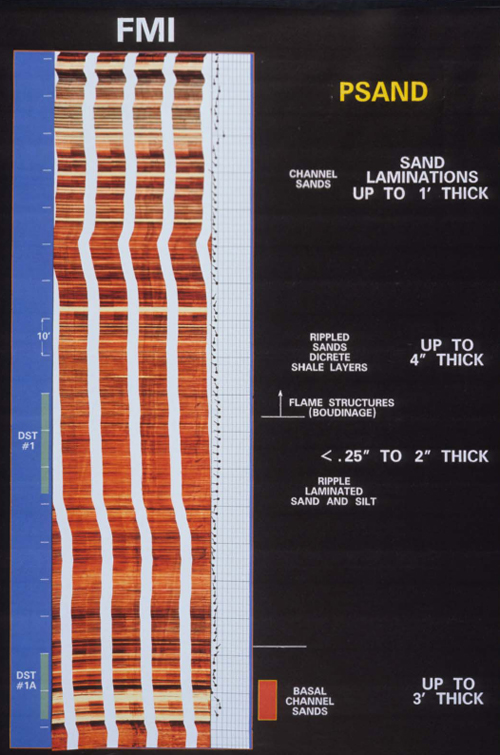
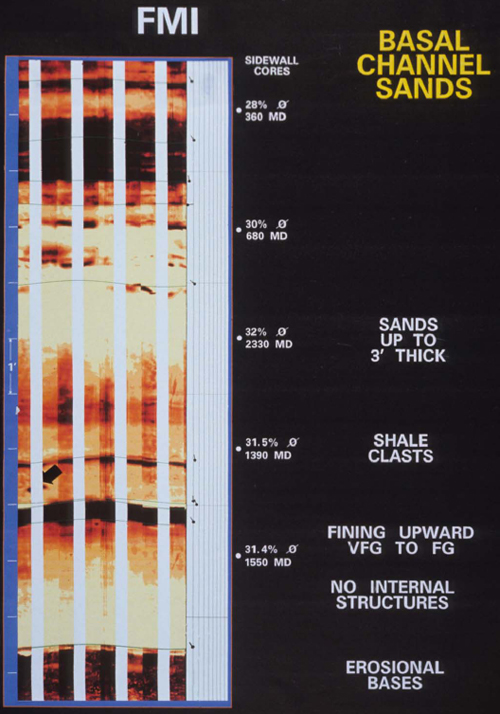
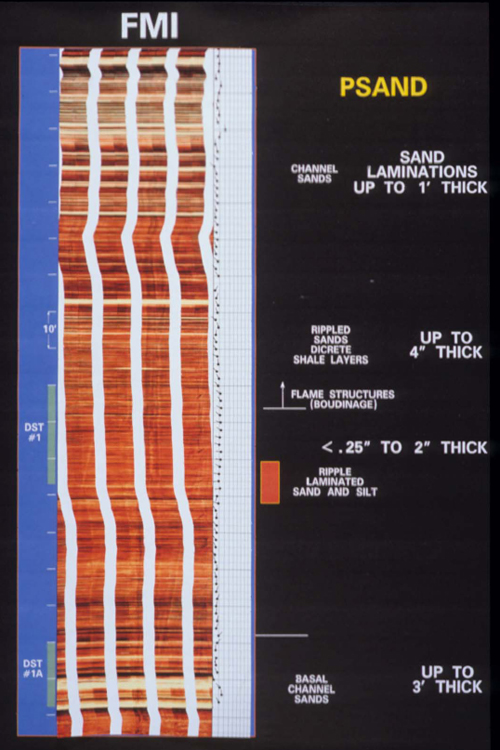
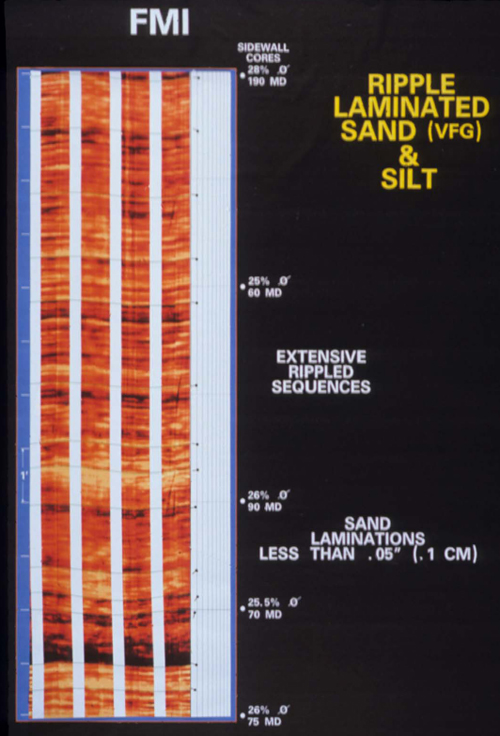
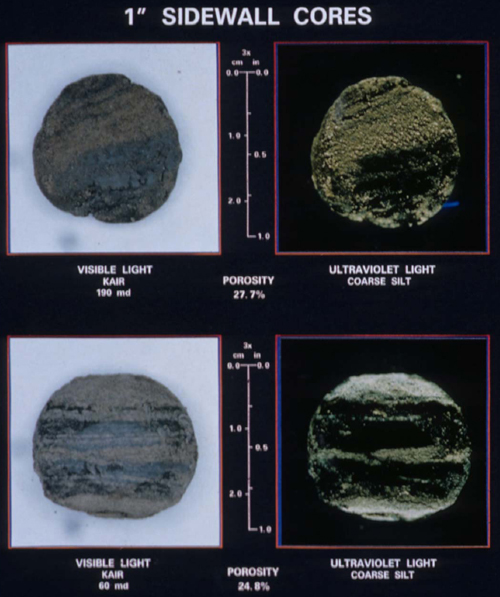
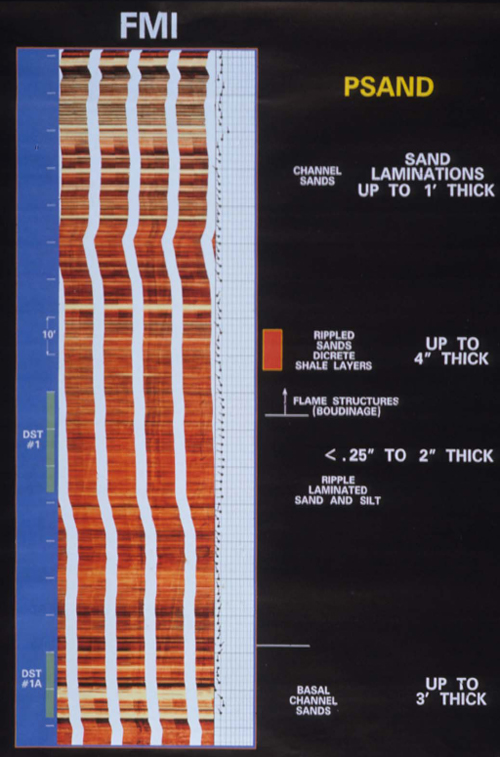
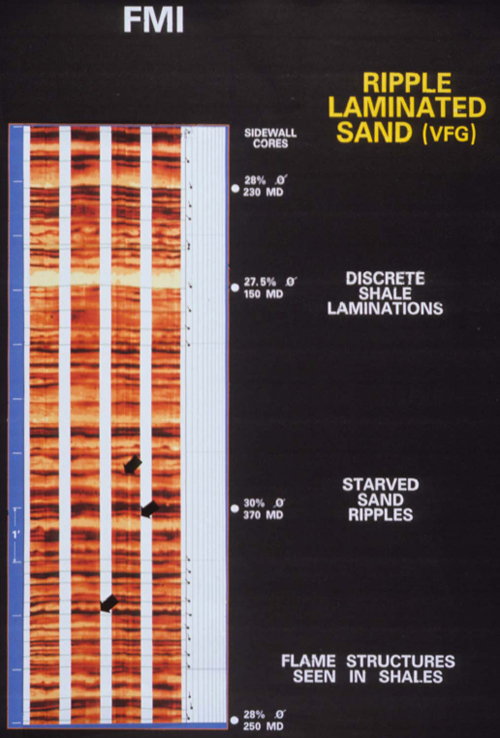
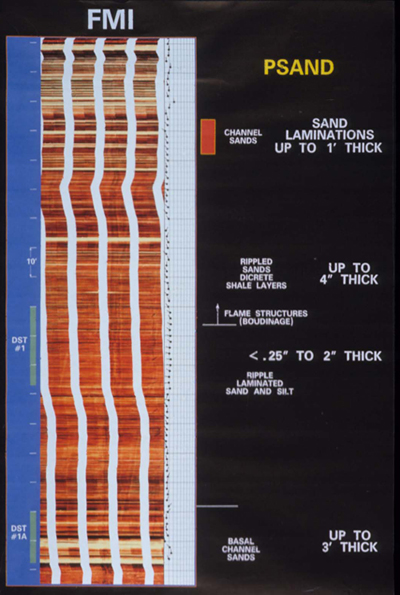
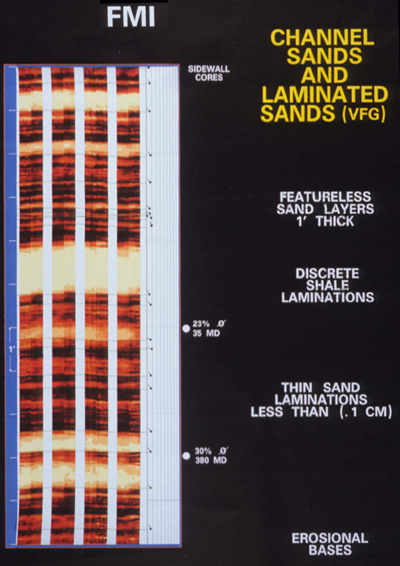
The primary The low resistivity log response of the pay sand is due to fine interlaminations of sand and shale (Figures 20 and 21). The Formation MicroImaging log and percussion sidewall cores reveal individual sand laminae less than 0.25 in. thick; yet the overall laminated sequence is capable of significant flow rates. Overall, the sand has a fining-upward texture with a more coarse-grained and thicker bedded layer at the base (Figures 22 and 23), overlain by an extensive rippled and highly laminated, low-resistivity sand and silt interval (Figures 24, 25, 26, 27, and 28), with channel and laminated sands at the top (Figures 29 and 30).
Phillips Production Company and partners Anadarko Petroleum Corporation and Amoco Production Company have drilled three oil wells at Mahogany-a straight-hole discovery well, and two directional wells are drilled-to the northeast and to the southwest. A fourth delineation well was spudded in May, 1995. Development plans include installing a platform with a production capacity of 45,000 BOPD and 100 MMCFD. First production is scheduled in December, 1996, with anticipated initial flow rate of about 22,000 BOPD and 30 MMCFD, making it the first
The major conclusions about the Mahogany
Darling, H.L., and R.M. Sneider, 1993, Productive low resistivity well logs of offshore Fletcher, R. C., M. R. Hudec, and I. A. Watson, 1995, Salt glacier and composite sediment-salt glacier models for the emplacement and early burial of allochthonous salt sheets, in M. P. A. Jackson, D. G. Roberts, and S. Snelson, eds., Salt tectonics: a global perspective: AAPG Memoir 65, p. 77-108.
Moore, D.C., and R. Brooks, 1995. The evolving exploration of the sub-salt play in offshore
Huber. W.F., 1989, Ewing Bank thrust fault zone
Shew, R.D., D.R. Rollins, G.M. Tiller, C.J. Hackbarth, and C.D. White. 1994, Characterization and modeling of thin-bedded turbidite deposits from the
Wu, S., A.W. Bally, and C. Cramez, 1990, Allochthonous salt, structure and stratigraphy of the north-eastern Used with permission of GCSSEPM Foundation whose permission is required for further use.
Copyright © AAPG. Serial rights given by author. For all other rights contact author directly. |