|
uIntroduction
uFigure
captions
u Data Data analysis
uConclusions
uReferences
uAcknowledgments
uIntroduction
uFigure
captions
uData
analysis
uConclusions
uReferences
uAcknowledgments
uIntroduction
uFigure
captions
uData
analysis
uConclusions
uReferences
uAcknowledgments
uIntroduction
uFigure
captions
uData
analysis
uConclusions
uReferences
uAcknowledgments
uIntroduction
uFigure
captions
uData
analysis
uConclusions
uReferences
uAcknowledgments |
Figure and Table Captions
Return to top.
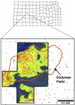
Lineaments, which cannot be seen using
conventional 3-D seismic attributes, have been interpreted on a maximum
negative curvature map extracted along a continuous, high amplitude
seismic reflection approximately 25 ms below the Mississippian
unconformity on the Dickman seismic survey (Figure 2a). Rose diagrams of
the interpreted lineaments (Figures 2b and 2c) show two main
orientations -- northeast and northwest. Although the number of
lineaments interpreted with northeasterly and northwesterly trends is
approximately equal (Figure 2b), the northeast-trending lineaments have
greater length and continuity than the northwest-trending lineaments
(Figure 2c). The northeasterly lineament trend parallels a
down-to-the-north normal fault at the northwest corner of the seismic
survey.
The lineaments were compared to geologic and
production data to determine if a relationship can be identified with
shale-filled fractures, which could be barriers to fluid flow, or open
fractures, which could serve as water conduits.
Evidence for the presence of shale-filled
fractures at the top of the Mississippian is found in a horizontal well
from central Ness County, KS, approximately 8 miles from the Dickman
Field study area (Carr et al., 2000). In this well, numerous
near-vertical shale intervals were identified along the lateral length
of the well. These intervals were interpreted as solution-enhanced
fractures extending down from the karst surface at the top of
Mississippian that have been filled by Pennsylvanian shale of the
Cherokee Formation (Carr et al., 2000). Since there are no horizontal
wells in Dickman Field, indirect evidence was used here to infer the
presence of shale-filled fractures. Fractures that were
solution-enhanced by post-Mississippian karst and remained open during
the Pennsylvanian are likely to have been filled by both Pennsylvanian
shale and weathered Mississippian debris. Therefore, it is assumed that
locations with evidence of a thicker section of weathered Mississippian
material at the base of the Pennsylvanian (subsequently referred to as
the “karst zone”) are related to shale-filled fractures. For the
purposes of this study, the karst zone in a well was defined as the
interval between the highest occurrence of the basal chert conglomerate
in the Pennsylvanian section (chert weathered from the Mississippian)
and the top of the un-weathered Mississippian.
In order to determine whether the shale-filled
fractures are preferentially related to either of the two dominant
lineament trends (i.e., was one particular fracture direction open and
preferentially solution-enhanced during karst formation?), crossplots
were created of the thickness of the karst zone versus the distance to
the nearest northeast- and northwest-trending lineaments (Figure 3).
These crossplots show that there is no apparent relationship between the
thickness of the karst zone and the northwest-trending lineaments;
however, there is an increase in the thickness of the karst zone within
approximately 50 ft of the northeast-trending lineaments. The
relationship between the thickness of the karst zone and distance to the
northeast-trending lineament suggests that interpreted
northeast-trending lineaments are likely to represent fractures, which
were preferentially solution-enhanced during karst formation and
subsequently filled with shale. Since some of the northeast-trending
lineaments have interpreted lengths in excess of 0.5 mile, they may
provide significant barriers to fluid flow in the northwest-southeast
direction.
The relationship between the interpreted
lineaments and fluid flow also was investigated by examining the spatial
variability of fluid production from the wells in Dickman Field in
relation to lineament proximity. In order to evaluate whether there is a
link between oil production and lineament orientation, oil production
was crossplotted against the distance to the nearest northeast- and
northwest-trending lineaments (Figures 4b and 4c). The crossplots
indicate that there is no identifiable relationship between oil
production and the northwest-trending lineaments, but there does appear
to be an overall increase in oil production away from the
northeast-trending lineaments. This suggests that oil production is
inhibited in proximity to the northeast-trending lineaments where there
may be a higher concentration of shale-filled fractures.
Water production from the wells in Dickman
Field may be related to open fractures that extend into the underlying
Mississippian aquifer. In order to evaluate whether open fractures are
preferentially linked to lineament orientation, water production was
crossplotted against the distance to the nearest northeast- and
northwest-trending lineaments (Figures 5b and 5c). The crossplots
indicate that there is no relationship between water production and the
northeast-trending lineaments but there is increased water production
with closer proximity the northwest-trending lineaments. A power law
function provides a good fit to this relationship. These results suggest
that the northwest-trending lineaments represent fractures, which serve
as conduits to the aquifer.
3-D seismic volumetric curvature attributes
highlight subtle fracture-related lineaments that cannot be identified
by other methods. In Dickman Field, 3-D seismic volumetric curvature
attributes reveal two main lineament orientations, northeast and
northwest. Integration of attribute and well information allows the
nature of the fractures (fluid conduits vs. fluid barriers) to be
inferred. Northeast-trending lineaments appear to represent shale-filled
fractures, which are barriers to fluid flow, while northwest-trending
lineaments appear to represent open fractures, which serve as conduits
into the aquifer. Understanding the orientations of open and filled
fractures in mature Mid-Continent Mississippian reservoirs is an
important prerequisite for effectively using techniques such as targeted
infill drilling, horizontal drilling, and gel polymer treatments to
enhance production.
Al-Dossary, S., and K. J.
Marfurt, 2005, 3-D volumetric multispectral estimates of reflector
curvature and rotation: Submitted to Geophysics.
Blumentritt, C., K. J. Marfurt,
and E. C. Sullivan, 2003, Application of seismic attributes to the study
of poly-phase deformation on the Central Basin Platform of West Texas
(abs.): Geological Society of America Abstracts with Programs, v.35,
no.6, p.152-153.
Blumentritt, C., K. J. Marfurt,
and E. C. Sullivan, 2005, Volume-based curvature computations illuminate
fracture orientations, Lower-Mid Paleozoic, Central Basin Platform, West
Texas: Geophysics (in press).
Carr, T. R., S. Bhattacharya,
and R. Pancake, 2000, Horizontal drilling in Kansas: A case history:
http://www.kgs.ku.edu/Workshops/Horz2000/R640/, posted March 7,
2005.
Serrano, I., A. Lacazette, C.
Blumentritt, E. C. Sullivan, K. J. Marfurt, and M. Murphy, 2003,
Unraveling structural development and fracture distribution at
Dollarhide Field, West Texas with new seismic attribute images (abs.):
Geological Society of America Abstracts with Programs, v.35, no.6,
p.177.
Sullivan, E. C., K. J. Marfurt,
J. Famini, and D. Pankhurst, 2003, Multi-trace seismic attributes
illuminate Permian mass wasting features and processes (abs.):
Geological Society of America Abstracts with Programs, v.35, no.6,
p.110.
Sullivan, E. C., K. J. Marfurt,
A. Lacazette, and M. Ammerman, 2005, Application of new seismic
attributes to collapse chimneys in the Fort Worth Basin: Submitted to
Geophysics.
The authors would like to thank Grand Mesa Operating Company for
providing seismic and well data, Seismic Micro-Technology, Inc. for
access to The KINGDOM Suite+ software, and GeoPLUS Corporation for
access to PETRA software. Rose diagrams were constructed with GEOrient
software, courtesy of Dr. R. J. Holcombe, University of Queensland (http://www.holcombe.net.au/software/).
Funding for this work was provided by the U. S. Department of Energy. Micro-Technology, Inc. for
access to The KINGDOM Suite+ software, and GeoPLUS Corporation for
access to PETRA software. Rose diagrams were constructed with GEOrient
software, courtesy of Dr. R. J. Holcombe, University of Queensland (http://www.holcombe.net.au/software/).
Funding for this work was provided by the U. S. Department of Energy.
Return to top.
|

 Print this page
 Click
to article in PDF format.
Click
to article in PDF format.