Print this page
 Click to view article in PDF format.
Thermal Models for Post-Glacial Evolution of the Gas Hydrate Stability Zone: Storegga Slide, Norwegian Margin*
By
Woo-Yeol Jung1 and Peter R. Vogt1
Search and Discovery Article #40108 (2004)
*Adapted from “extended abstract” for presentation at the AAPG Annual Meeting, Salt Lake City, Utah, May 11-14, 2003.
1Naval Research Laboratory, Washington, DC
Focusing on the
Storegga slide area, Norwegian margin, we modeled the evolution of the gas
hydrate stability zone (GHSZ) by combining the effects of post-glacial
bottom-water warming and sea-level rise (SLR), and including the latent heat of
GH formation/dissociation. The delayed onset and downward diffusing of bottom
water warmth above 800m water depths explains why the Storegga and other slides
did not occur until the early to mid-Holocene, if GH dissociation was a factor.
Intersections between the base of the GHSZ and the slide base suggest points of
slide initiation--below the upper slope or the shelf, where GH could have formed
AFTER the Low Glacial Maximum (LGM), but BEFORE the 8.15ka failure. We
quantified the sudden thinning  pressure
 -drop induced by SLR and subsequent
‘‘thermal’’ rethickening of the GHSZ within the slide scar. Different SLR curve
and pore water compositions were tried to test model sensitivities. At water
depths below ca. 800m, persistent cold water allowed the SLR to thicken the GHSZ
over time, ruling out post-LGM deepwater GH dissociation-induced initiation of
failure. The calculated modern GHSZ thickness increases from zero at 400m water
depth to 160m at 1200m, and its base agrees well with published bottom
simulating reflector (BSR) depths revealed by seismic data. Mass wasting on
upper continental slopes may have been triggered in many mid- to high-latitude
seas because the effect of post-Glacial ocean warming on GH stability overcame
the gas hydrate-stabilizing effects of SLR. In any event, gas hydrate
dissociation by Holocene mass wasting cannot have initiated deglaciation.
-drop induced by SLR and subsequent
‘‘thermal’’ rethickening of the GHSZ within the slide scar. Different SLR curve
and pore water compositions were tried to test model sensitivities. At water
depths below ca. 800m, persistent cold water allowed the SLR to thicken the GHSZ
over time, ruling out post-LGM deepwater GH dissociation-induced initiation of
failure. The calculated modern GHSZ thickness increases from zero at 400m water
depth to 160m at 1200m, and its base agrees well with published bottom
simulating reflector (BSR) depths revealed by seismic data. Mass wasting on
upper continental slopes may have been triggered in many mid- to high-latitude
seas because the effect of post-Glacial ocean warming on GH stability overcame
the gas hydrate-stabilizing effects of SLR. In any event, gas hydrate
dissociation by Holocene mass wasting cannot have initiated deglaciation.
|
|
Researchers have suggested that the occurrence of submarine landslides
over continental margins must have been triggered by the dissociation of
GH associated with the reduced
In this paper, we propose that Holocene sliding is not inconsistent with
GH dissociation as a trigger for mass wasting--but as a consequence,
rather than a cause, of deglaciation. We test the hypothesis that
sliding was delayed into the early Holocene by modeling the time it took
for late glacial or early post-glacial warming to penetrate to the base
of the GH stability zone. Our models take into consideration time
variations of both The concentration of GH in sediments is highly variable and not well known, so we calculated the latent heat effect based on typical hydrate-infested sediment: 55% porosity, and 50% of pore space occupied by GH (Booth et al., 1998). In and below the zones of GH formation or dissociation, latent heat will cause temperature changes to be slower than calculated - depending on the amount of GH actually present and the diffusivity of sediments surrounding the dissociation (or forming) gas hydrates. Vogt and Jung (2002) ignored latent heat effects; thus approximating the "end member" situation of little GH. However, only a very thin, thermally insignificant layer of GH dissociation may suffice to reduce shear strength and trigger sediment failure. The GHSZ does not necessarily contain gas hydrate. Although GH is stable in deeper water, any GH released into the water column would rise buoyantly to the ocean surface, losing methane to solution and oxidation on the way. Within the upper sediments, sulfate in downward circulating seawater would oxidize any methane (Borowski et al., 1999). Based on seismic results near the Storegga slide (Posewang and Mienert, 1999), we take this zone to be 115m thick in the area represented by our models.
We used the eustatic sealevel curve of Fairbanks (1989) to calculate the
time-dependent component of lithostatic The precise time variation of bottom water temperature in the slide areas is not well known. Based on the paleoceanographic reconstructions of Miller et al. (2001), we place the earliest possible time of emplacement of near-modern water temperatures at 15 ka, and we calculated models (not shown) based on this date. However, we consider the end of the Younger Dryas (11 ka) as the most probable time of significant warming and use this date here. We assume a modern-like (historical) water temperature structure was applied to the seafloor instantaneously at 11 ka. However, the subbottom temperature history several millennia later is not very sensitive to the exact times and rates of water warming. We assumed a constant -1oC for the glacial-age ocean prior to warming. The equilibrium function (phase boundary in P, T space) for hydrate depends on pore water composition (Sloan, 1998). Admixtures of heavier hydrocarbons tend to increase the range of stability, whereas pore water brackishness has the opposite effect. Our models were calculated for fresh water with no higher hydrocarbons, and with 1% and 2% ethane. We also explored the case of pore water with seawater salinity. Posewang and Mienert (1999) found that seawater and 1% ethane predicted a good fit to the lower BSR (Bottom Simulating Reflector) they detected north of the Storegga Slide, in 1000 m water.
Regional heatflow averages ca. 40-60 mW/m2 in both slide
areas (Sundvor et al., 2000). Typical conductivities in the top few
meters of sediment are ca. 1.29 W/m-oK for the Storegga area.
There are few thermal data from the continental shelves bounding the
slide headwalls. Posewang and Mienert (1999) used a
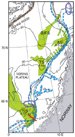
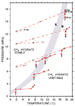
Our models predict how the GHSZ must have changed during the last 18,000 years in the area of the great Storegga slide. We show this change in two ways: Figure 2 shows conditions at various times along the red line (Figure 1) across the upper slide scar. Figure 3 shows how selected parcels of sediment (numbered in Figure 2) moved in P-T space.
During the greatest extent of glaciation (18ka), sea level, and hence
subbottom
While we did not try to model the transient slide event, we know it
stripped off most of the hydrate stability zone (8.15ka-), which then
rethickened as the warm subbottom exposed by the slide was cooled by the
overlying water. Some authors have suggested that reduced post-slide
The solid red tracks in Figure 3 illustrate how shallower sediment
parcels (1, 2, 4, 5) first moved upwards towards hydrate stability as
sea levels rose, and then veered back out towards instability due to
post-11ka warming. Deep parcels (e.g., 7) were unaffected by warming,
while other parcels (e.g., 3, 6) never approached the stability field,
except in the slide scar, where they were abruptly jerked towards lower
Our models suggest the Storegga slide removed and/or re-deposited all
sediment within the pre-slide GHSZ, except at water depths exceeding ca.
1350 m. At depths greater than this, GH remained below the slide sole,
but was abruptly moved out of its stability field by the slide-generated
Booth, J.S., W.J. Winters, W.P. Dillon, M.B. Clennell, and M.M. Rowe, 1998, Major occurrences and reservoir concepts of marine clathrate hydrates: Implications of field evidence, in J.-P. Henriet and J. Mienert, eds., Gas Hydrates: Relevance to World Margin Stability and Climate Change: Geol. Soc., London, Spec. Pub.137, p. 113-127. Borowski, W.S., C.K. Paull, and W. Ussler III, 1999, Global and local variations of interstitial sulfate gradients in deep water continental margin sediments: Sensitivity to underlying methane and gas hydrates, Marine Geology, v. 159, p. 131-154. Bugge, T., R.H. Belderson, and N.H. Kenyon, 1988, The Storegga slide: Phil. Trans. R. London A, v. 325, p. 357-388. Carlslaw, H.S., and J.C. Jaeger, 1959, Conduction of heat in solids, 2nd edition: Oxford Univ. Press, Oxford, 510 p. Fairbanks, R.G., 1989, A 17,000-year glacio-eustatic sea level record--influence of glacial melting rates on the Younger Dryas event and deep-sea circulation, Nature, v. 342, p. 637-642. Haflidason, H., H.P. Sejrup, P. Bryn, and R. Lien, 2001, The Storegga slide: Chronology and flow mechanism (abs.): EUG XI Symposium RCM4, Continental slope stability (COSTA) of ocean basins--Achievements and challenges, Strassburg, France, p. 740. Kennett, J.P., K.G. Cannariato, I.L. Hendy, and R.J. Behl, 2003, Methane hydrates in Quaternary climate change: Amer. Geophys. Union, Washington, DC 216 p. Miller, G.H., A. Geirsdottir, and R. M. Koerner, 2001, Climate implications of changing Arctic sea ice, Eos, v. 82, p. 97,103. Posewang, J., and J. Mienert, 1999, The enigma of double BSRs: Indicators for changes in the hydrate stability field?: Geo-Marine Lett., v.19, p. 157-163. Sloan, E.D., Jr., 1998, Physical/chemical properties of gas hydrates and applications to world margin stability and climatic change, in J.-P. Henriet and J. Mienert, eds.,Gas Hydrates: Relevance to World Margin Stability and Climatic Change: Geol. Soc. London Spec. Pub. v. 137, p. 31-50. Sundvor, E., O. Eldholm, T.P. Gladczenko, and S. Planke, 2000, Norwegian-Greenland Sea thermal field, in A. Noettvedt et al., eds., Dynamics of the Norwegian Margin: Geol. Soc. London, p. 397-410. Villinger, H., and E.E. Davis, 1987, A new reduction algorithm for marine heat flow measurements: Jour. Geophys. Res., v. 92, p. 12,846-12,856. Vogt, P.R., and W-Y. Jung, 2002, Holocene mass wasting on upper non-Polar continental slopes-due to post-Glacial ocean warming and hydrate dissociation?: Geophys. Res. Lett., v. 29 no. 9, p.55-1 to 55-4. |