
 Print this page
Click to view posters in PDF
PS Play
Play Analysis and Digital Portfolio of Major Oil Reservoirs in the Permian Basin: New
Mexico*
Analysis and Digital Portfolio of Major Oil Reservoirs in the Permian Basin: New
Mexico*
By
Ronald F. Broadhead1, William D. Raatz2, Shirley P. Dutton3, and Eugene M. Kim3
Search and Discovery Article #10065 (2004)
*In conjunction with: U.S. Department of Energy. Adapted from poster presentation at AAPG Annual Meeting, Dallas, Texas, April 18-21, 2004.
1New
Mexico Bureau of Geology and Mineral Resources, a division of New Mexico Tech,
Socorro, NM 87801 ([email protected])
2New
Mexico Bureau of Geology and Mineral Resources; present address: OxyPermian,
Houston, TX
3Bureau
of Economic Geology, University of Texas at Austin, Austin, TX 78713
Abstract
Approximately 300 reservoirs in the New Mexico part of the Permian Basin have cumulative production of more than 1 MMBO, with a combined production of 4.5 billion bbls oil as of 2000. Reservoirs with 1 MMBO cumulative production have been grouped into 17 plays based on geologic parameters, including reservoir stratigraphy, lithology, depositional environment, tectonic setting, and trapping mechanism. The 10 Permian plays have a cumulative production of 3501 MMBO. The two Pennsylvanian plays have a cumulative production of 424 MMBO. Three Siluro-Devonian plays have a cumulative production of 440 MMBO. The two Ordovician plays have a cumulative production of 86 MMBO. Four New Mexico plays are selected for detailed discussion based on favorable production trends, potential for significant bypassed pay, possibilities for enhanced production, or rethinking of exploration concepts that may result in rethinking of exploration, development, and production strategies.
The Delaware
Mountain Group Basinal Sandstone Play has 155 reservoirs in New Mexico, 33 with
more than 1 MMBO cumulative production. These 33 reservoirs have produced a
cumulative total of 112 MMBO. Production from the New Mexico part of this play
peaked in the mid-1990's at more than 7 MMBO per year. Reservoirs are deep-water
submarine fan sandstones. Primary production via solution gas drive declines
quickly as reservoir pressure is depleted. Pressure maintenance, and water
flooding in selected cases, may prevent premature abandonment and increase
ultimate recovery by more than 50 percent.
The Upper San
Andres and Grayburg Platform Artesia Vacuum Trend Play contains 13 reservoirs
with more than 1 MMBO production. These 13 reservoirs have produced a cumulative
total of 796 MMBO. Although much of this production has historically been from
vugular porosity in carbonates of the upper San Andres Formation, significant
reserves remain that may be produced by horizontal drilling to tap underproduced
reservoir compartments in established San Andres reservoirs as well as targeting
bypassed, behind-pipe pay within the less permeable sandstone of the Grayburg
Formation.
The Leonard
Restricted Platform Carbonate Play has 34 reservoirs with production exceeding 1
MMBO. Cumulative production from these reservoirs is 431 MMBO. Reservoirs
consist of limestones and dolostones deposited on a restricted carbonate
platform; associated platform sandstones are also productive. Traps are formed
by wide, low-relief anticlines. Uneven pay distribution across structures and
strata-limited fracture systems have compartmentailzed reservoirs and resulted
in bypassed pay that may be tapped through horizontal drilling.
The Northwest Shelf
Upper Pennsylvanian Carbonate Play has been productive from 197 reservoirs, 34
of which have produced more than 1 MMBO. These 34 reservoirs have produced a
combined 354 MMBO. Reservoirs consist of algal mounds and associated carbonate
sands. Trapping mechanisms are largely stratigraphic. Historically, the largest
reservoirs in this play yielded significant production (>10 MMBO cumulative)
only decades after initial discovery. Initial development was often predicated
on the presumption of structural entrapment of oil. Redevelopment proved
entrapment is stratigraphic, resulting in an increase in the productive area and
production rates, turning seemingly minor reservoirs into major ones.
Rediscovery of the Dagger Draw reservoir in the 1990's increased production by
more than one-hundredfold and resulted in an annual production rate of more than
10 MMBO during 1996.
|
uDelaware
Mountain Sandstone
uUpper
San Andres/Grayburg
uDelaware
Mountain Sandstone
uUpper
San Andres/Grayburg
uDelaware
Mountain Sandstone
uUpper
San Andres/Grayburg
uDelaware
Mountain Sandstone
uUpper
San Andres/Grayburg
uDelaware
Mountain Sandstone
uUpper
San Andres/Grayburg
uDelaware
Mountain Sandstone
uUpper
San Andres/Grayburg
uDelaware
Mountain Sandstone
uUpper
San Andres/Grayburg
uDelaware
Mountain Sandstone
uUpper
San Andres/Grayburg
uDelaware
Mountain Sandstone
uUpper
San Andres/Grayburg
uDelaware
Mountain Sandstone
uUpper
San Andres/Grayburg
uDelaware
Mountain Sandstone
uUpper
San Andres/Grayburg
|
Figures Captions (1.1-1.7)
About the ProjectThis
article summarizes the New Mexico part of our work developing a
Guadalupian (Upper Permian) Plays(Figures 1.1, 1.2, 1.3, 1.4, and 1.5)
Wolfcampian and Leonardian (Lower Permian) Plays(Figures 1.1, 1.2, 1.3, and 1.6)
Pennsylvanian Plays(Figures 1.1, 1.2, 1.3, and 1.7)
Ordovician, Silurian and Devonian Plays
Emphasized PlaysFour New Mexico plays have been selected for in-depth discussion and analysis in this article: These plays were selected based on favorable production trends, potential for significant future growth through either new or improved primary or secondary production, or newly applied geologic and/or engineering concepts that may result in rethinking of exploration, development, and production strategies.
Delaware
Mountain Group Basinal Sandstone
|

|
|
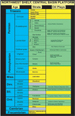
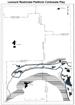
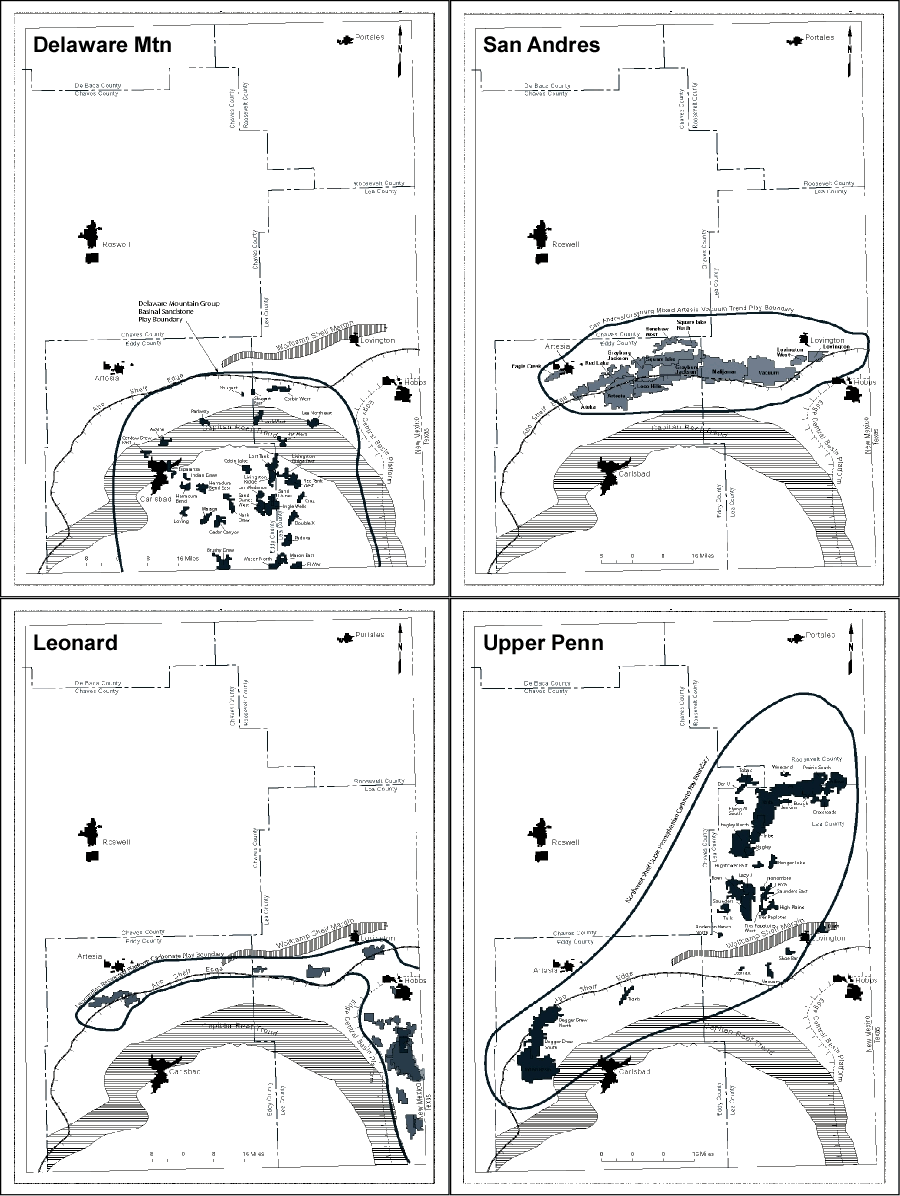
Figure 2.1. Reservoirs with > 1 MMBO
cumulative production in the Delaware Mountain Group Basinal
Sandstone |
|
|
|
|
|
|
|
|
|
|
|
|
|
|
|
|
|




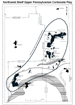
Reservoirs
in the Delaware Mountain Group Basinal Sandstone Play lie within the
Delaware Basin and stretch from the northern part of the basin in Eddy
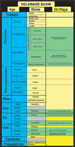
and Lea Counties south into Texas (Figure 2.1). Production is from
submarine fan sandstones in the Bell Canyon, Cherry Canyon, and Brushy
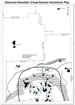
Canyon Formations (Figure 2.2). Traps are mostly stratigraphic and
formed by submarine fan sandstones deposited in channels and on fan
lobes (Figure 2.3). There are 155 known, discovered Delaware Mountain
reservoirs in New Mexico, 33 of which have produced > 1 MMBO. Cumulative
production from these 33 reservoirs was 112 MMBO as of 2000.
Production is obtained from all 3 formations in the Delaware Mountain Group - Bell Canyon, Cherry Canyon and Brushy Canyon (Figure 2.2). Most Bell Canyon reservoirs were found before 1970. Most Cherry Canyon reservoirs were found after 1970. Most Brushy Canyon reservoirs were found in the 1980's and 1990's.
Production
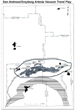
from this play has been declining over the past decade as primary
production declines within existing reservoirs (Figure 2.4). Currently,
most production is obtained from Brushy Canyon reservoirs discovered in
the mid-1980's to early 1990's with many earlier found Bell Canyon
reservoirs nearing depletion. The increase in production during the late
1980's and early 1990's was a result of discovery of numerous Brushy
Canyon reservoirs.
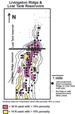
Figure 2.5 shows the decline in oil production from the average well in the Livingston Ridge Brushy Canyon reservoir from more than 3000 bbls/month after completion to less than 500 bbls/month 5 years (60 months) after well completion. Steep production declines result from early pressure depletion in these solution gas drive reservoirs. If the minimum economic production rate is considered to be 3 BOPD, then a typical Livingston Ridge reservoir may recover 91 MBO over a productive life of 108 months.
Injection of water for pressure maintenance by Phillips Petroleum at the Cabin Lake reservoir resulted in increased oil production from existing wells (Figure 2.6). Pressure maintenance in these solution gas drive pools should take place before a secondary gas cap is formed and may prevent premature well abandonment that can result from low production rates that accompany pressure and gas depletion. Pressure maintenance has similar effect at the Nash Draw reservoir (M. Murphy, personal communication, 2003).
Although the less permeable and more heterogeneous Delaware reservoirs may not be suitable for waterflooding, this EOR technique can have startling success in proximal Cherry Canyon and Brushy Canyon reservoirs. In the Indian Draw Cherry Canyon reservoir, discovered in 1973, an estimated 1.9 MMBO could be recovered by primary production and an additional 1.6 MMBO, or 81% of primary production, will be recovered as a result of waterflood operations (Figure 2.7). Waterflooding this reservoir will therefore prevent premature well and reservoir abandonment and will result in recovery of significant oil resources.
Upper San Andres and Grayburg Platform - Artesia Vacuum Trend Play
Figure Captions (3.1-3.7)
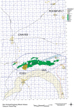


Play Geology
The Upper
San Andres and Grayburg Platform - Artesia Vacuum Trend Play extends
between the cities of Artesia and Hobbs in Eddy and Lea counties along
the Artesia-Vacuum arch. The play has 13 reservoirs with > 1 MMBO
cumulative production (Figure 3.1). Cumulative production from these 13
reservoirs was 796 MMBO as of 2000. Production is obtained from both the
San Andres Formation and the overlying Grayburg Formation; their
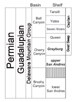
stratigraphic positions are illustrated in Figure 3.2.
The upper San Andres Formation was deposited on a restricted carbonate shelf and is a backreef deposit composed of dolowackestones, dolopacktones, and dolograinstones. It is composed of high-frequency, upward-shoaling carbonate depositional cycles capped by low-permeability peritidal facies that vertically compartmentalize the reservoir (e.g., Purves, 1986; Modica and Dorobek, 1996; Handford et al., 1996; Stoudt and Raines, 2001; Pranter et al., 2004). Reservoir facies lie between the Guadalupian shelf margin to the south and tight evaporites and dolostones of the inner shelf to the north. In some reservoirs, there is significant permeability and porosity enhancement associated with unconformities and subaerial exposure diagenesis (karsting; Hovorka et al., 1993). In other reservoirs such as Vacuum, karstification has acted to further compartmentalize reservoirs horizontally as well as vertically through development of karst pore systems and subsequent filling of karst pore systems with impermeable sandstones, collapsed carbonates and evaporites (Stoudt and Raines, 2001; Pranter et al., 2004). High-angle, low-displacement (<25 ft) faults have also acted to horizontally compartmentalize reservoirs (Pranter et al., 2004). This vertical and horizontal compartmentalization makes development of reservoirs incomplete with vertical wells drilled on standard 40-acre spacing. The Vacuum reservoir has responded favorably to CO2 flooding. Horizontal laterals have demonstrated the ability to produce bypassed, unswept, and banked oil.
The Grayburg Formation consists of interbedded sandstones, siltstones, and dolomitic carbonates (Handford et al., 1996; Modica and Dorobek, 1996). The sandstones are the main Grayburg reservoirs and were deposited in coastal sabka, sandflat, and eolian environments. Carbonates are generallly impermeable subtidal deposits. Substantial pay may remain behind pipe in Grayburg sandstones.
The
Artesia-Vacuum arch is a shallow structure that overlies the deeper Abo
shelf edge reef trend and Bone Spring flexure. Reservoir position with
respect to the crest of the arch determines whether the San Andres or
the Grayburg dominates production in any given field. The fields located
in structurally higher positions will have substantial production from
the Grayburg as well as the underlying San Andres. Fields occupying a
structural position lower on the arch tend to be productive mostly from
the Grayburg with the underlying San Andres mostly wet. The regional
vertical seals are impermeable facies in the upper Grayburg and Queen
Formations.
Annual
production from 1970 to 2000 for the 13 reservoirs within the Upper San
Andres and Grayburg Platform - Artesia Vacuum Trend Play that have
produced more than 1 MMBO is shown in Figure 3.3. The significant
increase in production during the mid-1980's was caused by
implementation of waterflood/pressure maintenance projects in the Vacuum
reservoir.
Figure 3.4, which plots annual oil production and number of injection wells in the Vacuum reservoir, shows the response of reservoirs to pressure maintenance/waterflooding in the 1980's. Small-displacement normal faults, along with depositional cycles, and sediment- and evaporite-filled karst pore systems have compartmentalized the San Andres in the Vacuum reservoir, leaving behind banked and unswept oil. Two laterals drilled by Texaco from an existing vertical well resulted in a substantial increase in production from a single well (Figure 3.5). The upturn in production from the Grayburg Jackson reservoir during the mid-1990's is due in large part to recompletions in previously bypassed pay of the Grayburg Formation (B. Brister, personal communication, 2003; Figure 3.6). Production history of three wells in Burnett Oil Company lease in Grayburg Jackson reservoir indicates a substantial increase in production due to recompletion of San Andres wells to behind-pipe pay in Grayburg sandstones (Figure 3.7).
Leonard
Restricted Platform Carbonate Play

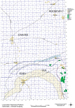



Reservoirs
in the Leonard Restricted Platform Carbonate Play lie on the Northwest
Shelf of the Permian Basin and on the Central Basin Platform. On the
Northwest Shelf, the play extends along a curvilinear trend near the
shelf margin and extends east into Texas. On the Central Basin Platform,
the play extends along a trend on the western edge of the platform and
south into Texas. Reservoirs are mostly dolostones and limestones in the
Yeso Formation (Permian: Leonardian), but Yeso sandstones are productive
in some reservoirs. Reservoir strata were deposited on a restricted
carbonate platform and a variety of depositional facies are present.
Traps are generally formed by low-relief anticlines. Facies variations
in reservoir strata create porosity pinchouts on anticlinal noses as
well as uneveness in reservoir quality across a structure, resulting in
compartmentalization of some reservoirs. A single structure may yield
productive pay in multiple zones. There are 102 known discovered
reservoirs in the New Mexico portion of this play, 34 of which have
produced more than 1 MMBO. Cumulative production from these 34
reservoirs was 431 MMBO as of 2000.
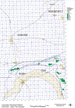
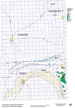
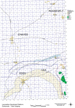
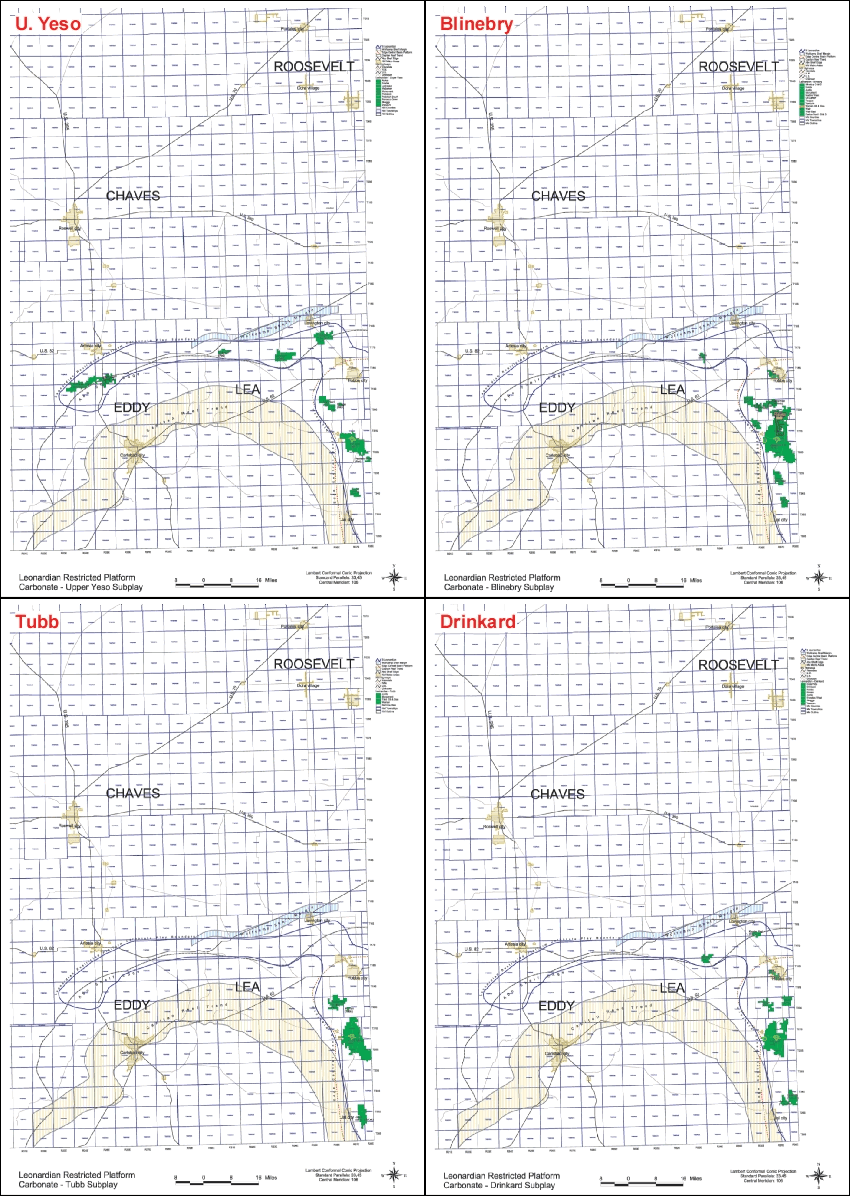
In New Mexico four subplays (Figure 4.1) are defined by the stratigraphic unit or units from which production is obtained within a reservoir:
1. Upper Yeso subplay (Glorieta Formation & Paddock Member of Yeso Formation) (Figure 4.2)
2. Blinebry subplay (Blinebry Member of Yeso Formation) (Figure 4.3)
3. Tubb subplay (Tubb Member of Yeso Fm.) (Figure 4.4)
4. Drinkard subplay (Drinkard Member of Yeso Formation) (Figure 4.5)
Production
from this play has been in decline over the past 30 years as the large
reservoirs, mostly discovered before 1965, were depleted (Figure 4.6).
The increase in total production from this play during the early 1990's
was a result of waterflooding and increased production in the Blinebry,
Dollarhide, Vacuum, and Warren reservoirs.
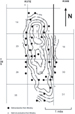
Figure 4.7
is a structure contour map of the Blinebry Member at the Justis Blinebry
reservoir, showing a typical trap in this play, formed by a low-relief
anticline. One structure will typically form traps in multiple pay zones
within multiple members of the Leonardian Yeso Formation.
The best reservoir strata are not blanket or sheet deposits that cover an entire trap-forming anticline. The block diagram of depositional environments in the Paddock Member at the Vacuum reservoir, in Figure 4.8A, shows that the oolite barrier (which is the most prolifically productive facies) is not everywhere present. This type of facies distribution explains porosity trends in the Oil Center Blinebry reservoir, which are not evenly spread across the trap-forming structure (Figure 4.8B).
The Paddock reservoir at Vacuum Glorieta consists of interbedded and interfingering facies, some of which are more densely fractured than others. The Paddock was waterflooded at the Vacuum reservoir. Premature water breakthrough in fractured lower Paddock dolostones, left bypassed recoverable oil remaining in unfractured upper Paddock grainstones (Martin and Hickey, 2002). Texaco drilled 31 horizontal laterals off of existing vertical wells in the unfractured grainstones in an effort to produce unswept oil. Twenty-four laterals were used as production wells, and seven laterals were used as water injection wells. The result was a substantial increase in production (Figure 4.9) with an ultimate increase in recovery projected to be 2.6 MMBO.
Northwest Shelf Upper Pennsylvanian Carbonate Play
|
|
Figure 5.1. Reservoirs with > 1 MMBO cumulative production in the
Northwest Shelf Upper Pennsylvanian Carbonate |
|
|
|
|
|
|
|
|
Figure 5.4. Plot of annual production, Northwest Shelf, Upper
Pennsylvanian Carbonate |
|
|
|
|
|
|


Reservoirs
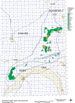
in the Northwest Shelf Upper Pennsylvanian Carbonate Play lie on the
Northwest Shelf of the Permian Basin. The play trend extends from the
shelf edge near Carlsbad in Eddy County to the shelf interior in Chaves
and Roosevelt counties. Reservoirs are limestones and dolostones of
Canyon (Upper Pennsylvanian:Missourian) and Cisco (Upper Pennsylvanian:
Virgilian) age. Traps are primarily stratigraphic and are formed by
phylloid algal mounds and associated grainstones and packstones (Cys,
1986; Speer, 1993; Mazzullo, 1998; Cox et al., 1998). Productive
porosity is primarily vugular, intercrystalline, and intergranular. Most
reservoirs in this play were initially discovered by drilling structures
or by testing shows encountered while drilling to deeper zones. There
are almost 400 known discovered reservoirs in this play, 200 of which
are currently nonproductive and 35 of which have produced more than 1
MMBO (Figure 5.1). Cumulative production from these 35 reservoirs was
354 MMBO as of 2000. Many of these reservoirs are characterized by high
water cuts; produced water volumes often exceed produced oil volumes.
Reservoirs
in this play are productive primarily from Canyon and Cisco strata of
Late Pennsylvanian age and from the Bough zones of earliest Wolfcampian
age (Figure 5.2). Depositional model for Upper Pennsylvanian algal mound
fairway for Dagger Draw South reservoir is shown in
Figure 5.3.
Production
from this play reached a peak in the 1990's as a result of redevelopment
of the Dagger Draw North and Dagger Draw South reservoirs and has been
declining since 1997 as redevelopment wells at Dagger Draw have begun to
enter depletion stages of the production cycle (Figure 5.4). The huge
decline in the early 1970's resulted from depletion of reservoirs
discovered and developed during the 1950's and 1960's.
The Baum
reservoir was discovered in 1955, but only minimal production was
obtained as wells were drilled on structural closures. This reservoir
saw a 1st phase of redevelopment in the late 1960's (Figure 5.5), and
production increased as new wells were drilled in previously
unrecognized parts of the reservoir and the stratigraphic nature of
entrapment became apparent. Production again spiked in the early 1980's
as yet another wave of wells was drilled in previously unrecognized
parts of the reservoir. Redevelopment brought into production 99% of the
oil reserves.
Upper
Pennsylvanian carbonate reservoirs in southeast New Mexico have
typically been discovered by drilling small seismically defined
anticlines. Initial development has generally been concentrated on the
crests of the structures, and in most of the larger reservoirs,
generally did not extend into offstructure areas. Subsequent drilling
generally proceeded in discrete phases, each with a corresponding
increase in production and reserves. The stratigraphic nature of
entrapment was often not recognized until most of the reservoir was
drilled out. Recognition of the stratigraphic nature of entrapment is
essential if the reservoir is to be drilled out efficiently and
completely in the years immediately following initial reservoir
discovery. Of the 400 reservoirs in this play, 84% have less than 10
producing wells, 57% have less than 3 wells, and almost 200 have no
productive wells, having never produced or having been abandoned. It is
likely that a number of small reservoirs that have been developed only
on structures are underdeveloped. Additional study of carbonate facies
is needed to fully delineate traps.
High water cuts often exceed produced oil volumes in a reservoir. Production under these circumstances may be feasible with the use of modern, downhole, high-volume pumps that can move large volumes of fluid economically, as is the case at Dagger Draw (Brent May, personal communication, 1998).
Most wells in the Dagger Draw North and Dagger Draw South reservoirs were drilled in the 1990's as a result of redevelopment (Figure 5.6). Initial reservoir discovery was in 1963. More than 90% of oil reserves have been brought into production as a result of redevelopment.
Acknowledgments
We thank
Dan Ferguson of DOE for his input, guidance, and support. We also
acknowledge our partners at the Bureau of Economic Geology: Cari Breton,
Steve Ruppel, Charlie Kerans, Jerry Lucia, and Mark Holtz. Brian Brister
of the New Mexico Bureau of Geology and Mineral Resources provided
insight into the San Andres/Grayburg Artesia Vacuum Trend reservoirs.
Mark Murphy of Strata Production Corporation provided helpful discussion
on pressure maintenance in Delaware Mountain Group Basinal Sandstone
reservoirs. Zhou Jianhua, a graduate student in computer science at New
Mexico Tech, did our GIS work. Irene Roselli, a New Mexico Tech
undergraduate student, energetically assembled reservoir production
data.
References
Broadhead, R.F., Luo, F., and Speer, S.W., 1998, Oil and gas resources at the Waste Isolation Pilot Plant (WIPP) site, Eddy County, New Mexico: New Mexico Bureau of Mines and Mineral Resources, Circular 206, p. 3-72.
Burnham, D.E., 1991, Depositional environments and facies distribution of the Permian Paddock member of the Yeso Formation, Vacuum (Glorieta) field, Lea County, New Mexico: M.S. thesis, The University of Texas of the Permian Basin, 140 p.
Cox, D.M., Brinton, L., and Tinker, S.W., 1998, Depositional facies and porosity development of an Upper Pennsylvanian algal mound reservoir, South Dagger Draw, Eddy County, New Mexico, in Winfree, K., ed., Cored reservoir examples from Upper Pennsylvanian and Lower Permian carbonate margins, slopes and basinal sandstones: West Texas Geological Society, Publication 98-103.
Cys., J.M., 1986, Lower Permian grainstone reservoirs, southern Tatum Basin, southeastern New Mexico, in Ahlen, J.L., and Hanson, M.E., eds., Southwest Section of AAPG Transactions and guidebook of 1986 convention, Ruidoso, New Mexico: New Mexico Bureau of Mines and Mineral Resources, p. 115-120.
Handford, C.R., Candelaria, M.P., and Lafollette, S., 1996, Accommodation cycles in peritidal carbonate and continental to shoreface siliciclastic facies, San Andres - Grayburg Formations, Eddy County, New Mexico, in Martin, R.L., ed., Permian Basin oil and gas fields: keys to success that unlock future reserves: West Texas Geological Society, Publication 96-101, p. 65-80.
Hovorka, S.D., Nance, H.S., and Kerans, C., 1993, Parasequence geometry as a control on permeability evolution: examples from the San Andres and Grayburg Formations in the Guadalupe Mountains, New Mexico, in Loucks, R.G., and Sarg, J.F., Carbonate sequence stratigraphy: AAPG Memoir 57, p. 493-514.
Kincheloe, D., and David, E.K., 1977, Oil Center Blinebry, in A symposium of the oil and gas fields of southeastern New Mexico, 1977 supplement: Roswell Geological Society, p. 142-143.
Marshall, L.R., and Foltz, G.A., 1960, Justis Blinebry, in A symposium of the oil and gas fields of southeastern New Mexico, 1960 supplement: Roswell Geological Sociey, p. 114-115.
Martin, R.L., and Hickey, K.F., 2002, Horizontal drilling at Vacuum Glorieta West unit, Lea County, New Mexico: a case history, in Hunt, T.J., and Lufholm, P.H., eds., The Permian Basin: preserving our past - securing our future: West Texas Geological Society, Publication 02-111, p. 117-124.
May, B.A., 1996, Geology and development history of the
Livingston Ridge and Lost Tank Delaware pools, southeastern New Mexico,
in DeMis, W.D., and Cole, A.G., eds., The Brushy Canyon play in
outcrop and subsurface: concepts and examples: Permian Basin Section
SEPM, Publication 96-38, p. 113-118.
Mazzullo, S.J., 1998, Depositional model and exploration strategies for the Cisco-Canyon (Upper Pennsylvanian) on the Northwest shelf, southeastern New Mexico, in DeMis, W.D., and Nelis, M.K., eds., The search continues into the 21st century: West Texas Geological Society, Publication 98-105, p. 31-40.
Modica, C.J., and Dorobek, S.L., 1996, High frequency sequence framework and effects of exposure events on porosity evolution and reservoir heterogeneity: Maljamar field, Lea County, southeast New Mexico, in Martin, R.L., ed., Permian Basin oil and gas fields: keys to success that unlock future reserves: West Texas Geological Society, Publication 96-101, p. 25-30.
Pranter, M.J., Hurley, N.F., Davis, T.L., Raines, M.A., and Wehner, S.C., 2004, Dual-lateral horizontal wells successfully target bypassed pay in the San Andres Formation, Vacuum field, New Mexico: AAPG Bulletin, v. 88, p. 99-113.
Purves, W.J., 1986, Depositional and diagenetic controls on porosity, upper San Andres Formation - Bridges State leases, Vacuum field, Lea County, New Mexico, in Bebout, D.G., and Harris, P.M., eds., Hydrocarbon reservoir studies, San Andres/Grayburg Formations, Permian Basin: Permian Basin Section SEPM, Publication 86-26, p. 49-53. Reddy, G., 1995, Dagger Draw South, in A symposium of oil and gas fields of southeastern New Mexico, 1995 supplement: Roswell Geological Society, p. 210-215.
Sheldon, V.P., 1956, Grayburg-Jackson field map:
Structural contours on top of red sand, in A symposium of oil and gas
fields of southeastern New Mexico: Roswell Geological Society, p. 188.
contours on top of red sand, in A symposium of oil and gas
fields of southeastern New Mexico: Roswell Geological Society, p. 188.
Speer, S.W., 1993, Upper Pennsylvanian, in Atlas of major Rocky Mountain gas reservoirs: New Mexico Bureau of Mines and Mineral Resources, p. 154-156.
Stoudt, E.L., and Raines, M.A., 2001, Reservoir compartmentalization in the San Andres Formation of Vacuum field, Lea County, New Mexico - peritidal deposits and karst overprints create vertical and lateral barriers to fluid flow on carbonate platform dolopackstones and dolograinstones (abstract): AAPG Bulletin, v. 85, p. 390.