Print this page
 Click to view article in PDF format.
GCHigh-Resolution Aeromagnetic (HRAM) Surveys: Exploration Applications from the Western Canada Sedimentary Basin -- Exploration in Highly Deformed Terrains Using Fixed-Wing Aircraft and Helicopter-Mounted Systems*
By
Zeev Berger1, Danny Fortin1, and Xiang Wang1
Search and Discovery Article #40123 (2004)
*Adapted from the Geophysical Corner columns in AAPG Explorer, November and December, 2003, entitled, respectively, “HRAM Overcoming Topography” and “Whirlybird Data Have Advantage,”and prepared by the authors. Appreciation is expressed to the authors, to R. Randy Ray, Chairman of the AAPG Geophysical Integration Committee, and to Larry Nation, AAPG Communications Director, for their support of this online version.
1Image Interpretation Technologies (IITech), Calgary, Canada.
Abstract
Typical high-resolution aeromagnetic (HRAM) data in the fold belt region of the Western Canada Sedimentary Basin (WCSB), acquired with fixed-wing aircrafts flying 125 meters above the ground, imaged deformed lithological units, allowing the recognition of key geological structures within the detached sedimentary section.
We also illustrate that an important contribution of HRAM surveys is the detection of reactivated basement faults, which either enhance the reservoir potential of rocks or result in the compartmentalization of certain hydrocarbon traps.
The quality of fixed-wing surveys might deteriorate in areas with rugged topography. Helicopter-mountain system has the advantage of increased resolution as well as the ability to perform draped surveys over rugged terrains.
|
uAbstractuFigure captionsuGeneral statementuHRAM data, WCSBuFort Norman areauColeman areauHelicopter-mounted system
uColeman
|
General StatementThe application of aeromagnetic data to hydrocarbon exploration has moved from primarily mapping basement structures and lithologies to imaging and mapping structures within the sedimentary section. High-resolution aeromagnetic (HRAM) surveys are now relatively inexpensive tools for 3-D mapping of faults and fracture systems propagating through hydrocarbon-bearing sedimentary levels.
Advances
in data acquisition techniques (enhancements in magnetometers,
compensation software/hardware for suppressing airplane noise,
positioning utilizing GPS systems, pre-planned drape surveys,
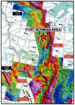
gradiometers measuring horizontal and vertical total Current industry standards view "high-resolution" aeromagnetic data as fixed-wing surveys with flight-line spacing of 400-800m and tie-lines every 1200-2400m, and with mean flight clearance of 100-125m. The Canadian petroleum industry has been receptive to the introduction of HRAM data as a tool for exploration. Consequently, a large volume of HRAM data has been collected over both mature and frontier portions of the Western Canada Sedimentary Basin (WCSB), including part of the highly deformed Canadian Fold Belt. HRAM Data In Western CanadaA portion of HRAM data collected in the WCSB is shown in Figure 1. The imagery represents an amalgamation of several different speculative HRAM surveys that were collected over the past decade by industry vendors and the Geological Survey of Canada (GSC). The area contains approximately one million line-kilometers of HRAM data (representing about a third of the total data collected in the entire basin), covering parts of the WCSB and Mackenzie Corridor. We focus first on the Canadian Fold Belt region because:
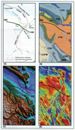
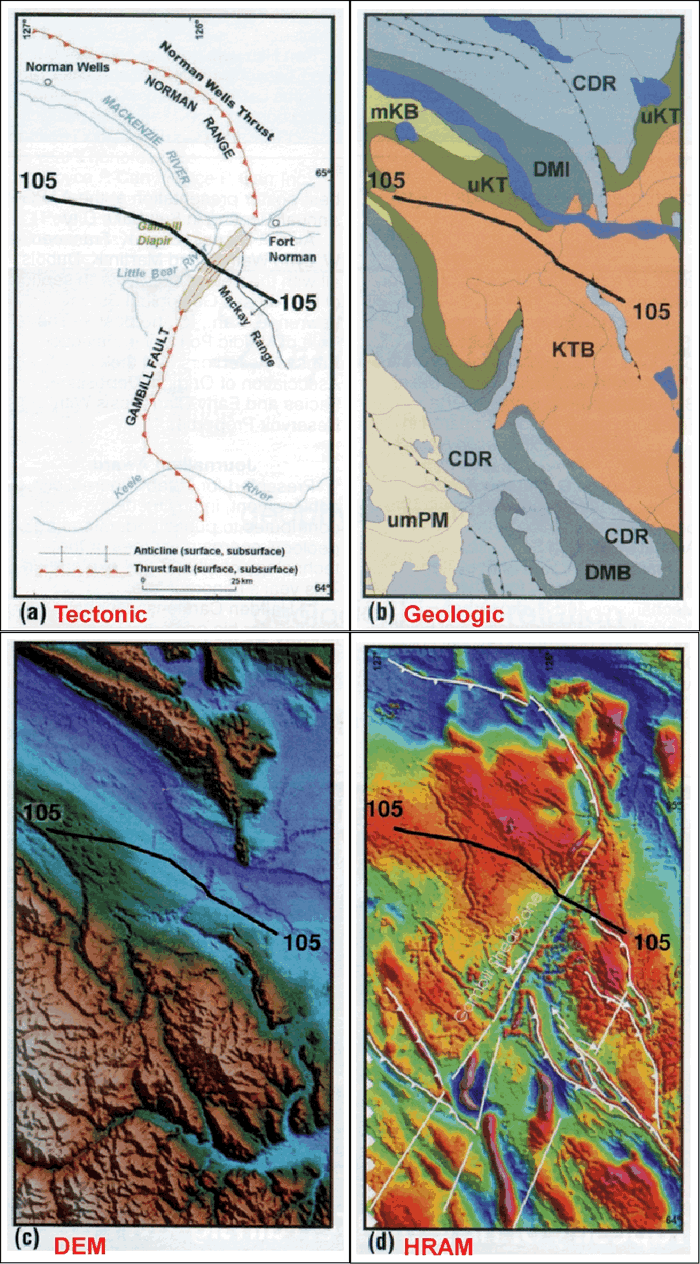
HRAM Mapping -- Fort Norman Area, Northwest TerritoriesIn 1998 the GSC began to collect a series of non-exclusive HRAM surveys along the Mackenzie Corridor. HRAM data was collected at 800m flight-line spacing and mean elevation of 125m above ground. One such survey was collected over the Fort Norman area, along a partially exposed portion of the Mackenzie Mountains thrust belt (Figure 2). In this area, the structural style of the fold belt is further complicated by the presence of a major northeast-trending tectonic element known as the Gambill Shear Zone (GSZ). Figure 2a illustrates that in the subsurface the Gambill Diapir acted as a transfer zone, linking the GSZ with the Norman Wells Thrust (MacLean and Cook, 1999). Geological mapping (Figure 2b) and the digital elevation model (Figure 2c) show that the structural features associated with these tectonic elements are only partially exposed at the surface. However, the HRAM data (Figure 2d) clearly demonstrate that the transfer zone reflects the presence of a complex shear element that exhibits basement-involved, right-lateral faulting, which resulted in a complex pattern of surface and near-surface anticlines.
In
addition, one can notice that the overall The block diagram shown in Figure 3 illustrates that the GSZ consists of high-angle wrench faults and a series of tight salt core anticlines that developed and wrapped around a structural high to the north. Strike-slip reactivation of northeast-trending basement faults may have triggered the development of salt diapir structures along this fault zone during Laramide deformation.
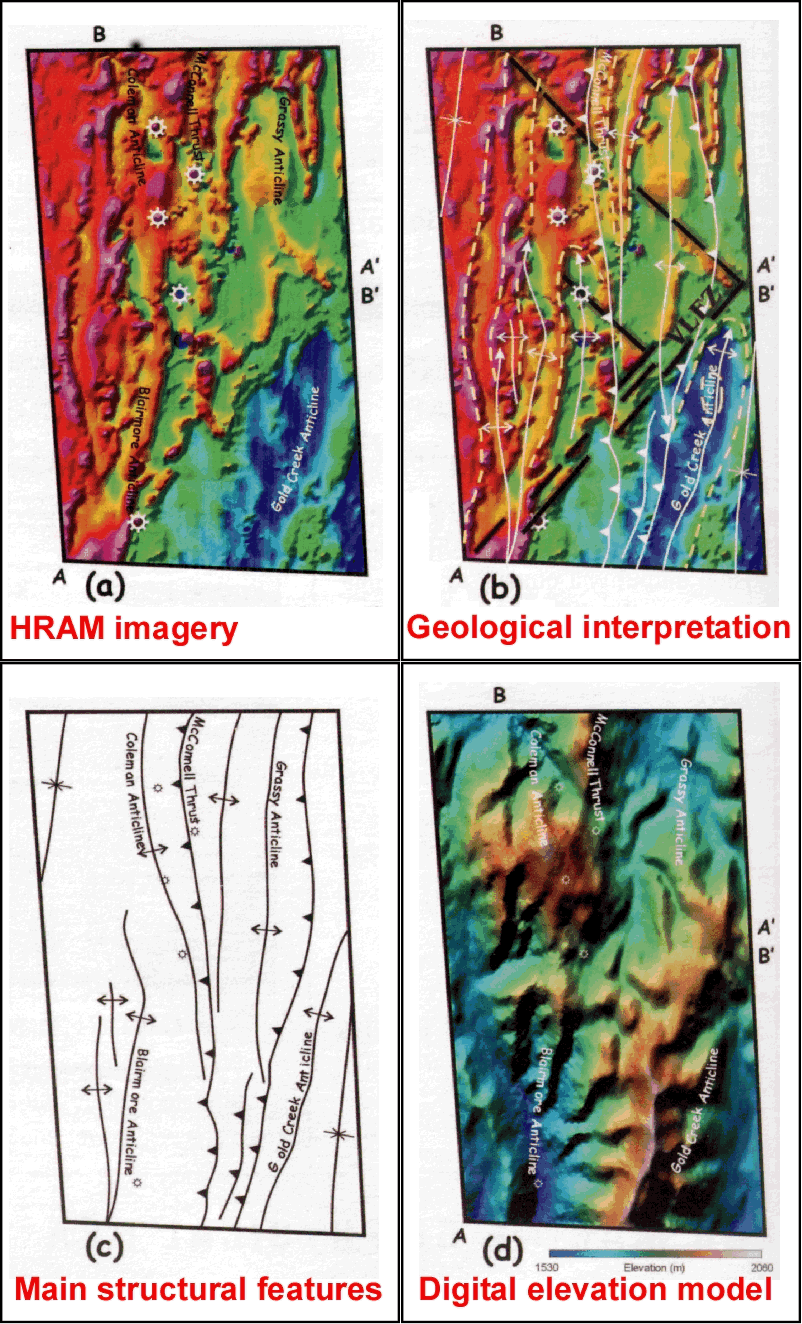
Magneto-Stratigraphy In the Coleman Area
Our
experience in fold belt regions shows that HRAM data collected at
sufficient resolution and flown at low altitude can resolve
For
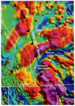
example, an HRAM TMI (total
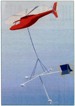
There are benefits of using helicopter-mounted systems to acquire HRAM data. These surveys are normally collected with 50- to 100-meter flight-line spacing by a sensor hanging from a helicopter at a mean altitude of 30 meters (Figure 5). The helicopter-mounted system has the advantage of increased resolution as well as the ability to perform draped surveys over rugged terrains -- however, the tight flight-line spacing requires that these surveys be flown over site-specific areas, such as existing fields or prospective regions.
Geological Mapping:
Coleman Gas
|