
 Print this page
PSSedimentology and Petrophysical Character of Cretaceous Marine Shale Sequences, Foreland Basins: Seismic Response of Seals Horizons*
By
Wm. C. Dawson1, W.R. Almon1, E. Rietsch1, F.G. Ethridge2, S.J. Sutton2, and B. Castelblanco-Torres3
Search and Discovery Article #40089 (2003)
*Adapted  from
from poster presentation at AAPG Annual Convention, Salt Lake City,
May, 2003.
poster presentation at AAPG Annual Convention, Salt Lake City,
May, 2003.
1ChevronTexaco, Bellaire, TX ([email protected])
2Colorado State University, Fort Collins, CO
3ChevronTexaco, Bakersfield, CA
Editorial Note: This article, which is highly graphic (or visual) in design, is presented as: (1) nine posters, each represented by a PDF image, which contains the usual enlargement capabilities; and (2) searchable HTML text with figure captions linked to corresponding illustrations with descriptions.
Users without high-speed internet access to this article may experience significant delay in downloading some of these illustrations due to their sizes.
Click on individual poster below, to view it in PDF format..

Development of predictive models to estimate the
distribution and petrophysical properties of potential mudstone flow barriers
can reduce risks inherent to exploration and exploitation programs. Such a
predictive model, founded in sequence stratigraphy, requires calibration with
outcrop and subsurface analogs. Detailed sedimentologic, petrophysical, and
geochemical analyses of Lewis Shale (Lower Maastrichtian) samples from SE
Wyoming reveal considerable variability in seismically significant rock
properties. Lower Lewis strata represent late-stage transgressive deposits that
include a distinctive condensed interval. The overlying progradational Lewis
interval consists mostly of interstratified very silty shales and argillaceous
siltstones. High-frequency sheet and lenticular sandstone bodies occur within
the progradational Lewis package. Sealing capacity, as measured by mercury
injection capillary pressure analysis (MICP), varies with fabric, texture, and
compositional factors that are related to sequence stratigraphic position.
Samples from the Lewis Shale transgressive interval have significantly greater
MICP values (average 18,000 PSIA) and are markedly better seals relative to
samples from the overlying Lewis Shale progradational package (average 3,000
PSIA). Transgressive shales with enhanced sealing capacity are characterized by
higher total organic carbon and hydrogen index values, lower permeability, and
less detrital silt content. These transgressive shales are enriched in
iron-bearing clay minerals and authigenic pyrite. Greater shear wave velocities,
larger shear moduli, and higher bulk density also characterize transgressive
Lewis shales.
The
most promising seal horizons are laterally extensive, silt-poor, pyritic shales
occurring in the uppermost transgressive systems tract. Stacking patterns of
slow and fast shale horizons can yield seismic responses comparable to those
interpreted as hydrocarbon-bearing reservoirs.
|
|
Figure Captions (1-2.1 - 1-2.3)
The ultimate goal of this research is to
develop sequence stratigraphic-based models for predicting seal
occurrence and
The Lewis Shale (Upper Cretaceous,
Maastrichtian), which crops out along the eastern margins of the Great
Divide and Washakie basins in south-central Wyoming, provides an
interesting analog for understanding stratigraphic architecture of
turbidite depositional systems (Figures 1-2.1,
1-2.2, and 1-2.3).
Previous outcrop and subsurface studies (e.g., Pyles and Slatt, 2000)
established a high-frequency sequence stratigraphic framework for the
Lewis Shale. Winton-Barnes et al. (2000) characterized sandstone
lithotypes within the Lewis Shale, and Costeblanco-Torres (2003)
completed a detailed study of shale lithotypes The Lewis Shale is exposed intermittently along a 60-mile-long outcrop belt on the Rawlins-Sierra Madre uplift west of Cheyenne, Wyoming (1-2.1). Extensive subsurface data are provided by numerous producing fields west of the outcrop belt.
Stratigraphy (Figures 3.1-3.5) Figure Captions (3.1-3.5)
High-frequency sequence stratigraphic cross-section reveals that the
Lewis Shale consists of at least twenty (probable 4th-order)
depositional sequences (Figure 3.3). Beneath the “Asquith Marker” Lewis
Shale deposition was basically aggradational (Figure 3.1). The overlying progradational unit consists dominantly of silty shales (3rd-order
highstand [HST]) with interstratified 4th-order “lowstand” (LST)
sandstones (Figure 3.2). These sandstones record below storm wave base
deposition
Subsurface DataChamplin 276 D-1, Section 13, T19N, R93W, Carbon County, Wyoming Figure Captions (4.1-4.2)
The Champlin 276 D-1 core (Figure 4.1) represents the transgressive (TST) part of the Lewis Shale. These samples have significantly higher MICP values (mean 18,000 psia) relative to other Lewis Shale samples (Figure 4.1). Shales exhibiting well-developed laminar fabrics and enrichment in iron-bearing clay minerals, TOC, and authigenic pyrite have excellent to exceptional seal.
Total clay content varies
Section 25/25, T16N, R92W, Carbon County, Wyoming Figure Captions (5.1-5.3)
The Sierra Madre outcrop represents the highly progradational (3rd-order highstand) part of the Lewis Shale; the dominant lithofacies are silty shales (microfacies 2) and argillaceous siltstones (microfacies 5) (Figure 5.1). Several high-frequency (4th- or 5th-order) lowstand sandstone units are interstratified with this highstand systems tract (HST). Two major types of sandstone bodies (lenticular and tabular) are recognizable in this outcrop (Witton-Barnes, 2000) (Figure 5.2). Massive
to weakly laminated shales and siltstones that compose the Lewis Shale
HST are characterized by relatively high (mean 37 %) content of detrital
silt, low TOC values, and the lowest sealing capacities (mean 1.150 psia)
measured within the Lewis Shale (Figure
5.1). These relatively low
sealing capacities are typical of shales
Total clay content ranges Behind Outcrop CoreColorado School of Mines Stratigraphic Test 61Section 25, T16N, R92W, Carbon County, WyomingFigure Captions (6.1-6.2)
Samples Total
clay content varies
Data SummaryFigure Captions (7.1-7.8)
Five microfacies have been recognized in the Lewis Shale in the study area; they are tabulated in Figure 7.1 and listed below:
Distal marine (TST) shales (microfacies 1 and 4) exhibit the “best” seal character based on MICP analysis (Figure 7.2). Discriminant function analysis of Lewis Shale microfacies yielded two functions that account for nearly 99% of the total variance (Figure 7.3). TST shales are enriched in iron-bearing clay minerals and pyrite and have strongly elevated MICP values relative to HST shales (Figure 7.4). Porosity of TST shales is significantly lower than porosity in HST shales (Figure 7.5). MICP values are increased as porosity is reduced significantly in the upper TST interval relative to all parts of the HST interval. The reduced porosity in clay-rich TST shales is attributed to improved organization of particles (well-developed laminar fabrics) as well as the precipitation of Fe-carbonate cements during early submarine diagenesis.
Additionally, there is a major difference in the permeability of TST and
HST shales. Within the Lewis HST there is a weak trend of upward
increasing permeability; this trend appears to correlate with a vertical
increase in the content of detrital silt. There is a correlation between
seal capacity and depositional systems, with an progressive increase in
capacity A strong correlation between subsurface and outcrop samples, along with evidence of comparable burial history (Tmax data), suggests that other factors (e.g., diagenetic processes) are responsible for differences in seal character (Figure 7.7). Tmax values are essentially the same for all Lewis Shale samples; this implies that they have undergone comparable burial histories (Figure 7.8).
Seismic ModelFigure Captions (8.1-8.10)
Rock Properties
Measurements reveal significant differences in the bulk density,
Poisson’s ratio, and shear
Shale Reflection Modeling Experiment
The basic modeling performed in this
experiment used measured elastic rock properties data and layer
thicknesses
Each trace of this gather represents a
specific reflection angle and was convolved with an angle-specific
wavelet. These wavelets were derived To assess the effect of the thin high-impedance shale (orange layer), it was removed, and the calculations repeated without it. The result (model 2--Figure 8.7) shows that the overall effect on the synthetic seismic is minimal. After removing both the orange and green layers (model 3--Figure 8.8), the effect is more noticeable but remains small (Figure 8.9).
The example of a seismic profile in
Figure
8.10 shows a shale horizon (strong seismic reflector) that could be
misinterpreted as hydrocarbon-saturated sandstone. Results
ConclusionsFigure Caption (9.1)
Lewis Shale strata consist of at least 5 argillaceous microfacies that exhibit distinctive sedimentological and petrophysical features along with significant variations in seal character. Uppermost transgressive and condensed shales (Lewis Shale microfacies 1 and 4) offer excellent to exceptional top seal potential. These shales occur preferentially in distal parts of marine depositional systems. The top seal capacity of highstand (Lewis Shale microfacies 2 and 5) and lowstand (Lewis Shale microfacies 3 and 5) intervals is reduced mainly because of elevated content (> 25%) of detrital silt and disrupted fabrics (extensive bioturbation). Significant stratigraphic separation (several hundred feet) can exist between a lowstand sandstone reservoir and its controlling top seal horizon (i.e., overlying transgressive shale) (Figure 9.1). Factors that tend to enhance sealing characteristics of marine shales include: low content (<25%) of detrital silt; relatively slow rates of accumulation; low oxygen levels and limited bioturbation (preservation of laminar fabrics); and increasing content of Fe- and Mg-enriched minerals.
Seismically significant parameters (e.g.,
density, shear Seismic modeling reveals a potential of some shales to exhibit an AVO response comparable to that exhibited by hydrocarbon-saturated sandstones.
Selected BibliographyAlmon, W.R., and Thomas, J.B., 1991, Pore systems aspects of hydrocarbon trapping: in Gluskloter, H. J., et al., (eds), Economic Geology of North America, v. P-2, Geological Society of America, Boulder, CO., p. 241-254. Almon, W.R., et al., 2002, Sequence stratigraphy, facies variation and petrophysical properties in deepwater shales, Upper Cretaceous Lewis Shale, south-central Wyoming: GCAGS Transactions, v. 52, p. 1041-1053. Castelblanco-Torres, B., 2003, Distribution of sealing capacity within a sequence stratigraphic framework: Upper Cretaceous Lewis Shale, south-central Wyoming: M.S. Thesis, Colorado State University. Dawson, Wm. C., 2000, Shale microfacies: Eagle Ford Group (Cenomanian-Turonian) north-central Texas outcrops and subsurface equivalents: GCAGS Transactions, v. 50, p. 607-621. Dawson, Wm. C., and Almon, W.R., 2002, Top seal potential of Tertiary deepwater Gulf of Mexico shales: GCAGS Transactions, v. 52, p. 1657-176. Dewhurst, D. N., et al., 1999, Permeability and flow in natural mudstones: in Aplin, A.C., et al. (eds), Muds and mudstones-Physical Properties: Special Publication 38, Geological Society of London, p. 23-43. Jennings, J.J., 1987, Capillary pressure techniques; application to exploration and development geology: AAPG Bulletin, v. 71, p. 1196-1209. Katsube, T.J., and Williamson, M.A., 1994, Effects of diagenesis on shale nano-pore structure and implications for sealing capacity: Clay Minerals, v. 29, p. 451-461. Pyles, D.R., and Slatt, R.M., 2000, A high-frequency sequence stratigraphic framework for the Lewis Shale and Fox Hill Sandstone, Great Divide and Washakie basins: GCSEPM Foundation 20th Annual Research Conference, p. 836-861. Rahmanian, V.D., More, P.S., Mudge, W.J., and Spring, D.E., 1990, Sequence stratigraphy and the habitat of hydrocarbons, Gippsland Basin, Australia, in Brooks, J., (ed), Classic Petroleum Provinces: Geological Society of London Special Publication no. 50, p. 525-544. Schieber, J., 1999, Distribution of mudstone facies in the Upper Devonian Sonyea Group of New York: Journal Sedimentary Petrology, v. 69, p. 909-925. Showalter, T. T., 1979, Mechanics of secondary hydrocarbon migration: AAPG Bulletin, v. 63, p. 723-760. Winn, R. D., et al., 1987, Shallow-water and sub-storm-base deposition of Lewis Shale in Cretaceous Western Interior Seaway, south-central Wyoming: AAPG Bulletin, v. 71, p. 859-881.
Winton-Barnes, E. M., et al., 2000, Outcrop
and subsurface criteria for the differentiation of sheet and
channel-fill strata: example
AcknowledgmentsThe authors thank ChevronTexaco for permission to present these data and interpretations. We are especially grateful to R.M. Slatt, D.R. Pyles and S.M. Goolsby for sharing their knowledge concerning the Lewis Shale. C.W. Ward aided with the collection of samples. W.T. Lawrence prepared thin sections, and J.L. Jones contributed SEM images. D.K. McCarty completed XRD analyses, and Poro-Technology (Houston, TX) provided MICP analyses. Graphic design by L.K. Lovell (ChevronTexaco). |
 Figure 1-2.1. Location of study area: western
part of Great Divide basin and Rawlins-Sierra Madre uplift.
Figure 1-2.1. Location of study area: western
part of Great Divide basin and Rawlins-Sierra Madre uplift. Figure 1-2.2. Paleogeographic map for lower
Maastrictian (approximately 69.4 Ma) (after McGookey et al., 1972).
Figure 1-2.2. Paleogeographic map for lower
Maastrictian (approximately 69.4 Ma) (after McGookey et al., 1972). Figure 1-2.3. Upper Cretaceous stratigraphy,
south-central Wyoming (after Schell, 1973).
Figure 1-2.3. Upper Cretaceous stratigraphy,
south-central Wyoming (after Schell, 1973).
 Figure 3.2. Sierra Madre outcrop, Section
24/25, T16N, R92W, Carbon County, Wyoming.
Figure 3.2. Sierra Madre outcrop, Section
24/25, T16N, R92W, Carbon County, Wyoming. Figure 3.3. High-frequency sequence
stratigraphic cross section of Lewis Shale, south-central Wyoming, with
location and position of core in
Figure 3.3. High-frequency sequence
stratigraphic cross section of Lewis Shale, south-central Wyoming, with
location and position of core in Figure 3.4. Upper Cretaceous stratigraphic
framework in terms of time, sequence stratigraphy, and polarity.
Figure 3.4. Upper Cretaceous stratigraphic
framework in terms of time, sequence stratigraphy, and polarity.  Figure 3.5. Relation between eustatic cycles,
depositional geometry cycles, and systems tracts (modified after Rahmanian et al., 1990).
Figure 3.5. Relation between eustatic cycles,
depositional geometry cycles, and systems tracts (modified after Rahmanian et al., 1990). Figure 4.1. Mercury injection capillary
pressure curves, pore size distribution, photomicrographs, and SEM
photographs
Figure 4.1. Mercury injection capillary
pressure curves, pore size distribution, photomicrographs, and SEM
photographs Figure
4.2. (Left) Major constituents of Lewis Shale in cored interval in
Champlin 276 D-1. (Right) Clay-mineral composition of Lewis Shale in
cored interval in Champlin 276 D-1.
Figure
4.2. (Left) Major constituents of Lewis Shale in cored interval in
Champlin 276 D-1. (Right) Clay-mineral composition of Lewis Shale in
cored interval in Champlin 276 D-1.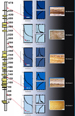 Figure 5.1. Mercury injection capillary
pressure curves, pore size distribution, and photomicrographs for
representative samples
Figure 5.1. Mercury injection capillary
pressure curves, pore size distribution, and photomicrographs for
representative samples  Figure
5.2. Photographs of outcrop area. A. General view. B. HST shale (15 cm
scale). C. Sandstone-filled channel within HST shale. D. Sheet sandstone
within HST shale.
Figure
5.2. Photographs of outcrop area. A. General view. B. HST shale (15 cm
scale). C. Sandstone-filled channel within HST shale. D. Sheet sandstone
within HST shale. Figure 5.3. (Left) Major consitituents of
Lewis Shale in Sierra Madre outcrop. (Right) Clay-mineral composition of
Lewis Shale in Sierra Madre outcrop.
Figure 5.3. (Left) Major consitituents of
Lewis Shale in Sierra Madre outcrop. (Right) Clay-mineral composition of
Lewis Shale in Sierra Madre outcrop. Figure 6.1. Mercury injection capillary
pressure curves, pore size distribution, photographs, photomicrographs,
and SEM photographs for representative core samples,
Figure 6.1. Mercury injection capillary
pressure curves, pore size distribution, photographs, photomicrographs,
and SEM photographs for representative core samples, Figure 6.2. (Left) Major constituents of Lewis
Shale in Colorado School of Mines Strat Test 61. (Right) Clay-mineral
composition of Lewis Shale in Colorado School of Mines Strat Test 61.
Figure 6.2. (Left) Major constituents of Lewis
Shale in Colorado School of Mines Strat Test 61. (Right) Clay-mineral
composition of Lewis Shale in Colorado School of Mines Strat Test 61.  Figure 7.1. Microfacies of the Lewis Shale and
some of their characteristics.
Figure 7.1. Microfacies of the Lewis Shale and
some of their characteristics.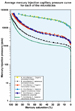 Figure 7.2. Average mercury injection
capillary pressure curve for each of the five microfacies of the Lewis
Shale, with TST showing the best seal character.
Figure 7.2. Average mercury injection
capillary pressure curve for each of the five microfacies of the Lewis
Shale, with TST showing the best seal character. Figure
7.3. Canonical discriminant analysis distinguishes the five Lewis Shale
microfacies, which are illustrated by photomicrographs.
Figure
7.3. Canonical discriminant analysis distinguishes the five Lewis Shale
microfacies, which are illustrated by photomicrographs. Figure 7.4. Iron 2:1 clay content of TST and
HST shales plotted against MICP @ 10% saturation (psia), with the former
showing higher values.
Figure 7.4. Iron 2:1 clay content of TST and
HST shales plotted against MICP @ 10% saturation (psia), with the former
showing higher values.  Figure 7.5. Plot of porosity of TST and HST
shales, with the former showing lower values. (MFS=maximum flooding
surface.)
Figure 7.5. Plot of porosity of TST and HST
shales, with the former showing lower values. (MFS=maximum flooding
surface.) Figure 7.6. Plot of 10%MICP saturation of
Lewis Shale samples according to depositional systems, with TST shales,
condensed shales, and paleosols showing the greatest seal capacity.
Figure 7.6. Plot of 10%MICP saturation of
Lewis Shale samples according to depositional systems, with TST shales,
condensed shales, and paleosols showing the greatest seal capacity.  Figure 7.7. Plot of porosity and permeability
shows a strong correlation between subsurface and surface samples.
Figure 7.7. Plot of porosity and permeability
shows a strong correlation between subsurface and surface samples. Figure 7.8. Tmax values of TST and HST shales
are effectively the same.
Figure 7.8. Tmax values of TST and HST shales
are effectively the same. Figure 8.1. Bulk density of TST shales greatly
exceeds the bulk density of HST shales.
Figure 8.1. Bulk density of TST shales greatly
exceeds the bulk density of HST shales. Figure 8.2. Poisson’s ratio in TST shales is
generally less than Poisson’s ratio of HST shales.
Figure 8.2. Poisson’s ratio in TST shales is
generally less than Poisson’s ratio of HST shales. Figure 8.3. Shear
  Figure 8.4. HST shales exhibit an overall
increase in compressional
Figure 8.4. HST shales exhibit an overall
increase in compressional  Figure 8.5. Data used for seismic model.
 Figure 8.6. Synthetic seismogram for model 1.
 Figure 8.7. Synthetic seismogram for model 2.
 Figure 8.8. Synthetic seismogram for model 3.
 Figure 8.9. Comparison of the seismic data
 Figure 8.10. Seismic profile, with features of
high-reflectivity shale resembling those of sandstone saturated with
hydrocarbons.
Figure 8.10. Seismic profile, with features of
high-reflectivity shale resembling those of sandstone saturated with
hydrocarbons. Figure 9.1. Wireline log of LST reservoir,
immediately overlain by waste-zone shale composed microfacies 2 and
microfacies 3, which in turn is overlain by the top-seal shale, composed
of microfacies 4.
Figure 9.1. Wireline log of LST reservoir,
immediately overlain by waste-zone shale composed microfacies 2 and
microfacies 3, which in turn is overlain by the top-seal shale, composed
of microfacies 4. 