
 Print this page
  Click to view page images in PDF format.
 3-D
3-D Seismic in the Glennpool Area, Northeastern Oklahoma*
By
Christopher L. Liner1
Search and Discovery Article # 40040 (2002)
*Adapted for online presentation from a presentation to the Tulsa Geological Society, January 8, 2002
1Department
of Geosciences, University of Tulsa, Tulsa, OK ([email protected]).
Acknowledgment is made to D. Kerr and M. Kelkar, DOE project managers for
geology engineering, respectively, for well data, especially those from Self
#82, and to Producers Oil, Opseis, and Mercury International Technology in
relation to the 3-D seismic data.
In 1996 a small 3-D seismic survey was acquired on the
west edge of the Glenn Pool oil field, near Tulsa, Oklahoma, to map a producing
120-acre Ordovician Wilcox structure. The goal was to establish a template for
the detection of such structures elsewhere. Among other results, the project
revealed the added value of 3-D imaging even in areas of dense well control and
the misalignment of time and depth structures.
|
uMaps,
uMaps,
uMaps,
uMaps,
uMaps,
uMaps,
uMaps,
|
The objectives of the project are: · Leverage DOE project well information. · Provide an analog for Ordovician Wilcox exploration. · Get a view of the Pennsylvanian Glenn interval adjacent to Glenn Pool oil field. ·
Test small-scale There are a total of 17 wells in Sections 19/24, N17N, R12E (Figure 1). Production was discovered in June, 1985, in the Wilcox Sandstone (Ordovician Simpson Group) at a depth of approximately 2500 ft. Thickness is as much as 34 ft, and porosity is up to 18%. Cumulative production through 1996 was 950,000 barrels of oil. The productive feature is a nose, covering approximately 120 acres, on the southwest flank of Glenn Pool oil field. Self
unit #82, in Section 21, T17N, R12E, is located approximately 2miles from
the area of the
– Sonic+Density => velocity X density = Impedance – Sonic => velocity => time/depth => event ID
Using the sonic and density logs from the Self #82, an acoustic impedance log was prepared (Figure 2). The sonic log can be ignored if the sonic values are predictable from the more common density log. In the case of the Ordovician Wilcox Sandstone (Figure 3), the relation of sonic to density values suggests that density values of themselves may be satisfactory. On the other hand, plots of the sonic vs. density values for the Pennsylvanian Glenn Sandstone (Figure 4) and for the entire stratigraphic interval (Figure 5) are such that the sonic values cannot be ignored in calculating acoustic impedance for synthetic seismograms. Figure 6 shows the velocity (from sonic values) in Self #82, from 300 ft to total depth, along with formation tops, plotted according to time so that the depth ticks are non-linear. Features
of – Vibroseis, with bin size of 55 x 55 ft – 141 E-W lines x 145 N-S lines – 1420 acres, 2.2 square miles – 1 sec, 2 ms – Frequency band--15-120 Hz
Based on the calculation in equation (1), the 55-ft bin size is a little too large because fault imaging is degraded and dips greater than 34o are also degraded.
Bin <Vint / (4 fmax) = 15000 / (4 X 120) = 31 ft (1)
The vertical resolution is shown by equation (2) to be 62 ft. Correspondingly, the Wilcox, with thickness of 34 ft or less, is a “thin bed.” Lateral resolution, given in equation (3), is 155 ft, or approximately 2 bins. Structural resolution is 11 ft, as derived in equation (4) and illustrated in Figure 7.
VR = Vint / (4fdom) = 15000 / (4 X 60) = 62 ft (2) LR = 2 X VR = 144 ft (~ 2 bins) (3) DZ = (VavgdT)/2 = 1000 X .002 / 2 = 11 ft (4)
Improved
quality of the
Maps,
With
the
The
following are conclusions from this ·
· Time structure is not depth structure, reflecting a strong lateral velocity gradient. ·
Postage-stamp sized
Liner,
C.L., 1999, Elements of |
 Figure
1.
Figure
1. Figure
2. Acoustic impedance log of Self #82.
Figure
2. Acoustic impedance log of Self #82. Figure
3. Density vs. sonic values for Ordovician Wilcox Sandstone in Self #82,
showing a fair level of correlation (R2 = 0.6319).
Figure
3. Density vs. sonic values for Ordovician Wilcox Sandstone in Self #82,
showing a fair level of correlation (R2 = 0.6319). Figure
4. Plot of density vs. sonic values for Pennsylvanian Glenn Sandstone in
Self #82 does not show a significant correlation between them.
Figure
4. Plot of density vs. sonic values for Pennsylvanian Glenn Sandstone in
Self #82 does not show a significant correlation between them. Figure 5. Plot of density vs. sonic values for the entire stratigraphic
interval in Self #82 does not show a significant correlation between them.
Figure 5. Plot of density vs. sonic values for the entire stratigraphic
interval in Self #82 does not show a significant correlation between them. Figure
6. Velocity (sonic) log of Self #82 plotted according to time, with
formation tops.
Figure
6. Velocity (sonic) log of Self #82 plotted according to time, with
formation tops. Figure
7. Structural resolution, as illustrated by minimum step down (dt), is
determined to be 11 ft, with the assumption of perfect removal of shallow
effects.
Figure
7. Structural resolution, as illustrated by minimum step down (dt), is
determined to be 11 ft, with the assumption of perfect removal of shallow
effects. Figure
8. Map of image area of
Figure
8. Map of image area of 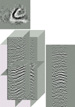 Figure
9. Components of
Figure
9. Components of  Figure
10. Time slice map--original version and enhanced version after
time-slicing smoothing.
Figure
10. Time slice map--original version and enhanced version after
time-slicing smoothing. Figure
11.
Figure
11.  Figure
12. Structure map, along with index maps, on top Ordovician Wilcox
Sandstone. Well depths are feet below 700 ft datum.
Figure
12. Structure map, along with index maps, on top Ordovician Wilcox
Sandstone. Well depths are feet below 700 ft datum.  Figure
13. Enlargement of structure map in Figure 12, showing detail of
Ordovician Wilcox structure.
Figure
13. Enlargement of structure map in Figure 12, showing detail of
Ordovician Wilcox structure.  Figure
14. Ordovician Wilcox structure map from well depths compared to two
time-slice maps from times comparable to the top of the Wilcox; the last
two are substantially different from the well-depth map.
Figure
14. Ordovician Wilcox structure map from well depths compared to two
time-slice maps from times comparable to the top of the Wilcox; the last
two are substantially different from the well-depth map.
 Figure
16. Detail well-depth structure map (left) and time-slice map from 434 ms,
illustrating the difference between them.
Figure
16. Detail well-depth structure map (left) and time-slice map from 434 ms,
illustrating the difference between them. Figure
17.
Figure
17.  Figure
18.
Figure
18.  Figure
19.
Figure
19.  Figure
20. Time structure of Ordovician Wilcox structure map (left) and map of
average velocity.
Figure
20. Time structure of Ordovician Wilcox structure map (left) and map of
average velocity. Figure
21. Structure map of Ordovician Wilcox structure map, from well and
Figure
21. Structure map of Ordovician Wilcox structure map, from well and
 Figure
22. Comparison of structure maps—from well
Figure
22. Comparison of structure maps—from well  Figure
23.
Figure
23. 