
 Print this page
 Click to view images in PDF format.
GC Seismic Guides Interpretation in the Ferron Coalbed Methane Play*
By
William S. Lyons1
Search and Discovery Article #40072 (2003)
*Adapted for online presentation from the Geophysical Corner column in AAPG Explorer December, 2001, entitled “Seismic Maps Ferron Coalbed Sweetspots,” and prepared by the author. Appreciation is expressed to the author, to R. Randy Ray, Chairman of the AAPG Geophysical Integration Committee, and to Larry Nation, AAPG Communications Director, for their support of this online version.
1ChevronTexaco, Denver, CO; present address: GeoGraphix, Denver, CO ([email protected])
General Statement
Recent work in Utah's Ferron coalbed methane (CBM) trend has demonstrated that seismic can be useful in evaluating CBM plays. Objective horizons in CBM trends are typically shallow, and acoustic impedance contrasts between the coals and interbedded sandstones are high, making many coalbed methane plays attractive candidates for seismic study. Although keeping costs low in these plays is important, 2-D seismic is now relatively inexpensive to acquire and can help greatly to:
- Establish areal extents of coal deposits.
- Identify structures that can enhance permeability.
- Guide stratigraphic and
 structural
 interpretation.
 - High-grade areas for pilot tests and further development.
Despite these potential benefits, seismic is used infrequently in CBM evaluations -- but successful use of seismic in the Ferron play suggests that its value in CBM trends is underestimated.
|
uGeneral statementuFigure captionsuFerron Coal playuFirst stepuKey LinkuStratigraphic observations, interpretations
u uAdditional opportunitiesuConclusionsuReference
uGeneral statementuFigure captionsuFerron Coal playuFirst stepuKey LinkuStratigraphic observations, interpretations
u uAdditional opportunitiesuConclusionsuReference
uGeneral statementuFigure captionsuFerron Coal playuFirst stepuKey LinkuStratigraphic observations, interpretations
u uAdditional opportunitiesuConclusionsuReference
uGeneral statementuFigure captionsuFerron Coal playuFirst stepuKey LinkuStratigraphic observations, interpretations
u uAdditional opportunitiesuConclusionsuReference
uGeneral statementuFigure captionsuFerron Coal playuFirst stepuKey LinkuStratigraphic observations, interpretations
u uAdditional opportunitiesuConclusionsuReference
uGeneral statementuFigure captionsuFerron Coal playuFirst stepuKey LinkuStratigraphic observations, interpretations
u uAdditional opportunitiesuConclusionsuReference
uGeneral statementuFigure captionsuFerron Coal playuFirst stepuKey LinkuStratigraphic observations, interpretations
u uAdditional opportunitiesuConclusionsuReference
|
Ferron Coal PlayOne of the most significant domestic CBM plays has been the Ferron trend along the western flank of the San Rafael Swell, near the town of Price, Utah (Figure 1). In this area, intertonguing coals, sands, and shales were deposited in a fluvial-deltaic environment on the western side of the Early Cretaceous Interior seaway (Figure 2). Development began on the play's north end, at Drunkards Wash Field in 1992. Since then, the producing part of the trend has been extended both south and north and now spans an area about 65 miles long and six to 10 miles wide. Despite the lateral extent of known Ferron production, large areas between producing fields remain undeveloped. Limited well control across these open areas has made characterizing the extent, thickness, quality and production characteristics of the coals uncertain, and development has proceeded cautiously. Coalbed gas contents also decrease southward in the play and project economics become progressively leaner. In these areas there is an additional need to focus development by locating production sweet-spots, or "fairways," quickly. Because of these factors, Texaco used seismic to help guide its most recent development activity in the play. A Requisite First StepIn two stages during late 1999, we uniformly reprocessed and interpreted about 140 miles of 1980's vintage 2-D seismic over the Ferron trend. The first stage was conducted over the Drunkards Wash Field, where dense well control was used to determine if seismic could identify the causes of observed production variations. The second stage was intended to expand what was learned at Drunkards Wash into the southern parts of the trend, where development is much less complete. Seismic lines from each stage are presented in this article. The emphasis in reprocessing was on attention to detail, particularly for imaging shallow horizons. Changes observed on seismic had to represent true changes in the Ferron interval, and even subtle features could not be ignored since they might prove to be important in understanding the stratigraphy. To achieve
reliable results, only lines with similar acquisition parameters were
chosen. Reprocessing efforts included applying refraction statics,
assuring zero-phase data, detailed velocity analyses, correction of CDP
geometry errors, careful The Key LinkThe Ferron interval in the coal-bearing areas is characterized by an upper sandstone, a middle interval with coal and interbedded siltstones, and a prominent sandstone at the base known as the Lower Ferron Sandstone. Synthetic seismograms from this sequence typically show a distinctive pattern (Figure 3). A weak reflection peak is generated from the upper Ferron sandstone due to a low impedance contrast with the overlying siltstones in the Bluegate Shale member. This is followed by a strong trough (or trough doublet) produced from relatively thick sections of high-contrast, negative reflection coefficient coals immediately below the upper sandstone. At the interval base, the tight sandstone of the lower Ferron once again contrasts sharply with coals, and another high amplitude peak is produced. Sonic logs were available from a few wells close to seismic lines in the Drunkards Wash area, and synthetic seismograms from these matched the newly reprocessed seismic quite well. The tool of choice in coal plays is the density log, however, and nearly all the wells in the field have one of these. Where wells had both sonic and density logs, pseudosonic curves created from the density log produced synthetic seismograms that were nearly identical to those produced from the sonic log. Drunkards Wash is fairly densely developed at 160-acre well spacing. Since the density logs from these wells could be used reliably to generate synthetics, we were able to tie many nearby wells into the seismic at closely sampled points along each line. Stratigraphic and lithologic changes observed in the wells could then be related directly to changes seen on seismic with high confidence and little interpolation. Stratigraphic Observations, InterpretationsFigure 4 shows a series of coincident lines that both demonstrate our results and show how lithologic and stratigraphic changes seen on well logs in the Ferron interval translate into changes observed on seismic:
The displays have been hung on a flattened Lower Ferron sandstone and scaled similarly so they can be compared with ease and accuracy. On the west (or left) side of Figure 4, well logs show a thicker Ferron interval. Individual coal seams occur in groups, forming relatively thick upper and lower packages. These are resolved as dual high-amplitude troughs (with maximum negative amplitudes shaded yellow) and are separated by a peak generated by the intervening siltstones and shales. The last high-amplitude peak at the interval base is caused by tight Lower Ferron sandstone. Moving east along the line, the coal sections merge and thin, and the intervening siltstone is lost. Similarly, on the seismic the intervening peak disappears and coal troughs merge to form a doublet. Amplitudes are observed to diminish as the section thins, and tuning effects cause destructive interference in the seismic signal. On the eastern end of the line, there is a facies transition to stacked Ferron shoreline sandstones and the coals are absent by nondeposition. The seismic interval thins and amplitudes dim further as the coal-sandstone impedance contrast is lost.
Once seismic stratigraphic and lithologic relationships such as these were established in areas of better well control, the seismic could be used to interpret significant changes in the Ferron interval elsewhere. Similar seismic "facies" observed on other lines were used to map significant features of the Ferron interval in undeveloped parts of the play. For example:
Attempts were also made to correlate observed amplitude changes with variations in production. Although no simple association was recognized, interval thickness variation occurring close to the tuning thickness may have caused amplitude fluctuations that obscured meaningful relationships.
|
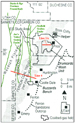 Figure
1.
Figure
1. Figure
2.
Figure
2. Figure
3.
Figure
3.
 Figure
5.
Figure
5.
