Print this page
 Click to view figures in PDF format.
The Power of Multiple Seismic Attributes in Revealing Geologic Understanding*
By
Walter E. Johnson1, Richard O. Louden2, Donald D. Lehman3, and Duncan L. Edwards4
Search and Discovery Article #40067 (2002)
*Adapted for online presentation from the Geophysical Corner column in AAPG Explorer, March, 2001, entitled “Seismic Has Its Multiple Attributes,” and prepared by the authors. Appreciation is expressed to the authors, to R. Randy Ray, Chairman of the AAPG Geophysical Integration Committee, and to Larry Nation, AAPG Communications Director, for their support of this online version.
Editor’s note: Please refer to related article, “3-D Seismic Data in Delineating Productive Ismay Algal Mounds in Southern Paradox Basin, Utah,” by the same authors previously posted on Search and Discovery.
1Consulting geophysicist, Denver, Colorado.
2Consulting geologist affiliated with Thomasson Partner Associates, Denver, Colorado. 3Former exploration manager for Miller Energy, is now with VuCom Data Services in Kalamazoo, Michigan.
4Independent consulting geophysicist in Rutherfordton, N.C.
 Analysis
 of 3-D seismic data with
several types of seismic attributes can reveal geologic factors that control the
location of productive algal mound reservoirs in the Paradox Basin. Routine
seismic mapping of the producing interval did not reveal the presence of a
regional strike-slip fault that is clearly shown using attribute analysis. This
previously unknown strike-slip fault controls the local stratigraphy and extends
for over 30 miles.
of 3-D seismic data with
several types of seismic attributes can reveal geologic factors that control the
location of productive algal mound reservoirs in the Paradox Basin. Routine
seismic mapping of the producing interval did not reveal the presence of a
regional strike-slip fault that is clearly shown using attribute analysis. This
previously unknown strike-slip fault controls the local stratigraphy and extends
for over 30 miles.
Although each attribute when used
alone has some level of ambiguity, it is important to note that when a number of
attributes with different mathematical algorithms yield similar results, the
reliability of the geologic interpretation is enhanced. Several commercially
available seismic attributes, along with attributes generally incorporated
within most workstations, collectively have had a significant impact on the
understanding of how and where the algal mound reservoirs form, and indicate
that their stratigraphic development is often not a random act. The purpose of
this article is to demonstrate that the small cost of time and money required to
perform attribute analysis is far outweighed by the increased understanding of
the geologic dynamics of an area.
The ability to map more geologic detail will ultimately result in reduced risk of drilling dry holes.
|
uAlgal mound reservoirs in Paradox Basin
uAlgal mound reservoirs in Paradox Basin
uAlgal mound reservoirs in Paradox Basin
uAlgal mound reservoirs in Paradox Basin
uAlgal mound reservoirs in Paradox Basin
uAlgal mound reservoirs in Paradox Basin
|
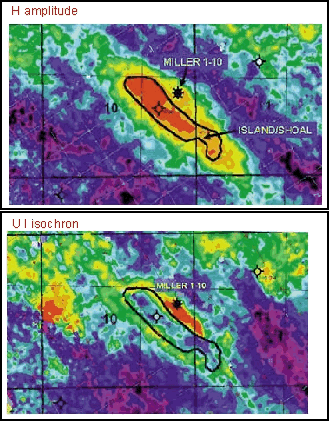
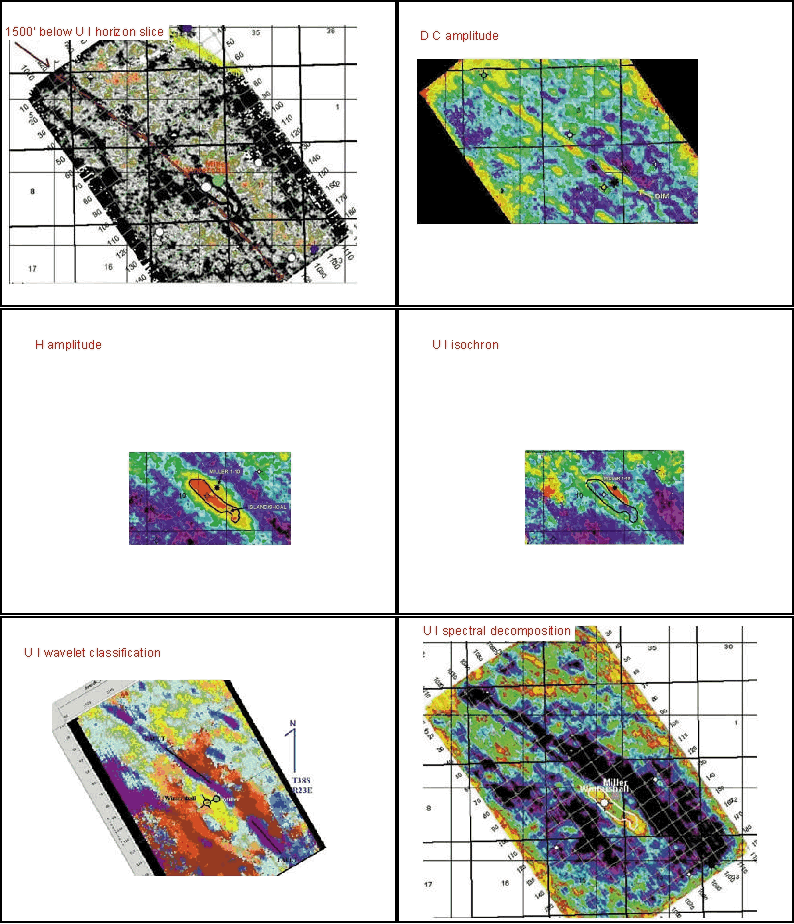
Click here to view sequence of Figures 3 and 4, (Hovenweep amplitude and Upper Ismay isochron maps).
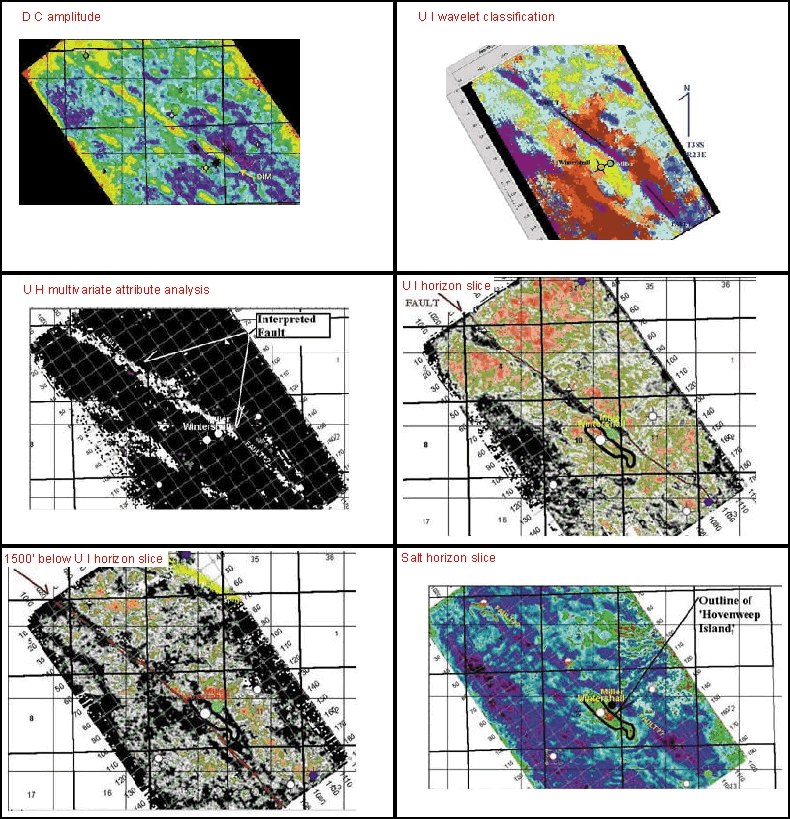
Click here to view sequence of attribute displays in Figures 5-10.
Click here to view sequence of Figures 11 and 12. Algal Mound Reservoirs in the Paradox Basin Miller Energy, of Kalamazoo, Michigan, and its partners completed the Miller Horse Canyon 1-10 in 1998 for an initial potential of 960 barrels of oil per day and 940 MCFG/D from a depth of 5,850 feet from an algal mound reservoir. The well was featured in the 1999 EXPLORER. Figure 1 shows the location of the Paradox Basin in the southwestern United States, where shelf carbonate buildups within the Pennsylvanian basin have produced oil and gas since the 1950s. Generally these carbonate buildups are the result of algal debris from Ivanovia (these Ivanovia algal skeletons are much the same size as cereal corn flakes). In the 1980s it became generally known that there could be a seismic expression resulting from these carbonate buildups, but the 2-D seismic data that existed then added little to the understanding of the genesis of these features.
Figure 2, a geologic cross section through the discovery well, is a
good reference for the various geologic strata that will be mentioned
throughout this article. The well was completed in an Upper Ismay
carbonate buildup; however, the test also encountered a deeper Desert
Creek carbonate buildup that is further revealed with attribute
A seismic tuning effect owing to thickness changes in the Hovenweep shale creates a mappable high amplitude that indicates where the shale is extra thick, as shown in Figure 3. This thick resulted in a positive “island” that existed during the time of deposition of the Upper Ismay. The island is outlined in black and will be shown on subsequent displays. Note in Figure 2 how the Hovenweep thick is located to the left of the discovery well. The isochron thickness map of the Upper Ismay (from the top of the Hovenweep to the top of the Upper Ismay) shown in Figure 4 demonstrates that there is an atoll shape of increased thickness of Upper Ismay surrounding the Hovenweep island. A series of different
seismic attribute displays are shown in Figures
5,
6,
7,
8,
9, and
10, which reveals a linear fault zone that affected the formation of
the Hovenweep thick and thus the locations for mound development. The
attribute analyses include several types of methods, including
multivariate An attribute process that
could be characterized as “wavelet classification” was run on the
shallower Upper Ismay seismic Another attribute, which
can be classified as multivariate attribute It is important to note
that both the wavelet classification map and the multivariate attribute
Edge detection technology
has been used in the seismic industry for several years, and is designed
to compare each trace of the data with its neighbors in order to map
dissimilarities.
Figure 8 is the edge detection Figure 9 is another coherency slice that is approximately 1,500 feet below the Upper Ismay, and again this same lineament can be mapped. Two-D seismic has been shot in the area for decades, and this very small-offset fault (or perhaps zone of weakness) has not been observed. In fact it was not even observed on the 3-D data until output was displayed and interpreted using the various attribute packages.
Figure 10 is an amplitude map of the top of the Akah salt, and it is
believed that the dim shown in green and red is the result of salt
dissolution. Note how the amplitude dim conforms with the overlying
Hovenweep thick. We postulate that the fault may have been a conduit to
cause dissolution of the Akah salt. A As another attribute
comparison, spectral decomposition is a very precise frequency
measurement tool that can also be viewed as a wavelet measurement tool.
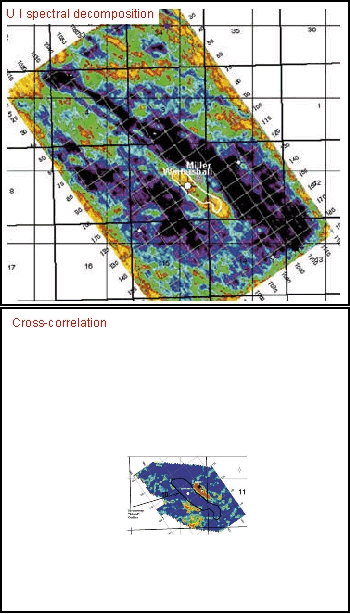
Figure 11 is the result of spectral decomposition over the Upper
Ismay Many workstations have
add-on packages that allow some trace processing. A Note the similarity between Figures 12 and 6 . Both the cross-correlation and wiggle classification mapping techniques indicate strong potential for new drill site locations on the south side of the Hovenweep “island.” The enhanced geologic understanding gained from the various attribute analyses far outweighs the small costs and interpretation time required trying them. The similar patterns that emerge by running many different techniques reinforces the interpreter’s confidence when mapping subtle geologic variations. This improved geologic understanding leads to reduced risk in both development and exploration projects.
Often seismic interpreters are discouraged from mapping anything but the
primary producing zone. Our experience on this stratigraphic play shows
that attribute |
 Figure
1. Location of Paradox Basin.
Figure
1. Location of Paradox Basin. Figure
2. Stratigraphic cross section through the discovery.
Figure
2. Stratigraphic cross section through the discovery.
 Figure
4. Upper Ismay isochron map showing atoll character of algal mounds.
Figure
4. Upper Ismay isochron map showing atoll character of algal mounds. Figure
5. Desert Creek amplitude map showing NW-SE lineament.
Figure
5. Desert Creek amplitude map showing NW-SE lineament. Figure
6. Wavelet classification map output at Upper Ismay
Figure
6. Wavelet classification map output at Upper Ismay  Figure
7. Multivariate attribute
Figure
7. Multivariate attribute  Figure
8. Edge detection
Figure
8. Edge detection  Figure
9. Edge detection
Figure
9. Edge detection  Figure
10. A
Figure
10. A  Figure
11. Spectral decomposition at the Upper Ismay showing NW-SE fault along
with other features.
Figure
11. Spectral decomposition at the Upper Ismay showing NW-SE fault along
with other features. Figure
12. Cross-correlation with trace from successful well indicating
additional locations.
Figure
12. Cross-correlation with trace from successful well indicating
additional locations.