Print this page
 Click to view images of illustrations in PDF format.
Normal MoveOut and Dip MoveOut*
By
Christopher L. Liner1
Search and Discovery Article #40037 (2002)
*Adapted for online presentation from two articles by the same author in AAPG Explorer (April and May, 1998), respectively entitled “Normal MoveOut, an Effect, Process” and “Dip MoveOut Just Isn’t ‘Normal.’” Appreciation is expressed to the author and to M. Ray Thomasson, former Chairman of the AAPG Geophysical Integration Committee, and Larry Nation, AAPG Communications Director, for their support of this online version.
1Department of Geosciences, University of Tulsa ([email protected])
|
|
Click here for sequence of Figures 2, 5, 6.
Click here for sequence of Figures 2, 5, 6.
Click here for sequence of Figures 2, 5, 6.
Petroleum seismology is, and always has been, changing very quickly. You might have heard whispers about exotic topics like crosswell tomography, wavelet transforms, cluster analysis, texture segmentation impedance inversion, geostatistical estimation, etc. So why in this high-tech age is someone writing about something as ancient as normal moveout? The answer involves the importance of understanding fundamental concepts, the natural lead-in that normal moveout provides to the juicier topic of dip moveout, and a chance to do it without any equations. Normal moveout has two meanings – it is both:
By
itself, the term “moveout” goes back to the earliest days of The human eye is wonderfully adept at seeing patterns and relationships in very confusing data, e.g. recognizing a face across a crowded room full of strangers. Early seismic records were like that – lots of noise, not much signal. But the signals were there, and skilled interpreters could recognize them. Some of these signal events came in straight lines across the traces; others formed curves. But whatever the shape, each kind of signal showed a delay from trace to trace as we move away from the source – and thus was known as moveout. You can talk about Normal MoveOut (NMO) all day long without mentioning migration, but Dip MoveOut (DMO) is another matter. In fact, DMO started out with the cumbersome-but-descriptive name “pre-stack partial migration.” That was in 1979, but at least two years earlier there was a DMO processing product on the market. It was named DEVILISH, an acronym for “dipping event velocity inequality licked.” You think I am making this up, but it’s true. Before moving on, I should say something about name-dropping. Unlike NMO, the development of DMO is very recent. The people involved are still alive and kicking. We owe a debt of gratitude for their hard work and ingenuity, but if I mention one name I will have to mention them all. So we shall deal here with the concepts and not the names. We shall attempt to understand what DMO is and does, not create a historical who’s who. A
shot record is the collection of seismic traces generated when one source shoots
into many receivers, as shown in Figure 1. In this example, the upper black line
is the acquisition surface and the lower one is the reflector. Dots below the
reflector show subsurface In
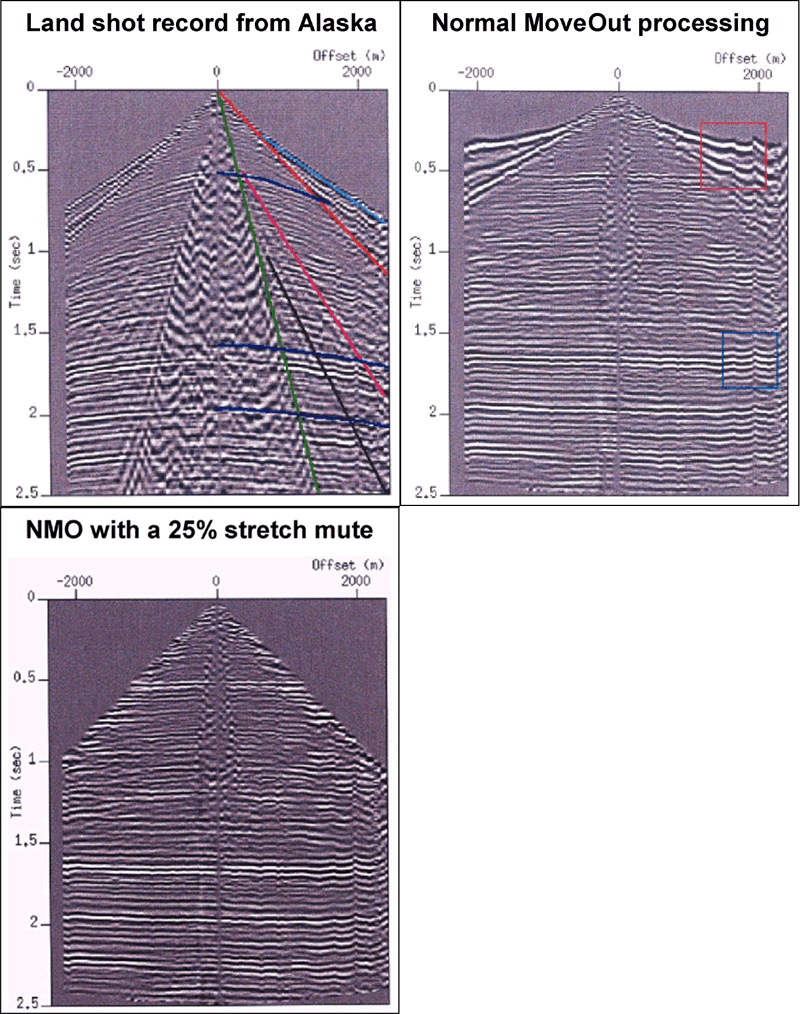
Figure 2 (page 26), reflections can be seen in real data along with other kinds
of events. There are receivers on both sides of the shot in this case. The right
side has been marked-up to identify different kinds of events – direct
arrivals (p-wave, s-wave, air wave, surface wave), head waves and (a few)
reflections. The left side is uninterpreted. The So now we know something about normal moveout, the effect. What about normal moveout, the process? For this we will use the acronym NMO (Normal MoveOut) since for most people this term implies the process, not the effect. What is NMO? The short answer is: A
seismic processing step whereby A
seismic line is generated by “rolling” the shot and receivers forward a
certain distance and firing again. As shown in Figure
3, this generates a second
shot record which partially overlaps the first. Note that six of the seven
As
the shots roll along, there will be many source-receiver pairs with the same CMP
location, and the CMP fold is the total number of traces that live at any given
CMP (Figure 4). CMP fold can vary from as few as
six (low-fold land 3-D) up to several hundred (2-D marine). The reason for
gathering multifold data is that we get redundant information about the
NMO
is aimed at removing the hyperbolic curvature in Figure
5 shows the data after NMO processing (and air wave removal). In this case, we
see the events are pretty well flattened by NMO, but there are a couple of
interesting areas. The blue box shows some disturbing behavior along a flattened
The red box shows what NMO does to the direct arrivals. Since these were linear and not hyperbolic, NMO has not flattened them. Also, note how fat (not flat) these events look after NMO. This is because NMO actually operates by stretching the trace – and the shallower something is, the more it stretches. Since our goal is to eventually flatten all these traces and add them together to make one trace, keeping this kind of stuff would wipe out shallow reflections. It needs to go. We get rid of these events by muting – which is nothing more than replacing the offending data with zeros. We could do this by hand, but a seismic line may contain many thousands of CMP gathers. It turns out we can let NMO itself do the muting for us. The idea is to keep track of how much stretch NMO is doing to the trace. The stretch changes down the trace – biggest at the top, smallest at the bottom. So the idea of an NMO stretch mute is to set a limit on how much stretch we are going to allow. If the stretch gets bigger than our limit, then the data values are replaced by zeros in that part of the trace. Figure 6 shows the result of allowing a 25 percent stretch in the NMO process. At
this The fact is that NMO has a constant dip assumption built in. If every bed were dipping at the same angle, say 23 degrees, it turns out we could do NMO just fine. The real problem comes where there are many dips in the subsurface. In this case, NMO acts like a dip filter – preferentially passing some dip the processor chooses while suppressing others. This was particularly notorious in places like the Gulf of Mexico, where gently dipping beds often meet steep salt domes. You could do NMO in such a way as to get a good image of one or the other, but not both. This was the situation up until about 1981 or 1982. Then something new came on the scene. It was called – you guessed it – dip moveout. In
the field, a source and receiver are located, say, 3,000 meters apart (the
Figure
8 illustrates the NMO idea. On the left is a field trace with some arbitrary
But
what if the interface is not horizontal? It is tempting to think that the
reflector could be anywhere and still be consistent with the observed travel
time. But this is not the case. Assume that the original travel time is 1.0
second, and we know the velocity is 3,000 m/s. The total distance traveled has
got to be 3,000 meters. So all valid reflector positions have one thing in
common: The total distance from source to Figure 9
shows such an ellipse. Remember the goal is to remove From Figure 8, we saw that NMO is a process that takes one trace in and gives one trace out. DMO is different. One trace into DMO generates many traces out – all of which live between the original source and receiver locations. This is illustrated in Figure 9 (lower) and Figure 10. In Figure 10, we have a panel of data containing only two spikes of amplitude on one trace (left panel). The other traces are there, but empty. NMO moves the spike up on the same trace (middle panel). DMO then throws the spike out along a curve, which lives between the source and receiver (right panel). This is sometimes called the DMO smile. Since it comes from a spike or impulse on the input data, it is also called the DMO impulse response. Now
here is some magic. By creating the DMO smile, all possible dips are handled
simultaneously. We do not need to know what the dip is in the earth – by
processing all traces with DMO, the actual reflections will emerge because they
are tangent, at some Since DMO spreads things out across traces, it is much more expensive than NMO, which only shifts things up on one trace. Even so, NMO+DMO is still cheaper than pre-stack migration. Figure 11 gives some representative run times for these, and other, processes. Here
is the bottom line: If structure and velocity NMO + DMO + Stack + PostStackMigration. In this equation, “+” means “followed by.” However, if things get really tough down there (e.g., subsalt), this sequence breaks down and fails to give a good image. In this case we are compelled to do one grand process called pre-stack migration. In fact, DMO was originally invented to complete the following equality under mild subsurface conditions: PreStackMigration = NMO + ? +Stack + PostStackMigration. The “?” turned out to be DMO – and is used world-wide every day. |
 Figure
1
Figure
1 
 Figure
2 – A land shot record from Alaska (courtesy of SEG). Several kinds of events,
in addition to reflections, are marked on the right side of the record,
indicating the path and wave type from source to receiver.
Figure
2 – A land shot record from Alaska (courtesy of SEG). Several kinds of events,
in addition to reflections, are marked on the right side of the record,
indicating the path and wave type from source to receiver. Figure
3 – A seismic line is acquired by rolling the shot and receivers a certain
distance forward. This gives more than one trace with the same midpoint.
Figure
3 – A seismic line is acquired by rolling the shot and receivers a certain
distance forward. This gives more than one trace with the same midpoint. Figure
4 – All the traces that live at the same CMP location will be processed
together as a family. Ultimately, they will be added (stacked) to make one stack
trace that lives at this location. The process of Normal MoveOut (NMO) helps
prepare the traces before they are added together.
Figure
4 – All the traces that live at the same CMP location will be processed
together as a family. Ultimately, they will be added (stacked) to make one stack
trace that lives at this location. The process of Normal MoveOut (NMO) helps
prepare the traces before they are added together. Figure
5 – Data from
Figure
5 – Data from Figure
6 – Data after NMO with a 25 percent stretch mute. Note that the nasty events
in the red box of
Figure
6 – Data after NMO with a 25 percent stretch mute. Note that the nasty events
in the red box of Figure
7 – When the reflector is dipping, midpoints are not vertically above
Figure
7 – When the reflector is dipping, midpoints are not vertically above
 Figure
8. Normal MoveOut (NMO) is a process applied to pre-stack data. Here the effect
is shown on a single trace with one
Figure
8. Normal MoveOut (NMO) is a process applied to pre-stack data. Here the effect
is shown on a single trace with one  Figure
9. Dip MoveOut (DMO) is a process that is applied after NMO. Since NMO assumes
the
Figure
9. Dip MoveOut (DMO) is a process that is applied after NMO. Since NMO assumes
the  Figure
10. This numerical example illustrates the effect of NMO and DMO on a trace with
two spikes, or
Figure
10. This numerical example illustrates the effect of NMO and DMO on a trace with
two spikes, or  Figure
11. This chart illustrates processing time in seconds for a small sample data
set. The relative times are important, not the size of the data set or kind of
machine used. Starting from the bottom, the processes represent (in order) a
more-or-less standard processing flow. By far the most expensive item here is
DMO. However, if we run pre-stack migration instead, it is even more expensive.
Basically, the pre-stack migration replaces NMO, DMO, stack and post-stack
migration. Due to the cost, pre-stack migration is a method to be used only when
required by strong lateral velocity variations and/or extreme structure.
Figure
11. This chart illustrates processing time in seconds for a small sample data
set. The relative times are important, not the size of the data set or kind of
machine used. Starting from the bottom, the processes represent (in order) a
more-or-less standard processing flow. By far the most expensive item here is
DMO. However, if we run pre-stack migration instead, it is even more expensive.
Basically, the pre-stack migration replaces NMO, DMO, stack and post-stack
migration. Due to the cost, pre-stack migration is a method to be used only when
required by strong lateral velocity variations and/or extreme structure.