
 Print this page
 Click to view article in PDF format.
GCSpectral
Decomposition for  Seismic
 Stratigraphic Patterns*
By
Kenny Laughlin1, Paul Garossino2, and Greg Partyka3
Search and Discovery Article #40096 (2003)
*Adapted for online presentation from the Geophysical Corner
column in AAPG Explorer May, 2002, entitled “Spectral
Decomp Applied to 3-D,” prepared by the authors. Appreciation is
expressed to the authors, to R. Randy Ray, Chairman of the AAPG Geophysical
Integration Committee, and to Larry Nation, AAPG Communications Director, for
their support of this online version.
1Landmark Graphics, Denver; Col.orado
2Upstream Technology Group, BP, Houston, Texas
3Upstream Technology Group, BP, Sunbury, U.K.
While seismic processors have long used spectral
decomposition, it is only in recent years that it has been applied directly to
aspects of 3-D seismic data interpretation. The method for doing this was first
published in “The Leading Edge” in 1999, in a paper by Greg Partyka et al.,
that illustrated the idea of using frequency to “tune-in” bed thickness.
Although spectral decomposition is a relatively new technique, some companies are experiencing great success in many basins around the world. (Most of the best examples are in clastic environments where depositional stratigraphy is a key driver.) Companies using spectral decomposition observe significant detail from these images at great depth – but have found that interpretation and integration with well data and models are critical to its success.
|
|
Click to view sequence highlighting different parts of reservoir (thicker to thinner).
As shown by the channel system in
Figure 1,
spectral decomposition can extract detailed stratigraphic patterns that
help refine the geologic interpretation of the In other words, higher frequencies image thinner beds, and lower frequencies image thicker beds. This approach is similar to how remote sensing uses sub-bands of frequencies to map interference at the earth’s surface. Just like remote sensing, it is very important to dynamically observe the response of the reservoir to different frequency bands. The key is to create a set of data cubes or maps, each corresponding to a different spectral frequency, which can be viewed through animation to reveal spatial changes in stratigraphic thickness. Spectral decomposition reveals details that no single frequency attribute can match.
Based on well-understood principals, typical
amplitude maps are dominated by the frequency content of What is needed is to see all the different stratigraphic thicknesses in a meaningful way. Spectral decomposition provides this by generating a series of maps or cubes that observe the response of the reservoir to different frequencies. These are then animated allowing the interpreter’s eye to catch subtle changes in the reservoir through motion. There are other good methods that can analyze tuning, but none are as easy to create or as routinely used as the method of animation called the “Tuning Cube.”
To use spectral decomposition, you would
interpret a
If you believe that amplitude is a meaningful
indicator for reservoir presence, then spectral decomposition is a new
step in the interpretation workflow. The
Subtle changes in reservoir thickness or
internal heterogeneities can be observed when comparing these images.
Very quickly you will get a feel for areas with active stratigraphic
variation that need to be evaluated in more detail. Tracking between
these maps and the
In this example, there are actually 30 images
that need to be animated to allow the eye to catch all of the detail
available. Integration with well control is critical to determining the
accuracy of the geologic interpretations. As mentioned, spectral
decomposition is a relatively new technique that already has helped
bring great success in many basins around the world. As such, it is
poised to become an essential tool for the geologic interpretation of
Partyka, G., J. Gridley, and J. Lopez, 1999, Interpretational applications of spectral decompositiion in reservoir characterization: The Leading Edge, v. 18, p. 353-360 |
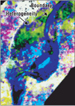 Figure 1– Spectral decomposition images
combined to highlight channel edges and thins as well as overbank
heterogeneity.
Figure 1– Spectral decomposition images
combined to highlight channel edges and thins as well as overbank
heterogeneity. Figure
2 – Thin bed interference. In thin reservoirs with varying thickness
(left)
Figure
2 – Thin bed interference. In thin reservoirs with varying thickness
(left)  Figure 3 – Three successive spectral
decomposition images showing the different parts of the reservoir being
highlighted by different frequency bands. Thicker on the
left, thinner on the right.
Figure 3 – Three successive spectral
decomposition images showing the different parts of the reservoir being
highlighted by different frequency bands. Thicker on the
left, thinner on the right.
