Print this page
 Click to view article in PDF format.
The Case for the Regressive  Systems
 Tract with Examples from
the Tertiary and Pleistocene of the Northern Gulf Coast Basin*
Tract with Examples from
the Tertiary and Pleistocene of the Northern Gulf Coast Basin*
by
Marc B. Edwards1
Search and Discovery Article #40063 (2002)
*Adapted for online presentation from article of the same title by the same author at the GCAGS 52nd Annual Convention, Austin, Texas, October 30-November 1, 2002. Appreciation is expressed both to the author and to GCAGS.
1Marc B. Edwards Consulting Geologists, Inc., Houston, Texas (www.marcedwards.com; [email protected])
Until the advent
of sequence stratigraphy (late 1980s), geologists commonly subdivided the
siliciclastic units of the Gulf Coast Basin into regressive and transgressive
components. Sequence stratigraphy divided the regressive component into two
separate units: the highstand systems tract (HST) and the lowstand systems tract
(LST).
According to sequence stratigraphic theory, the HST and the LST are
separated by a sequence boundary, with two implications: (1) the LST of a
particular sequence is younger than the HST of the preceding sequence, and (2)
the two systems tracts contain facies that are not genetically related. In the
years following the introduction of sequence stratigraphy (early 199Os), it was
noted in several publications that in areas where sediment input was active
during a period of overall sea level fall, a single widespread sequence boundary
did not form. Since the model necessitated the existence of a sequence houndary,
stratigraphers argued over where the sequence boundary should he placed. To try
to deal with this problem, the concept of “forced regression” was introduced,
hut this did not resolve the fundamental problems.
Uncritical
application of the original (eustatically forced) sequence-stratigraphic
paradigm requires geoscientists to identify stratigraphic components without any
basis in fact or theory. Where analysis of the data indicates that updip and
downdip facies are genetically related, a sequence model may he inappropriate or
misleading. In these cases, the term regressive systems tract is preferred, as
it removes the need to identify a conceptual artifact: the
chronostratigraphically and geometrically significant sequence boundary.
|
uLate Pleistocene shelf to shelf margin uSequence stratigraphy of Late Pleistocene uLate Pleistocene shelf margin to slope
uTertiary
depositional
uLate Pleistocene shelf to shelf margin uSequence stratigraphy of Late Pleistocene uLate Pleistocene shelf margin to slope
uTertiary
depositional
uLate Pleistocene shelf to shelf margin uSequence stratigraphy of Late Pleistocene uLate Pleistocene shelf margin to slope
uTertiary
depositional
uLate Pleistocene shelf to shelf margin uSequence stratigraphy of Late Pleistocene uLate Pleistocene shelf margin to slope
uTertiary
depositional
uLate Pleistocene shelf to shelf margin uSequence stratigraphy of Late Pleistocene uLate Pleistocene shelf margin to slope
uTertiary
depositional
uLate Pleistocene shelf to shelf margin uSequence stratigraphy of Late Pleistocene uLate Pleistocene shelf margin to slope
uTertiary
depositional
uLate Pleistocene shelf to shelf margin uSequence stratigraphy of Late Pleistocene uLate Pleistocene shelf margin to slope
uTertiary
depositional
uLate Pleistocene shelf to shelf margin uSequence stratigraphy of Late Pleistocene uLate Pleistocene shelf margin to slope
uTertiary
depositional
uLate Pleistocene shelf to shelf margin uSequence stratigraphy of Late Pleistocene uLate Pleistocene shelf margin to slope
uTertiary
depositional
uLate Pleistocene shelf to shelf margin uSequence stratigraphy of Late Pleistocene uLate Pleistocene shelf margin to slope
uTertiary
depositional
uLate Pleistocene shelf to shelf margin uSequence stratigraphy of Late Pleistocene uLate Pleistocene shelf margin to slope
uTertiary
depositional
uLate Pleistocene shelf to shelf margin uSequence stratigraphy of Late Pleistocene uLate Pleistocene shelf margin to slope
uTertiary
depositional
uLate Pleistocene shelf to shelf margin uSequence stratigraphy of Late Pleistocene uLate Pleistocene shelf margin to slope
uTertiary
depositional
uLate Pleistocene shelf to shelf margin uSequence stratigraphy of Late Pleistocene uLate Pleistocene shelf margin to slope
uTertiary
depositional
uLate Pleistocene shelf to shelf margin uSequence stratigraphy of Late Pleistocene uLate Pleistocene shelf margin to slope
uTertiary
depositional
|
Thumbnails with Abbreviated Captions
Click here for sequence of the phases of progradation and minibasin initiation.
Figure 1. Depositional elements and significant surfaces in a shelf to
shelf margin setting characterized by high sediment input and falling
Figure 2. Strata1 patterns and chronostratigraphy according to the standard
Exxon sequence-stratigraphic model. For simplicity, the transgressive
Figure 3. Strata1 patterns and chronostratigraphy for the regressive
Building paleogeographic maps (which represent, by implication, a time
interval) requires the ability to delimit, both vertically and
laterally, a corresponding rock-stratigraphic interval. Sequence
stratigraphy provides principles for recognizing time-significant
stratigraphic surfaces, thereby improving stratigraphic prediction.
However, observations on Cenozoic Gulf Coast strata appear to contradict
some aspects of the sequence stratigraphic model. Dip sections through
Gulf Coast Tertiary units typically show blocky and upward-fining
sand-dominated units updip, that are replaced gradually downdip by
upward-coarsening shale to sand units (e.g., Van Wagoner et al., 1990
Figure 33). If we accept the sequence-stratigraphic premise that all
strata below a sequence boundary are older than all strata above that
sequence boundary, and if a sequence boundary is placed at the base of
the blocky sand units (as in the above referenced cross section), then
there can be no overlap in time between shelf to shelf-margin deltaic
progradation and updip channelized erosion and deposition. According to
sequence stratigraphy, a paleogeographic map that combined different
Another property of a sequence boundary that is unsatisfactory in a Gulf Coast context is the manner in which it separates highstand regressive deposits from lowstand regressive deposits (e.g., Vail et al., 1977, Figures 8a and 9; Van Wagoner et al., 1988, Figure 2; Posamentier and Vail, 1988, Figure 23). This problem was discussed at length by Morton and Suter (1996), discussed below. In this case, the sequence-stratigraphic model divides a continuous regressive package of sediment into two components. The main purpose of this paper is to argue that the above assumptions do
not apply to regressive sequences formed in a high-sediment-supply
regime where sediment is delivered to the shoreline during One of the most confusing aspects of sequence stratigraphy is the multiple
use of the key terms. Thus a rock unit can be variably interpreted as:
(1) having been deposited during a particular time interval, (2) having
been deposited during a particular This paper argues that fundamental tenets of the sequence-stratigraphic
model violate a significant body of observations on Pleistocene and
older depositional units in the Gulf of Mexico Basin. Stratigraphers
require a termi nology that allows: (1) the designation of
paleogeographic position without reference to a
Late Pleistocene Depositional Late Pleistocene depositional The first comprehensive regional database and interpretation of the
Pleistocene of the northern Gulf of Mexico is the landmark work of
Berryhill et al. (1986). Numerous seismic lines in this atlas illustrate
not only the incised fluvial Studies of the late Pleistocene Mississippi deltas by Morton and Suter
(1996) were conducted to compare the development of these deltas to the
predictions of the sequence-stratigraphic model. These authors reached
several conclusions that are pertinent here. Their first key conclusion
was that the “strata1 patterns are continuous from shelf The second key conclusion of Morton and Suter (1996) concerned the
comparative properties of the highstand and lowstand deltas: “Strata1
patterns and lithologic relationships clearly demonstrate that potential
reservoir facies of lowstand shelf-margin deltas include distributary
mouth bars, channel fills, and reworked shoreline and shelf sands that
are not constrained by an incised valley or former shelf margin and are
comparable in stratigraphic position and paleogeographic location to
sand bodies of the highstand The third key conclusion reached by Morton and Suter (1996) involves the
placement of the lower boundary of the depositional sequence. They
stated: “At the depositional lowstand shoreline fluvial
Sequence Stratigraphy of Late Pleistocene Depositional The discussion by Morton and Suter (1996) on the issues surrounding the choice of surface to serve as a sequence boundary is only one of numerous viewpoints on this topic. Figure lA, modified from Morton and Suter (1996, their Figure 4D) shows the key features and surfaces of a shelf-margin delta. Note the updip sequence boundary at the base of the fluvially incised valley. As an erosion surface, this surface terminates downdip in the erosional base of the distributary channels. Note that the downdip portion of the sequence boundary, as defined by Morton and Suter (1996) exists as a correlative conformity, in particular the zone composed of the downlap surface of the prodelta clinoforms and the condensed section represented by the prodelta clinoform toes. A problem arises when the correlative-conformity downlap surface is traced
updip to an area where the overlying section contains an incised fluvial
channel (Figure 1). A sequence-stratigraphic interpretation constructed
by the Morton and Suter (1996) rules would show ambiguity where incised
valleys overlie the intact downlap surface: the sequence boundary could
be either surface (but probably not both). A related problem is
presented by the designation of the emergent coastal plain as the top of
the depositional sequence. According to sequence stratigraphic practice,
the emergent coastal plain is part of the sequence boundary that
separates the highstand For the purpose of placing genetically related sediments in the same
stratigraphic unit, it would seem desirable to retain the lower boundary
along the correlative conformity, except where this is removed locally
by valley incision. But this essentially places the sequence boundary
along (or very close to) the flooding surface, which is clearly not in
accord with sequence stratigraphic practice. I conclude that in areas of
continuous sediment supply during a The above considerations do not apply in areas where sedimentation was shut
off for a significant portion of the time during a Two diagrams are included to contrast the stratigraphic architecture and
chronostratigraphic interpretation of late Pleistocene deltas described
above according to the sequence-stratigraphic model (Figure
2) and the
modified Morton and Suter (1996) model (Figure
3). The latter figure was
based upon regional studies of Tertiary strata, described below. In the
sequence-stratigraphic model, there is a moment of time when the entire
sequence boundary existed as a physical surface. In contrast, in the
regressive- An alternative sequence-stratigraphic approach places a higher order
sequence boundary between each successive downstepping event (Mitchum
and Van Wagoner, 1991; Posamentier et al., 1992; Kolla et al., 2000), so
that a fourth order
Late Pleistocene Depositional Just as the sequence boundary serves as a crucial boundary between the
highstand and lowstand In general terms, Beaubouef and Friedman (2000) agree: “The southern limit
of the Texas-Louisiana Shelf is rimmed by thick shelf margin deltas
interpreted to have formed during the last Wisconsin glacial event These
fluvio-deltaic On the other hand, Morton and Suter (1996) emphasized that “. . . no incised valleys or submarine canyons breach the paleoshelf margin, even though incised drainages were present updip.. .” (p. 505), apparently implying that sediment gravity flows originated on shelf-margin-delta clinoforms (as shown in their Figure 4), and then continued downslope into minibasins. The late Pleistocene Mississippi canyon that strongly eroded a narrow corridor of the shelf and shelf margin did not form until after the Mississippi deltas had reached the shelf margin (Coleman et al., 1983). Additional work is required to resolve the important issues raised by Beaubouef and Friedman (2000), as cited above.
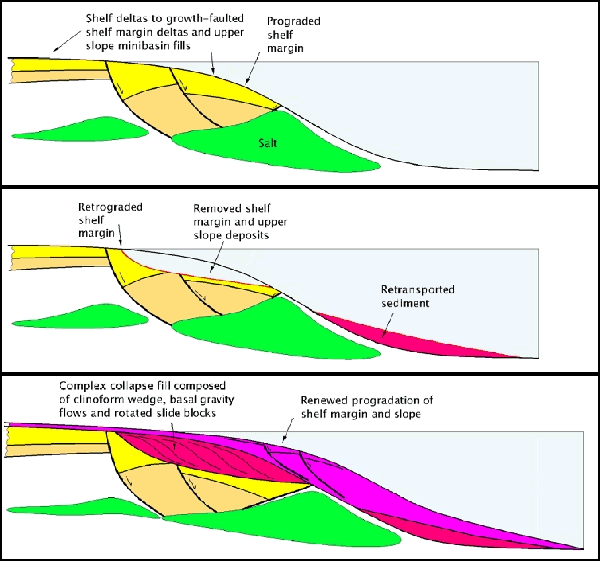
Tertiary Depositional The large-scale relationships between stratigraphy and structure in the Gulf of Mexico basin, where the depositional substrate is highly mobile salt and shale, are well established (Diegel et al., 1995). Prodigious stratigraphic thickening in the region of the shelf margin and upper slope is associated with regional extension associated with the displacement of salt, and in some cases, the downdip gliding of thick sediment layers (Figure 4). The outer shelf, shelf margin, and upper slope area can be defined in terms
of two fundamental and complementary regimes that define the
stratigraphic relationships around the important interface between
shallow water (topset, or shelf) and deep water (foreset, slope)
settings (Figure 4). The first regime is characterized by shelf-margin
progradation associated with complex Collapse events affect wide areas of the shelf margin along strike, unlike
submarine canyons that excavate narrow dip-oriented erosional features.
Retrogradational shelf-margin collapse is related to high rates of
sediment supply, rapid progradation of the shelf margin and progradation
over a buried shelf margin (see Ross et al., 1994). There is no clear
evidence that these features form as a direct response to relative In seismic data, the diagnostic features of the retrogradational collapse are the basal collapse discontinuity, which truncates updip strata, and the internal till, which commonly has an internal clinoform signature. The features are similar in appearance, respectively, to the sequence boundary and lowstand prograding wedge unit of the sequence stratigraphic model (e.g. Edwards, 1990, 1991), although in plan view the collapse is strike continuous rather than dip elongate, as pointed out above. The collapse events usually truncate several regressive cycles, and the fill contains one to several regressive cycles. Therefore, the alternating pulses of progradation and retrogradation would be considered third order according to sequence-stratigraphic terminology (e.g. Mitchum and Van Wagoner, 1990). The relative importance of regional drainage switching, climate, eustasy, and hinterland tectonics in influencing third-order cycles still does not appear to be well understood in the Paleogene. In the Gulf Coast Basin individual regressive pulses are stratigraphic events that are commonly referred to as fourth-order sequences (e.g. Mitchum and Van Wagoner, 1990). Several papers presented under the “sequence stratigraphy” theme have discussed these cycles in the Gulf Coast Basin. A key paper that included the upper Wilcox of South Texas (Mitchum and VanWagoner, 1991) did not recognize the existence of growth faults along a cross section (their Figure 17) that traverses the well-documented upper Wilcox trend (e.g. Edwards, 1981). Unquestionably, the complex structural history of all but the youngest deposits greatly complicates the application of sequence stratigraphy to this basin margin. Nevertheless, a number of regional stratigraphic studies conducted on the Gulf Coast Basin provide a basis for delineating several key features of depositional cycles or sequences in the region (e.g. Edwards, 1980, 1990, 1991, 1994; Galloway et al., 1982; Van Wagoner et al., 1990; Xue and Galloway, 1995). Unfortunately, relatively few of the published studies combine sufficient detail (correlation and mapping to at least “fourth-order” cycles), adequately dense well control (to encounter incised valleys and channels), and regional scope extending across an entire depocenter and flank system (or even a significant portion of a depocenter or flank). Marine flooding surfaces and their associated transgressive shales and
“highstand” condensed sections are the best, and often only, regional
markers for correlating depositional cycles (e.g. Van Wagoner et al.;
1990, their Figs. 22 and 33). The cycles formed in a range of waveto
river-dominated coastal plains and shorelines, often in relation to
well-defined depocenters and depoflanks (Fisher and McGowen, 1967;
Galloway, 1989a, b; Edwards, 199 1; Morton et al., 1988, 1991).
Depending on facies, cycles can be traced along dip for tens of miles.
The downdip extensions of these cycles are either truncated by collapse
erosional events or thickened dramatically by growth faulting. Regional studies illustrate examples of the distribution of lithofacies,
depositional environments, and stratigraphic architecture for the
various units mentioned above. These include the river-dominated
depocenter and depoflank of the Yegua (Edwards, 1990, 1991), the
wave-dominated interdeltaic bight of the Frio (Edwards, 1986; Galloway
and Morton, 1989), growth-faulted river-dominated, wave-influenced
Wilcox deltas (Edwards, 198 l), and the river-dominated lower Miocene
(Edwards, 1994). A key element of depocenter versus depoflank setting is
the rate of sediment supply. In a depocenter the sediment supply “hose”
is on most of the time; small relative changes in The relationship between third- and fourth-order events is shown in a dip stratigraphic cross section in the lower Miocene of southwest Louisiana (Figure 5). This section connects 20 wells and is based on the integrated analysis of almost 2,000 wells in a 1,500-mi2 area (Edwards, 1994). In this section, the higher resolution stratigraphy is provided by flooding surfaces. Two shelf-margin collapse events are identified, of which the larger earlier one represents a third-order event, as does the group of regressive cycles that occur in this part of the lower Miocene. Sediment gravity flows locally overlie the collapse unconformities. I will selectively cite the literature in order to make several points
within the scope of this paper. These concern the distribution and
properties of channel-form features, and the delivery of sand to the
shelf margin. Typically, sequence stratigraphy recognizes channel-form
features to be either distributary channels or incised valleys (e.g. Van
Wagoner et al., 1966, their Figure 26). This model of extremes led to an
interpretation of the middle Miocene sandstones as having been either
lowstand incised valleys or highstand shelf and mouth bar sands (Van
Wagoner et al., 1988, their Figure 33). In a study of the lower Miocene
(Edwards, 1994), I displayed a series of maps of selected channel-form
Although the study of the lower Miocene mapped and analyzed the section
using fourth-order stratigraphic features, another example that may be
more compelling is a regional study of the middle Eocene Yegua and Cook
Mountain Formations that spans the entire depocenter and flanks
(Edwards, 1990, 1991). This study was based on about 4,500 well logs and
detailed fourth-order The depocenter is characterized by an area of amalgamated and coalesced
mouth-bar sands along the shelf margin, with mappable associated
channels. Thus, many of the channels are surrounded by mouth bars. Some
of the channels, however, appear to be associated with downdip
shelf-margin deltas, without adjacent mouth-bar deposits (bays of Figure
6). In contrast, in the depocenter flanks, channels can be mapped across
the shelf and are associated with downdip shelf-margin deltas. In
several cases channels cannot be mapped across the entire shelf but only
inferred from limited updip well control. The occurrence of shelf-margin
deltas in the same depositional At times, science goes to great lengths to adapt new data to existing
explanations. Past examples include complex solar system models designed
to remain geocentric, and the original grouping of the Burgess Shale
invertebrate fauna in existing phyla (Gould, 1989). How important are
the underlying premises if the whole paradigm shifts as refinements are
introduced? Is an underlying principle effectively buried by subsequent
developments, or does it remain a permanent, integral property of the
paradigm? For example, the astronomical system based on the positioning
of the Earth at the center of the Solar system had to eventually be
swapped out, in its entirety, for a Solar-centric system (although
lessons learned about various orbital geometries could be retained for
use in different
During relative It is possible that some degree of “forcing,” or
I would like to acknowledge Tucker Hentz’s careful review of the manuscript. Numerous oil and gas companies have supported the regional studies that underlie many of the observations made and conclusions reached in this paper. I appreciate the encouragement and support they have given to me. Beaubouef, R. T., and S. J. Friedman, 2000, High resolution seismic/sequence stratigraphic framework for the evolution of Pleistocene intra slope basins, in P. Weimer, R. M. Slatt et al., eds., Western Gulf of Mexico: Depositional models and reservoir analogs, Gulf Coast Section-SEPM Twentieth Research Conference, Deep-Water Reservoirs of the World, p. 40-60. Berryhill, H. L., Jr., J. R. Suter, and N. S. Hardin, 1986, Late Quaternary facies and structure, northern Gulf of Mexico: American Association Petroleum Geologists Studies in Geology, 23, 289 p.
Coleman, J. M., D. B. Prior, and J. F. Lindsay, 1983,
Deltaic Influences of shelf edge instability processes, in D.J. Stanley
and G Moore, eds., The Shelf Break: Critical Interface on Continental
Margins: SEPM Special Publication 33, p. 121-137. Edwards, M. B., 1980, The Live Oak delta complex, an unstable shelf-edge delta in the deep Wilcox trend of South Texas. Gulf Coast Association of Geological Societies Transactions v. 30, p. 71-79. Edwards, M. B., 1981, Upper Wilcox Rosita Delta System of South Texas: growth faulted shelf edge deltas: American Association Petroleum Geologists Bulletin v.65, p. 54-73. Edwards, M. B., 1986, Sedimentary effects of differential subsidence in Frio shoreface-shelf sediments, Gulf Coast Tertiary: Houston Geological Society Bulletin v. 29, nr. 3, p. 10-14. Edwards, M. B., 1990, Stratigraphic analysis and reservoir prediction in the Eocene Yegua and Cook Mountain Formations of Texas and Louisiana. Sequence Stratigraphy as an Exploration Tool: Gulf Coast Section SEPM, Eleventh Ammal Research. Conference, p. 15 l-l 64. Edwards , M. B., 1991, Control of depositional environments eustacy, and gravity and salt tectonics on sandstone distribution in an unstable shelf edge delta, Eocene Yegua formation, Texas and Louisiana: Gulf Coast Association of Geological Societies Transactions, v. 41, p. 237-252. Edwards, M. B., 1994, Enhancing sandstone reservoir prediction by mapping erosion surfaces, Lower Miocene deltas, southwest Louisiana, Gulf Coast Basin: Gulf Coast Association of Geological Societies Transactions, v. 44, p. 205-215. Edwards, M. B., 1995a, Differential subsidence and preservation potential of shallow water Tertiary sequences, northern Gulf Coast Basin, U.S.A., in A. G. Plint, ed., Sedimentary Facies Analysis: A Tribute to the Research and Teaching of Harold G. Reading. International Association of Sedimentologists Special Publication 22, p. 285-281. Edwards, M. B., 1995b, A Journeyman’s Approach to Sequence Stratigraphy: Lafayette Geological Society, Lafayette, Louisiana, 11 p. Edwards, M. B., 2000, Origin and significance of retrograde failed shelf margins; Tertiary northern Gulf Coast Basin: Gulf Coast Association of Geological Societies Transactions, v. 50, p. 81-93.
Fisher, W. L., and J. H. McGowen, 1967, Depositional
Fisk, H. N., 1944, Geological investigation of the alluvial valley of the lower Mississippi River: Vicksburg, Mississippi, U.S. Army, Corps of Engineers, Mississippi River Commission, 78 p. Frazier, D. E., 1974, Depositional episodes-their relationship to the Quaternary stratigraphic framework in the northwestern portion of the Gulf Basin: The University of Texas at Austin, Bureau of Economic Geology Circular No. 74-1,28 p. Galloway, W. E. 1989a, Genetic stratigraphic sequences in basin analysis I: architecture and genesis of flooding-surface bounded depositional units: American Association Petroleum Geologists Bulletin v.73, p.125-142. Galloway, W. E. 1989b, Genetic stratigraphic sequences in basin analysis II: application to northwest Gulf of Mexico Cenozoic basin: American Association Petroleum Geologists Bulletin v.73, p. 143-154. Galloway, W. E. and R. A. Morton, 1989, Geometry, genesis, and reservoir characteristics of shelf sandstone facies , Frio Formation (Oligocene), Texas coastal plain, Gulf Coast Section SEPM Seventh Ammal Research Conference, p. 89-115.
Galloway, W. E., D. K. Hobday, and K. Magara 1982, Frio
Formation of the Texas Gulf Coast Basin: Depositional Gould, S. J.,1989, Wonderful Life. W. W. Norton and Co. NY. 347 p.
Hunt, D., and M. E. Tucker, 1992, Stranded parasequences
and the forced regressive wedge
Hunt, D., and M. E. Tucker, 1995, Stranded parasequences
and the forced regressive wedge Kindinger, J. L., 1988, Seismic stratigraphy of the Mississippi-Alabama shelf and upper continental slope: Marine Geology, v. 83, p. 79-94. Kolla, V., P. Biondi, B. Long, R. and Fillon, 2000, Sequence stratigraphy and architecture of the late Pleistocene Lagniappe delta complex, northeast Gulf of Mexico, in D. Hunt and R. L. Gawthorpe, eds., Sedimentary Responses to Forced Regressions, Geological Society London Special Publication 172, p. 291-327.
Kolla, F., H. W. Posamentier, and H. Eichenseer, 1995,
Stranded parasequences and the forced regressive wedge Mitchum, R. M., and J. C. Van Wagoner, 1990, High-frequency sequences and eustatic cycles in the Gulf of Mexico Basin: Gulf of Mexico: Sequence Stratigraphy as an Exploration Tool: Gulf Coast Section SEPM, Eleventh Ammal Research Conference, p. 257-267. Mitchum, R. M., Jr., and J. C. Van Wagoner, 1991, High-frequency sequences and their stacking patterns: sequence-stratigraphic evidence of high-frequency eustatic cycles: Sedimentary Geology, v. 70, p. 131-160. Morton, R. A.,1993, Attributes and origins of ancient submarine slides and filled embayments: examples from the Gulf Coast Basin: American Association Petroleum Geologists Bulletin, v. 77, p. 1064-1081. Morton, R. A., L. A. Jirik, and W. E. Galloway, 1988, Middle-Upper Miocene Depositional Sequences of the Texas Coastal Plain and Continental Shelf: Geologic Framework, Sedimentary Facies, and Hydrocarbon Plays: The University of Texas at Austin, Bureau of Economic Geology Report of Investigation 174, 40 p. Morton, R. A., R. H. Sams, and L. A. Jirik, 1991, Plio-Pleistocene Depositional Sequences of the Southeastern Texas Continental Shelf and Slope: Geologic Framework, Sedimentary Facies, and Hydrocarbon Distribution: The University of Texas at Austin, Bureau of Economic Geology Report of Investigation 200, 80 p. Morton, R.A., and J. R. Suter, 1996, Sequence stratigraphy and composition of late Quaternary shelf-margin deltas, northern Gulf of Mexico: American Association Petroleum Geologists Bulletin, v. 80, p. 505-530.
Posamentier, H. W., and P R. Vail, 1988, Eustatic
controls on elastic deposition II-sequence and Posamentier, H. W., G. P. Allen, D. P. James, M. Tesson, 1992, Forced regressions in a sequence stratigraphic framework: concepts, examples, and exploration significance: American Association Petroleum Geologists Bulletin, v. 76, p. 1687-1709. Prather, B. E., J. R. Booth, G. S. Steffens, and P. A. Craig, 1998, Classification, lithologic calibration, and stratigraphic succession of seismic facies of intraslope basins, deep-water Gulf of Mexico: American Association Petroleum Geologists Bulletin, v. 82, p. 701-728. Pulham, A. J., 1993, Variations in slope deposition, Pliocene-Pleistocene, offshore Louisiana, northeast Gulf of Mexico: American Association Petroleum Geologists Memoir 58, p. 1999233. Ross, W. C., B. A. Halliwell, J. A. May, D. E. Watts and J. P. M. Syvitski, 1994, Slope readjustment: a new model for the development of submarine fans and aprons: Geology, v. 22, p. 5 1 l-5 14. Suter, J. R., and H. L. Berryhill, Jr., 1985, Late Quaternary shelf-margin deltas, northwest Gulf of Mexico: American Association Petroleum Geologists Bulletin, v. 69, p. 77-91. Sydow, J., and H. H. Roberts, 1994, Stratigraphic framework of a late Pleistocene shelf-edge delta, northeast Gulf of Mexico: American Association Petroleum Geologists Bulletin, v. 78, p. 1276-1312. Sydow, J., H. H. Roberts, A.H. Bouma, and R. D. Wlnn, 1992, Constructional subcomponents of a shelf-edge delta, northeast Gulf of Mexico: Gulf Coast Association of Geological Societies Transactions, v. 42, p. 717-726.
Van Wagoner, J. C., H. W. Posamentier, R. M. Mitchum, P.
R. Vail, J. F. Sarg, T. S. Loutit, and J. Hardenbol, 1988, An overview
of sequence stratigraphy and key defmitions, in C. K. Wilgus et al.,
Van Wagoner, J. C., R. M. Mitchum, K. M. Campion, and V D. Rahmanian, 1990, Siliciclastic sequence stratigraphy in well logs, cores, and outcrops: concepts of high-resolution correlation of time and facies: American Association Petroleum Geologists Methods in Exploration 7, 55p.
Vail, P. R., R. M. Mitchum, and S. Thompson, 1977,
Seismic stratigraphy and global changes of Winker, C. D., and J. R. Booth, 2000, Sedimentary dynamics of the salt-dominated continental slope, in P. Weimer, R. M. Slatt et al., eds., Deep-Water Reservoirs of the World, Gulf Coast Section SEPM Twentieth Research Conference, p. 1059-1086. Winker, C.D. and Edwards 1983: Unstable progradational elastic shelf margins, in D.J. Stanley and G. Moore, eds., The Shelf Break: Critical Interface on Continental Margins, SEPM Special Publication 33, p.139-157. Winn, R. D., Jr., H. H. Roberts, B. Kohl, R. H. Fillon, A.H. Bouma, and R.E. Constans, 1995, Latest Quaternary deposition on the outer shelf, northern Gulf of Mexico: Facies and sequence stratigraphy from Main Pass Block 303 shallow core: Geological Society of America Bulletin, v. 107, p. 851-866. Winn, R. D., Jr., H. H. Roberts, B. Kohl, R. H. Fillon, J. A. Crux, A.H. Bouma, and H. W. Spero, 1998, Upper Quaternary strata of the upper continental slope, northeast Gulf of Mexico: Sequence stratigraphic model for a terrigenous shelf edge: Journal of Sedimentary Research, v. 68, n. 4, p. 579-595. Xue, Liangqing, and William E. Galloway, 1995, High-Resolution Depositional Framework of the Paleocene Middle Wilcox Strata, Texas Coastal Plain: American Association Petroleum Geologists Bulletin, 79, p. 205-230. |
 Figure
1. Depositional elements and significant surfaces in a shelf to shelf
margin setting characterized by high sediment input and falling
Figure
1. Depositional elements and significant surfaces in a shelf to shelf
margin setting characterized by high sediment input and falling  Figure
2. Strata1 patterns and chronostratigraphy according to the standard
Exxon sequence-stratigraphic model.
Figure
2. Strata1 patterns and chronostratigraphy according to the standard
Exxon sequence-stratigraphic model. Figure
3. Strata1 patterns and chronostratigraphy for the regressive
Figure
3. Strata1 patterns and chronostratigraphy for the regressive  Figure
4. Schematic cartoon to illustrate the large-scale (third-order) phases
of shelf-margin progradation and slope-minibasin initiation, alternating
with phases of shelf-margin retrogradation.
Figure
4. Schematic cartoon to illustrate the large-scale (third-order) phases
of shelf-margin progradation and slope-minibasin initiation, alternating
with phases of shelf-margin retrogradation. Figure
5. Stratigraphic dip section hung on the Lower Miocene S. davisi
marker.
Figure
5. Stratigraphic dip section hung on the Lower Miocene S. davisi
marker. Figure
6. Depositional-environment map of a major regressive sequence of the
Yegua Formation, middle Eocene of southeast Texas and southwest
Louisiana.
Figure
6. Depositional-environment map of a major regressive sequence of the
Yegua Formation, middle Eocene of southeast Texas and southwest
Louisiana.