
 Print this page
 Click to view page images in PDF format.
The USGS World  Oil
Oil and Gas Assessment*
Thomas S. Ahlbrandt, United States Geological Survey, Denver, CO
Search and Discovery Article #10006 (2000)
*Slight
revision of abstract of paper presented at AAPG Convention, April, 2000, in New
Orleans, together with parts of article, World Oil Resource Forecast Increases,
in AAPG Explorer, June, 2000.
A
new assessment by the U.S. Geological Survey of the technically recoverable
undiscovered oil and gas resources of the world was released at the World
Petroleum Congress in Calgary in June 2000. Assessments were made by a team of
over 30 geoscientists at the end
of the calendar year 1999. Petroleum systems are identified and assessed using a
probabilistic methodology coupled with geologic analysis. Nearly 1,000 provinces
were defined; they in turn were grouped into eight regions roughly comparable to
the eight economic regions defined by the U.S. State Department. Petroleum
resources are allocated to 409 of these (refer to Figures
1, 2). A total of 76
priority provinces containing 95% of the world’s known oil and gas and 26
boutique, or highly prospective, provinces are assessed. Based upon our initial
analyses, several observations are clear. First, our estimates of undiscovered
technically recoverable oil resources will not differ greatly from those of the
1994 USGS assessment; however, estimates of both natural gas and natural gas
liquid resources will be larger than previous estimates (refer to Figures
3, 4).
In addition, field growth estimates** of known fields will likely be large and
several algorithms are utilized to encompass uncertainty
associated with this critical component of any analysis of world oil and
gas supply. A production plateau concept of reserve development rather than a
bell shaped (or Hubbert) production profile is advocated and is linked to the
concept of field growth. Continuous or unconventional oil and gas resources have
been captured digitally for a future assessment effort and represent a
significant future resource. A series of digital products including geologic
maps of the world as well as petroleum system write-ups have been made available
via the CD-ROM and the internet. These digital products and the methodology
employed in the assessment have been favorably reviewed by the National Academy
of Science (NRC), AAPG and GIS World.
**Estimates of reserve growth at the world level were made for the first time in Assessment 2000. Reserve growth estimates nearly equal those of undiscovered resources. Reserve growth results from the following:
-
As drilling and production within discovered fields progresses, new pools or reservoirs are found that were not previously known.
-
Advances in exploration technology make it possible to identify new targets within existing fields.
-
Advances in drilling technology make it possible to recover
oil, and gas not previously
considered recoverable in the initial reserve estimates. -
Enhanced
oil recovery techniques increase the recovery factor for oil and thereby
increase the reserves within existing fields.
Other highlights of the assessment:
-
A 20 percent increase in undiscovered
oil and a slight decrease in undiscovered
natural gas. -
More
oil and gas in the Middle East and in the offshore areas of western Africa and
eastern South America than previously reported. -
Significantly lower volumes of natural
gas in the Former Soviet Union.
Notable Quotes:
Thomas S.
Ahlbrandt: “There is still an abundance of oil and gas in the world. Since oil
became a major energy source about 100 years ago, about 539 billion barrels of
oil have been produced outside of the United States. We now estimate the total
amount of future technically recoverable oil, outside the U.S., to be about
2,120 billion barrels.”
Gene Whitney, USGS:
“These assessments provide a snapshot of current information about the
location and abundance of undiscovered oil and gas resources at a point in
history, Such an overview provides exploration geologists, economists and
investors a general picture of where oil and gas resources are likely to be
developed in the future.”
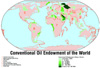 Figure 1.
Conventional oil endowment of the world.
Figure 1.
Conventional oil endowment of the world.
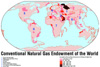 Figure 2.
Conventional natural gas endowment of the world.
Figure 2.
Conventional natural gas endowment of the world.
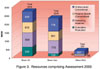 Figure 3. Estimates
of oil and gas resources, including conventional reserve growth, in Assessment
2000.
Figure 3. Estimates
of oil and gas resources, including conventional reserve growth, in Assessment
2000.
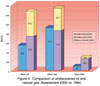 Figure 4.
Estimates of undiscovered oil and natural gas, together with reserve
growth, Assessment 2000 in comparison to assessment in 1994.
Figure 4.
Estimates of undiscovered oil and natural gas, together with reserve
growth, Assessment 2000 in comparison to assessment in 1994.
