Print this page
 Click to view article in PDF format.
GCSobel Filtering Brings Edges into Sharp Focus*
Satinder Chopra¹ and Kurt J. Marfurt²
Search and Discovery Article #41511 (2015)
Posted January 12, 2015
*Adapted from the Geophysical Corner column, prepared by the authors, in AAPG Explorer, January, 2015. Editor of Geophysical Corner is Satinder Chopra ([email protected]). Managing Editor of AAPG Explorer is Vern Stefanic. AAPG © 2015
¹Arcis Seismic Solutions, TGS, Calgary, Canada ([email protected])
²University of Oklahoma, Norman, Oklahoma
Mapping of geologic edges such as faults or channel levees forms a critical component in the  interpretation
 on 3-D seismic volumes. While the more prominent features often can be easily visualized, smaller features important to understanding the structural and depositional environment can be easily overlooked. Careful manual interpretation of such features is both tedious and time consuming. A seismic coherence attribute that enhances edges not only accelerates the interpretation process, it also provides a quantitative measure of just how significant a given discontinuity is in relation to others.
Since the seismic coherence attribute extracts all subtle features in the seismic amplitude volume, then preconditioning the data to enhance geologic edges and minimize edges due to acquisition and processing is key to accurate analysis. We find that the application of a Sobel filter to energy-ratio coherence volumes significantly sharpens faults and channel edges of interest. We demonstrate this simple cascaded workflow with examples from Canada, where one of the objectives is to provide improved attributes for subsequent automatic fault plane extraction.
|
♦General statement ♦Figures ♦Method ♦Examples ♦Conclusions
♦General statement ♦Figures ♦Method ♦Examples ♦Conclusions
♦General statement ♦Figures ♦Method ♦Examples ♦Conclusions
♦General statement ♦Figures ♦Method ♦Examples ♦Conclusions |
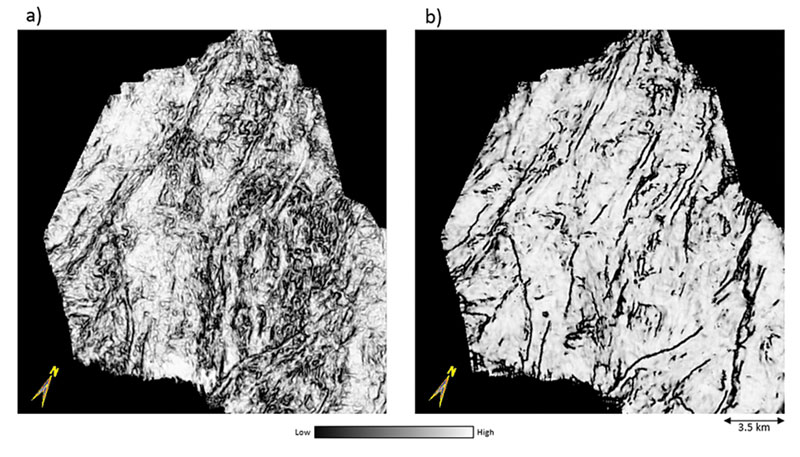
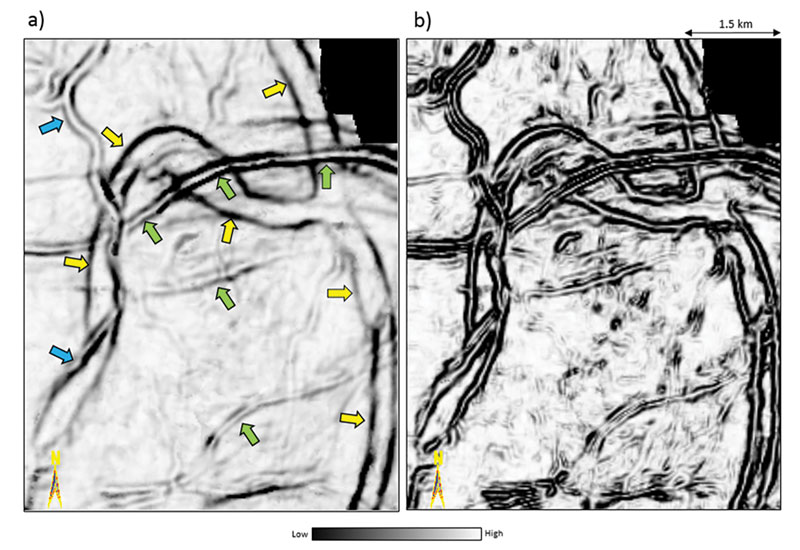
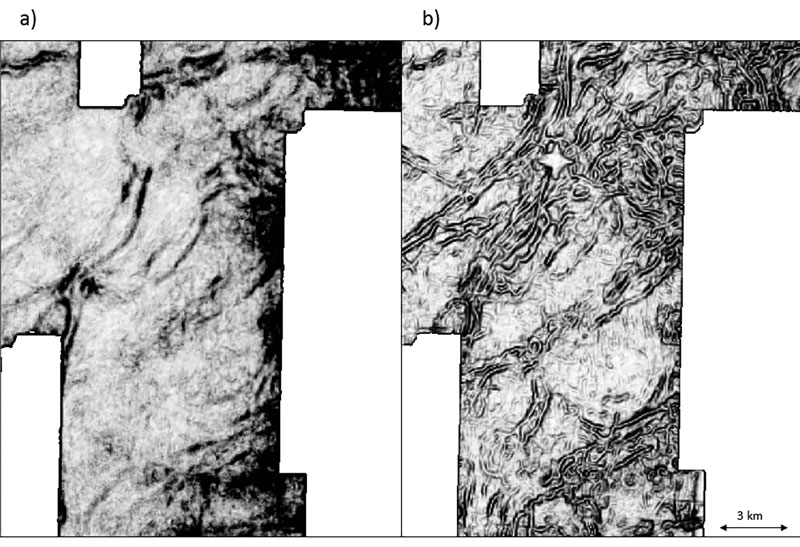
Sobel filters are one of many filters that are commonly distributed when one purchases a digital camera. For a flat photograph containing pixels of a given amplitude aligned along the x and y axes, the classical Sobel-filtered image is simply obtained by running a process equivalent to the square-root of the sum of the squares of derivatives of the amplitude in the x and the y directions. Unlike a photograph, seismic images have a third dimension. A similar process (equivalent to the square-root of the sum of the squares of derivatives of the amplitude in the inline and crossline directions along structural dip) normalized by the RMS amplitude in the window of application to account for structural dip can be run on the seismic data. This normalization will enhance lower amplitude edges when applied to a coherence input volume. In Figure 1 we show the application of Sobel filtering on a 3-D seismic volume from Alberta, Canada, and compare it with an energy-ratio algorithm application for coherence attribute. Notice that subtle stratigraphic features appear stronger on the Sobel filter display while the larger faults and fractures are much clearer on energy-ratio coherence. In this image, the two attributes are not redundant, but complementary. Since the classical Sobel filter is routinely used in sharpening photographic images, we hypothesize that we can do the same by applying it to edge-sensitive seismic attributes such as coherence. We can achieve this goal by simply cascading the two attribute calculations. First we apply energy-ratio coherence to the original seismic amplitude to obtain good quality The data going into coherence computation are usually preconditioned In Figure 2b we show the result of applying the Sobel filter to the coherence volume. Notice the crisp definition of the channels on this display. Besides the main channels, many of the narrower channels are seen clearly. Invariably, the definition of all the channels on the display is very prominent. In Figure 3 we show a comparison of Such convincing displays of the application of Sobel filters to coherence volumes suggest that discontinuity features – such as channels as well as faults – can be enhanced, resulting in crisper and more focused images. We believe such images provide superior input to modern object extraction software application, as well as in visualizing the channel features clearly. The present exercise can be easily extended to other features of interest, such as faults, which would be a useful input for automatic |