Print this page
 Click to view article in PDF format.
GCAutotracking  Horizons
 in Seismic Records*
Satinder Chopra¹ and Kurt J. Marfurt²
Search and Discovery Article #41489 (2014)
Posted November 17, 2014
*Adapted from the Geophysical Corner column, prepared by the authors, in AAPG Explorer, November, 2014, and entitled "Autotracking Your Way to Success". Editor of Geophysical Corner is Satinder Chopra ([email protected]). Managing Editor of AAPG Explorer is Vern Stefanic.
¹Arcis Seismic Solutions, TGS, Calgary, Canada ([email protected])
²University of Oklahoma, Norman, Oklahoma
A horizon is a reflection surface picked on a 3-D seismic data volume that is considered to represent either a lithologic interface or a sequence stratigraphic boundary in the subsurface. Usually, an interpreter begins the exercise of identifying the different subsurface horizons by correlating the available well log data with the seismic data. In its simplest form, such identification can be done by hanging an impedance log curve on the seismic data – or more quantitatively, by generating a synthetic seismogram from the impedance log curve using an appropriate wavelet and correlating the result with measured seismic traces about the well. Depending on the seismic data quality and either the presence or lack of isolated strong reflectors, identifying horizons can be a trivial exercise or a challenging problem.
|
♦General statement ♦Figures ♦Metod ♦Examples ♦Conclusions
♦General statement ♦Figures ♦Metod ♦Examples ♦Conclusions
♦General statement ♦Figures ♦Metod ♦Examples ♦Conclusions
♦General statement ♦Figures ♦Metod ♦Examples ♦Conclusions
♦General statement ♦Figures ♦Metod ♦Examples ♦Conclusions
♦General statement ♦Figures ♦Metod ♦Examples ♦Conclusions |
In the beginning, Today's automated horizon-
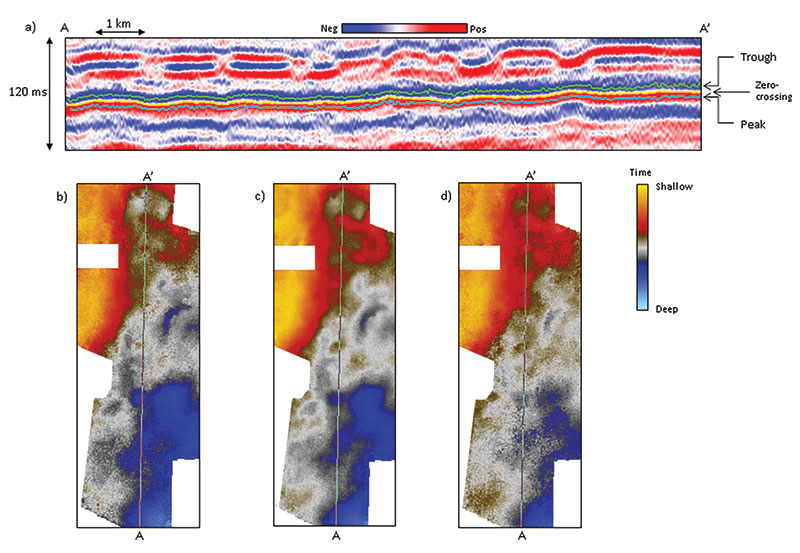
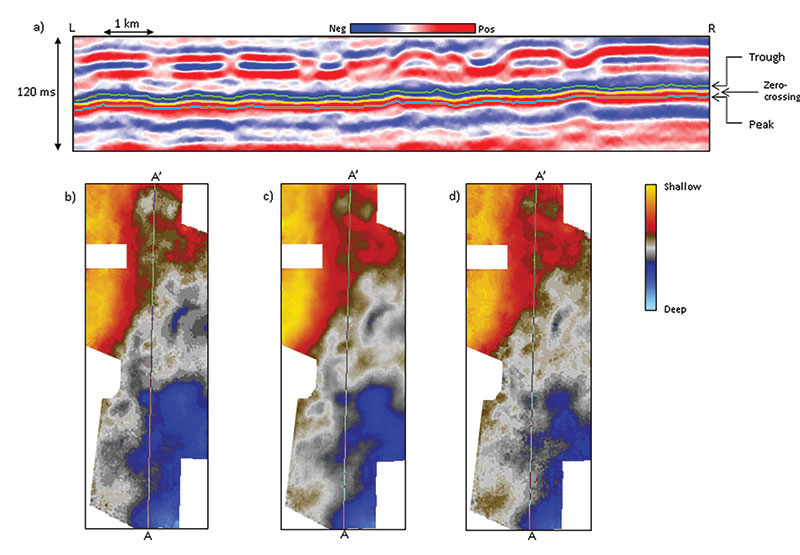
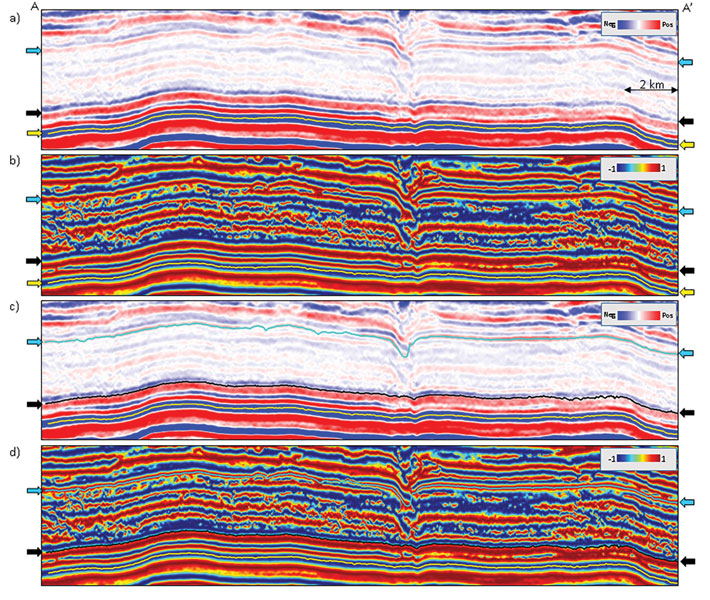
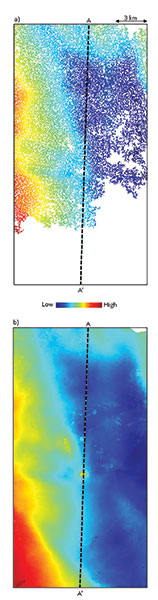
Autotracking works very well on coherent seismic reflectors. With a single click of a cursor on the given phase (peak, trough, and positive to negative or negative to positive zero crossings) the complete surface can be rapidly picked in no time. Through the use of time-structure and dip magnitude maps, one can just as rapidly identify busts in the Because of lateral changes in overburden and vertical changes in reflectivity, seismic A question that usually arises is: Why should one pick a zero-crossing if the seismic well tie is a peak or a trough? If the objective is to map an abrupt change in impedance between thick layers, the well tie usually will be a peak or a trough. If the objective is to map a thin bed, the well tie is usually a zero-crossing. Our experience has shown that seismic travel time picks are less contaminated with noise along a zero-crossing than along a peak or a trough. Peaks and troughs are locally flat, so a small amount of noise shifts them vertically. In contrast, zero-crossing occurs where the amplitude changes most rapidly, such that its location is less impacted by low amplitude noise. Of course, the quality of such horizon displays will depend on the S/N ratio of the In Figure 1 we show a vertical slice through a seismic amplitude volume with automatic picks made of peaks (in cyan), troughs (in green), and zero-crossings (in yellow). Notice the resulting time-structure maps from the peak and trough picks are noisier than that from the zero-crossing picks. As the input seismic In Figure 2, we show the equivalent segment of the seismic section shown in Figure 1, but after application of a structure-oriented median filter. The same The take-away from this simple exercise is that Not all geological markers of interest may correspond to a strong peak or a strong trough. Many times a horizon has to be tracked along a weak amplitude peak or trough, where autotracking breaks down. In such cases the use of seismic attributes has been suggested. In the November 2004 Geophysical Corner – Search and Discovery Article #40141, an interesting application in terms of the use of the cosine of instantaneous phase attribute for autotracking was discussed. The complex trace attributes serve to examine the amplitude, phase and frequency delinked from each other. The instantaneous phase attribute can be analyzed without the amplitude information, but is discontinuous for both 180 degrees and -180 degrees. The cosine of instantaneous phase has a value of unity for both these angles, and so is a better attribute to pick In Figure 3a we show a segment of a seismic section, where a strong trough (yellow arrows) has been conveniently autotracked. However, if the zero-crossing corresponding to the blue and black arrows has to be picked, it does not track well. The equivalent cosine of instantaneous phase attribute section is shown in Figure 3b. In Figure 4a we show the display of the autotracked horizon attempted on the seismic corresponding to the black arrow. Notice it is not tracked as a complete surface. The same horizon when tracked on the cosine of the instantaneous phase attribute is shown in Figure 4b and is seen as a complete, relatively smooth surface. Most autotrackers internally use a cross-correlation algorithm to compare adjacent waveforms. Weak reflectors can be overpowered by adjacent stronger reflectors as well as by stronger cross-cutting noise. By balancing the amplitude, the cosine of instantaneous phase attribute minimizes these interference effects. If |