Print this page
 Click to view article in PDF format.
GCSpectral Decomposition for 3-D Geomodeling*
Brad C. Wallet¹
Search and Discovery Article #41408 (2014)
Posted August 11, 2014
*Adapted from the Geophysical Corner column, prepared by the authors, in AAPG Explorer, August, 2014. Editor of Geophysical Corner is Satinder Chopra ([email protected]). Managing Editor of AAPG Explorer is Vern Stefanic.
¹University of Oklahoma, Norman, Oklahoma ([email protected])
Spectral decomposition  attributes
 use a localized time-frequency decomposition within individual traces to characterize seismic data by its spectral content. Since localized spectral content can be linked to physical phenomena of channels such as fill velocity and thickness, such techniques have been popular in the past decade for characterizing and interpreting of fluvial systems including turbidites.
The original work using spectral decomposition focused upon qualitative interpretation upon time slices and/or phantom horizons with a goal of broad scale interpretation and reservoir description. In recent years, however, a number of workflows have been developed to use spectral decomposition for 3-D geomodeling to extract architectural elements such as channels. Most of these methods are proprietary – and, to my knowledge, few have been documented or published.
A typical workflow might involve the use of the instantaneous frequency attribute to determine the dominant frequency associated with a channel. Once this information has been ascertained, an interpreter then might use some spatially associated thresholding (i.e. amplitude clipping) method to extract the channel. These results then would undergo further processing, such as smoothing or denoising, to produce a final interpretation.
|
♦General statement ♦Figures ♦Method ♦Example ♦Conclusion ♦Acknowledgment
♦General statement ♦Figures ♦Method ♦Example ♦Conclusion ♦Acknowledgment
♦General statement ♦Figures ♦Method ♦Example ♦Conclusion ♦Acknowledgment
♦General statement ♦Figures ♦Method ♦Example ♦Conclusion ♦Acknowledgment
♦General statement ♦Figures ♦Method ♦Example ♦Conclusion ♦Acknowledgment |
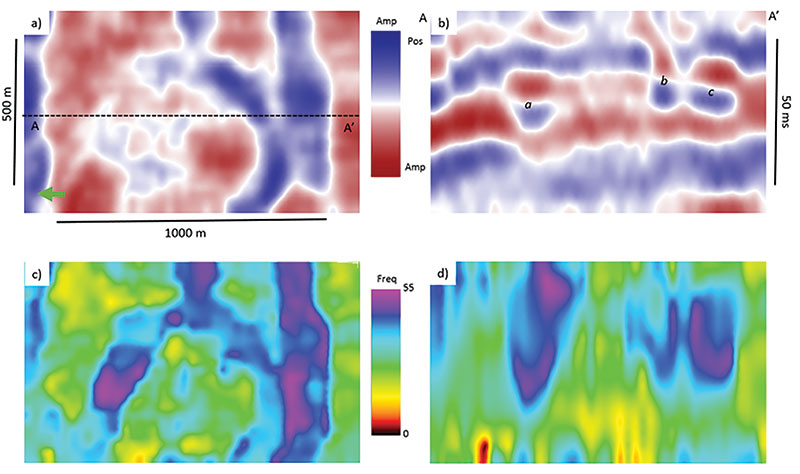
Figure 1 illustrates how a workflow like this would be constructed: instantaneous frequency attribute at locations matching those shown in Figure 1a and Figure 1b, respectively.An examination of these images suggests that the channels might be associated with frequencies in the 40-60 Hz range. This relationship is much stronger for channels "a" and "c," which have better defined tops than channel "b." Note that 50 Hz corresponds to a period of 20 ms, which is the approximate trough to trough thickness associated with all three channels. One possible pitfall is related to the spatial uncertainty associated with spectral To assess whether a 3-D geomodeling workflow was feasible and valid, I decided to look at the vertical characteristics of some spectral magnitude One aspect of the vertical localization will depend upon the algorithm, as there are a number of methods to calculate spectral decomposition Note that the trough-to-peak distance for all three channels is approximately 30 ms, while the trough-to-trough distance in these channels, as previously noted, is approximately 20 ms. These correspond to frequencies of approximately 30 Hz and 50 Hz, respectively. A low magnitude region matches our intuition for a peak-to-trough region when decomposed using a unimodal wavelet with an internal peak and trough as the internal components will destructively combine when convolved with the two positive sides of the wavelet. Channel "c," while well defined, is not delineated to its proper top. Again, channel "c" is particularly well defined. However, there are some less well defined regions along a portion of the top of channel "a." Either channel b's top or bottom would be somewhat misplaced spatially, depending upon the choice of cutoff for segmenting. Additionally, the inter-fluvial region between channels b and c is sharply defined by a particularly strong low magnitude event. In conclusion, these results show that there is a promise to algorithms using spectral decomposition Finally, while the results do show vertical localization, all of the images of the I would like to thank Victor Aarre and AAPG members Kurt Marfurt and Roger Slatt (Honorary) for many insightful discussions concerning this and related topics. Additionally, I would like to thank Schlumberger for providing the data used in this work. Finally, I would like to thank the sponsors of the Attribute Assisted Seismic Processing and Interpretation (AASPI) Consortium for their ongoing support. |