Print this page
 Click to view article in PDF format.
GCSpectral Decomposition Methods: Applicability and Limitations*
Satinder Chopra¹ and Kurt J. Marfurt²
Search and Discovery Article #41323 (2014).
Posted April 14, 2014
*Adapted from the Geophysical Corner column, prepared by the author, in AAPG Explorer, March, 2014, and entitled "So Many Challenges – But So Many Choices".
Editor of Geophysical Corner is Satinder Chopra ([email protected]). Managing Editor of AAPG Explorer is Vern Stefanic.
¹Arcis Corp., Calgary, Canada ([email protected])
²University of Oklahoma, Norman, Oklahoma
The previous three Geophysical Corner articles have focused on the spectral decomposition of seismic data, describing some of the methods and their applications (Search and Discovery Articles #41260, #41272 and #41273)
This month we add another one on the same topic, showing the comparative performance of some of the methods commonly available in the interactive interpretation software packages. Each of these methods has its own applicability and limitations, and the choice of a particular method also could depend on the end objective.
|
|
The most basic and perhaps the simplest method is the traditional Fourier transform method, also known as the short-window discrete Fourier transform (SWDFT) method. As the name implies, when using a fixed
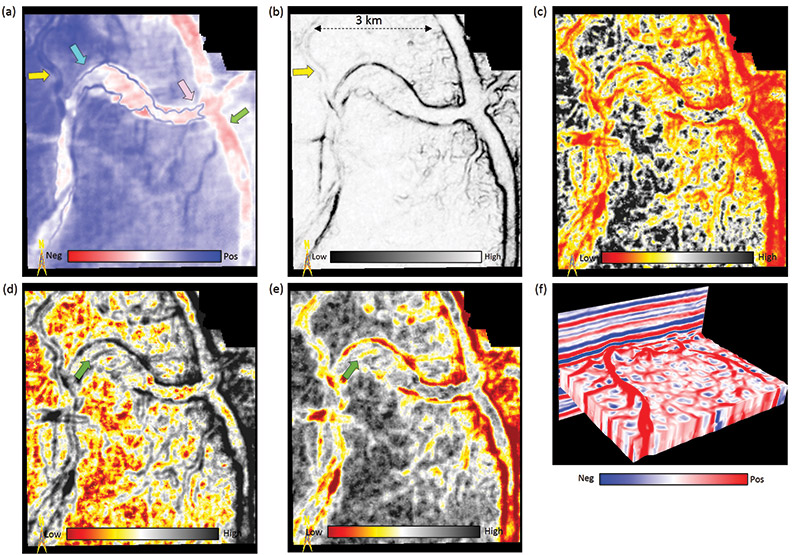
Figure 1a shows a comparison of stratal
The shape of
In Figure 1d we show a 55 Hz spectral magnitude display, using CWT equivalent to the previous stratal One can implement these transforms in two ways: In general, the S-transform yields better temporal resolution than the SWDWT, especially at higher frequencies (Figure 1e). By construction, the CWT and S-transforms produce lower temporal resolution at lower frequencies. The continuous wavelet packet-like transform (CWPT) method overcomes this limitation by dividing the window into sub-windows but keeping the same central frequency. This makes it somewhat flexible and in the process displays higher resolution. This can be seen in Figure 1f, where it resolves the channel morphology better than the SWDFT and the CWT displays in Figures 1b, 1c and 1d.
In the CWT spectral decomposition method when the spectral magnitude display is sought at a given frequency – at, say, 55 Hz – it usually produces the averaged spectral amplitude response from the neighboring frequencies 50 Hz to 60 Hz.
In doing so, it results in producing a higher The wide choice of algorithms can be quite confusing. As is often the case, no algorithm is always best. If the objective is to measure the number of geologic cycles per unit The algorithm that shows the most "geology" is not necessarily the best. Longer window algorithms like the SWDFT will often cause more vertical mixing of stratigraphy, providing images with "more channels" than a shorter window S transform. While these channels exist in the data, they may be more properly associated with shallower or deeper horizons than the one being examined. Different spectral decomposition methods provide an effective way of examining the seismic response of stratigraphic geologic features in terms of spectral components and so help in the interpretation. Each of the methods described above have their own advantages and limitations. The user is expected to understand these characteristics of the methods before making their application. We hope this article helps provide some insight into this aspect. |
 General statement