Print this page
 Click to view article in PDF format.
GCSpectral Decomposition Helps Define Channel Morphology*
Rongfeng Zhang1
Search and Discovery Article #41272 (2014)
Posted February 17, 2014
*Adapted from the Geophysical Corner column, prepared by the author, in AAPG Explorer, January, 2014.
Editor of Geophysical Corner is Satinder Chopra ([email protected]). Managing Editor of AAPG Explorer is Vern Stefanic.
1Geomodeling Technology Corp., Calgary, Alberta ([email protected])
When we see a rainbow, it is visually appealing – and the natural tendency is to appreciate its aesthetic qualities rather than study it on an analytical basis, as  frequency
 sub-bands decomposed from white light. In a similar vein, geoscientists studying seismic waves can derive results from the data as a composite signal, as well as gain insight by studying the data decomposed into frequency component parts.
Spectral decomposition has been employed in seismic interpretation for more than two decades, evolving from a niche technique to a commonly used approach due to its advantages in channel delineation, gas reservoir detection and thin-bed interpretation. Since it was formally introduced, several methods of spectral decomposition have emerged, from the popular short time Fourier transform (STFT) and continuous wavelet transform (CWT), to less frequently used methods such as matching pursuit, S-transform, chirprit transform and wavelet packet transform.
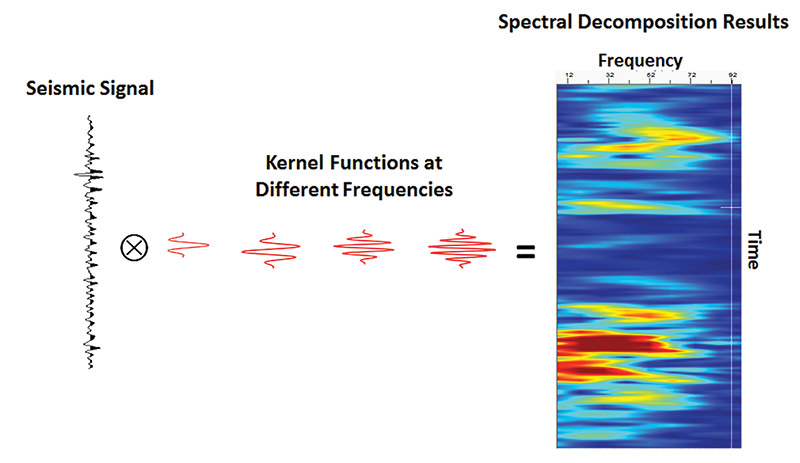
Each approach has its advantages and disadvantages, but most of these approaches have in common some kind of operation between the seismic data and serial kernel functions with closed form expressions (Figure 1):
- In STFT, sine, cosine and window functions are used.
- In CWT, a mathematic wavelet is used.
- In S-Transform, the Gaussian function is used.
In geophysical terms, these operations are designated as convolution, essentially some kind of multiplication and summation carried out in a running-window manner.
|
|
Seismic data is a collection of reflection events from the subsurface. There are diffractions, refractions and noise, but these are minor considerations when used for oil and gas exploration and reservoir characterization. These subsurface reflection events can overlap, partially or completely, depending on
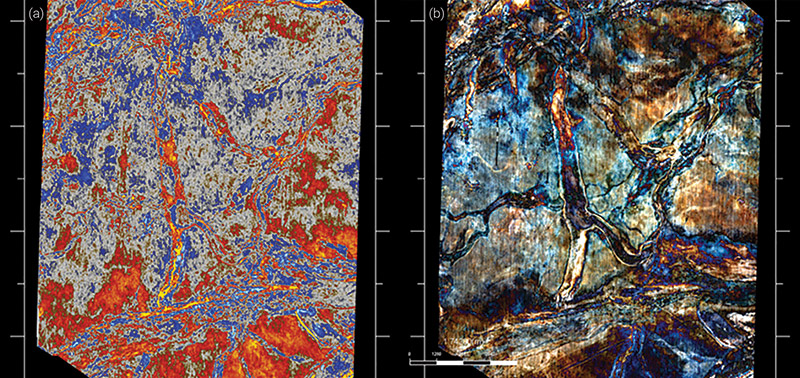
Sometimes, it is not just one particular
In Figure 2b, RGB color blending is used to put three
Combining these This article has shown the advantages of spectral decomposition in methodology and practice – but it does have drawbacks that sometimes challenge even the experienced practitioners. One of the most significant problems in spectral decomposition is the side-lobe effect: a fake event created by spectral decomposition that has nothing to do with the subsurface geology. I describe this effect in another article – and introduce a new spectral decomposition method developed to address the problem. Spectral decomposition is an effective way of analyzing the seismic response of stratigraphic geologic features. Because of tuning and the variation of the signal-to-noise ratio with |
 General statement