Print this page
 Click to view article in PDF format.
GC5-D Interpolation Fills in Missing  Data
Data *
*
Satinder Chopra1 and Kurt J. Marfurt2
Search and Discovery Article #41136 (2013)
Posted June 30, 2013
*Adapted from the Geophysical Corner column, prepared by the author, in AAPG Explorer, June, 2013, and entitled “Finding the Path Past ‘Attribute Footprints’”.
Editor of Geophysical Corner is Satinder Chopra ([email protected]). Managing Editor of AAPG Explorer is Vern Stefanic
1Arcis Corp., Calgary, Canada ([email protected])
2University of Oklahoma, Norman, Oklahoma)
Three-D seismic surveys usually are designed in a way that the subsurface features are regularly sampled in different dimensions, comprising the spatial coordinates, offsets and azimuths. Many processing algorithms require this regularity for their optimum performance. For example:
acquisition suffers from platforms, shallow shoals, and tides and currents that give rise to feathering, all of which result in irregularity in spatial sampling of the data. For older marine surveys, inlines are well sampled while crosslines are more coarsely spaced.
Land acquisition encounters a different suite of obstacles, such as highways, buildings and lakes. Such obstacles, coupled with limited recording capacity and greater cost, results in missing data or “holes” in seismic data coverage.
acquisition may add more missing traces to the usable recordable data.
Sparse or missing data create problems while processing, as the different algorithms applied pre-stack or post-stack demand regularity in the offset and azimuth dimensions for optimum performance. Non-uniformity in offsets and azimuths leads to inconsistencies in fold that follow a regular pattern we refer to as “acquisition footprint.” This imprint is an undesirable artifact that masks geologic features or amplitude variations seen on time slices from the seismic data, especially at shallow times. Besides, the seismic data-derived attribute volumes also show acquisition footprint and other artifacts. Obviously, the ideal way to fill in the missing data gaps would be to reshoot the data in those areas – although such infill acquisition would be extremely expensive per data point, if the equipment could be made available for such a small time in the field.
Such problems have been addressed at the processing stage since the advent of digital processing. The most common preconditioning of seismic data improves the signal-to-noise ratio of the seismic data by removing spatial noise or enhancing the coherency and alignment of the reflection events, without unnecessary smoothing or smearing of the discontinuities. Although we usually think of removing unwanted features, we also can improve the signal-to-noise ratio by predicting unmeasured signal, such as dead traces and lower-fold areas corresponding to unrecorded offsets and azimuths in the gathers.
|
|
Prediction or population of missing traces in
These methods worked well on stacked
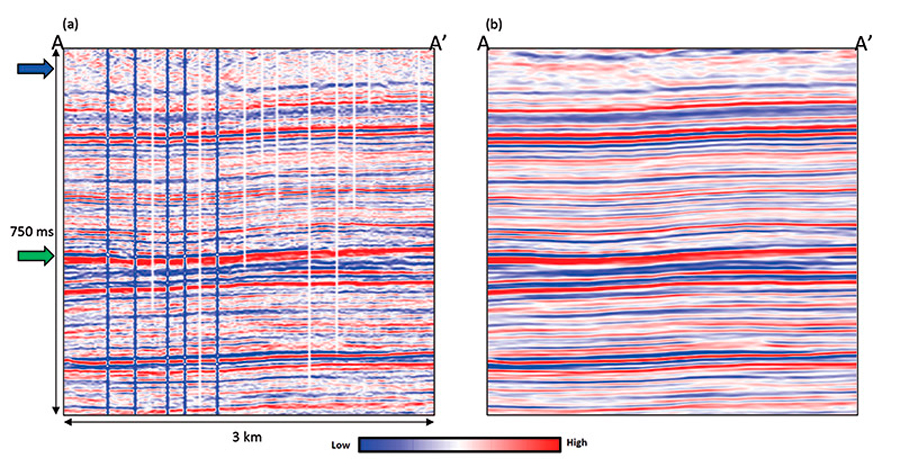
During the last decade or so, more sophisticated methods for We demonstrate here the application of one such method of 5-D interpolation on
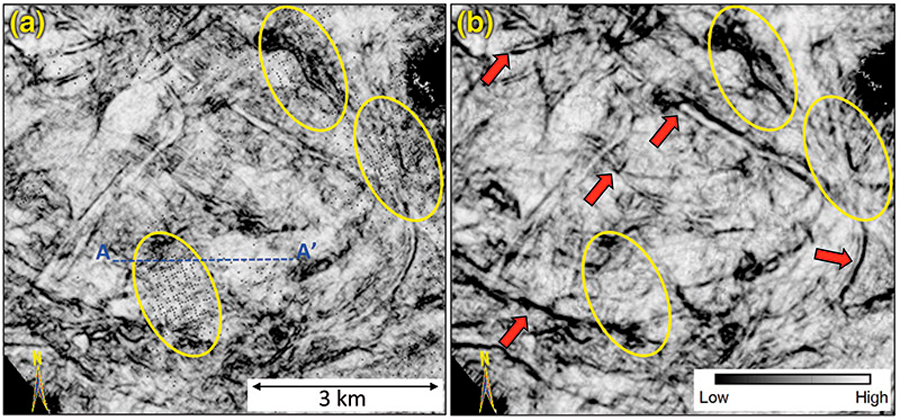
The location of this inline is shown in
Figure 2a, where we show a horizon slice through the corresponding coherence volume. The dead traces result in the speckled pattern indicated with yellow ellipses. To regularize the
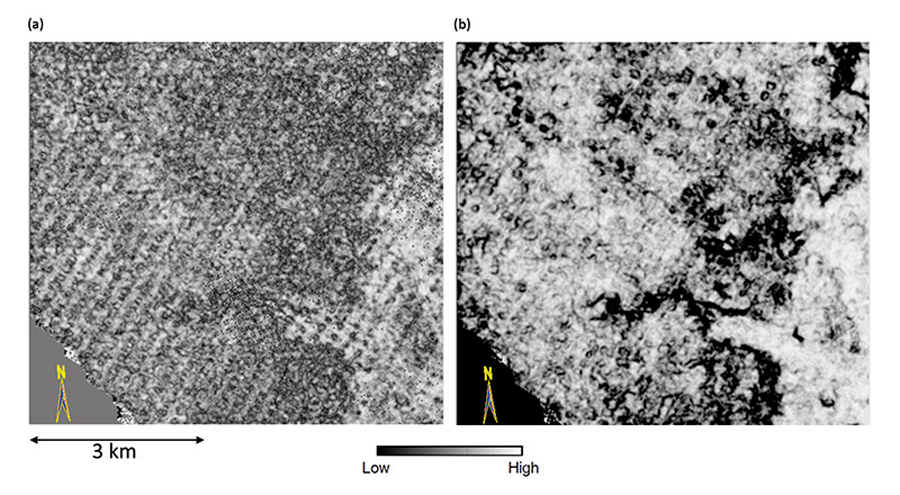
The inference we draw from this example is that regularization by 5-D interpretation yields better-focused images. Interpretation carried out on such attributes will definitely be more accurate than the one carried out on
As 5-D interpolation discussed above regularizes the geometry of the
We thank Arcis |
 General statement