Print this page
  Click to view article in PDF format.
GCP-Wave Wipeout Zones Caused by Low Gas Saturation Strata*
Bob Hardage1
Search and Discovery Article #40923 (2012)
Posted May 7, 2012
*Adapted from the Geophysical Corner column, prepared by the author, in AAPG Explorer, April, 2012, and entitled "Wipeout Zones –Blame the Rocks". Editor of Geophysical Corner is Satinder Chopra ([email protected]). Managing Editor of AAPG Explorer is Vern Stefanic; Larry Nation is Communications Director. AAPG©2012
1 Bureau of Economic Geology, The University of Texas at Austin ([email protected])
A hydrocarbon exploration application that has caused multicomponent  seismic
 data to be acquired across several offshore areas is the ability of S-wave modes to image geology inside broad, thick intervals of gas-charged sediment where P-P seismic data show no usable reflections. The term “P-wave wipeout zone” is often used to describe this imaging problem.
|
|
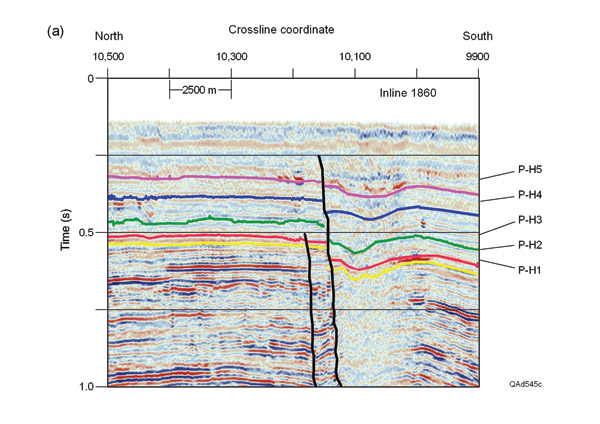
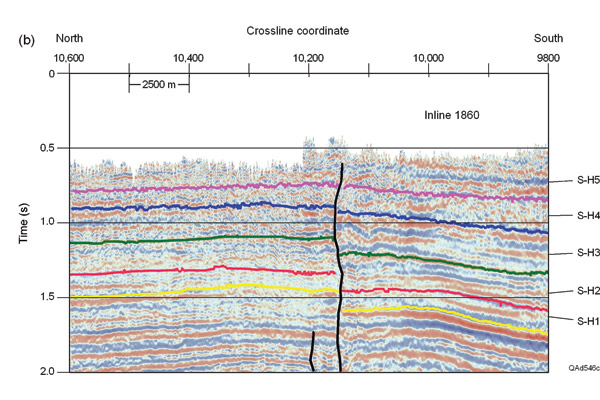
An example of P-P and converted-shear (P-SV) imaging across an area of shallow, gas-charged sediments of the Gulf of Mexico is displayed as Figure 1. Visual inspection of these images shows the P-P mode provides poor, limited information about geological structure, depositional sequences and sedimentary facies inside the image space dominated by gas-charged sediment (CDP coordinates 10,000 to 10,150). Conventional In contrast, the P-SV mode (Figure 1b) provides an image that is sufficient for structural mapping, as well as for analyzing A simple Earth model consisting of a shale layer atop a sand layer can be used to evaluate P-P and P-SV reflectivity behaviors associated with P-wave wipeout zones. Two pore-fluid situations are defined on table 1:
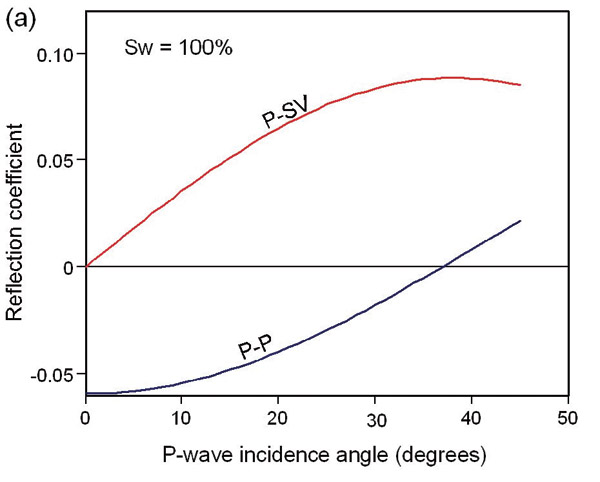
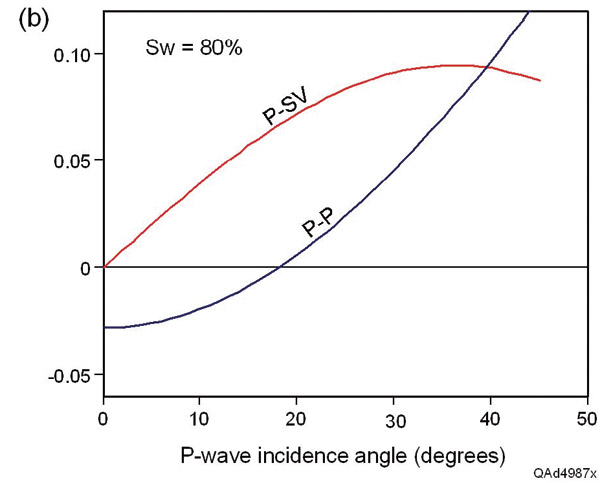
P-P and P-SV reflectivity curves for these two pore-fluid conditions are shown as Figure 2. When pore fluid is 100% brine, P-P and P-SV reflectivities have opposite algebraic signs but approximately the same average magnitude (about 5%) for incidence angles ranging from 0 to 25% (Panel a). When pore fluid changes to 20% gas (Panel b), P-SV reflectivity is unchanged, but P-P reflectivity decreases in magnitude and undergoes a phase reversal at an incident angle of approximately 18%. The gas-charged sediment, thus, does not affect P-SV imaging – but P-P imaging is seriously degraded. The negative reflectivity for incident angles between 0 and 18 degrees essentially cancel the positive reflectivities for incident angles greater than 18%, resulting in “wipeout” P-wave reflections. The effect would be similar to that exhibited by the data on Figure 1. There is logical rock physics evidence why P-wave wipeout zones occur in strata having low gas saturation and why S-mode data are insensitive to low gas saturation. |
 General statement