Print this page
  Click to view article in PDF format.
GCEqualizing Wavelets Produced by Different Seismic Sources*
Bob Hardage1
Search and Discovery Article #40894 (2012)
Posted March 26, 2012
*Adapted  from
from the Geophysical Corner column, prepared by the authors, in AAPG Explorer, March, 2012, and entitled "When All Data Are Not Created Equally". Editor of Geophysical Corner is Satinder Chopra
([email protected]).
Managing Editor of AAPG Explorer is Vern Stefanic; Larry Nation is Communications Director. AAPG©2012
the Geophysical Corner column, prepared by the authors, in AAPG Explorer, March, 2012, and entitled "When All Data Are Not Created Equally". Editor of Geophysical Corner is Satinder Chopra
([email protected]).
Managing Editor of AAPG Explorer is Vern Stefanic; Larry Nation is Communications Director. AAPG©2012
1 Bureau of Economic Geology, The University of Texas at Austin ([email protected])
Tidewater areas can be difficult places to acquire consistent-quality seismic data, because different sources have to be used across exposed land surfaces than what are used across shallow-water areas. Typically, explosives are used in shot holes in the onshore portion of a tidewater prospect, whereas environmental regulations may require that an air-gun source be used in shallow-water areas.
These two seismic sources produce different basic wavelets – and profiles produced with explosives and air guns rarely tie in an optimal manner at common image coordinates without using wavelet-shaping algorithms to create equivalent reflection character across targeted intervals.
|
|
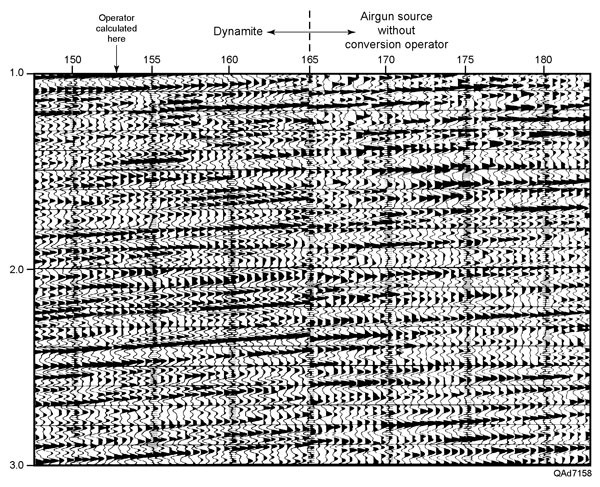
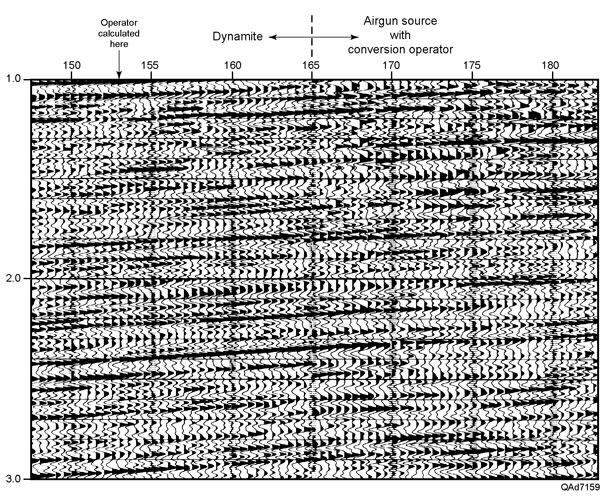
An example of using an explosive source and an For one profile, the source was a 30-pound (13.6-kilogram) charge positioned at a depth of 135 feet (41 meters) at each source station. For the second data acquisition along the same profile, the source was an Considerable processing effort was expended to make the final reflection character identical on each test line. The data illustrated as Figure 1 show the results of the data processing. The frequency content of the two profiles is approximately the same, but wavelet character is not identical at the junction point (station 165). In this instance, the interpreter responsible for this prospect decided that the reflection character expressed by the explosive source was preferred rather than the wavelet response shown by the The challenge was that in neighboring tideland areas, regulations required that an Said another way, the problem was to create a basic wavelet in An approach used by many data processors to ensure that equivalent basic wavelets exist in two seismic profiles acquired with different sources is to calculate numerical cross-equalization operators that convert the phase and frequency spectra of source A to be equivalent to the phase and frequency spectra of source B. This technique was applied to the tidewater seismic data illustrated on Figure 1 by using data The example discussed here is |
 General statement