Print this page
  Click to view article in PDF format.
GCHow 4-D  Seismic
 Monitoring Works*
Roger Anderson1
Search and Discovery Article #40615 (2010)
Posted October 22, 2010
*Adapted from the Geophysical Corner column, in AAPG Explorer, September 1996, prepared by the author. Appreciation is expressed to M. Ray Thomasson of the AAPG Geophysical Integration Committee and to Larry Nation, AAPG Communications Director, for their support of this online version.
1Lamont-Doherty Earth Observatory, New York, NY ([email protected])
More than half the oil and gas in every field in the world is bypassed, even when using the best of technologies. However, we are in the midst of a profound technological transition within the industry that promises to significantly improve these recovery efficiency percentages. Because we are experiencing it first-hand, it is sometimes hard to discern the magnitude of this change. During the 1980s and on into the mid-1990s, the upstream industry as a whole was testing, adapting, and finally accepting 3-D seismic surveys as the cost-effective tool for both exploration and enhanced recovery.
Most 3-D seismic acquisitions were over old fields, ironically, and so from the very beginning, geologists were seeing changes in gas/oil/water that had occurred since production began—usually long before the first 3-D survey was shot. The 3-D surveys were, in fact, the first 4-D, or time dependent seismic monitoring projects.
|
|
4-D is 3-D
The transition from 2-D to 3-D has resulted in improved recovery efficiencies that have increased from 25 percent to 30 percent of oil-in-place with 2-D control, to 40-50 percent with 3-D coverage. British Petroleum expects the industry’s most ambitious 4-D project in the North Sea’s Foenhaven Field to improve those statistics to 65-75 percent (November 1995 EXPLORER; Petroleum Engineer International, January, 1996). Time-lapsed images of producing reservoirs are acquired through the repeated acquisition of 3-D The removal of large volumes of oil and gas from a Petrophysics and careful
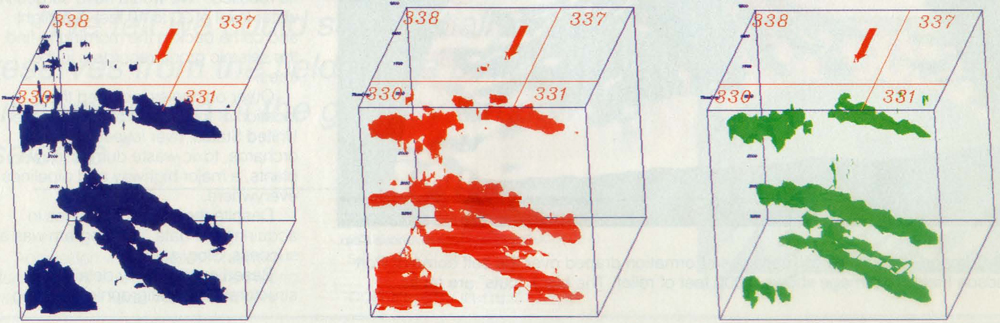
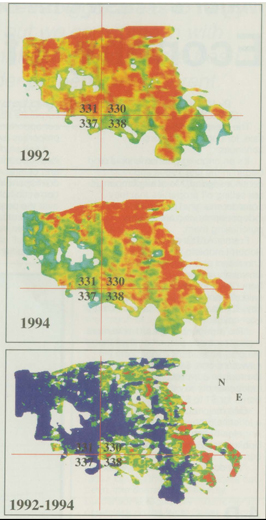
Real-World, 4-D Drainage Changes The utility of 4-D The 4-D study was begun in 1992. At that time, a traditional gravitational water drive was assumed to be sweeping the studied About 2.4 million barrels of oil equivalents were produced from these areas and about 600 acres were dimmed. These drained areas are shown in blue in Figure 2c. Assuming a 100-foot thick pay sand with 30 percent porosity and an increase in salt water of 30 percent that would require that each acre foot produce about 400 bbl/acre foot, quite reasonable for clean Pleistocene sands in the Gulf of Mexico. New Wells to Recover Bypassed Oil The bypassed oil remaining after 1994 will require the placement of yet another well into the fault block. Therein lies the power of 4-D. Each new well recovers an additional percentage of oil-in-lace, increasing the ultimate recovery efficiency. Amplitudes drained by the new well are predicted to account for an additional two million barrels. In another two years, that well will water out, and additional amplitudes are predicted to remain requiring another well and so on into the future. Four-D Contributing to this report was Liqing Xu, Albert Boulanger, and Wei He, all of Lamont-Doherty.
Copyright © AAPG. Serial rights given by author. For all other rights contact author directly. |