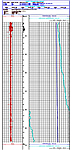
| Figure 1. Temperature log does not indicate any temperature anomaly.
|

| Figure 2. Sonan log taken during re-entry operations, 2 months after eruption did not show any noise indicating no flow behind casing.
|

| Figure 3. Illustration of underground blowout scenario of what would be expected.
|

| Figure 4. Location of the  mud mud eruption, major stress directions, fault zones and their relative movements. eruption, major stress directions, fault zones and their relative movements.
|

| Figure 5. BJP-1 Real time data dated May 28, 2006. The maximum casing pressure was 1054 psi, pressure reading 30 min after shut in. Well was dead and BOP was opened at 10:00 hrs, May 28, 2006.
|
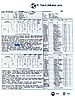
| Figure 6. BJP-1 IADC report dated May 29, 2006. Note the 8.9 ppg fluid influx into the wellbore that was circulated out after a kick.
|

| Figure 7. Real time data May 27, 2006, shows 220 bbls to fill the hole.
|

| Figure 8. Range of bottom hole pore pressures. The pore pressures are derived from a number of pressure prediction methods with different reliability. The ‘Fill Up’ method is considered the most reliable and widely used in drilling.
|

| Figure 9. Banjarpanji-1 Leak off test result of 16.4 ppg at the 13-3/8” casing shoe at a depth of 3580 ft. The result is consistent with the nearest offset Wunut-2 well which had 16.6 ppg LOT from a shallower depth of 3160 ft.
|

| Figure 10. BJP-1 Pressure profile shows that the pressure within the wellbore is still lower than the strength of the rock at its weakest point; i.e., lower than the LOT.
|

| Figure 11. BJP-1 RTD showing drilling mud losses less than 10 minutes after May 27, 2006, recorded in Tretes BMG Station (10 km away from LUSI.
|
Introduction
On
May 29, 2006, at around 05:00 hrs it was reported that Hot Water eruption
intermittently with a maximum height of 25 ft and elapsed time of 5 minutes
between the burst occurred around 200 meters from the well. This burst was
very dramatic with a distinct geyser-like cycle of active and passive periods.
This marks the formation of a new mud volcano known as LUSI in East Java,
Indonesia. This new mud volcano adds to the many mud volcanoes existing in
the area, such as the Porong collapse structure (NE of LUSI), Kalang Anyar
& Pulungan (Sedati, Sidoarjo), Gunung Anyar (UPN campus, Surabaya),
Bleduk Kuwu & Keradenan (Purwodadi), Wringin Anom / Pengangson (Gresik),
Semolowaru (Unitomo campus, Surabaya), Dawar Blandong (Mojokerto), Sangiran
(Central Java), Socah (Bangkalan, Madura) and others. LUSI however is
special, as one can observe the ongoing geological processes from its
controversial birth.
Three
different hypotheses have been proposed as the trigger of LUSI; namely:
i).
Underground Blowout (Davies et al., 2007; Tingay et al., 2008).
ii).
Mud Volcanism due to remobilization of overpressured shale through a
reactivated fault as the conduit (Mazzini et al., 2007).
iii).
Geothermal activities where superheated hydrothermal fluids at high
temperature and pressure are released through fault zone or fracture network
as the conduit.
The
objective of this paper is to clearly and transparently set out the drilling
engineering data and analysis to correct the technical record and to provide
a platform for further analysis. It focuses on key drilling pressure
measurements and drilling facts to investigate the early speculation that
drilling was the trigger of LUSI.
Underground Blowout As a Hypothesis
Several
writers suggested that an Underground blowout triggered LUSI (Davies et.al,
2007; Tingay et al., 2008). However, the facts and pressure calculations
clearly show that an underground blowout did not happen in the Banjarpanji-1
well. Several conditions must be met for an underground blowout to occur. The
most important is that pressure in the wellbore must be sufficiently high to
break the weakest formation (typically the casing shoe). Secondly, sustained
fracture propagation pressure is required to extend the fracture to surface.
Davies et al. (2007) suggested that the casing shoe was fractured and
breached. However, calculations based on proper data obtained from the well
and related facts clearly show the opposite; the shoe was still intact and
not breached.
An
investigation was carried out to determine if there was a connection between
the well and the mud eruption. If an underground blowout did occur, then it
was expected that a temperature anomaly and noise would be recorded in the
Banjarpanji-1 wellbore. Temperature and Sonan logging were carried out during
the relief well campaign to determine if such phenomena occurred. The
temperature logs did not record any anomaly within the Banjarpanji-1 well (Figure 1). The sonan
log did not indicate any unusual noise, indicating there was no flow behind casing
(Figure 2).
Other
facts that do not support the underground blowout hypothesis include:
- From the time after
the well kick was killed on May 28, 2006, until the mud eruption, the Blow Out Preventer (BOP) was kept in the open position and numerous
activities were conducted in the wellbore, such as fishing, cementing,
and circulating. If the well was fractured, in order to propagate the
fracture to surface, it would require sustained high pressure and for
the BOP to be kept closed.
- No mud or gas or
steam came out of the well despite the BOP being in the open position.
It would have been easier for the mud to come out of the well instead of
having to fracture the formation (Figure
3-I/D). If caused by drilling, the well should at the least be
surging and flowing itself as the path of least resistance to surface
and there would definitely be some gas and steam coming from the
wellhead. It seems totally impossible for 300,000 bbl/day of mud and steam
and gas at the beginning to flow through a well that is totally dead at surface.
- Noting this
nearby eruption, the first information required was evidence for any connection
or channel between the eruption and the well. This assessment was done
by closing the well and pumping into it on May 29, 2006. After pumping two batches of mud the well did not experience any losses and the pressure was
holding at 900 psi. Another injection test was done on May 30, 2006, prior to placing the cement plug with an injection pressure at 370 psi with
a rate of 2.5 bbl/minute. Pumping into the well confirmed no connection
between the well and the mud eruption.
- The unprotected
wellbore was expected to enlarge due to erosion from the very high mud
rates. Such erosion was expected to result in the dropping of the fish
and cement (Figure 3-II/H); however
this did not happen and the fish remained intact as reported in Daily
Drilling Report on July16, 2006, 1.5 months after the eruption.
- The mud eruption
occurred along lines of weakness aligned with the Watukosek fault zones;
this is not typical of underground blowouts. The crack that formed at
the rig site on June 2, 2006, was not followed by extrusion of fluid nor
mud, suggesting they were not due to hydro-fracturing. Other fractures
parallel with the Watukosek fault were observed at the same time as the
initial mud eruption. The movements suggest sinistral reactivation of
the faults. Second-order dextral movements were observed several times
in the railway line movements in September, 2006
(Figure 4).
Banjarpanji-1 Casing Shoe Strength Analysis
The
following data is used to calculate the pressure at the casing shoe and
determine if an underground blowout occurred in the well.
Shut
In Casing Pressure
The
maximum Casing Pressure of 1,054 psi is used based on the Real Time Data
(RTD) of May 28th, 2006. This casing pressure of 1,054 psi is considered as
more reliable pressure measurement where stabilized maximum pressure is reached
36 minutes after shut in, and remained constant until it was bled off as part
of the well control procedure, as shown in Figure
5.
Note
that the normal reading of ISICP (Initial Shut In Casing Pressure) is not
applicable here since the casing pressure was not stable throughout the shut in
period. Similarly the drill pipe pressure cannot be used to calculate well
pressure in this instance because of a flapper valve at the bottom of the
drill string that prevented wellbore pressure reading.
Fluid
Density at the Top of the Well
The
well took a fluid influx of over 300 bbls. During the kill process, the well
was bled off and found water instead of gas or mud. After the well was
killed, this influx was circulated out with a density of 8.9 ppg as shown in
the well’s IADC report and Morning Report dated May 29, 2006 (Figure 6). The influx
represents approximately 30% of the hole volume. This large influx of water,
due to its lighter density found its way to the top and occupied the upper
portion of the well.
Bottom
Hole Pressure
The
bottom hole pressure is calculated to be 12.8 ppg based on the fill-up volume
of the well (Real Time Data of May 27, 2006). The common practice for calculating bottom hole pressure when a loss circulation occurs is by measuring the
amount of mud needed to fill the hole (Fill Up method). It took 220 bbl to
fill-up the hole, equivalent to 6200 psi (12.8 ppg) of bottom hole pressure (Figure 7).
This
calculated BHP value of 12.8 ppg was checked using other theoretical bottom
hole pressure calculations using the drilling Dc-exponent and Resistivity log
which shows that the value is within the correct range (Figure 8). Other evidence
that supports the correctness of this Bottom Hole Pressure includes:
- The well lost
mud twice on May 27, 2006, indicating that the BHP is less than the mud
weight of 14.7 ppg (Figure 11).
- The Static
Influx Test conducted at 9010 ft on May 27, 2006, was used to check the Bottom Hole Pressure. This test was negative with no increase in gas
reading meaning that the pore pressure was less than the Mud Weight used,
which was 14.7 ppg.
Leak
Off Test
The
leak off test done at the 13 3/8” casing shoe is shown in Figure 9. The LOT was 16.4 ppg at a depth of 3580 ft. The LOT result is consistent with the LOT of Wunut 2,
an offset well approximately 2 km away which had a LOT of 16.6 ppg at a
shallower depth of 3160 ft. It should be noted that the shallow section of
Banjarpanji-1 is within the Wunut anticlinal structure.
Pressure
Analysis at the Casing Shoe
This
analysis showed that it is intact.
Using
the basic data above, the pressure analysis is as follows:
1.
Maximum Casing Pressure = 1,054 psi.
2.
Fluid in the upper part of the hole = 8.9 ppg. Maximum mud weight = 14.7 ppg.
3.
Bottom Hole Pressure = 12.8 ppg.
4. Leak
Off Test at the casing shoe (3,580’) = 16.4 ppg.
The
resulting graph is shown in Figure 10. The pressure at the shoe exerted by the fluid is 2710
psi which is lower than the strength of the rock (LOT) of 3053 psi. This
proves that the weakest point in the well, which is the shoe, was still
intact and was not fractured.
Underground Blowout Arguments
Observers
were quick to assume that the mud eruption was caused by an Underground
Blowout because of its proximity to the well. Arguments on Underground Blowout,
however, are not supported by facts.
These
include:
1.
Davies et al. (2007) showed the bottom hole pressure of 48 MPa (14.4 ppg) and
proposed a kick occurred while drilling into the Kujung Formation. However, in
fact well had a loss, not a kick, when drilling using 14.7 ppg drilling mud
on May 27, 2006. The well suffered a partial loss of 20 bbls of drilling mud
less than 10 minutes after May 27, 2006, earthquake recorded at the Tretes BMG Station (Figure 11). The
total loss of circulation of 130 bbls occurred in the well after 2 major
aftershocks around midday of the same day.
2.
Tingay et al. (2008) quoted pore pressures which are unrealistically high (Figure 3). Pore
pressure in BJP-1 was reported as 17.84 MPa/km (15.2 ppg) at 2130 m depth and
17.1 MPa/km (14.5 ppg) at 2800 m depth. These pressures are higher than the
mud weight and the Static Influx Test that shows the actual pore pressure to
be much lower than 14.7 ppg.
3.
Claims made by Davies et al. (2007) that hydrofracturing occurred and by Tingay
et al. (2008) that the fluid pressures inside the well exceeded 19.5 MPa/km
(16.4 ppg) shortly after the blowout preventer was closed. Contrary to
claims, as shown on Figure 10
and by calculations below, the pressure at the casing
shoe, which is the weakest point of the wellbore, was lower than the fracture
pressure.
Pressure at casing shoe = Maximum casing pressure +
hydrostatic pressure of fluid
P@3580 = 1054 + (0.052 x 8.9 x 3580)
= 2710 psi < 3053 psi (fracture
pressure)
Conclusion
A
number of papers hypothesized that the birth of the LUSI mud volcano was
related to drilling of the Banjarpanji-1 well.
This
article presents drilling data, facts, analysis, and investigation during the
re-entry and relief well campaign, which show that the well casing shoe did
not breach. The well bore pressure was too low to fracture the well.
Supporting this conclusion, field data demonstrated that the well was still
intact and indicated no communication between the well and the mud eruption.
Therefore it is concluded that an Underground Blowout as a trigger of the
LUSI mud volcano is a hypothesis not supported by drilling data and facts.
In
the absence of any evidence supporting an underground blow out hypothesis,
reactivation of the Watukosek Fault is seen as the most likely and natural
trigger for the mud volcano, as there was a clear connection between the
timing of earthquake and after-shocks, and mud losses in the well.
References
Davies, R.J., R.E. Swarbrick, R.J. Evans, M. Huuse, 2007,
Birth of a mud volcano, east Java, 29 May 2006: GSA Today, v. 17/2, p. 4-9.
http://dx.doi.org/10.1130/GSAT01702A.1
Mazzini, A., H. Svensen, G.G. Akhmanov, G. Aloisi, S.
Plante, A. Malthe-Sorenssen, and B. Istadi, 2007, Triggering and dynamic
evolution of the LUSI mud volcano, Indonesia: Earth and Planetary Science
Letters, v. 261/3-4, p. 375-388. http://dx.doi.org/10.1016/j.epsl.2007.07.001
Tingay, M., O. Heidbach, R. Davies, and R. Swarbrick,
2008, Triggering of the Lusi mud eruption; earthquake versus drilling
initiation: Geology Boulder, v. 36/8, p. 639-642.
http://dx.doi.org/10.1130/G24697A.1
Tingay, M., O. Heidbach, R.
Davies, and R. Swarbrick, 2008, The Lusi mud eruption of East Java
(abstract): Search and Discovery Article #90082 (2009) http://searchanddiscovery.net/abstracts/html/2008/intl_capetown/abstracts/469863.htm eruption of East Java
(abstract): Search and Discovery Article #90082 (2009) http://searchanddiscovery.net/abstracts/html/2008/intl_capetown/abstracts/469863.htm
Return to top.
|

 Print this page
 Click to view article in PDF
format.
Click to view article in PDF
format.