Print this page
 Click to view article in PDF format
GCExploring Beneath High-Velocity Surfaces*
Bob Hardage1
Search and Discovery Article #40334 (2008)
Posted February 13, 2009
*Adapted from the Geophysical Corner column, prepared by the author, in AAPG Explorer, August, 2008, Part 1 entitled “Getting Under Surface Challenges”, and September, 2008, Part 2 entitled “Options Exist for Surface Problems”. Editor of Geophysical Corner is Bob A. Hardage. Managing Editor of AAPG Explorer is Vern Stefanic; Larry Nation is Communications Director.
1Bureau of Economic Geology, The University of Texas at Austin ([email protected])
In general, the quality of conventional P-wave  seismic
 data is poor when data are acquired across areas where high-velocity rocks (primarily carbonates and basalts) form the exposed, first-layer of the Earth. Some basins that have high-velocity rocks exposed at the surface have deeper layers with good oil/gas potential. Examples would include:
· Large areas of Argentina, Paraguay and Brazil (basalt outcrops).
· The Val Verde Basin and other areas of West Texas (carbonate outcrops).
Numerous other carbonate-covered and basalt-covered exploration areas could be listed. Explorationists working in these high-velocity outcrop areas are frustrated by their inability to acquire seismic data that have signal-to-noise character sufficient to see and map deeper hydrocarbon plays.
Here we examine some principles of seismic imaging in areas where the seismic propagation velocity in the shallowest Earth layer is greater than the velocity in the layers immediately below the surface layer. We consider the question “Does the downgoing compressional (P) wave successfully penetrate a high-velocity surface layer and illuminate deeper targets?” and then the cause of poor data quality before one option for resolving the imaging dilemma.
|
|
Example of Surface Problem
A generalized picture of the geology that needed to be imaged in one basalt-covered area is shown as Figure 1. The Earth surface here was covered by a thick basalt layer characterized by a fast
Oil production had been established across this particular area by random drilling, without the aid of
VSP data acquired in one well are displayed as Figure 2 after considerable data processing has been done to isolate downgoing and upgoing P and S (shear) wave modes. The
· A robust downgoing P wave (center panel), as well as a strong downgoing SV wave (left and right panels), travels through the deep, slower-velocity layers. All doubts are removed about the possibility that the downgoing source wavelet does not penetrate the surface basalt layer and illuminate deeper geology. A good-quality illuminating wavelet reaches all target depths.
· Good-quality upgoing P-wave (left panel) and converted-shear (SV) reflections (center panel) are generated at several deep interfaces, including interfaces associated with critical reservoir intervals.
At this point we know that the deep geology has been illuminated and that reflection events from our primary targets head back toward the Earth’s surface. Yet these reflections cannot be recognized by surface-positioned receivers.
Why not? We appear to have isolated the imaging problem to something that occurs in the local vicinity of the surface receivers.
Cause of Surface Problem
Because good-quality reflections head upward toward the earth’s surface, why do we not capture these reflections with earth-surface receivers? The culprit that prevents the capture of good-quality reflection events often seems to be severe, unorganized ground-roll noise. The earth model in Figure 3 will be used to illustrate the wave
· One surface wave is the Rayleigh mode, created by any surface-based source that produces a vertical displacement. Almost all onshore
· The second surface wave that can propagate along the earth-air interface is a Love wave, which can be generated only by an SH shear source that creates pure horizontal displacement, and the wave propagates horizontally as a pure SH shear mode that produces no vertical displacement Figure 3. Of these two surface waves, the Rayleigh mode is the “bad” noise mode when the surface layer has a fast
Why is the Rayleigh ground roll so troublesome across outcropping basalts and carbonates? For most poor-data areas, the answer is that the exposed high-velocity layer usually has a rough surface and numerous large internal voids (Figure 1), and these randomly positioned irregularities cause the ground roll to backscatter from many azimuth directions and at many different time delays to create a continuous overprinting of high-amplitude, unorganized noise on top of the deep reflection events that arrive at each surface receiver.
Because this noise is unorganized (i.e., it does not arrive from a fixed direction, and its components have variable time origins), it is difficult – and usually impossible – to remove from the data. Upcoming reflections from deep targets do indeed arrive at the surface receivers as we suspected, but these reflections are overwhelmed by the reverberating, unending ground-roll noise.
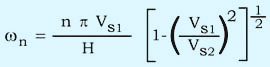
SolutionHow then can geology beneath a high-velocity outcrop be imaged? The answer is a beautiful bit of wave
In this equation, ω is the frequency (Hz) of the Love wave, H is the thickness of the high-velocity surface layer, VS1 is the S-wave velocity in the surface-exposed layer and VS2 is the S-wave velocity in the interval beneath the surface layer. When VS1 is greater than VS2, as it is when the surface layer is basalt or carbonate, the quantity inside the square-root bracket is negative; this results in an imaginary frequency. Because no Love wave can have an imaginary frequency, the physical consequence is that no Love wave propagates in this type of velocity layering, and there can be no surface noise mode. If we therefore use SH shear technology to image beneath high-velocity outcrops, we have no surface-wave noise, and we should be able to capture SH reflections from deep targets.
Concluding Example
One test of this principle – work done years ago by researchers at Arco – is shown in Figure 4 to illustrate the
References
|