Introduction
The Mackenzie/Beaufort  province
 (Figure
1) exhibits a complex basin evolution (Figure
2A), from an open marine setting throughout most of the
Paleozoic, followed by a rift-drift system in Jurassic to Early
Cretaceous. The Late Cretaceous-Cenozoic successions represent a
post-rift passive-margin basin comprising more than 14 km of deltaic
sediments (Dixon et al., 1992), complicated by the Cordilleran
Thrust Belt in the west. Tectonically, the province can be divided
into four structural domains: a stable craton in the south and
southeast, a rifted margin in the southeast, the Cordilleran Fold
Belt in the southwest, and the Canada Basin in the north.
Figure 2 is a composite diagram, showing
regional stratigraphy, major tectonic events, essential petroleum
system elements, petroleum plays/play groups and their stratigraphic
position and spatial association, and discovered reserve and
estimated potential oil resources. Although oil discoveries are from
almost all stratigraphic levels, from Paleozoic to Cenozoic, more
than 95% of discovered oil accumulations are in Tertiary
successions.
(Figure
1) exhibits a complex basin evolution (Figure
2A), from an open marine setting throughout most of the
Paleozoic, followed by a rift-drift system in Jurassic to Early
Cretaceous. The Late Cretaceous-Cenozoic successions represent a
post-rift passive-margin basin comprising more than 14 km of deltaic
sediments (Dixon et al., 1992), complicated by the Cordilleran
Thrust Belt in the west. Tectonically, the province can be divided
into four structural domains: a stable craton in the south and
southeast, a rifted margin in the southeast, the Cordilleran Fold
Belt in the southwest, and the Canada Basin in the north.
Figure 2 is a composite diagram, showing
regional stratigraphy, major tectonic events, essential petroleum
system elements, petroleum plays/play groups and their stratigraphic
position and spatial association, and discovered reserve and
estimated potential oil resources. Although oil discoveries are from
almost all stratigraphic levels, from Paleozoic to Cenozoic, more
than 95% of discovered oil accumulations are in Tertiary
successions.
This study is based on the previous
petroleum resource assessment conducted by the Geological Survey of
Canada (GSC) (Dixon et al., 1994), with emphasis on the
petroliferous rifted basin margin and the southern part of the
Canada Basin, extending from south of the Mackenzie Delta, north to
about 2500 meter water depth because this is the most accessible
region for exploration and development. Areal extent of the
assessment and boundaries of the play groups are shown in
Figure1. Several petroleum plays
overlap, particularly in the south, because of the nature of the
rifted passive margin and the stacked stratigraphy of the delta
systems. Recent studies in organic geochemistry, basin
hydrodynamics, petroleum systems analysis, and geoscience data
integration in cooperation with industry, provide an improved
geoscience framework for understanding the petroleum resource
potential in this province.
Source
Rocks
Three major potential source rock sets may
exist in this province: a) the Jurassic-Lower Cretaceous syn-rift
shales, b) Upper Cretaceous passive margin marine shales, and c)
Tertiary passive margin marine shales. The syn-rift Jurassic-Lower
Cretaceous successions may have three potential source beds. Shale
in the Husky Formation is found in the southeast basin margin and
nearshore areas, and it is also possibly present in some of the
deeply buried grabens in the shelf area. If the rotational model of
Arctic plate tectonics is valid, the syn-rift Jurassic-Lower
Cretaceous (J-lK) successions should also be present in the west
Beaufort Sea. Oil and source rock correlation indicates that this
shale could be a major contributor of natural gas in the Parsons
Lake gas field and Unak gas discovery (Langhus, 1980). The Lower
Cretaceous Arctic Red Formation, found in the Kugmallit Trough in a
slope to basinal environment (Dixon et al., 1994), is presumably
present in most of the province and represents sedimentation during
the last phase of continental drifting. Recent organic geochemical
analyses indicate biomarker signatures from the Arctic Red shale in
a number of discoveries (Li, personal communication, 2006).
Localized source rock, such as the Lower Cretaceous McGuire shale,
is inferred to be responsible for oils found in the Kamik discovery
well and adjacent areas (Dixon, personal communication). It may also
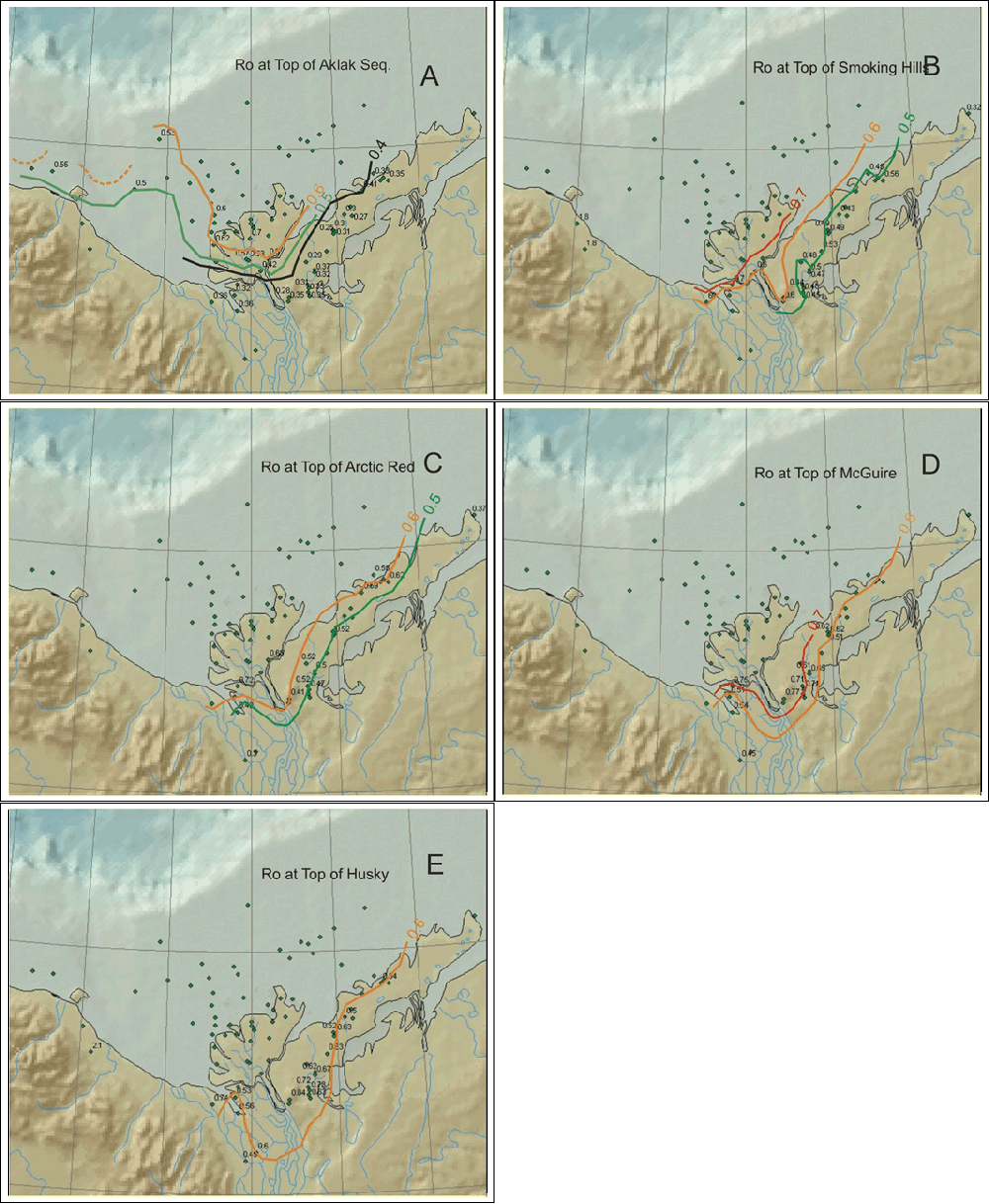
be present in the offshore area. Source rock maturity studies (see Figure
5) indicate that the J-lK source rocks could be one of the
sources for the Rifted Margin, Taglu Delta and Kugmallit Delta play
groups, but are over-cooked in most of the offshore area, because of
deep burial.
The Upper Cretaceous succession of the
Boundary Creek and Smoking Hills formations represents the earliest
sedimentary records accumulated in outer shelf and slope
environments of this passive margin basin and contain organic-rich
and radioactive shales, which are widely distributed in the Arctic
region. These shales are recognized to be one of the major
contributors to the oils found in the discoveries in the Tuk,
Atkinson and Mayogiak wells, in the central and northern Tuktuyaktuk
Peninsula (Dixon et al., 1994; Dixon et al., 1985). Biostratigraphic
data and new 3D seismic interpretation indicate that the uK mobile
substrata cores some of the shale diapirs (Bergquist et al., 2003)
in the west Beaufort Sea, and part of the uK source rock could still
be in the hydrocarbon generation window in part of the offshore
area.
The Lower Tertiary succession contains
several organic-rich shale intervals in the major sequences, such as
Richards, Taglu and Aklak, and are inferred to be responsible for
some of the oil and gas accumulations found in this province (Snowdon,
1984; Snowdon et al., 2004; Brooks, 1986). Where it is mature, the
Tertiary succession is considered to be one of the major source
rocks for the accumulation in the deep/ultra deep-water setting.
Analyses of the measured vitrinite reflectance from cuttings and
cores indicate that the maturity level of the Lower Tertiary
succession has reached the oil window just below 3000 meters
(Ro>0.6%) in the Richards Island and western Beaufort Sea. The
vitrinite reflectance reached 0.6% at top of the Aklak Sequence in
Richards Island and offshore areas. The oil correlations indicate a
good correspondence between the oils from the Adlartok P-09 well and
Tertiary source rocks (Li, personal communication). It is
anticipated that the Lower Tertiary shales and coal seams are the
major sources for the oil and gas accumulation in the west Beaufort
Sea play and an important contributor in other part of the shelf
areas.
Organic geochemical analyses indicate a
large range of variation in TOC% measured from cuttings and side
wall cores in exploration boreholes at almost all stratigraphic
levels. Although most samples have a TOC% <3%, a number of
stratigraphic intervals show a fairly high TOC, up to 9%.
Figure 3 displays histograms of TOC%
from nine stratigraphic levels, showing the variations. Results from
Rock-Eval analysis suggests a diversity of kerogen types in the
basin. Figure 4 is a cross-plot set of
hydrogen index vs. oxygen index of borehole cuttings from nine
stratigraphic intervals, suggesting predominant type II and type III
kerogen in this province.
Vitrinite reflectance was measured from
cuttings and cores in ninety two wells (green dots,
Figure 5). Maturity level increases
basin-wards at the top of the Aklak Sequence; whereas it increases
northwest-wards for the Mesozoic and older strata.
Figures 5a - e show maturity trends at
tops of five different stratigraphic levels, indicated by the
vitrinite reflectance (Ro) contours. Figure
5f is a Ro contour map at a depth of 3000 meters, showing the
spatial variation of the basin thermal heterogeneity.
Generation/Migration/Timing
Petroleum system modeling suggests
multiple phases of petroleum generation and migration from potential
source rocks at different burial depths. Significant petroleum
generation/migration may have started as early as Late Cretaceous
and continued to rather recently, depending upon the thermal history
of the source rocks. Figure 6 shows
results from 1D modeling at four synthetic well locations,
illustrating hydrocarbon generation/expulsion histories in different
parts of the basin.
In the west Beaufort Sea, the Tertiary
sources appear to be the effective source rocks because of the high
thermal maturity level, whereas the Cretaceous and older source
rocks have all passed through oil window and the oils were expelled
before the major phase of trap formation in the late Eocene. In
contrast, in the southeast part and deep-water portion of the basin,
the Cretaceous source rock seems to be the major contributor because
of either a shallow burial depth of the Tertiary source rocks in the
rifted margin or a low level of maturity in the Tertiary depocenters.
Faults/fracture zones associated with
mobile substrata, listric and thrust fault systems provide adequate
vertical migration routes. However, fluid migration and entrapment
are dynamic processes throughout the entire basin development
history. The episodic nature of overpressure and pressure release
may have led to loss/partial loss or redistribution of early
accumulated hydrocarbons.
Several episodes of tectonic activity in
the Tertiary are recognized in this province (Lane and Dietrich,
1998). The most important ones include tectonic inversion during the
Late Eocene, which led to diapirism and trap formation over a wide
area. While in the eastern part, the same tectonic episode
reactivated the pre-existing faults and generated roll-over
structures. Tectonic activity at the end of the Miocene may have
triggered large scale submarine sliding and formed turbidities and
basin-floor sheet sands over a wide area. Tectonic activity at the
end of the Miocene may have accelerated the secondary migration
process and caused re-migration of some previously trapped
hydrocarbon accumulations.
Reservoir
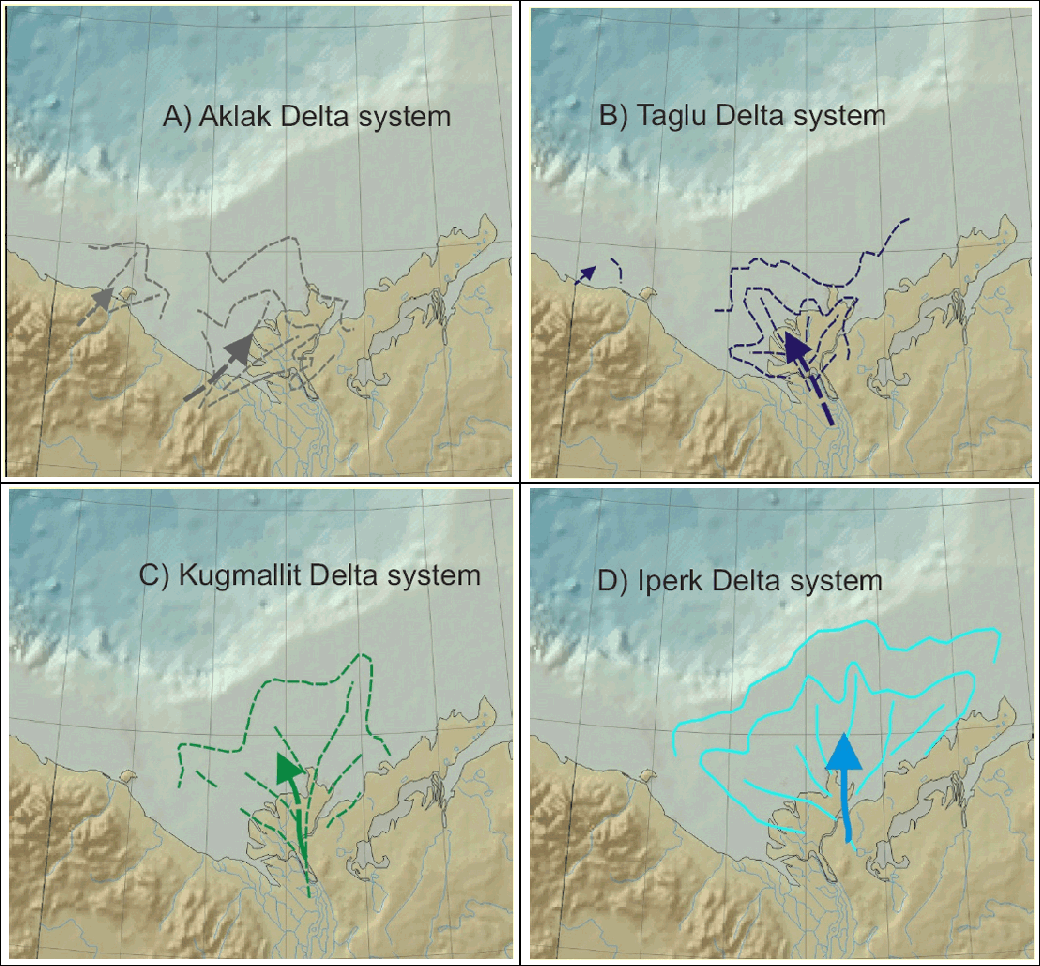
In the Tertiary basin-fill history, five
major delta systems developed (Figure 2A).
Figure 7 shows four of the major delta
systems, illustrating the extent of each of the systems, and how the
delta systems evolved in time and space in response to tectonism,
and depositional provenances. The shape and areal extent of each
individual delta system is defined from the 20% and 30% sand content
derived from borehole logs. The major delta systems cover almost the
entire present continental shelf and Richards Island. The deltaic
sandstones of delta plain and delta front provide quality reservoirs
for hydrocarbon accumulations in the Taglu Delta, Kugmallit Delta,
and West Beaufort Sea play groups.
Additional types of reservoir rock include
channel-fill sandstones and submarine-fan sands in recent as well as
paleo-slope and deep-water basins. Interpretation of the newly
acquired 3D seismic data indicates the existence of large scale
channel-fill sandstones in the Richards Sequence (Bergquist et al.,
2003) in the west Beaufort Sea (Figure 8).
The Oligocene and Miocene sequences are shale-dominant in general,
and they may also contain channel-fill sandstones or other type of
sand bodies. For example, clinoforms (Figure 41 of Dixon et al.,
1985; Figure 11b and 13 a and b of Hubbard, et al., 1985) and
channel forms (seismic profile 8E of Dixon et al., 1990) on seismic
lines in the Mackenzie Bay Sequence indicate delta front, delta
plain and channel sands. Sandstones associated with submarine fan
systems in the Iperk, Mackenzie Bay and Kugmallit sequences are the
major reservoir type in the Basinal facies play.
In the deep-water play, inferences were
made based on analogy to known world deep-water settings (Weimer and
Slatt, 2004), as well as the pale-slope and deep-water basin of this
province, and limited regional seismic interpretation. Three
possible reservoir types may exist in this play: channel fill
sands/sandstones, basin floor turbidite sand sheets, and overbank
levee sand beds. Interpretation of available reflection seismic
lines indicates various channel fills and possible basinfloor sheet
sands in Tertiary stratigraphic successions. These reservoir rocks
are more subtle in older strata on seismic profiles, but possibly
also present.
For the Rifted Margin play group,
discoveries in the Mesozoic and Lower Paleozoic indicate both porous
clastics and carbonates are present and can be reservoir rocks.
However, they are restricted to the rifted margin play group in the
southeast and shallow shelf in the east.
Trap Styles
Several types of traps have been
recognized in this region. Structural closures associated with
shale-cored anticlines formed during the Eocene tectonic inversion (Bergquist
et al. 2003; Dixon, et al., 1994) are typical in the fold belt in
the western part of the province (Figure 9).
This type of structural trap is also common in the slope between
water depths of 500 m to 2500 m. Beyond the outer continental slope,
the magnitude of the structures becomes smaller and then disappears.
This type of structures is large (see closure size distribution in
Figure 10 from mapped structure traps),
and faults are commonly part of this structural trap. These Tertiary
diapiric structures become progressively younger northward, from the
uK Smoking Hills/Boundary Creek cored structures (Bergquist et al.
2003) in the west Beaufort Sea to pre-Eocene diaper-cored structures
in the slope (Dixon et al., 1990) to the north. Other trap types
associated with shale diapirism include the stratigraphic pinch-out
against diapirs, fault-sealed structural noses, and drape structures
over the diapirs. In contrast, the trap styles of a typical passive
margin comprise roll-over structures in the east and the delta, and
fault blocks in the southeast along the basin margin. These later
types of structure are more apparent in the older stratigraphic
succession. Roll-over anticlines associated with listric faults are
most common in the delta area.
Stratigraphic traps are recognized in this
province. Unconformity traps are interpreted from seismic data, and
pinch-out is an important component for several discoveries made in
the basinal facies play (Dixon et al., 1994). Other traps, such as a
combination of structural and stratigraphic traps and unconformity
associated traps (e.g., erosional truncations), are anticipated in
this basin.
Top Seal
The shale-dominant Richards, Mackenzie Bay
and Akpak sequences are regional top seals in this area. The shales
in this region may contain substantial amount of silts, which may
affect the seal capacity.
The seal integrity may be at risk for some
of the diaper-cored anticlines because diapirism, overpressure, and
associated crestal faulting/fracturing may have weakened the top
seal. Note the shallow overpressure zone in the basinal facies play,
north to the Tarsiut-Amauligak Fault Zone (TAFZ).
Assessment Results
Eighteen plays were defined based on the
trap configurations and reservoir age/types, among which fourteen
are identified or inferred to have oil potential.
Figure 2C shows the stratigraphic and
predominant trap type of the plays/play groups. This assessment
employs the GSC's probabilistic approach and uses plays as the
assessment unit. For the established plays with sufficient
discoveries, statistics from known pools/fields provide good data
for estimating the distribution of volumetric parameters, such as
pool area, reservoir porosity, net pay, and hydrocarbon saturation.
For the immature and conceptual plays, the estimation of the
volumetric parameters is based on geological similarities with known
plays. For the deep water area, where no wells were drilled, analogs
were used to derive the volumetric parameters.
These fourteen plays were assessed
separately for oil, and the resources were then aggregated into play
groups to represent the stratigraphic and geographic distribution of
the oil potential. The six play groups include the Rifted Margin
group, the Taglu Delta group, the Kugmallit Delta group, the basinal
facies group, the deep water group, and western Beaufort Sea group.
Estimated oil potential appears to increase basinward, reflecting
the geological control of source-rock quality and source-rock
maturity. Other geological factors such as overpressure and top-seal
leakage may also affect the geographical distribution of oil
resources.
Figure 12a to
f are cumulative distributions of the aggregated play group
resources for the six play groups, showing the estimated potential
and associated ranges of uncertainties. The estimated resource
potential in the six play groups, as well as the province are
summarized in Table 1. The rifted
margin play group has an estimated mean of 1.6 billion barrels (268
x106m3) and the Taglu Delta group has 1.2
billion barrels (184 x106m3) recoverable oil
resources. The plays in these groups are more gas prone and have the
lowest oil potential among the plays assessed. The Kugmallit Delta
has a mean estimate of 2.6 billion barrels (415 x106m3)
of recoverable oil. The basinal facies play has potential of 2.4
billion barrels (386 x106m3), and deep water
play group has the largest oil resource with a mean estimate of 6.7
billion barrels (1072 x106m3) recoverable oil.
The western Beaufort play group has a mean of 2.2 billion barrels
(351 x106 m3) recoverable oil. The aggregated
total mean for the six play groups is 16.8 billion barrels (2.7 x10⁹m3)
recoverable oil (Figure 13).
Future Discovery Potential
Given the large undiscovered oil resource
potential, the future discovery growth in this province is expected
to come from:
-
a) Drilling the
untested/unmapped prospects in the established oil plays, tests
of the Tertiary targets where earlier wells focused on deeper
Cretaceous targets, such as many wells in the Tuk play (Dixon et
al., 1994), or untested targets in deeper intervals where the
original targets were at shallower depths;
-
b) New play types
in areas where discoveries have been made, such as shale-diapir-related
plays (Bergquist et al., 2003);
-
c) Untested deep
water plays in the north. The deep water region, characterized
by mobile substrata fed by large rivers of the
Beaufort/Mackenzie province, is the most petroliferous type of
deep water basin in Worrel's classification (2001). Geological
similarities with the Niger Delta deep water setting, as well as
the Gulf of Mexico, suggest that a great oil resource potential
may exist.
-
d) Reserve growth
has accounted for a large portion of total world oil reserve
additions (Klett, 2005); this could also happen in this
province, as indicated by untested seismic anomalies around the
Amauligak discovery (Enachesu, 1990) and newly estimated
reserves of natural gas and NGLs. For example, the recently
released industry estimates of gas reserves in the three
principal gas fields (Taglu, Parsons Lake and Nignintgak)
indicate much higher volumes than the previous NEB's estimates
(6.2 tcf vs. 3.7 tcf).
Only a part of the entire
Mackenzie/Beaufort province prospective sedimentary succession is
the subject to this petroleum resource potential appraisal. Our
focus is limited to the region south of continuous pack ice and
restricted to the shallow part of the total sedimentary succession
(largely in the Tertiary succession). This reflects the current,
early exploration history stage of this province. It is expected
that there will be both increased data and understanding that will
lead to new large discoveries in the more remote areas and deeper
parts of the sedimentary succession as the scope of exploration
expands both geographically and technologically. The discovery and
reserve growth patterns of the Mississippi Delta petroleum province,
where very large accumulations continue to be found as exploration
expands into the geographically remote, deep water and
technologically challenging parts of the Gulf of Mexico, may provide
a useful analogy for the future exploration outlook and overall
potential of the Mackenzie/Beaufort province.
References
Bergquist, C.I., Graham,
P.P., Johnston, D.H. and Rawlinson, K.R., 2003, Canada's Mackenzie
Delta: Fresh look at an emerging basin, Oil and Gas Journal, v. 101,
Nov. 3, p. 42-46.
Dixon, J. and Dietrich, J.,
1990, Canadian Beaufort Sea and adjacent land areas, in
Grantz,A., Johnson,L., and Sweeney, J.F., The Arctic Ocean Region,
The geology of North America, Volume L, p. 239-256.
Dixon, J. Dietrich,J.R.,
McNeil,D.H.Snowdon,LR., and Brooks,P., 1985, Geology,
biostratigraphy and organic geochemistry of Jurassic to Pleistocene
strata, Beaufort – Mackenzie Area, northwest Canada.
Dixon, J.
Deitrich, J., and McNeil, D.H., 1992.
Jurassic to Pleistocene
sequence stratigraphy of the Beaufort - Mackenzie Delta and Banks
Island areas, Northwest Canada: Geological Survey of Canada,
Bulletin 407, 90p.
Dixon, J, Morrel, G.R.,
Dietrich, J. R., Taylor, G.C., Procter, R.M., Conn, R.F. Dallaire,
S.M., and Christie, J. A., 1994, Petroleum resources of the
Mackenzie Delta and Beaufort Sea; Geological Survey of Canada,
Bulletin 474, 52p.
Enachesu, 1990, Structural
setting and validation of direct hydrocarbon indicators for
Amauligak Oil Field, Canadian Beaufort Sea: AAPG Bulletin, v.74,
p.41-59.
Harper, F., 2005, The
future of global hydrocarbon exploration: APPEX, March 2005.
Hubbard, R., Pape, J., and
Roberts D.G., 1985, Depositional sequence mapping to illustrate the
evolution of a passive continental margin, in Berg, O.R., and
Woolverton, D.G., eds., Seismic stratigraphy II: an integrated
approach to hydracarbon exploration: AAPG Memoir 39, p.93-105.
Klett, T.R., Gautier, D.L.
and Ahlbrandt, T.S., 2005, An evaluation of the U.S. Geological
Survey World Petroleum Assessment 2000: AAPG Bulletin, v. 89,
p.1033-1042.
Lane, S.L. and Dietrich,
J.R. 1995, Tertiary structural evolution of the Beaufort
Sea-Mackenzie Delta region, Arctic Canada: Bulletin of Canadian
Petroleum Geology, v. 43, no. 3, p. 293-314.
National Energy Board,
1998, Probabilistic estimate of hydrocarbon volumes in the Mackenzie
Delta and Beaufort Sea discoveries, 9p.
Osadetz, K.G., and Chen,
Z., 2005, A re-examination of Beaufort Sea-Mackenzie delta basin gas
hydrate resource potential using a petroleum play approach, in
Proceedings of the 5th International Conference on Gas Hydrate, June
13-16, 2005, Trondheim, Norway, vol. 2.
Saller, A., Lin, R., and
Dunham, J., 2006, Leaves in turbidite sands: the main source of oil
and gas in the deepwater Kutei Basin, Indonesia: AAPG Bulletin,
v.90, p.1585-1608.
Stepheson, R., 1996,
Crustal velocities and thickness , - Campbell Uplift to southern
Beaufort Sea Shelf edge, in Geological Atlas of the
Beaufort-Mackenzie Area, (ed.) J. Dixon: Geological Survey of
Canada, Miscellaneous Report 59.
Snowdow, L.R., 1987,
Organic properties source potential of two early Tertiary shales,
Beaufort-Mackenzie Basin : Bulletin of Canadian Petroleum Geology,
v.35, p. 212-232.
: Bulletin of Canadian Petroleum Geology,
v.35, p. 212-232.
Weimer P., and Slatt, R.M., 2004, Petroleum systems
of deepwater settings: European Association of Geoscientists &
Engineers (EAGE) Distinguished Instructor Series, No. 7, Society of
Exploration Geophysics, Tulsa, USA.

 Print this page
 Click to view poster in PDF format (~5.3 mb).