PSUse
of High-Resolution Core Description Data to Risk Net Pay from Log-Based
Petrofacies for Thinly Bedded Deepwater Channel Complexes, Zafiro  Field
Field ,
Equatorial Guinea
,
Equatorial Guinea
By
T.C. Lukas1 and P. Schwans2
Search and Discovery Article #40248
Posted July 30, 2007
*Adapted from poster presentation
at AAPG Annual Convention, Long Beach, California, April 1-4, 2007
1Consultant,
Houston, TX (
[email protected] )
2Devon
Energy, Houston, TX ( [email protected]
)
Abstract
Log-based facies or petrofacies contain thin beds at
or below log-resolution. Individual beds range from 2 – 0.01 feet. As a result
of thickness variations and stacking densities, estimates of thin bed net pay
are associated with significant uncertainty. Cores from Zafiro Field, Equatorial
Guinea, were used to define thin-bed types and the ranges of uncertainties
associated with the beds identified via logs and cores.
The
Zafiro Field of Equatorial Guinea comprises a series of stacked channel
complexes of Miocene-Pliocene age deposited in the mid to lower slope position
of the Niger Delta. Thin bed environments in channel complexes include crevasse
splays, avulsion related lobes, lobes associated with overbank channels, levees,
and indeterminate remnants of near-channel overbank. High-resolution core
description data (100 samples/ft) from proximal to distal overbank deposits were
compared to log-based petrofacies computations. Data from the two methods were
compared as a function of hydrocarbon saturation, bed thickness, lithology, and
grain size and used to condition the computations. This was compared to the pay
computed and predicted from the petrofacies probability curves. A set of
confidence levels are applied to a range of So cutoffs to better define the
uncertainty range. The described approach allows better benchmarking and risking
of log-based thin bed calculations and can be used in geostatic models.
|
uAbstract
uQ &
A / goals
uPetrofacies
probabilities
uZafiro-3
vs Opalo-2
uFigures
11-14
uZafiro-3
uOpalo-2
uPrediction
uFigures
15-17
uApplication
uSerpentina
West
uTopacio
South 2
uFacies
& petrophysical modeling
uFigures
25-33
uAbstract
uQ &
A / goals
uPetrofacies
probabilities
uZafiro-3
vs Opalo-2
uFigures
11-14
uZafiro-3
uOpalo-2
uPrediction
uFigures
15-17
uApplication
uSerpentina
West
uTopacio
South 2
uFacies
& petrophysical modeling
uFigures
25-33
uAbstract
uQ &
A / goals
uPetrofacies
probabilities
uZafiro-3
vs Opalo-2
uFigures
11-14
uZafiro-3
uOpalo-2
uPrediction
uFigures
15-17
uApplication
uSerpentina
West
uTopacio
South 2
uFacies
& petrophysical modeling
uFigures
25-33
uAbstract
uQ &
A / goals
uPetrofacies
probabilities
uZafiro-3
vs Opalo-2
uFigures
11-14
uZafiro-3
uOpalo-2
uPrediction
uFigures
15-17
uApplication
uSerpentina
West
uTopacio
South 2
uFacies
& petrophysical modeling
uFigures
25-33
uAbstract
uQ &
A / goals
uPetrofacies
probabilities
uZafiro-3
vs Opalo-2
uFigures
11-14
uZafiro-3
uOpalo-2
uPrediction
uFigures
15-17
uApplication
uSerpentina
West
uTopacio
South 2
uFacies
& petrophysical modeling
uFigures
25-33
uAbstract
uQ &
A / goals
uPetrofacies
probabilities
uZafiro-3
vs Opalo-2
uFigures
11-14
uZafiro-3
uOpalo-2
uPrediction
uFigures
15-17
uApplication
uSerpentina
West
uTopacio
South 2
uFacies
& petrophysical modeling
uFigures
25-33
uAbstract
uQ &
A / goals
uPetrofacies
probabilities
uZafiro-3
vs Opalo-2
uFigures
11-14
uZafiro-3
uOpalo-2
uPrediction
uFigures
15-17
uApplication
uSerpentina
West
uTopacio
South 2
uFacies
& petrophysical modeling
uFigures
25-33
uAbstract
uQ &
A / goals
uPetrofacies
probabilities
uZafiro-3
vs Opalo-2
uFigures
11-14
uZafiro-3
uOpalo-2
uPrediction
uFigures
15-17
uApplication
uSerpentina
West
uTopacio
South 2
uFacies
& petrophysical modeling
uFigures
25-33
uAbstract
uQ &
A / goals
uPetrofacies
probabilities
uZafiro-3
vs Opalo-2
uFigures
11-14
uZafiro-3
uOpalo-2
uPrediction
uFigures
15-17
uApplication
uSerpentina
West
uTopacio
South 2
uFacies
& petrophysical modeling
uFigures
25-33
|
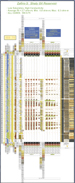
Basic Q & A,
Data Analysis, and Data Products
(Figures 1-3)
Goals, Evaluation, Description, and
Comparison
(Figures 4-10)
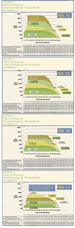
Petrofacies Probabilities for Thin Beds (ISS)
How Do Petrofacies Probabilities for
Thin beds (ISS) Relate to Possible Pay as a Function of:
How Do These Relationships:
Zafiro-3 vs. Opalo-2
-
Shaly, conductive
thin beds (Oil) vs. Sandy resistive thin beds (Gas)
-
Petrofacies
probability of thin beds: 0.75
-
Core description
sample rate: 100/ft
-
Core description
@ 20/ft shown for comparison.
-
For various
values of So and methods used to compute Sw,
-
GOAL: Optimize
the value for ISS used in geologic models, so as Not to
underpredict the occurrence and volume of thin beds.
Figures
11-14
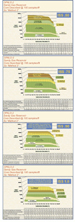
What are the effects of changing the
probability functions and how does this relate to lithology?
Zafiro-3
(Figures
11 and 12)
-
Shaly, conductive
thin beds (Oil).
-
Petrofacies
probabilities of thin beds: 0.50, 0.75, 0.90, 1.00.
-
Core description
sample rate: 100/ft.
Opalo-2
(Figures
13 and 14)
-
Petrofacies
probabilities of thin beds: 0.50, 0.75, 0.90. 1.00.
-
Core description
sample rate: 100/ft.
Prediction—Petrofacies
and Pay
Figures
15-17
How Much of the Predicted Petrofacies
for Thin beds (ISS) is Valid by Core Description at a Specified
Probability for a Particular So?
There are several ways to answer this
question, using core description as the Benchmark. The most
pertinent uses calibration of thin beds as predicted by ISS
probability curves to pay valid by core description, for use in
uncored wells.
In Cored Wells, for a Given Set of ISS
Probabilities and So Values, What % of ISS Is Likely to Be Pay?
(Figure
15)
How Does this Ultimately Affect Net
Pay? (Figures
16 and 17)
Results from cored wells provide these
answers; as So increases, particularly for shaly thin beds, the
percentage of ISS valid by core description expressed as a function
of net pay, and ultimately gross, decreases.
Application
to Static Modeling
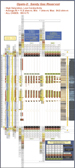
Serpentina West Model
Figures 18-22
Goals
-
Define the
sedimentary facies, especially thin bed facies in core for
better reservoir models.
-
Integrate cores
and open-hole logs to calibrate log-based facies interpretation
(Petrofacies).
-
Integrate
high-resolution seismic volume interpretation (geobodies) into
reservoir model by relating petrofacies and seismic, if
possible.
-
Assess possible
contributions of thin bed facies to well behavior, potential for
future development, and possible reserve adds.
Results
-
Identified three
reservoir facies (PBSS, MFSS, IBSS ) in Zafiro cores and
defined, together with non-reservoir facies, the appropriate
depositional setting.
-
Defined
methodology to create core- to-log calibrated petrofacies and
applied this to all wells in Zafiro.
-
Analysis reduced
the uncertainty on reserve estimation in Serpentina West.
-
Identified
potential well locations for future development.
-
Created workflow
to apply learning to other reservoirs.
Topacio
South 2 (Figures 23-24)
Facies and Petrophysical Modeling
Figures 25-33
Return to top.
|

 Print this page
 Click to view poster in PDF format (~6.6 mb).