Print this page
 Click
to article in PDF format.
Click
to article in PDF format.
A New Upper Oligocene Oil Play in Southern Burgos Basin, México*
By
Cuevas Leree, Antonio1, Rogelio Muñoz-Cisneros2, Pedro Silva-Saldivar2, Victor Hugo De la Rosa-R.2, Esmer O. Rivas-R.2, Jesus González-O.2, and Ramiro Fernández-Turner2
Search and Discovery Article #10077 (2005)
Posted January 27, 2005
*Adapted  from
from extended abstract prepared for
presentation at AAPG Annual convention, April 18-21, 2004.
extended abstract prepared for
presentation at AAPG Annual convention, April 18-21, 2004.
1Activo Regional de Exploracion, PEMEX E&P, Poza Rica, Ver, Mexico
2Activo Integral Burgos. PEMEX E&P, Reynosa, Tamps, Mexico
Abstract
Discovery of
oil in a new play has increased the petroleum potential of the Tertiary coastal
plain in the southern part of the Burgos Basin. In this Upper Oligocene
shoreface-sandstone play, the clastic succession is related to a deltaic system
with sediments unrelated to the Rio Grande Embayment but related to uplifted
terrains along the Sierra Madre Thrust Belt. Geochemical modeling indicates a
Tithonian origin of the oil and generation in a “kitchen” adjacent to the
discoveries, implying a few kilometers of migration of light oil (46° API)
through pathways afforded by the listric faults that also contributed to
formation of traps.
The intervals
tested are fine-grained sandstones that have a gross thickness of 600 meters, at
depths ranging from 2600 to 2900 meters below sea level. Porosity and
permeability range from 11 to 17% and 0.5 to 21 millidarcys, respectively.
Resistivity of sandstones typically is from 2 to 10 ohm-m. These rocks produce
at estimated rates of 4000 bpd and 9 MMCMPD of gas. Original potential resource
estimation of the prospect is close to 100 MMBOE. According to play analysis of
the region, the Upper Oligocene play could have up to 5000 km2 of
prospective area.
|
|
IntroductionThe study area is located in the southeastern part of the Burgos Basin (Figure 1). The exploration play for the Frio covers about 15,000 km2. The Nejo exploration area involved in the study is shown in Figure 1, as well as some of the most productive gas-fields of the eastern part of Burgos Basin. During the beginning of 2003, PEMEX (PETROLEOS MEXICANOS) started an exploration campaign in the southeastern part of the Burgos Basin called “Vicksburg-Frio Plays.” The objectives of these plays involve the clastic sequences of Frio Marino Formation and Vicksburg Formation (Middle-Lower Oligocene).
Using 2-D seismic data, the first
exploration well (Nejo) was located and subsequently drilled with an
oil-base mud (OBM) system. This well resulted in the discovery of the
field, with good production of light oil and gas Figure 2 illustrates the Cenozoic stratigraphic section and the position of the interval under study, the shallow-marine clastic sequences of the Frio Marino Formation (Middle Oligocene). General geological background studies of the Burgos Basin related to Cenozoic strata may be found in Echanove (1986) and Perez-Cruz (1992), among others. There are in existence other non-published studies of the area conducted for PEMEX.
General StratigraphyThe stratigraphic column of the study area above a Paleozoic basement of igneous, metamorphic, and volcano-clastic rocks consists of carbonates and marine evaporitic sequences of Mesozoic age overlain by a thick succession of Tertiary rocks (Figure 2), all with a maximum thickness of about 10 km in the deepest part of the basin.
According to Perez-Cruz (1992) the Cenozoic
strata has prograded,
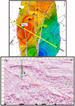
Structural FrameworkThe study area is located between two major synthetic listric faults that delimit the field (Figure 3a, 3b). The western fault has contributed to the creation of the rollover that forms the structure for the exploration test, and the eastern one formed later, simultaneously with the basinward migration of the Oligocene depocenter. Secondary synthetic normal faults affect the crestal area of the main rollover structure.
Reservoir Rock
Based on analysis of the well logs (OBMI
images) and core samples, the lithofacies were identified and recognized
in order to make an interpretation and propose a sedimentary model for
the Frio Marino Formation. In combination with the structural
deformation obtained This lithofacies can be interpreted as having been formed in a nearshore and shelfal zone, as indicated by the Ophiomorpha ichnofacies (Figure 4) and the presence of benthic shallow-water foraminifera.
Due to the thin-bed
Source RockModeling indicates that source rocks are Tithonian shales which normally yield low-gravity oil (18-22° API); however, light oil (46° API) is present. Therefore, secondary migration may have occurred over a long distance along pathways of the listric fault system where the traps are located to charge them with light oil (Figure 5).
AcknowledgmentsThis paper was made possible thanks to the invaluable help of the PEMEX Exploration Burgos authorities who released the data and allowed us the opportunity to develop this paper. Special thanks to geologist Marco Sanguinetti (Schlumberger-DCS, Reynosa) for substantial contributions.
ReferencesEchanove, Oscar, 1986, Geología Petrolera de la Cuenca de Burgos: Coordinación Regional de Exploración, Zona Noreste: Petroleos Mexicanos, v. 38, p. 3-69. Perez-Cruz, G.A., 1992, Estilos estructurales de la Cuenca de Burgos y sus perspectivas economicopetroleras (abs.): II Symposio Asociacion Mexicana de Geologos Petroleros, Instituto Mexicano del Petroleo, Mexico, D.F.
|