Print this page
 Click to view article in PDF format.
PSFrom collection to utilization: Outcrop analog data in a 3D world*
By
John B. Thurmond1
Search and Discovery Article #40126 (2004)
*Adapted from poster presentation at AAPG Annual Meeting, Dallas, Texas, April 18-21, 2004.
1University of Texas at Dallas ([email protected])
The collection of
three-dimensional data from outcrops is playing an increasingly important role
in reservoir characterization studies. There are a variety of techniques that
can be  used
used to acquire three-dimensional data from outcrops, and each should be
applied individually or in concert to collect data in specific circumstances.
The current suite of emerging methods typically used in outcrop-scale
measurement includes traditional surveying, direct GPS measurement, laser
scanning (LIDAR), photogrammetry, and photorealistic mapping (texture draped
geometry). Depending on the morphology, setting, and particular data needs of a
specific outcrop, different methods can be used to acquire data. Case studies of
individual outcrops will be shown to illustrate the problems and benefits of
several of these methods.
to acquire three-dimensional data from outcrops, and each should be
applied individually or in concert to collect data in specific circumstances.
The current suite of emerging methods typically used in outcrop-scale
measurement includes traditional surveying, direct GPS measurement, laser
scanning (LIDAR), photogrammetry, and photorealistic mapping (texture draped
geometry). Depending on the morphology, setting, and particular data needs of a
specific outcrop, different methods can be used to acquire data. Case studies of
individual outcrops will be shown to illustrate the problems and benefits of
several of these methods.
Once
three-dimensional data is collected, utilizing the data can present its own set
of challenges. Each collection method produces a different type of data, each of
which requires a variety of processing and interpretation methods to utilize
effectively. In most cases, there is also the need to integrate data from a
variety of sources into a single interpretable data set. Again, case studies
provide specific illustrations of effective methods that have been used in
various projects to produce reservoir models from a variety of environments,
including deep-water channel systems, heavily faulted fluvial environments, and
carbonate build-ups.
|
uAbstractuPhotorealistic outcrop capture
uAbstractuPhotorealistic outcrop capture
uAbstractuPhotorealistic outcrop capture
uAbstractuPhotorealistic outcrop capture
uAbstractuPhotorealistic outcrop capture
uAbstractuPhotorealistic outcrop capture
|
Figure Captions
MethodsGPS Mapping (Figures 1 and 4) The most straightforward method for mapping geologic surfaces in 3D is to simply walk them out with a high-precision GPS system. This type of mapping is most appropriate on accessible outcrops and in places where contacts or facies boundaries are subtle. Normally,
Real-Time Kinematic GPS systems are
Advantages: High accuracy (50 cm or less). Accurate data distribution (no surface, no data) eliminates “interpolation” problems.
Disadvantages: Slow (5-10 km per day). Re-interpretation can require re-mapping.
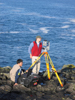
Laser Rangefinder Mapping (Figures 2 and 3) Often, it is not physically possible to “walk” on a stratigraphic surface, so other techniques are required. Reflectorless Laser Rangefinders, coupled with high-precision GPS receivers, provide the opportunity to capture data from such locations. These systems integrate an EDM for distance measurement with a digital compass and inclinometer, so 3D position can be measured remotely. However, this technique requires surfaces that are visible from a remote location.
Advantages: Fast.
Disadvantages: Lower accuracy (varies with distance). Encourages interpolation/extrapolation. Re-interpretation can require re-mapping.
Photorealistic Outcrop Capture (Figures 7 and 8) Using a
scanning laser system, coupled with a high-accuracy GPS system, it is
possible to scan the topography of an outcrop with a high degree of
accuracy. Digital photographs can then be accurately mapped to the
topography, which provides an accurate, three-dimensional
Advantages: Fast. High accuracy (5-10cm pixel error (!)). Provides images with data, so interpretations are believable. Data sets can be re-interpreted as paradigms change.
Disadvantages: Expensive equipment required. Processing can be intensive.
CarbonatesLocation: Last Chance Canyon, Guadalupe Mountains, New Mexico (Figures 5 and 6) Problem: Excellent 3D exposures of a mixed carbonate and siliciclastic system. Antecedent topography is an important control on subsequent facies deposition. Mapping of paleogeomorphological surfaces and subsequent facies in 3D provides the opportunity to build models which predict facies deposition as a function of topography for specific systems. Techniques: Currently, only GPS mapping has been applied. Photorealistic mapping scheduled for Q2 of 2004. Sample transects integrated into a 3D VRML data base containing outcrop photos, photomicrographs and sample descriptions (the live visualization has been demonstrated at oral and poster presentations). Results:
Current: 3D geologic Future:
Interpreted photorealistic
SiliciclasticsLocation: Eocene Ainsa II deepwater channel and lobe complex of the South-Pyrenean Foreland Basin, Spain (Figures 7, 8, 9, 10, and 11) With: Ole J. Martinsen and Tore M. Løseth, Jan Rivenaes, and Kristian Soegaard, Norsk Hydro Research Centre Problem:
These deep-water siliciclastics are an excellent analog for active
production fields in offshore Angola. Accurate 3D data captured from
outcrop facies relationships is
Techniques: Numerous integrated photorealistic models were Results:
A reservoir
Fault MappingLocation: Various faults in central Utah (Figures 12 and 13) With: Rod Myers, Peter Vrolijk, and Tom Hauge, ExxonMobil Upstream Research Problem: Fault systems have complicated 3D geometries, and fault properties vary as a function of geometry. Mapping of fault geometries and properties in 3D allows these relationships to be determined quantitatively, allowing them to be applied algorithmically to fault geometries observed in the subsurface.
Techniques: Many of these faults are difficult to see from a
distance, and outcrops are generally accessible, so direct GPS mapping
was Results:
A faulted framework
AcknowledgmentsThe author would like to thank the following individuals and companies for financial, conceptual, and/or fieldwork support for these projects: Norsk Hydro Research Centre ExxonMobil Upstream Research NSF Graduate Fellowship Carlos Aiken Xueming Xu Janok Bhattacharya
The author thanks Roxar for the generous donation of their software to UTD. |