|
uBackground
uFigure
captions
uGeologic
setting
uCoalbed
features
uHistory
and activity
uPotential
uReferences
uBackground
uFigure
captions
uGeologic
setting
uCoalbed
features
uHistory
and activity
uPotential
uReferences
uBackground
uFigure
captions
uGeologic
setting
uCoalbed
features
uHistory
and activity
uPotential
uReferences
uBackground
uFigure
captions
uGeologic
setting
uCoalbed
features
uHistory
and activity
uPotential
uReferences
uBackground
uFigure
captions
uGeologic
setting
uCoalbed
features
uHistory
and activity
uPotential
uReferences
uBackground
uFigure
captions
uGeologic
setting
uCoalbed
features
uHistory
and activity
uPotential
uReferences
|
Figure Captions
Return to top.
The Illinois Basin began as a rift complex that failed and evolved into
a rapidly subsiding Paleozoic cratonic embayment that was structurally
closed by major tectonic events in post Pennsylvanian time (Leighton et
al., 1990). The basin was at one time part of an extensive
continental-wide Pennsylvanian deltaic system that included, but was not
limited to, the Western Interior, Black Warrior, Michigan, and
Appalachian basins. The Illinois Basin is bounded by several major
arches that have separated it from adjacent basins. The basin contains
several large anticlinal features that have produced over 4 billion
barrels of oil from depths generally less than 2500 feet from
Mississippian, Devonian, Silurian and Ordovician reservoirs since the
late 1800s.
All of the significant coals in the Illinois Basin are found in the
Pennsylvanian rocks that are concealed by a thin veneer of Pleistocene
sediments. The present maximum thickness of the Pennsylvanian strata is
approximately 2500 feet. The Pennsylvanian sediments were deposited
unconformably on older rocks following a major period of uplift and
erosion at the end of the Mississippian (Willman, 1975). The
Pennsylvanian rocks were generally deposited in a marine to upper
deltaic environment on a shallow cratonic platform. Within the
Pennsylvanian rocks there are over 51 identified cyclothems in the
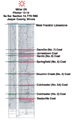
Illinois Basin. The coals that can be exploited for coalbed  methane methane potential are confined to the Carbondale and Spoon formations of
Desmoinesian age (Figure 2). Other coals
present in overlying and underlying formations have limited lateral
extent and seem to be barren of gas. The main coal seams that are
actively mined or have potential for coalbed methane are the Danville
(No. 7), Jamestown, the Herrin (No. 6), the Briar Hill (No. 5A), the
Springfield (No. 5), Houchin Creek (No. 4), Colchester (No. 2) and
Seelyville and its equivalents such as the Davis and Dekoven coals.
These coals are laterally extensive,m covering a vast majority of the
basin and have been extensively mapped. Major distributary channel
systems have been mapped in the No. 5 and No. 6 coal seams because of
the extensive mining involving these coals. Major black shales in the
Illinois Basin that overlie some of the coals are the Excello Shale
which overlies the Houchin Creek (No. 4), the Dykersburg Shale, and the
Anna Shale that overlies the Herrin (No. 6) coal. The coals in the
Illinois Basin range from High Volatile A from the depositional center
in Southern Illinois and Western Kentucky trending toward High Volatile
C on the fringes of the basin to the north, east, and west.
potential are confined to the Carbondale and Spoon formations of
Desmoinesian age (Figure 2). Other coals
present in overlying and underlying formations have limited lateral
extent and seem to be barren of gas. The main coal seams that are
actively mined or have potential for coalbed methane are the Danville
(No. 7), Jamestown, the Herrin (No. 6), the Briar Hill (No. 5A), the
Springfield (No. 5), Houchin Creek (No. 4), Colchester (No. 2) and
Seelyville and its equivalents such as the Davis and Dekoven coals.
These coals are laterally extensive,m covering a vast majority of the
basin and have been extensively mapped. Major distributary channel
systems have been mapped in the No. 5 and No. 6 coal seams because of
the extensive mining involving these coals. Major black shales in the
Illinois Basin that overlie some of the coals are the Excello Shale
which overlies the Houchin Creek (No. 4), the Dykersburg Shale, and the
Anna Shale that overlies the Herrin (No. 6) coal. The coals in the
Illinois Basin range from High Volatile A from the depositional center
in Southern Illinois and Western Kentucky trending toward High Volatile
C on the fringes of the basin to the north, east, and west.
An expected aggregate net thickness of coals in the Carbondale and Spoon
formations in the Illinois Basin is 15 to 45 feet except in areas of
outcrop or subcrop. The BTU content of the coal varies from 11,000 to
15,500 DMMF. Moisture content varies from 5% to 19%; ash content varies
from 1% to 25%; and volatile matter content varies from 28% to 41%.
Gas content for the Illinois Basin varies from a low of 5 to 6 Scf per
ton along the shallow areas of the basin, 80 to 150 scf per ton in the
center part of the basin, to 40 to 230 scf per ton in the areas of
higher rank coals in the southern part of the basin. Adsorption data is
generally ranging from 150 to 225 scf per ton. Gas content indicates the
coals are under-saturated based on present methods of analysis.
Permeability measurements to date have been estimated via injection
fall-off tests and indicate in the higher scf per ton areas in Southern
Illinois and Western Kentucky that permeability is generally in the
microdarcy to less than 10 millidarcies range. Permeability data in the
central part of the basin varies from the single digits to over 50
millidarcies.
Gas quality data is limited. Recently collected data indicates85% to 98%
methane, 1% to 6% C2 through C4 with the remainder
being nitrogen and trace amounts of carbon dioxide. BTU content has been
reported to be as low as 450 (gob or mine gas) to as high as 1050 BTU.
Based on isotopic analysis, the gas seems to be predominantly biogenic,
with a minor thermogenic composition.
Coalbed Methane
History and Activity
There is one non-mine or non-gob well that has produced from the virgin
coals prior to 1995. That well produced gas from unidentified coals and
provided lighting for Hidalgo, Jasper County. The well reportedly was
completed in the early 1920s in a coal seam(s) and was used for public
lighting of streetlights for a town of approximately 800 people. The
well was abandoned in the early 1930s. There has been no underground
mining within 30 miles of the town. There have been indications of gas
flows or shows from coals in Illinois while drilling along the La Salle
Anticline in Eastern Illinois and flows of gas when drilling exploration
holes for coal in Daviess County, Indiana.
Presently, there is one project producing from virgin coals that
consists of over 25 wells in Vigo and Sullivan counties and is operated
by BPI of Vancouver, British Columbia and Pulse Energy of Evansville,
Indiana. The wells produce from the Seelyville coal seam at 300 to 500
feet. The Seelyville coal in this area is 3 to 7 feet thick. Water rates
are reported to be 10 to 300 barrels a day with gas production beginning
several weeks after production is started. Gas rates have been reported
at 10 to 150 MCFGPD. No scf per ton data are available; it is reported
that the project has been underway for sometime, but no production data
are available inasmuch as they currently are held confidential by the
State of Indiana. However, the project is not considered to be
economic.
Most of the past and present activity is concentrated in areas of
historical coal mining in southern Illinois, in Franklin, Saline,
Gallatin, Williamson, Hamilton and White counties (Figure
3). Several operators, Berry Petroleum (Bakersfield, California),
Dorado Gas Resources LLC (Englewood, Colorado), DeMier Oil (Mt. Vernon,
Illinois), BPI Industries (Vancouver, Canada), Peabody Coal (St. Louis),
and CH4 (Harrisburg, Illinois) continue to attempt moving projects into
the pilot stage or from the pilot stage to full production.
Around the basin there are several wells that have been drilled and
completed in abandoned mines. Flow rates have varied from less than 100
MCFGPD to over 14 MMCFGPD. The gas quality ranges from 30% to 90%
methane with the remainder typically nitrogen. The gas is either sold to
existing pipelines or local end-users. Initial flow rates from these
wells are typically strong followed by rapid decline.
The focus in the basin is presently dominated by multiple zone
completions of several coals. There are several coals that can be
grouped into packages, such as the No. 5 through the No. 7 coal; the
Seelyville, Davis, Dekoven and Colchester coals. In some areas the
strata between the coals can be significant, whereby it will require
individual seam completion. Some coals, such as the Houchin Creek No. 4,
are typically isolated within the geologic section and may not be
considered economic and may have to remain behind pipe. Gob wells
require drilling into an exiting pillar or a few feet above the mine,
set pipe and then drill or frac into a dry part of the mine and
produce.
To date the water produced from the coalbed methane gas wells in Saline,
Williamson, Franklin, and White counties, Illinois, has been saline.
Wells that have produced water from unmined coal seams in Illinois are
slightly saline and require subsurface disposal. Produced water from the
wells in Indiana has been reported to be potable and is presently being
disposed of on the surface. There are several potential disposal zones,
Pennsylvanian sandstones in the lower part section and several
carbonates or sandstones in the Mississippian strata.
The vast majority of the land in the Illinois Basin is held in fee.
Invariably in areas where there is oil and gas production there are
split minerals present. In the southern part and western part of the
basin many coal-mining companies own individual seams through
conveyances via coal severances in the areas that are presently or have
historically been mined. In the central part of the basin these types of
severances do not exist. These severances are a major roadblock to
developing coalbed methane resources in areas where the No. 5 and No. 6
coals lie along the shallower parts of the basin. Land use in the
Illinois Basin is predominately farming. Population density is high in
certain areas due to the proximity to major interstates and cities such
as St. Louis, Peoria, Effingham, and Springfield.
Estimates of potential coal gas resources for the Illinois Basin have
been identified to be up to 21 TCF by the Gas Research Institute (now
known as GTI). This resource evaluation of gas in-place was based on
estimates using coal rank, depth, gas content, seam thickness, and
lateral continuity in the basin. Based on new data being collected in
the basin, the resource seems to be considerably less but significant.
Potential reserves on a per well basis are unknown. Based on existing
gas scf per ton and using 15 to 30 feet of net coal in the Carbondale
and Spoon formations, expected gas in-place reserves will probably range
from 1.5 to 5 BCF of gas per section depending on recovery factors,
location in the basin, and depth. The potential for the basin seems to
be 3 to 11 TCF of gas in place.
The present negatives for the Illinois Basin are:
The positives for the Illinois Basin are:
-
Multiple coal seams from
100 to 1,700 feet
-
Net coal of 15 to 35 feet
in the Carbondale and Spoon formations
-
Strong local and regional
gas markets that are dominated by unlimited end-users and several gas
pipelines purchasers
-
Predominantly fee land
-
Pro-industry regulators and
minimal environmental opposition.
Archer, P.L., 1979, Illinois Basin Report, Pennsylvanian
Geology and Coal and Coalbed Methane Resources of the Illinois Basin,
Illinois, Indiana and Kentucky: TRW Energy Systems Group, Contract No.
DE-AC21-78MC08089.
Archer, P.L., and J.N. Kirr, 1984, Pennsylvanian Geology,
Coal, and Coalbed Methane Resources of the Illinois Basin -- Illinois,
Indiana, and Kentucky, in Craig T. Rightmire et al., eds.,
Coalbed Methane Resources of the United States: AAPG Studies in Geology
Series #17, p 105-134.
Damberger, Heinz H., 1999, Miscellaneous Information on
Coals, Coalbed Methane and Coal Mine Methane in the Illinois Basin:
Illinois Geological State Survey, Handout, 30p.
Demir, I., and H.H. Damberger, 2000, Coalbed and Coal
Mine Methane Potential of Illinois Basin: Rocky Mountain Association of
Geologists, 2000 Coalbed Methane in the Rocky Mountains Symposium,
Denver, Colorado.
Smath, Richard A., David A. Williams, James C. Cobb, and
Barry W. Fisher, 1985, Feasibility Assessment of Unconventional Gas in
Kentucky, Phase II -- Western Kentucky Coal-Bed Methane Study: Kentucky
Geological Survey Grant Number 201-65-8W220-S5276, 451p. Study: Kentucky
Geological Survey Grant Number 201-65-8W220-S5276, 451p.
Smith, William H., and John B. Stall, 1975, Coal and
water resources for coal conversion in Illinois: Illinois State Water
Survey and Illinois State Geological Survey Cooperate Resources Report
4, 79p.
Willman, H.B., et al., 1975, Handbook of Illinois
stratigraphy: Illinois State Geological Survey, Bulletin 95, 261p.
Wood, Gordon
H., Jr., and William V. Bour, III, 1988, Coal Map of North America:
United States Geological Survey, 2 map sheets, 1:5,000,000.
Return to top.
|

 Print this page
 Click to view article in PDF format.