Print this page
 Click to view article in PDF format.
GCElectromagnetics Help Lower Drilling Risk*
By
Terry W. Donze1
Search and Discovery Article #40116 (2004)
*Adapted for online
presentation from the Geophysical Corner column in AAPG Explorer, March, 2003,
entitled “EM  Techniques
 Show Promise” and prepared by the author. Appreciation
is expressed to him, to R. Randy Ray, Chairman of the AAPG Geophysical
Integration Committee, and to Larry Nation, AAPG Communications Director, for
their support of this online version.
Show Promise” and prepared by the author. Appreciation
is expressed to him, to R. Randy Ray, Chairman of the AAPG Geophysical
Integration Committee, and to Larry Nation, AAPG Communications Director, for
their support of this online version.
1Independent geophysicist/geologist, Denver, Colorado ([email protected])
Updated electromagnetic profiling techniques hold promise for evaluating shallow
oil and gas plays along basin margins. An electromagnetic (EM) exploration
system has been commercialized by Montason Exploration Inc., using recently
developed theory combined with computer and measurement instrumentation.
The basic
geophysical properties of subsurface reservoirs indicate the range of
resistivity variation is much larger than the range of P-wave seismic velocities
(Figure 1). By measuring subsurface conductivity, a "virtual" resistivity log
can be derived for geological mapping, the company says. Because resistivities
of hydrocarbon-filled and wet reservoirs vary significantly, EM resistivity data
may define reservoir fluid content without drilling.
|
uGeneral statementuFigure captionsuField testsuApplicationsuBottom lineuReference
uGeneral statementuFigure captionsuField testsuApplicationsuBottom lineuReference
uGeneral statementuFigure captionsuField testsuApplicationsuBottom lineuReference
uGeneral statementuFigure captionsuField testsuApplicationsuBottom lineuReference
|
Real World Field Tests
Some of the scientific theory has been published in the United States and Russia. Successful lab and field tests have been independently conducted. Testing was done in the shallow Cretaceous Niobrara chalks in the D-J Basin in eastern Colorado, where:
Niobrara gas fields are structurally-trapped accumulations. Typical gas wells produce under 500 MCFPD and have reserves averaging from 100-700 MMCF up to 2 BCF per well. Formation resistivity is 1-2 ohm-m in wet wells and 4-25 ohm-m in producers.
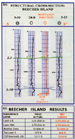
Beecher
Island Field covers 27 square miles; production is at 1,400 feet, with
200 feet of
A survey
also was conducted over the Applications
Reconnaissance work can be done as well as prospect
The current EM system's depth limit is about 2500 feet, but signal penetration is area-dependent, and some areas allow deeper penetration. Advanced system designs will soon permit recording well below 5000 feet. A conductivity contrast is necessary for the tool to work. In the examples presented, productive Niobrara generally has a 100 percent or greater contrast, but EM detects much lower contrasts. Mineralized zones are identifiable because they generally show very high contrasts. Effective analysis of EM profiles requires calibration to known subsurface conditions. Cultural problems affecting use are electric transmission lines, pumps, pipelines with cathodic protection, and high traffic areas. EM surveys are highly efficient -- analysis is completed in a few days, allowing for great acquisition versatility. Because of this, the crew can be redirected to sample an anomaly on a tighter grid before moving. EM also is easy on the environment, lowering permitting costs due to negligible surface disturbance. The Bottom Line
The main
advantage of an EM survey is its low cost compared to 3-D seismic
designed for high frequency at shallow depths. This is especially true
when the cost of three-component
Wright, D.A., Ziolkowski, A., and Hobbs, B.A., 2001, Hydrocarbon detection with a multi-channel transient electromagnetic survey (Expanded Abstracts): 71st SEG Meeting, 9-14 September, San Antonio, p 1435-1438.
|