Print this page
Click to view the posters in PDF
PSSeal
and Reservoir Characterization of Upper Slope Fan  Lithofacies
 :
:
Example of High-Frequency Variability
By
William C. Dawson1, William R. Almon1, and S.J. Johansen2
Search and Discovery Article #40124 (2004)
*Adapted from poster presentation at AAPG Annual Meeting, Dallas, Texas, April 18-21, 2004; closely related poster/article, prepared and presented by Wm. R. Almon and Wm. C. Dawson, is entitled "Seal Character and Variability Within Deep-Marine Depositional Systems: Seal Quantification and Prediction" (Search and Discovery Article #40125).
1ChevronTexaco, Bellaire, TX ( [email protected] ; [email protected])
2Ameriven, Venezuela
Abstract
Conventional cores
of a lowstand sequence (interpreted as a slope fan) reveal fine-scale
variability within potential seal and reservoir units and provide insights
concerning depositional process, sedimentation rates, and stratigraphic
compartmentalization, which are below wire-line log and seismic resolution. The
lower cored interval consists of dark gray to black foraminiferal shale
representing slow (hemipelagic to hemi-turbiditic) deposition during a
highstand. This maximum flooding shale is a major correlation marker because of
its distinct gamma ray signature; it has an erosional upper contact (sequence
boundary). This erosional contact is overlain by stacked, fining-upward stratal
packages consisting of: deformed, argillaceous, fine-grained sandstones; sandy
mudstones; and very silty gray shales. The sand-prone units consist of thinly
interstratified shale, siltstone, and sandstone interpreted as blocks of levee
deposits that probably slumped into channels. The interstratified sandy
mudstones represent thin debris flows. Compartmentalization by numerous shale
laminations and clay smears (along micro-faults) is conspicuous. The character
of this argillaceous slope-fan reservoir is interpreted as poor (< 10%
porosity). Results of high-pressure mercury capillary injection analysis reveal
excellent seal character (10% nonwetting saturation > 10,000 psia) is exhibited
by these shales below the sequence boundary. In contrast, silty shales and
argillaceous siltstones from the overlying lowstand units have moderate to poor
seal potential. Seal character is related to shale texture and fabric, content
of detrital silt, early marine diagenesis (carbonate cementation), and
stratigraphic position. These data provide a compelling argument for textural
control of seal character induced by high-frequency sedimentary cycles.
|
uAbstract
uAbstract
uAbstract
uAbstract
uAbstract
uAbstract
uAbstract
uAbstract
uAbstract
uAbstract
|
Introduction(Figures 1,2-1, 1,2-2, and 1,2-3)
Several
important discoveries have been made in channelized slope fans along the
margin of West Africa and other deepwater basins (Weimer et al., 2000;
Prather, 2003). Seismic elements isolated from within these muddy slope
packages commonly exhibit sinuous patterns on plan-view maps (Kolla et
al., 2001; and Fonnesu, 2003). In offshore Angola, and elsewhere, these
sinuous features are interpreted as migrating deep marine channels that
acted as conduits for turbidity flows (e.g., Sinclair and Tomasso,
2002). High-resolution data (wire-line logs and cores) reveal very
complex association of
Considerable by-passed oil (~30% OOIP) can be trapped in thin-bedded
channel-margin
Core Descriptions
General Statement
Fine-scale variability in
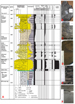
8035 to 8057 feet Lithology: Yellowish-orange, fine-grained sandstones, interstratified with dark gray shales, argillaceous siltstones, and pebbly mudstones. Convoluted bedding is developed throughout. Wire-line log character: GR curve has an irregular profile reflecting thin alteration of shales and sandstones with values ranging from 30 to 80 AMP units. Resistivity log compromised by washout and caving of bore hole. Interpretation: Lowstand systems tract (slope fan depositional system). Probable abandonment channel filled with slumped channel-levee blocks and debris flow lags.
8057 to 8068.4 feet Lithology: Moderate dark gray to grayish black noncalcareous shales. Sub-fissile with scattered lenses of siltstone. Bedding ranges from planar to convoluted. Wire-line log character: Slightly elevated GR (~ 90 API units) with low resistivity values (1.2 to 2 ohms). Interpretation: Minor condensed interval separating two stacked channel-levee units or shale-filled channel (abandoned channel).
8068.4 to 8105.25 feet Lithology: Complex of thinly interstratified oil-stained, yellowish-gray, fine-grained sandstones, argillaceous siltstones, dark gray shales, and pebbly mudstones. Exhibits syndepositional deformation (convoluted laminae) and microfaulting. Wire-line log character: GR ranges from 20 to 85 API units (fining upward). Resistivity readings vary between 2.5 (siltstones) and 45 ohms (oil-bearing sandstones). Interpretation: Lowstand systems tract (slope-fan depositional setting). Probable abandoned channel filled with slumps (levee-derived) and debris flows.
8105.25 to 8117.5 feet Lithology: Grayish black to brownish black shales. Less calcareous than underlying unit. Sub-fissile with moderately developed laminations. Wire-line log character: Modest resistivity (~ 25 ohms) with depressed sonic (100 to 110 ms/ft). Exhibits prominent GR spike (160 to 175 API units). Interpretation: Highstand systems tract or initial falling stage systems tract.
8117.5 to 8123 feet Lithology: Grayish black, calcareous and pyritic shale. Exhibits blocky fracture and faint laminations (accentuated by concentrations of foraminifer tests). Wire-line log character: High GR (130 to 150 API units); elevated resistivity (> 40 ohms). Interpretation: Maximum flooding shale.
Angola Seal Data(Figures 4-1, 4-2, 4-3, 4-4, 4-5, 4-6, 4-7, and 4-8)
Our seal analyses reveal the common presence of six recurring shale types in deepwater depositional settings. Shale types 1, 2, and 6 exhibit excellent top (membrane) seal potential. Silt-rich shales (types 3, 4, and 5) have considerably lower seal capacity. Shapes
of mercury-injection curves (MICP Each shale type occupies a particular stratigraphic position. Type 2 shales represent upper transgressive and condensed intervals. Type 3 shales occur in middle to lower parts of transgressive units, and very silty (type 4) shales represent lowstand and highstand stratal packages.
Seal Stratigraphy
This core penetrated stacked submarine channels, which are encased in marine shales. Our data show clearly that shale facies and variations in shale fabric are important factors in determining seal competency. Shale facies and seal capacity vary within the context of sequence stratigraphy. The underlying fossiliferous black shale has exceptional seal character, and the overlying dark gray fissile shale (probable condensed interval) exhibits excellent seal potential. The sequence boundary at 8105 ft is a significant pressure barrier. These marine shales are expected to have lateral continuity exceeding that of the channelized sandstone units.
Reservoir Character(Figures 6-1, 6-2, 6-3, 6-4, 6-5, 6-6, 6-7, 6-8, 6-9, 6-10, 6-11, 6-12, and 6-13)
Petrographic
Summary and ConclusionsSeal character in slope-fan settings is related to variations of shale fabric and texture (e.g., content of detrital silt). At least three distinctive shale microfacies, each having different MICP (seal) profiles are present in the cored interval. · Top seal potential ranges from moderate to excellent (in the absence of fractures). · Lateral seal potential ranges from moderate to poor.
Variations in depositional fabric, which correlate with high-frequency (wire-line log-scale) stratigraphic fluctuations, are responsible for observed variations in seal capacity.
Reservoir compartmentalization, induced by
shale laminae and clay smears (micro-faults), is a common aspect of
channel-margin
Reservoir character (especially permeability)
is compromised by ductile folding and small-scale faulting. Slumping
along with the deposition of mud drapes contribute to limited internal
connectivity in channel-margin
Porosity-depth modeling suggests that the
reservoir potential of fine-grained channel-margin
ReferencesAlmon, W.R., Dawson, Wm. C., Sutton, S.J., Ethridge, F.G., and Castelblanco, B., 2002, Sequence stratigraphy, facies variation and petrophysical properties in deepwater shales, Upper Cretaceous Lewis Shale, south-central Wyoming: GCAGS Transactions, v. 52, p. 1041-1053. Dawson, Wm. C., and Almon, W.R., 2002, Top seal potential of Tertiary deepwater Gulf of Mexico shales: GCAGS Transactions, v. 52, p. 167-176. Fonnesu, F., 2003, 3D seismic images of a low-sinuosity slope channel and related depositional lobe (West Africa deep-offshore): Marine and Petroleum Geology, v. 20, p. 615-629. Galloway, 1998, Siliciclastic slope and base-of-slope depositional system: Component facies, stratigraphic architecture, and classification: AAPG Bulletin, p. 569-595. Jennings, J.J., 1987, Capillary pressure techniques: application to exploration and development geology: AAPG Bulletin, v. 71 (10), p. 1196-1209. Kolla, V., Bourges, P., Urruty, J.M., and Safa, P., 2001. Evolution of deep-water Tertiary sinuous channels offshore Angola (west Africa) and implications for reservoir architecture: AAPG Bulletin, v. 85 (8), p. 1373-1405. Prather, B.E., 2003, Controls on reservoir distribution, architecture and stratigraphic trapping in slope settings: Marine and Petroleum Geology, v. 20, p. 529-545. Prather, B.E., Booth, J.R., Steffens, G.S., and Craig, P.A., 1998, Classification, lithologic calibration and stratigraphic succession of seismic facies from intraslope basins, deep water Gulf of Mexico, USA: AAPG Bulletin, v. 82 (5), p. 701-728. Sinclair, H.D., and Tomasso, M., 2002, Depositional evolution of confined turbidite basins: Journal Sedimentary Research, v. 72 (4), p. 451-456. Weimer, P., Slatt, R.M., Dromgoole, P., Bowman, M., and Leonard, A., 2000, Developing and managing turbidite reservoirs: case histories and experiences: results of the 1998 EAGE/AAPG Research Conference: AAPG Bulletin, v. 84, p. 453-465.
AcknowledgementsWe thank ChevronTexaco for granting permission to present these data and interpretations. W.T. Lawrence prepared thin sections and assisted with core photography. J.L. Jones provided SEM images, and D.K. McCarty completed XRD analyses. Poro-Technology, Houston, TX conducted MICP analyses. Graphic design by L.K. Lovell.
|