|
uAbstract
uIntroduction
uFigures
1-2
uBackground
uHistory
of Long  Beach Beach Unit Unit
uHistory
of old Wilmington area
uFigure
3
uCase
histories
uFigures
4-12
uCase
history 1(Tar zone)
uCase
histories
2 & 3
uFigures
13-18
uCase
history 2 (Tar zone)
uFigures
19-24
uCase
history 3 (Terminal zone)
uConclusions
uAcknowledgments
uReferences
uAbstract
uIntroduction
uFigures
1-2
uBackground
uHistory
of Long Beach Unit
uHistory
of old Wilmington area
uFigure
3
uCase
histories
uFigures
4-12
uCase
history 1(Tar zone)
uCase
histories
2 & 3
uFigures
13-18
uCase
history 2 (Tar zone)
uFigures
19-24
uCase
history 3 (Terminal zone)
uConclusions
uAcknowledgments
uReferences
uAbstract
uIntroduction
uFigures
1-2
uBackground
uHistory
of Long Beach Unit
uHistory
of old Wilmington area
uFigure
3
uCase
histories
uFigures
4-12
uCase
history 1(Tar zone)
uCase
histories
2 & 3
uFigures
13-18
uCase
history 2 (Tar zone)
uFigures
19-24
uCase
history 3 (Terminal zone)
uConclusions
uAcknowledgments
uReferences
uAbstract
uIntroduction
uFigures
1-2
uBackground
uHistory
of Long Beach Unit
uHistory
of old Wilmington area
uFigure
3
uCase
histories
uFigures
4-12
uCase
history 1(Tar zone)
uCase
histories
2 & 3
uFigures
13-18
uCase
history 2 (Tar zone)
uFigures
19-24
uCase
history 3 (Terminal zone)
uConclusions
uAcknowledgments
uReferences
uAbstract
uIntroduction
uFigures
1-2
uBackground
uHistory
of Long Beach Unit
uHistory
of old Wilmington area
uFigure
3
uCase
histories
uFigures
4-12
uCase
history 1(Tar zone)
uCase
histories
2 & 3
uFigures
13-18
uCase
history 2 (Tar zone)
uFigures
19-24
uCase
history 3 (Terminal zone)
uConclusions
uAcknowledgments
uReferences
uAbstract
uIntroduction
uFigures
1-2
uBackground
uHistory
of Long Beach Unit
uHistory
of old Wilmington area
uFigure
3
uCase
histories
uFigures
4-12
uCase
history 1(Tar zone)
uCase
histories
2 & 3
uFigures
13-18
uCase
history 2 (Tar zone)
uFigures
19-24
uCase
history 3 (Terminal zone)
uConclusions
uAcknowledgments
uReferences
uAbstract
uIntroduction
uFigures
1-2
uBackground
uHistory
of Long Beach Unit
uHistory
of old Wilmington area
uFigure
3
uCase
histories
uFigures
4-12
uCase
history 1(Tar zone)
uCase
histories
2 & 3
uFigures
13-18
uCase
history 2 (Tar zone)
uFigures
19-24
uCase
history 3 (Terminal zone)
uConclusions
uAcknowledgments
uReferences
uAbstract
uIntroduction
uFigures
1-2
uBackground
uHistory
of Long Beach Unit
uHistory
of old Wilmington area
uFigure
3
uCase
histories
uFigures
4-12
uCase
history 1(Tar zone)
uCase
histories
2 & 3
uFigures
13-18
uCase
history 2 (Tar zone)
uFigures
19-24
uCase
history 3 (Terminal zone)
uConclusions
uAcknowledgments
uReferences
uAbstract
uIntroduction
uFigures
1-2
uBackground
uHistory
of Long Beach Unit
uHistory
of old Wilmington area
uFigure
3
uCase
histories
uFigures
4-12
uCase
history 1(Tar zone)
uCase
histories
2 & 3
uFigures
13-18
uCase
history 2 (Tar zone)
uFigures
19-24
uCase
history 3 (Terminal zone)
uConclusions
uAcknowledgments
uReferences
uAbstract
uIntroduction
uFigures
1-2
uBackground
uHistory
of Long Beach Unit
uHistory
of old Wilmington area
uFigure
3
uCase
histories
uFigures
4-12
uCase
history 1(Tar zone)
uCase
histories
2 & 3
uFigures
13-18
uCase
history 2 (Tar zone)
uFigures
19-24
uCase
history 3 (Terminal zone)
uConclusions
uAcknowledgments
uReferences
uAbstract
uIntroduction
uFigures
1-2
uBackground
uHistory
of Long Beach Unit
uHistory
of old Wilmington area
uFigure
3
uCase
histories
uFigures
4-12
uCase
history 1(Tar zone)
uCase
histories
2 & 3
uFigures
13-18
uCase
history 2 (Tar zone)
uFigures
19-24
uCase
history 3 (Terminal zone)
uConclusions
uAcknowledgments
uReferences
uAbstract
uIntroduction
uFigures
1-2
uBackground
uHistory
of Long Beach Unit
uHistory
of old Wilmington area
uFigure
3
uCase
histories
uFigures
4-12
uCase
history 1(Tar zone)
uCase
histories
2 & 3
uFigures
13-18
uCase
history 2 (Tar zone)
uFigures
19-24
uCase
history 3 (Terminal zone)
uConclusions
uAcknowledgments
uReferences
uAbstract
uIntroduction
uFigures
1-2
uBackground
uHistory
of Long Beach Unit
uHistory
of old Wilmington area
uFigure
3
uCase
histories
uFigures
4-12
uCase
history 1(Tar zone)
uCase
histories
2 & 3
uFigures
13-18
uCase
history 2 (Tar zone)
uFigures
19-24
uCase
history 3 (Terminal zone)
uConclusions
uAcknowledgments
uReferences
uAbstract
uIntroduction
uFigures
1-2
uBackground
uHistory
of Long Beach Unit
uHistory
of old Wilmington area
uFigure
3
uCase
histories
uFigures
4-12
uCase
history 1(Tar zone)
uCase
histories
2 & 3
uFigures
13-18
uCase
history 2 (Tar zone)
uFigures
19-24
uCase
history 3 (Terminal zone)
uConclusions
uAcknowledgments
uReferences
uAbstract
uIntroduction
uFigures
1-2
uBackground
uHistory
of Long Beach Unit
uHistory
of old Wilmington area
uFigure
3
uCase
histories
uFigures
4-12
uCase
history 1(Tar zone)
uCase
histories
2 & 3
uFigures
13-18
uCase
history 2 (Tar zone)
uFigures
19-24
uCase
history 3 (Terminal zone)
uConclusions
uAcknowledgments
uReferences
uAbstract
uIntroduction
uFigures
1-2
uBackground
uHistory
of Long Beach Unit
uHistory
of old Wilmington area
uFigure
3
uCase
histories
uFigures
4-12
uCase
history 1(Tar zone)
uCase
histories
2 & 3
uFigures
13-18
uCase
history 2 (Tar zone)
uFigures
19-24
uCase
history 3 (Terminal zone)
uConclusions
uAcknowledgments
uReferences
uAbstract
uIntroduction
uFigures
1-2
uBackground
uHistory
of Long Beach Unit
uHistory
of old Wilmington area
uFigure
3
uCase
histories
uFigures
4-12
uCase
history 1(Tar zone)
uCase
histories
2 & 3
uFigures
13-18
uCase
history 2 (Tar zone)
uFigures
19-24
uCase
history 3 (Terminal zone)
uConclusions
uAcknowledgments
uReferences
|
Figure Captions (1-2)
Return to top.
The
Wilmington oil field of southern California (Figure 1), the largest oil
field in the Los Angeles Basin (Biddle, 1991), has produced more than
2.6 billion barrels of oil (California Department of Conservation,
1999). Discovered in 1932, it produces from semi- and unconsolidated
Pliocene and Miocene clastic slope and basin turbidite sandstones
(Henderson, 1987; Blake, 1991). The individual reservoirs are defined by
graded sequences of sandstone interlayered with siltstones and shales (Slatt
et al., 1993). The entire sequence is folded and faulted (Mayuga, 1970;
Clarke, 1987; Wright, 1991). Even the typical rhythmically deposited
sequences have lenticular, lobate shapes and are complicated by basal
scour, amalgamation, onlapping, and channeling. The result is a sequence
of rocks that often appears to be uniform but is not. These complexities
also result in permeability variations that hinder the producibility of
the sandstones, impact waterflooding, and result in a substantial amount
of bypassed oil.
The
Wilmington field has been divided stratigraphically into seven producing
zones, 52 subzones and, locally, into even finer subsubzones (Henderson,
1987). A serious effort was made to establish stratigraphic continuity
in detail as fine as possible. The finer subdivisions are defined as
hydrologic bodies or depositional sequences. Many techniques and tools
were applied to characterize the thinner sand bodies into unique units,
including core description combined with log-rock typing, detailed log
correlation, production/injection history matching, bypassed
pay-saturation analysis on recent pass-through wells, and reservoir
simulation (Otott, 1996; Davies and Vessell, 1997; Davies et al., 1997).
Six geologists spent the better part of one year working with thousands
of old logs and assorted base maps to sort out a consistent and logical
stratigraphic sequence. In addition to the authors, Keith Jones, Mike
Henry, Linji An, Rick Strehle, and David K. Davies performed a
significant portion of the characterization.
Although we
are still learning about the intricacies of Wilmington field’s
reservoirs, today’s computerized visualization tools, combined with
advanced measurement-while-drilling (MWD) data, have contributed
significantly to the collective knowledge base about this field. We thus
confidently conclude that the field’s poorly drained sandstones remain
ideal targets for horizontal drilling.
The
Wilmington oil field is a faulted asymmetrical anticline. The reservoirs
of the 10 larger fault blocks in the field have been managed
independently. The city of Long Beach, Department of Oil Properties,
operates most of them (Figure 2). The Wilmington Townlot Unit (WTU), a
portion of the westernmost Fault Block I, is operated by Magness
Petroleum Company. Pacific Energy Resources operates a portion of Fault
Block II. Tidelands Oil Production Company is the field contractor for
most of the western portion (Fault Blocks I–V). THUMS Long Beach Company
is the field contractor for the eastern part of Wilmington oil field
(Fault Blocks VI–90N), which is called the Long Beach Unit (LBU). The
LBU was originally produced with more than 1000 wells drilled between
1965 and 1982 (Otott and Clarke, 1996). Despite the very long completion
intervals used and water injection for pressure support, oil remained in
pockets of tight, thin sandstones, as well as in areas with poor
injection support. Widely ranging permeabilities and faulting caused
typically viscous oil (12.5° to 16° API) to be left behind in sandstone
units 6 to 15 m thick.
An
additional 460 wells were drilled in the Long Beach Unit from 1982 to
1986 using a subzone approach to improve sweep efficiency, which allowed
another 25.4 million cubic meters (m3), or 160 million
barrels (bbl), to be produced. After 1986, bypassed sandstones were
selectively perforated in even finer intervals. The first horizontal
well was completed in November 1993 as part of the optimized waterflood
project. Thirty-nine more horizontal wells have been drilled since then,
using a combination of computerized mapping and digitized injection
surveys to identify the dominant, unswept flow units. Reservoir
exploitation was enhanced by geosteering supported by logging while
drilling (LWD) and real-time analysis of MWD/LWD data to update cross
sections.
Typically,
the wells were placed 3 to 5 m (10 to 15 ft) below the top of the
sandstone. Initial oil-production rates from the best horizontal wells
exceeded 95.4 m3/day (600 bbl/day) and about 47.7 m3/day
(300 bbl/day) from the average wells, at 80% water cut, stabilizing at
about 15.9 m3/day after 300 days. Total unit oil production
is 6042 m3/day (38,000 bbl/day). Blesener and Henderson
(1996) describe several of the new engineering technologies that have
been applied to the Long Beach Unit. These include coiled-tubing
drilling, drill-cuttings injection, and reclaimed-water injection. In
1995, the LBU ran a 3-D seismic survey to help define the subsurface in
greater detail (Otott et al., 1996). The survey did not provide the
desired results, but it did serve as a valuable tool for deep work.
Several exploratory prospects were identified. One or more of these may
be drilled in 2003.
THUMS was
purchased from ARCO by Occidental Oil and Gas Corporation in May 2000.
In 2002, THUMS conducted a 3-D vertical seismic profile (VSP) in the
area between Islands Freeman and Chaffee. These data are being
processed.
The history
of the Wilmington oil field has been detailed by Mayuga (1970), Ames
(1987), and Otott and Clarke (1996). More than 5000 wells have been
drilled conventionally in the 70 years Old Wilmington has been on
production. The entire field is on secondary recovery, and oil
production is down to 1113 m3/day (7000 bbl/day) with an
average water cut of 96.9%. Because of the steep, 14%-per-year decline,
it was decided to investigate new ways to produce more oil. As part of
this effort, Tidelands Oil Production Company has drilled 14 horizontal
wells since 1993 in four heavily drilled (3000-plus wells) fault blocks
(Phillips and Clarke, 1998; Phillips et al., 1998). The first horizontal
well project was a “Huff ’n’ Puff ” conducted in 1993 in Fault Block I
Tar zone. Two 274.3 m- (900 ft-) long horizontal wells were drilled into
the D1 sandstone. The second project was a steamflood in
Fault Block II Tar zone. In 1995 for project 2, four horizontal wells
were drilled on average 488 m (1600 ft) within the D1
sandstone. A Fault Block IV Terminal zone waterflood well was drilled
335.3 m (1100 ft) within the Hxb sandstone in 1995 as the third project.
Again in 1995, five horizontal wells were drilled into the Fault Block V
Tar zone as part of a steamflood. The wells were drilled on average
457.2-m (1500 ft) horizontally within the S4 sandstone. In
1997, a 304.8-m (1000-ft) horizontal well was drilled into the Hx0
sandstone of Fault Block V Terminal zone to complete the fifth project.
For each
project, the horizontal laterals for the waterflood wells were placed at
the top of the sandstone to recover attic reserves. The laterals for the
steamflood wells were placed at the bottom of the sandstone to maximize
capture of oil through steam-assisted gravity drainage.
Except for
the first project, 3-D modeling and visualization were used from
planning through completion. To be effective, horizontal wells require
precision placement. The studied areas required significant geologic
evaluation and characterization. The area then was modeled with software
that provided 3-D visual displays of stratigraphic and structural
relationships and enabled excellent error checking of data and grids in
3-D space. The geologic model was revised and modified in 3-D space. The
3-D model provided a visual reference for well planning and
communicating the spatial relationships contained within the reservoir.
Accurate 2-D and 3-D visualization was used for interpreting the LWD
response and monitoring well progress while drilling. Maps and section
plots brought to the rig site allowed the drilling team to relate to the
geology, thus providing a strong confidence factor. Accurate and rapid
postdrilling analysis for completion-interval selection and LWD analysis
completed the process.
Return to top.
Figure Caption (3)
Three case
histories are presented herein. Case history 1 describes a
thermal-enhanced recovery project that expanded on an existing
steamflood project. The expansion area was subjected to detailed
characterization with 3-D modeling and visualization before completion
of the development project. The technologies developed in the steamflood
project were applied to the areas in Fault Block V and are described as
case histories 2 and 3. Figure 3 shows the location of the three case
histories.
Figure Captions (4-12)
|
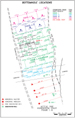 |
Figure
4. Map of Fault Block II area showing the location of the Wilmington
oil field Tar zone, Fault Block II-A steamflood project.
Each phase
of the project is shown in color code. The project described here
focuses on the southern area where the four horizontal wells were
drilled. Cross section A-B follows the well course of UP955. |
|
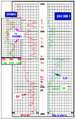 |
Figure
5. Type logs for Tar zone, Fault Block II (Well 2AU 30B 1).
Original
markers are shown in black, and the newly picked markers in red. The
inset shows the T4 channel from well 2AT58B. Note the good
saturation between D1 and D1E. The location of
these two wells is shown in Figure 10. |
|
 |
Figure
6. Map showing location of Fault Block II horizontal wells in
relation to the subsidence bowl. Red contour lines are total
elevation loss in feet. The four horizontal wells were completed in
an area of 14 to 22 ft (4.3 to 6.7 m) of subsidence.
Producing well
courses are shown in blue, and steam-injection well courses are
shown in green. The line of cross section A-B parallels well UP 955.
|
|
 |
Figure
7. Three components of subsidence correction.
(A) Adjustments must
be made for rock compaction that occurs after a well is drilled.
(B)
The kelly bushing must be corrected for subsidence that occurred
prior to drilling. (C) Finally, an adjustment must be made within
the formation to correct the overlying sediments for compaction that
has occurred below. |
|
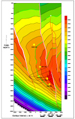 |
Figure
8. Structure map of the T marker in Fault Block IIA. Observation and
horizontal wells are shown. Contour intervals shown are 50 ft (15.2
m) from –2400 to –3400 ft (–731.5 to –1036 m) below sea level.
|
|
 |
Figure
9. Cross section A-B, which follows the well course of UP 955.
Perforations are shown on well course.
The onlap of the D1E
is shown; no detail below EV is shown. The section is scaled in feet
and has a 2x vertical exaggeration. The locations of the cross
section and well UP 955 are also shown in
Figures 3,
4,
6, and
8.
|
|
 |
Figure
10. Three-dimensional structural display of the T2 horizon in Fault
Block II (FB II), showing locations of the two type wells in
Figure
5. The T4 paleochannel cuts through several horizons. |
|
 |
Figure
11. Three-dimensional display of the D1F onlap onto the D2
shale in Fault Block II. The figure has a 2x vertical exaggeration,
and the units displayed are in feet. |
|
 |
Figure
12. Three-dimensional display of Fault Block II showing locations of
wells drilled for the steamflood project.
The figure has a 2x
vertical exaggeration, and the wellbores are greatly exaggerated to
enhance the visual impact of the well pattern. |
Return to top.
Case History 1: Fault Block II, Tar Zone Steamflood Project
Case
history 1 is in the Tar zone of Fault Block II (Figure 4). The Tar zone
of the lower Pliocene Repetto Formation (Figure 5) is the shallowest of
the major oil-producing zones in the Wilmington field. It has been
interpreted to consist of large, lobate, submarine-fan deposits (Redin,
1991), which are composed of interbedded siltstones, shales, and
unconsolidated fine- to medium-grained arkosic sandstones. The sand
bodies were deposited as a set of compensating turbidite lobes, as
opposed to the sheet sandstones (or larger sheet lobes) that occur lower
in the section. This section is composed of smaller sandstone lobes that
are generally limited to less than two miles in lateral extent. The
sequence is also complicated by onlap and channeling. In Fault Block II,
the Tar zone is 76–91 m (250–300 ft) thick and occurs at depths of
697–848 m (2300–2800 ft) below sea level. The T and D sandstones (Figure
5) are the best developed and most productive. Oil gravity ranges from
12° to 15° API, with a viscosity of 260 cp at the ambient reservoir
temperature of 51.7°C (125°F).
Fault Block
IIA is located in the western portion of the field between the
Wilmington and the Ford faults (Figure 3) and is downplunge from the
crest of the Wilmington structure. The fault block is bounded to the
west by the Wilmington fault and to the east by the Cerritos fault, both
of which are permeability barriers (Figure 3). The faults show normal
displacement with vertical offsets that range from 15 to 30 m (50 to 100
ft), but they may have complex histories of movement. In addition,
several smaller-scale faults (Ford, Ford A-1, Ford A-lB) exist in the
southeastern portion of the block (Figure 4). These faults exhibit
vertical offset on the order of 4.5–9.0 m (15–30 ft) and are only
partially sealing. The north and south limits of production are defined
by oil-water contacts within the productive sandstones.
A Tar zone
steamflood in Fault Block II was initiated in 1982 and expanded in 1989,
1990, 1991, and 1993. In 1995, a plan was created to expand the
steamflood to the south (Figure 4). Instead of the inverted seven-spot
pattern used in the earlier phases, it was decided to use horizontal
wells, carefully laid out so that each horizontal well would replace
three or four vertical wells. Five temperature-observation wells (OB2-1
to 5, Figure 4) would be interspersed to monitor distribution of the
thermal energy.
The four
horizontal wells were drilled into the bottom of the18.3 m- (60 ft-)
thick D1 sandstone. Two steam injectors and two producers
were placed about 122 m (400 ft) apart horizontally as part of a
pseudosteam-assisted, gravity-drainage project. This innovative Fault
Block II steamflood project received partial funding from the U.S.
Department of Energy as part of a class III midterm project (Koerner et
al., 1997; U.S. Department of Energy, 1999).
The
existing maps had insufficient detail for the planned development. The
only way to obtain success was to perform a detailed geologic analysis
of Fault Block II. The well tops, coordinates, and fault data were
entered into a computer modeling package, and, after a rough 3-D model
was constructed to assess the problems, it was clear that a complete
revision of the geology was necessary.
The
existing six subzone intervals were further divided into 18 subsubzones,
and the faults were reevaluated. A team of geologists spent months on
detailed log work to define the 18 horizons and six faults. The log data
ranged from electric logs from the 1930s through complete log suites of
the 1980s. Each subsubzone was hand-mapped for lateral extent. The
faults and horizons were then modeled three-dimensionally and compared
to the original interpretation.
A
significant amount of the well planning was performed using this
detailed, 3-D working model, which made visualization of the
inconsistent data very easy. The data inconsistencies came from
differentially subsiding horizons caused by intraformational compaction
from oil withdrawal over a 60-year period and an assortment of data
entry and coordinate conversion errors. These errors were rapidly
identified and corrected.
Subsidence
was probably the most difficult problem to solve. The intraformational
compaction of the producing reservoirs varied over time and directly
impacted the surface (and the distance to the producing horizons). From
3.7 to 6.7 m (12 to 22 ft) of surface elevation was lost above the
proposed horizontal lateral locations (Figure 6). The subsidence varies,
increasing from west to east toward the center of an elliptical
subsidence bowl, where the maximum subsidence to date is 8.8 m (29 ft).
To
compensate for the errors, data were adjusted for ground-level change
and internal compaction. These adjustments are time dependent. For
example, a well drilled in 1940 could have been drilled to 762 m (2500
ft) below sea level to reach the T marker. The same well drilled today
to the same X, Y position might require drilling to 768 m (2520 ft)
below sea level to reach the T marker (Phillips, 1996). The ground level
is lower now because of subsidence, and the depths to the other markers
also are different (intraformational compaction). The stratigraphic
section has been compressed. Figure 7 illustrates the corrections that
are applied.
After data
were modified, the mapping software facilitated the rapidly generated
new geologic models by using the predefined geologic criteria. This data
was quickly integrated into a more comprehensive structural model
(Figure 8), which was edited and modified where necessary. The 3-D model
was recalculated many times during this iterative process. Not only was
the resulting model excellent at revealing subtle differences in the
geology, it also was an invaluable tool for finding data errors.
When the
acceptable 3-D deterministic model was established, cross sections along
the well courses were constructed and used for geosteering (Figure 9).
The cross sections derived from the model proved extremely accurate and
were used extensively. The combination of detailed sequence
characterization and 3-D modeling allowed us to accurately map a
previously unrecognized channel (Figure 10) and onlap (Figure 11).
The
computerized 3-D displays greatly enhanced communication among the
geologist, the petroleum engineer, and the driller. The geologist could
rotate, slice, and change the look of the model to improve the
visualization. The geologist also displayed the offset log information
on a cross section along a well course that had been scaled up to match
the real-time LWD logs. This was invaluable during drilling because the
geologist could accurately follow the drill bit by plotting the MWD data
directly onto the computer-generated cross section.
In Fault
Block II, the bottom of the D1 sandstone was targeted.
Instantaneous drilling rates as great as 183 m/hr (600 ft/hr) were
achieved because the accurate geologic model enabled the well site team
to bypass slow-drilling, problematic shales and otherwise to modify the
drilling program for improved efficiency. In the end, steam-assisted,
gravity-drainage horizontal wells UP-955, UP-956, 2AT-61, and 2AT-63
were successfully drilled within a 4.5-m (15-ft) target window (Figure
12). The steamflood project had to be terminated in January, 1999,
because ground elevations had dropped nearly one foot. Subsidence has
been a historical problem for the city of Long Beach, and the
continuation of activities that may cause subsidence is not permitted by
the city.
Although
this project was marginally economic, we consider it a technical
success. The project started with a steam/oil ratio of 7; by the time
the steam project was shut down, the steam/oil ratio was 14. More
drilling would have helped greatly, but expansion was not possible at
the time. In October 1999, flank wells were converted to cold-water
injection. A 3-D deterministic reservoir simulation model that
calculated mass balance and heat balance was used for injection
conversion. Subsidence was halted, and by September, 2002, the area was
very profitable, producing 179 m3/day (1130 bbl/day) net with
a gross of 4515 m3/day (28,400 bbl/ day).
Fault
Block V Projects (Case Histories 2 and 3)
The next
step was to see if these techniques could be applied to Fault Block V.
There are two horizontal-well projects in this block. The first is in
the Tar zone, where five horizontal wells were drilled. The second is in
the Upper Terminal zone, where a single well was drilled into the thin,
shaley Hx0 sandstone. The accuracy of the 3-D geologic model
and the usefulness of the computerized tools used to extract information
from the model greatly enhanced the success of both projects.
Figure Captions (13-18)
Return to top.
Case History 2 (Tar Zone)
As with the
Fault Block II project, the more than 60-year-old electric logs were
reviewed and recorrelated, dividing the Tar zone into 14 subsubzones.
The log (Figure 13) shows a portion of the stratigraphic section from
probe-hole well FJ-204. The S4 sandstone was chosen as the target
because it shows the highest resistivity (oil saturation) and is the
thickest, continuous, clean sandstone across the fault block. A probe
hole was drilled to verify reserves, not for horizontal placement.
A
deterministic geologic model was created, from which the maps and cross
sections were extracted and used to geosteer the horizontal wells. The
modeling was more straightforward than the earlier project, because the
area where the horizontal wells were planned is unfaulted (Figure 14).
The
experience gained in Fault Block II and improvements to the software
made modeling still easier. Areas of no data were controlled by adding
interpretive “ghost” points through the 3-D viewer, then reconstructing
the model. This interpretive technique cut modeling time significantly.
Data from
one area of the model indicated an anomalous structural low. The survey
and log picks appeared to be correct for a well located in the area of
this low. The data point was honored, and horizontal well J-201 was
drilled into the area. It was apparent from the LWD curve separation and
bed boundary intersections that the T shale was shallower than the model
indicated. The offending well data were removed, and the model was
rebuilt based on the horizon picks from well J-201. Because this
remodeling can now be done in almost real time, the geologist revises
the model as drilling proceeds. An improved model is built if needed as
each new well is completed. Well J-201 did not go as planned; it was
difficult to determine the completion interval until the other
horizontal wells and their perforations were displayed in 3-D (Figure
14).
The 3-D
model in Figure 14 is bench cut and shows the five horizontal wells and
their perforations. The goal was to keep the wells parallel to the top
of the T shale to maximize recoverable reserves from the superjacent S4
sandstone. The maps, cross sections, and geologic model all were used to
place the horizontal wells accurately. Figure 15 shows the cross section
for well J-203.
Overall,
the Tar V drilling project (case history 2) was a major technical and
economic success. Based on what was learned in Fault Block II and the
accuracy of the 3-D model, the drilling team was able to plan and drill
with confidence. It was easy to anticipate the highs and lows of the
horizons and the locations of bed boundaries. No wells were plugged back
for geologic reasons, and drilling time was reduced by spreading out
survey lengths, using less time for correctional sets, and rotating the
tool string while drilling a large percentage of the horizontal section.
Roller reaming prior to running casing was eliminated by avoiding shales,
thus allowing reaming with the bit already in the hole. In addition, no
pilot holes (except for FJ-204) were necessary. As a result, time and
money were saved.
The
drilling team appreciated having visuals from 3-D modeling at the rig
site because they stimulated better feedback and established a clearer
understanding of the geology encountered. The team could see what a
particular directional tool set accomplished and thus refine drilling
techniques for added efficiency. Previously, drillers had relied only on
numbers, which were much less intuitive and informative.
The Tar V
horizontal well budget was based on the Fault Block II wells. An average
savings per well was realized of U.S. $12,400 on directional costs and
U.S. $18,000 as a result of fewer drilling days. In total, U.S. $152,000
was saved on the five horizontal wells drilled. Because of the monetary
savings and the drilling team’s confidence in the 3-D model, all of the
laterals were extended an extra 12% on average, effectively increasing
the producible area and adding 60,734 stock tank m3 (STCM),
or 382,000 stock tank barrels (STB), of oil.
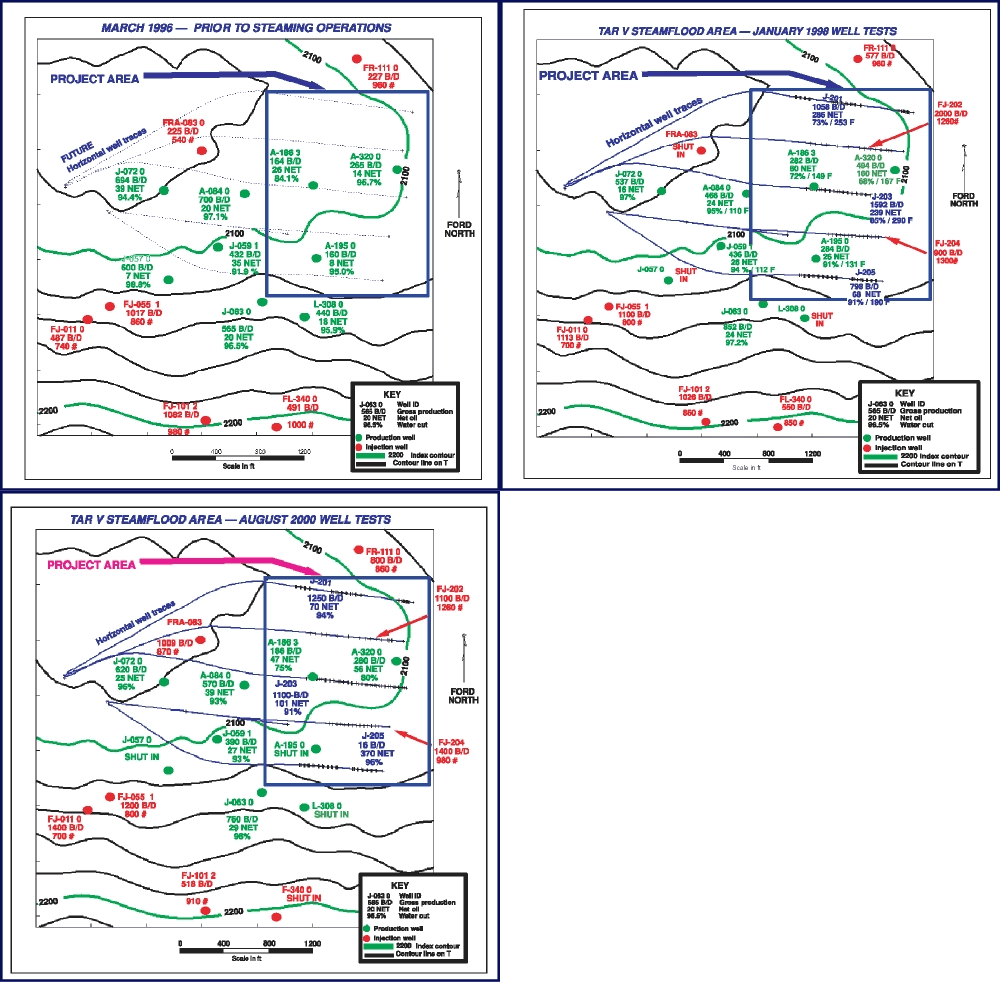
The five
horizontal wells were steam cycled and placed on production (Figures 16,
17, and 18). Two of them, FJ- 204 and FJ-202, were placed on permanent
steam injection. A-186 3, A-195 0, and A-320 0, each well more than 30
years old, remained on production within the steamproject boundaries. As
of March 1996, they had averaged 2.5 m3/day (16 bbl/day) net
with 31.8 m3/day (200 bbl/day) gross, at an average water cut
of 92%.
When the
horizontal project was initiated, this area had only about five years of
remaining economic life under waterflood, and recoverable reserves were
estimated at 11,924 m3 (75,000 bbl). The average pool-water
cut prior to steaming was 95%. The water cut in the project area was 81%
in 1998 and 92% in July 2000; another 270,283 m3 (1,700,000
bbl) of reserves has been added to the Tar V pool.
Steam
communication to the existing waterflood wells, from cyclic steam
injection into wells FJ-202 and FJ-204, resulted in a six- to tenfold
net production increase in the old waterflood wells (Figure 17). Peak
annual production rates under steam drive were forecast at 93.8 m3/day
(590 bbl/day) for the horizontal project. During the first four months
of 1998, the average oil production was 111 m3/day (698 bbl/
day). In July 2000, the average oil production was 38.5 m3/day
(242 bbl/ day). The production rates should be several times greater,
but the performance of each well has been hindered by fluid levels
exceeding 457.2 m (1500 ft). The high fluid level suppresses oil
production and cools the produced fluids, resulting in lower recoveries.
The success of the program is reflected in Figures 16,
17, and 18, which
show how the project area has changed over time. Note in
Figure 16 that
prior to steaming, the average net was about 2.5 m3 day (16
bbl/day). By January 1998 (Figure 17). the average net was more than
23.9 m3/day (150 bbl/day). In August 2000, the average net
was still more than 15.9 m3/day (100 bbl/day).
Three-dimensional techniques contributed significantly to the success of
the Tar zone horizontal project. Assuming a 50% recovery factor, every
foot above the target is equivalent to 2524 STCM (15,876 STB) in lost
reserves (Phillips, 1996). At U.S. $14/bbl oil, an error of as much as
1.5 m (5 ft) vertically would equate to U.S. $ 1.1 million in lost
revenue.
Figure Captions (19-24)
Return to top.
Case History 3: Upper Terminal Zone: Hx0 Thin-Sandstone
Sequence
The Hx0
sandstones of Fault Blocks V and VI were reviewed as part of a U.S.
Department of Energy (DOE) class III short-term project (Phillips,
1998). The project proposed using new reservoir characterization tools
and techniques to exploit bypassed oil. The new technologies included
detailed reservoir characterization; 3-D geologic modeling; geosteering
in thin, heterogeneous beds; and modeling the LWD responses (MacCallum
et al., 1998).
A
deterministic geologic model was created to define the Hx0
layer and the horizons above and below it (Hx1 above, Hx2
and Hx below). The sandstone percentage was calculated for each data
point. A 3-D property model was created by gridding the sandstone
percentage in 3-D space using the top and bottom of the Hx0
as confining surfaces (Figure 19). The original oil saturation (So) was
property modeled similarly to identifying target areas for exploitation
(Figure 20).
A display
of the So model and wells drilled in the 1980s clearly showed that Fault
Block VI was effectively drained, but Fault Block V still had reserves.
The difference between the original So and that indicated by the 1980s
wells was quantifiable. This is easily seen in Figure 20 for wells A-160
and A-189. The calculated So is less than 40%, whereas the property
model shows the original So to be 60%. The So calculated from the old
wells was decremented, the two data sets were combined, and Fault Block
V was again property modeled (Figure 21). The sandstone percentage model
and the So model were combined, and the original oil in place was
calculated to be 540,566 STCM (3.4 million STB). The current oil in
place was calculated, and the reserves were reduced to 445,172 STCM (2.8
million STB) (Phillips and Clarke, 1998). Obviously, significant
reserves remain.
Based on
the geologic model, the block engineer proposed that a horizontal well
be drilled within and adjacent to the modeled area along the structural
high. An existing wellbore was sidetracked with a horizontal lateral to
capture hydrocarbon reserves not economically recoverable with
conventional methods. Idle well J-017 was selected for drilling the high
dogleg horizontal well, and a production rig was configured for drilling
to keep costs to a minimum. By investigating the area west of the
original Hx0 project area, it was determined that the target
sandstone thins and shales out to the west, thus reducing oil
saturation. Electric logs from wells penetrating the area as far as 305
m (1000 ft) to the west were correlated, and a second 3-D geologic model
was created.
A facies
boundary was delineated to constrain the planned well course within the
higher water-saturation (So) target. The Hx0 layer was
subdivided, and two sandstone lobes were identified within the Hx0
layer. The Hx0J and Hx0B horizons were defined and
added to the 3-D model. Maps and cross sections were extracted from the
3-D model and used for well planning (Figures 21 and
22).
A cross
section along the well course was created for the geologist. The
directional vendor required three linear cross sections for drilling
because the well plan showed a U-turn (Figure 22). Stratigraphic
sections consisting of adjacent wells also were created to help in
geosteering. Both pasteup and digital varieties were used.
Structure
maps were created on the Hx1, Hx0, and newly
defined Hx0J (Figure 23) and Hx0B sandstones.
These plots, as well as the 3-D model, were used for geosteering.
Ultimately, they also were used for directional control because of
rig-site problems.
A recently
introduced, probe-based multiple-propagation- resistivity (MPR) device
was used to provide LWD geosteering as well as directional information.
This resistivity sensor was part of a slim-hole, positive-pulsetype MWD/LWD
system that was used instead of carrier wave tools because of its
smaller size (the tool diameter is 4 3/4 in.). These newer tools have
well-integrated surface equipment, are battery-powered, and provide more
reliable telemetry signals. The MPR tool is a four-transmitter,
two-receiver array that provides a total of eight compensated
resistivities at 2 MHz and the deeper-reading 400 kHz in boreholes as
small as 5 7/8 in. For additional geosteering control, an inclinometer
and gamma-ray scintillation detector are placed below the MPR sub (MacCallum
et al., 1998). The well was successfully placed within two sandstone
lobes of the thin sequence by geosteering using the LWD data.
The
interval is thin and shaley (total thickness of 5.2 m [17 ft]), and the
LWD showed the anisotropic effect throughout the log (Figure 24). The resistivity response in anisotropic conditions is similar to conductive
invasion in that the short-spaced measurement reads less than the
long-spaced for both the phase difference and attenuation resistivity
measurements. However, the shallow-reading, phase-difference resistivity
curves measure a higher resistivity than the deep-reading attenuation
curves for both frequencies and spacings. This curve order is not
indicative of conductive invasion but of anisotropy (Meyer et al.,
1996). The presence of anisotropy plus formation heterogeneity
complicated the interpretation of the LWD data so that the geosteering
team had to rely significantly on the geologic model.
A simple
layer model was used for previous horizontal-well projects. The
sandstone package was thick enough that the LWD gave a unique, easily
interpretable response. The Hx0 sandstone is divided by a
continuous shale. The upper sandstone, referred to as the Hx0,
is 1.8 m (6 ft) thick; the lower sandstone, Hx0J, is 2.4 m (8
ft) thick. Again, the horizontal well was successfully placed into each
of these sandstones.
Postwell
analysis and support were excellent. The LWD analyst spent significant
time studying the LWD data and explaining the results. For wells drilled
parallel to bedding, adjacent beds and formation anisotropy were
significant factors in the log response. The anisotropy was quantified,
the horizontal and vertical resistivity was determined, and a
mathematical model of the LWD response was created (MacCallum et al.,
1998).
The 3-D
model was refined based on conclusions reached by collaboration between
the LWD analyst and the geologist. The shales above the Hx0
and Hx0J sandstones were modeled, which helped significantly
in data interpretation. A new anisotropy inversion algorithm and the
inclusion of shales in the geologic model allowed for a clearer
understanding of the 2-MHz resistivity responses to the formation and
their boundaries.
The fault
geometry of a previously unidentified fault also was determined during
this process using the 3-D model and further mathematical modeling of
the LWD. There was a good correlation between the tops calculated from
the 3-D geologic model and the tops selected from the LWD log. The
average vertical distance between the bed boundary calculated from the
3-D geologic model and the well, as determined by the LWD log, is less
than 0.08 m (0.25 ft).
Return to top.
A geologist
working with carefully characterized rock data and 3-D modeling and
visualization techniques adds greatly to a horizontal drilling team. The
highly accurate 3-D visualizations of the reservoir greatly increase the
confidence factor of the team, thus enabling Wilmington field reserves
to be maximized.
To be
effective, horizontal wells require precision placement.
Three-dimensional models help isolate data inconsistencies, and 3-D
viewers are good for adding data to correct the geologic model. Once the
final geologic model is created, the drilling team can use the resulting
3-D visuals with confidence to improve drilling techniques and
directional control. Postwell analysis of the LWD data also is
facilitated using 3-D geologic models.
We would
like to acknowledge the help and support of Mike Domanski, president of
Tidelands Oil Production Company; Jim Quay, Steve Siegwein, Scott
Walker, Scott Hara, Rudy “Bud” Payan, and Chris Parmelee, technical
engineering staff at Tidelands Oil Production Company; Dennis Sullivan,
director of the Department of Oil Properties, city of Long Beach; Donald
McCallum of Baker-Hughes INTEQ; and Art and Tamara Paradis and Heather
Kelley of Dynamic Graphics Inc. Computer modeling was done with DGI
EarthVision on an SGI Iris Indigo workstation.
Ames, L. C., 1987, Long Beach oil operation—A history,
in D. D. Clarke and C. P. Henderson, eds., Geologic field guide to
the Long Beach area: Pacific Section AAPG, p. 31–36.
Biddle, K. T., 1991, The Los Angeles basin: An overview,
in K. T. Biddle, ed., Active margin basins: AAPG Memoir 52, p.
5–24.
Blake, G. H., 1991, Review of the Neogene biostratigraphy
and stratigraphy of the Los Angeles Basin and implications for basin
evolution, in K. T. Biddle, ed., Active margin basins: AAPG
Memoir 52, p. 135–184.
Blesener, J. A., and C. P. Henderson, 1996, New
technologies in the Long Beach Unit, in D. D. Clarke, G. E. Otott
Jr., and C. C. Phillips, eds., Old oil fields and new life: A visit to
the giants of the Los Angeles Basin: Pacific Section AAPG, p. 45–50.
California Department of Conservation, Division of Oil,
Gas, and Geothermal Resources, 1999, 1998 annual report of the state oil
and gas supervisor: California Department of Conservation, Sacramento,
269 p.
Clarke, D. D., 1987, The structure of the Wilmington oil
field, in D. D. Clarke and C. P. Henderson, eds., Geologic field
guide to the Long Beach area: Pacific Section AAPG, p. 43–56.
Davies, D. K., and R. K. Vessell, 1997, Improved
prediction of permeability and reservoir quality through integrated
analysis of pore geometry and openhole logs: Tar zone, Wilmington field,
California: Society of Petroleum Engineers, SPE Paper 38262, 9 p.
Davies, D. K., R. K. Vessell, and J. B. Auman, 1997,
Improved prediction of reservoir behavior through integration of
quantitative geological and petrophysical data: Society of Petroleum
Engineers, SPE Paper 38914, 16 p.
Henderson, C. P., 1987, The stratigraphy of the
Wilmington oil field, in D. D. Clarke and C. P. Henderson, eds.,
Geologic field guide to the Long Beach area: Pacific Section AAPG, p.
57–68.
Koerner, R. K., D. D. Clarke, S. Walker, C. C. Phillips,
J. Nguyen, D. Moos, and K. Tagbor, 1997, Increasing waterflood reserves
in the Wilmington oil field through improved reservoir characterization
and reservoir management: Annual report submitted to the U.S. Department
of Energy, Cooperative Agreement Number DE-FC22- 95BC14934, unpaginated.
MacCallum, D., M. Pactel, and C. C. Phillips, 1998,
Determination and application of formation anisotropy using multiple
frequency, multiple spacing propagation resistivity tool from a
horizontal well, onshore California: Society of Professional Well Log
Analysts 39th Annual Logging Symposium, Keystone, Colorado, May 1998.
Mayuga, M. N., 1970, Geology and development of
California’s giant Wilmington oil field, in Geology of giant
petroleum fields—Symposium: AAPG Memoir 14, p. 158–184.
Meyer, W. H., T. Maher, and P. J. McLean, 1996, New
methods improve interpretation of propagation resistivity data:
Presented at the Society of Professional Well Log Analysts 37th Annual
Symposium, Taos, New Mexico.
Otott, Jr., G. E., 1996, History of advanced recovery
technologies in the Wilmington field, in D. D. Clarke, G. E.
Otott, Jr., and C. C. Phillips, eds., Old oil fields and new life: A
visit to the giants of the Los Angeles Basin: Pacific Section AAPG, p.
37–44.
Otott, Jr., G. E., and D. D. Clarke, 1996, History of the
Wilmington field: 1986–1996, in D. D. Clarke, G. E. Otott, Jr.,
and C. C. Phillips, eds., Old oil fields and new life: A visit to the
giants of the Los Angeles Basin: Pacific Section AAPG, p. 17–22.
Otott, Jr., G. E., D. D. Clarke, and T. A. Buikema, 1996,
Long Beach Unit 3-D survey, in D. D. Clarke, G. E. Otott, Jr.,
and C. C. Phillips, eds., Old oil fields and new life: A visit to the
giants of the Los Angeles Basin: Pacific Section AAPG, p. 51–55.
Phillips, C. C., 1996, Enhanced thermal recovery and
reservoir characterization, in D. D. Clarke, G. E. Otott, Jr.,
and C. C. Phillips, eds., Old oil fields and new life: A visit to the
giants of the Los Angeles Basin: Pacific Section AAPG, p. 65–82.
Phillips, C. C., 1998, Geological review of Hx0
Sands, in U.S. Department of Energy, Increasing waterflood
reserves in the Wilmington oil field through improved reservoir
characterization and reservoir management: 1997 Annual Report, Contract
No. DE-FC22-95BC7 4934, Appendix 1, 12 p.
Phillips, C. C., and D. D. Clarke, 1998, 3D
modeling/visualization guides horizontal well program in Wilmington
field: Journal of Canadian Petroleum Technology, v. 37, no. 10, p. 7–15.
Phillips, C. C., D. D. Clarke, and L.Y. An, 1998, Give
new life to aging fields: Oil and Gas Investor, v. 39, no. 9, p.
106–115.
Redin, T., 1991, Oil and gas production from submarine
fans of the Los Angeles Basin, in K. T. Biddle, ed., Active
margin basins: AAPG Memoir 52, p. 239–259.
Slatt, R. M., S. Phillips, J. M. Boak, and M. B. Lagoe,
1993, Scales of geologic heterogeneity of a deep water sand giant oil
field, Long Beach Unit, Wilmington field, California, in E. G.
Rhodes and T. F. Moslow, eds., Frontiers in sedimentary geology, marine
clastic reservoirs, examples and analogs: New York, Springer-Verlag, p.
263–292.
U.S. Department of Energy, 1999, Increasing heavy oil
reserves in the Wilmington oil field through advanced reservoir
characterization and thermal production technologies, partners: The city
of Long Beach , Tidelands Oil Production Company (Tidelands), University
of Southern California, and David K. Davies and Associates: 1996 Annual
Report, Contract No. DE-FC22-95BC1 493, 85 p. , Tidelands Oil Production Company (Tidelands), University
of Southern California, and David K. Davies and Associates: 1996 Annual
Report, Contract No. DE-FC22-95BC1 493, 85 p.
Wright, T. L., 1991, Structural geology and tectonic
evolution of the Los Angeles Basin, California, in K. T. Biddle,
ed., Active margin basins: AAPG Memoir 52, p. 35–134.
Return to top.
|

 Print this page
 Click to view article in PDF format.