Print this page
Click to view posters in PDF
PSInterpretation of depositional environments of upper Seven Rivers Formation from core and well logs, Grayburg Jackson Pool, Eddy County, New Mexico*
By
Brian S. Brister1 and Dana S. Ulmer-Scholle2
Search and Discovery Article #20023 (2004)
*Adapted from poster presentation at Southwest Section, AAPG Annual Meeting, Fort Worth, Texas, March 1-4, 2003.
1New Mexico Bureau of Geology and Mineral Resources, New Mexico Tech, Socorro, NM; currently Gunn Oil Company, Wichita Falls, TX ([email protected])
2Department of Earth and Environmental Sciences, New Mexico Tech, Socorro, NM ([email protected])
Abstract
The Seven
Rivers Formation is a potential oil and gas reservoir in many fields across the
northern shelf of the Delaware Basin. The largest Seven Rivers reservoir,
Grayburg Jackson Pool (formerly Fren Pool), has yielded more than 5.4 mmbo and
1.6 bcf of associated gas. Grayburg Jackson and other fields that overlie the
Artesia-Vacuum Abo reef trend mark the northernmost significant Seven Rivers
production where porous dolomite stringers pinch out landward into bedded
anhydrite. Two wells were cored and thin sectioned to study these thin (< 4
feet) dolomite reservoir beds. The cores demonstrate that the upper Seven Rivers
is comprised of massive to bedded nodular anhydrite (majority); non-reservoir,
algally laminated, fenestral, dolomitized boundstone/mudstone; and dolomitized
grainstone/packstone reservoir rocks. Petrography reveals complete
dolomitization of carbonate units, abundant anhydrite cements in the laminated
 facies
 , and excellent porosity preservation in the higher energy facies. These
lithofacies represent depositional environments that range from supratidal
sabkha to intertidal mud flat and tidal channel. The grainstone/packstone facies
are the primary contributors to production, having porosity ranging from 10 to
28.5 % and permeabilities ranging from 0.1 to 35 md. Well log-derived pore
volume mapping demonstrates that the higher energy facies are related to
shore-perpendicular porosity, zones suggestive of tidal channels.
, and excellent porosity preservation in the higher energy facies. These
lithofacies represent depositional environments that range from supratidal
sabkha to intertidal mud flat and tidal channel. The grainstone/packstone facies
are the primary contributors to production, having porosity ranging from 10 to
28.5 % and permeabilities ranging from 0.1 to 35 md. Well log-derived pore
volume mapping demonstrates that the higher energy facies are related to
shore-perpendicular porosity, zones suggestive of tidal channels.
|
uAbstractuGeologic frameworkuLog & core correlationuPetrographyuCore porosity & permeabilityuDepositional environmentsuSetting
uPorosity
volume
|
Geologic Framework (Figures 1.1-1.3)
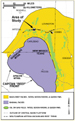
Grayburg Jackson Pool (study area) is one of several similar fields
overlying the crest of the Wolfcampian Artesia-Vacuum Abo reef trend.
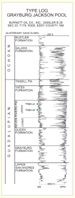
Figure 1.1 is a The axis of Artesia-Vacuum Abo reef trend, which lies north of the Seven Rivers evaporite-carbonate transition, extends through the study area (Figure 1.2) (Sheldon, 1954). Lithostratigraphic nomenclature for Grayburg Jackson Pool and log features of the interval containing the reservoirs are shown on the type log in Figure 1.3.
Well Log and Core Correlation (Figure 2.1)
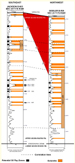
“Potential oil pay zones” are based on log and core characteristics (i.e,. neutron log porosity > 10%; core fluorescence). Present gas/oil contact elevation is approximately 1830 feet above sea level. Figure 2.1 shows the correlation between the two wells from which cores were examined as a part of this study.
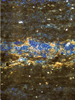
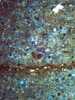
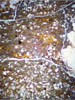
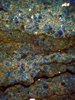
Petrography (Figures 2.2-2.16)
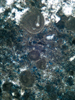
Various
Core Porosity and Permeability (Figure 3.1)
The boundstone is characterized by low permeability even though the porosity, in some cases, may be as much as 12-14% (Figure 3.1). The grainstones/packstones have higher permeability, and in general they show a correlation between porosity and permeability. Due to low permeability, “pay” porosity threshold is approximately 10%.
Depositional Environments (Figures 3.2-3.3)
SettingThe predominance of thick units of massive to nodular chicken-wire anhydrite interbedded with algally laminated carbonates indicates that evaporative, supratidal, coastal sabkha conditions dominated this area (Figure 3.2). Thin, porous tidal-channel carbonate units represent intermittent episodes of higher stands of base level, such that intertidal depositional conditions shifted temporarily landward.
Implications from
Porosity Volume
|