|
uAbstract
uFigure
captions
uPaleogeography
uSea
level & subsidence
uDiscussion
uReferences
uAbstract
uFigure
captions
uPaleogeography
uSea
level & subsidence
uDiscussion
uReferences
uAbstract
uFigure
captions
uPaleogeography
uSea
level & subsidence
uDiscussion
uReferences
uAbstract
uFigure
captions
uPaleogeography
uSea
level & subsidence
uDiscussion
uReferences
uAbstract
uFigure
captions
uPaleogeography
uSea
level & subsidence
uDiscussion
uReferences
uAbstract
uFigure
captions
uPaleogeography
uSea
level & subsidence
uDiscussion
uReferences
|
Figure Captions
|
 |
Figure 1.
Early Pliocene paleogeography of central California at ~5 Ma (this
study and in part modified from Foss, 1972; Harris, 1987; Loomis,
1990). Faults west of the San Andreas fault are not shown. By this
time the Sierra Nevada, San Emigdio Range, Temblor Range, and
Diablo Range had been uplifted to near present elevations
(Wakabayashi and Sawyer, 2001; Argus and Gordon, 2001).
Locations of Purisima Formation and
Salinas, Huasna, and Santa Maria basins are shown relative to the
San Joaquin Basin at that time.
The modern California coastline is shown for reference. |
|
 |
Figure 2.
 Paleobathymetry Paleobathymetry determined from foraminifera faunas recovered from
Bakersfield Energy Resources well Tisdale 71X-22, section 22,
T27S, R21E, MDB&M, southeast Lost Hills oil field, Kern County,
California. Subsurface correlations from this study.
Paleobathymetry is interpreted from foraminifera bathymetry by the
Shell Oil Company Stratigraphic
Services (unpublished memorandum dated February 24, 1981). The
diatom stratigraphy is by Mobil Exploration and Producing Services
Inc. (unpublished memorandum dated
September 7, 1983) and is correlated from nearby Bakersfield
Energy Resources well Truman 121-26, section 22, T27S, R21E,
MDB&M, and from Bowersox (2003). determined from foraminifera faunas recovered from
Bakersfield Energy Resources well Tisdale 71X-22, section 22,
T27S, R21E, MDB&M, southeast Lost Hills oil field, Kern County,
California. Subsurface correlations from this study.
Paleobathymetry is interpreted from foraminifera bathymetry by the
Shell Oil Company Stratigraphic
Services (unpublished memorandum dated February 24, 1981). The
diatom stratigraphy is by Mobil Exploration and Producing Services
Inc. (unpublished memorandum dated
September 7, 1983) and is correlated from nearby Bakersfield
Energy Resources well Truman 121-26, section 22, T27S, R21E,
MDB&M, and from Bowersox (2003). |
|
 |
Figure 3.
Comparison of the late Neogene northwest
San Joaquin Basin relative sealevel curve
(this study) to the Gulf of Mexico eustatic curve (Wornardt and
Vail, 1991; Wornardt et al., 2001)
shows close correlation. Correlative
latest Miocene through Late Pliocene lowstands are identified by
letters A-F. The timing of lowstand events from this figure were
used to refine Santa Margarita
Formation and Etchegoin Group chronostratigraphy to construct
Figure 4. The
correlative North Pacific diatom zones (Maruyama, 2000;
see also Figure 1)
are shown for reference. |
|
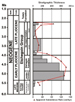 |
Figure 4.
Time-thickness diagram for the northwest San Joaquin
Basin margin. Individual bars represent ~40 m stratigraphic
intervals correlating to faunazonules 6 and 7 of Adegoke (1969)
in the Santa Margarita Formation and ~200
m stratigraphic intervals correlating to faunazonules 8-16 of
Adegoke (1969) in the Etchegoin Group. Rapid subsidence in the
basin coincident with Coast Range
uplift in the earliest Pliocene slowed substantially by the middle
Pliocene. Late Pliocene basinal subsidence was less than one-third
that of the Early Pliocene. Closing of the Priest Valley Strait
(Figure 6) in the latest Pliocene
coincided with a slight increase in basin subsidence prior to
filling with lacustrine and fluvial sediments of the Tulare
Formation. |
Return to top.
By the late Neogene the San Joaquin Basin had reached its present overall
geographic configuration (Figure 1) and was
bounded to the east by the southern Sierra Nevada and to the south and
west by the San Emigdio and southern Coast Ranges (see Reid, 1995, fig.
11). Incision of the San Joaquin River began at ~10 Ma (Wakabayashi and
Sawyer, 2001) while the age of the base of the Kern River Formation is
estimated at 8 Ma (Graham et al, 1988). To the northeast the basin was
filled by fluvial deposits of the late Neogene San Joaquin and Kings
rivers, and the substantial fan-delta Kern River Formation was deposited
by the Kern River on the southeast basin margin (see Foss, 1972,
Pliocene transgressive phase map). This suggests that all major southern
Sierra Nevada Rivers were draining into the San Joaquin Basin by the late Neogene (Figure
1). To the northwest the San Joaquin Basin opened to the Pacific Ocean
through the shallow and narrow Priest Valley Strait (Loomis, 1990).
Uplift of the southern Sierra Nevada reached 2.5 km by 57 Ma, then
stopped until ~ 5 Ma (Wakabayashi and Sawyer, 2001). Renewed uplift
elevated the southern Sierra Nevada above 3.5 km by 3.0 Ma (Graham et
al., 1988). Uplift of the Temblor Range and southern Coast Ranges began
their current phase by 5.4 Ma (Miller, 1999). Based on fault-normal
convergence of the Pacific and Sierran plates across the San Andreas
fault transform boundary, Argus and Gordon (2001) demonstrated that
uplift of the Coast and San Emigdio Ranges probably commenced by 6.6 Ma
or 8 Ma.
The late Neogene San Joaquin Basin inland sea
was 175 km long, 100 km wide, and connected to the Pacific Ocean at the
northwest through a narrow and shallow strait (Figure
1) ~13 km wide and <50 m deep (Loomis, 1990). Paleobathymetry
determined from benthic foraminifera faunas from the subsurface of
southeastern Lost Hills oil field (Figure 2),
~12 km southwest of the basin axis, shows water depth in the San Joaquin
Basin >200 m in the latest Miocene, becoming progressively shallower to
~125 m by middle Pliocene, then (by middle Late Pliocene) to ~25 m,
where it remained until the Pacific Ocean connection was tectonically
closed at 2.2 Ma. Abrupt decrease in paleobathymetry at ~4 Ma may be
related to rapid sediment deposition in the basin associated with
increased uplift of the Coast Ranges (Loomis, 1990), coincident with
eustatic sea level fall (Figure 3), and the
slowing of subsidence on the basin margin (Figure
4) leading to sediment bypass.
The thick section of the Etchegoin Group
exposed on the northwest margin of the San Joaquin Basin has been measured and described
in several studies (Arnold and Anderson, 1910; Adegoke, 1969; Stanton
and Dodd, 1976; Loomis, 1990). Approximately 2500 m of late Neogene
Santa Margarita through San Joaquin Formations strata are exposed from
Coalinga to the Kreyenhagen and Kettleman Hills. Sedimentary structures
and megafossil faunas studied in outcrop over an area stretching ~130 km
from Priest Valley, Fresno County, to the Bacon Hills, Kern County,
suggest that the northwestern San Joaquin Basin remained near sea level
throughout the late Neogene despite lying on a tectonically active basin
margin. What may be inferred is that from latest Miocene through Late
Pliocene deposition kept pace with basin subsidence. To construct the
northwest San Joaquin Basin relative sealevel curve (Figure
3), I first assigned an appropriate
water depths from bathymetry (1.5 - 25 m) to the molluscan communities
recognized by Stanton and Dodd (1970) in San Francisco Bay and Etchegoin
Group faunas from the Kettleman Hills. The upper Etchegoin through San
Joaquin Formations portion of the northwest San Joaquin Basin relative sealevel curve was
constructed by applying the interpreted water depths above to the
sequence of molluscan communities found in the Kettleman Hills by
Stanton and Dodd (1970). I then applied this technique to faunas of the
Jacalitos through middle Etchegoin Formations from the Kreyenhagen Hills
(Adegoke, 1969; Loomis, 1990) and Santa Margarita Formation from
Coalinga (Adegoke, 1969; Cote, 1991). The curve was then smoothed to
remove most tectonic “noise” through the Jacalitos and Etchegoin
Formations and then correlated to the Gulf of Mexico eustatic curve (Figure
3). Rapid flooding of the San
Joaquin Basin during the late Neogene, characteristic of a relatively
shallow silled basin, is suggested by the flat-based highstand sections
of the relative sealevel curve immediately following lowstands.
Using
Figure 3 to
refine the timing of late Neogene formation boundaries, I was able to
construct a time-thickness diagram for the northwest San Joaquin Basin and calculate the basin-margin
subsidence rate (Figure 4). Latest Miocene
basin-margin subsidence averaged ~25 cm/kyr, then accelerated to a peak
of 140 cm/kyr in the middle Early Pliocene coincident with increasing
Coast Range uplift. By Late Pliocene subsidence slowed to 11 cm/kyr,
then again peaked in latest Pliocene at 86 cm/kyr immediately preceding
closure of the Priest Valley Strait and the connection of the San
Joaquin Basin to the Pacific Ocean.
Comparison of basinal paleobathymetry (Figure
2) and basin-margin subsidence (Figure
4) clarifies the basin-filling
history. The steady reduction in subsidence at the basin margin during
the Early Pliocene beginning ~4.6 Ma and consistently low rate of
subsidence during the Late Pliocene reduced the available accommodation
space on the basin margin. The abrupt decrease in basinal
paleobathymetry at ~4 Ma (Figure
2) corresponds to a fivefold
reduction in subsidence rate at the northwestern basin margin at the
same time (Figure
4). When accommodation space on the
western basin margin was filled, the additional sediment supply passed
on towards the basin center. Eustatic lowstands in the Late Pliocene led
to deposition of thick sands out in the basin With the prograding deltas
on the eastern margin included in the overall depositional picture,
sediment supply to the basin was sufficient to fill the San Joaquin
Basin to a very shallow depth, to ~25 m at southeastern Lost Hills oil
field and probably not much more at the basin center, by latest
Pliocene. at ~4 Ma (Figure
2) corresponds to a fivefold
reduction in subsidence rate at the northwestern basin margin at the
same time (Figure
4). When accommodation space on the
western basin margin was filled, the additional sediment supply passed
on towards the basin center. Eustatic lowstands in the Late Pliocene led
to deposition of thick sands out in the basin With the prograding deltas
on the eastern margin included in the overall depositional picture,
sediment supply to the basin was sufficient to fill the San Joaquin
Basin to a very shallow depth, to ~25 m at southeastern Lost Hills oil
field and probably not much more at the basin center, by latest
Pliocene.
Adegoke, O.S., 1969,
Stratigraphy and paleontology of the marine Neogene formations of the
Coalinga region, California: University of California, Publications in
Geological Sciences, v. 80, 241 p., 13 pl.
Argus, D.F., and Gordon, R.G.,
2001, Present tectonic motion across the Coast Ranges and San Andreas
fault system in central California: GSA Bulletin, v. 113, p. 1580-1592.
Arnold, R., and Anderson, R.,
1910, Geology and oil resources of the Coalinga district, Fresno and
Kings counties, California: U.S. Geological Survey Bulletin 398, 354 p.
Bowersox, J.R., 2003, Pliocene
age of the Etchegoin Group, San Joaquin Basin, California [abstract]:
AAPG Pacific Section, and SPE Western Region, Conference Program and
Abstracts, p. 55.
Cote, R.M., 1991, Paleontology
of the “Santa Margarita” Formation on the Coalinga anticline, Fresno
County, California [MS thesis]: Northridge, California, California State
University, Northridge, 259 p., 8 pl.
Foss, C.D., 1972, A preliminary
sketch of the San Joaquin Valley stratigraphic framework, in
Rennie, E.W., ed., Guidebook: Geology and Oil Fields of the West Side
Central San Joaquin Valley: AAPG, SEG, and SEPM Pacific Sections, p.
40-50.
Graham, S.A., Carroll, A.R.,
and Miller, G.E., 1988,Kern River Formation as a recorder of uplift and
glaciation of the southern Sierra Nevada, in Graham, S.A., and
Olson, H.C., Studies of the Geology of the San Joaquin Basin: Pacific
Section, SEPM, Book 60, p. 319-332.
Harris, W.M., 1987, Organism
interactions and their environmental significance, as exemplified by the
Pliocene-Pleistocene fauna of the Kettleman Hills and Humboldt basin,
California [Ph.D. thesis]: College Station, Texas A&M University, 254 p.
Loomis, K.B., 1990, Late
Neogene depositional history and paleoenvironments of the westcentral
San Joaquin Basin, California [Ph.D. thesis]: Stanford, California,
Stanford University, 594 p.
Maruyama, T., 2000, Middle
Miocene to Pleistocene diatom stratigraphy of Leg 167, in Lyle,
M., Koizumi, I., Richter, C., and Moore, T.C., Jr., eds., Proceedings of
the Ocean Drilling Program, Scientific Results, v. 167: College Station,
Texas, Ocean Drilling Program, p. 63-110.
Miller, D.D., 1999, Sequence
stratigraphy and controls on deposition of the upper Cenozoic Tulare
Formation, San Joaquin Valley, California [Ph.D. thesis]: Stanford,
California, Stanford University, 179 p.
Reid, S.A., 1995, Miocene and
Pliocene depositional systems of the southern San Joaquin Basin and
formation of sandstone reservoirs in the Elk Hills area, California,
in Fritsche, E.A., ed., Cenozoic Paleogeography of the Western
United States - II: SEPM Pacific Section, Book 75, p. 131-150.
Stanton, R.J., Jr., and Dodd,
J.R., 1970, Paleoecologic techniques – comparison of faunal and
geochemical analyses of Pliocene paleoenvironment, Kettleman Hills,
California: Journal of Paleontology, v. 44, p. 1092-1121.
Stanton, R.J., and Dodd, 1976,
Pliocene biostratigraphy and depositional environment of the Jacalitos
Canyon area, California, in Fritsche, E.A., Ter Best, H., and
Wornardt, W.W., eds., The Neogene Symposium: Pacific Section, SEPM, p.
85-94.
Wakabayashi, J., and Sawyer,
T.L., 2001, Stream incision, tectonics, uplift, and evolution of
topography of the Sierra Nevada, California: Journal of Geology, v.109,
p.539-562.
Wornardt, W.W., and Vail, P.R.,
1991, Revision of the Plio-Pleistocene cycles and their application to
sequence stratigraphy and shelf and slope sediments in the Gulf of
Mexico: Transactions GCAGS, v. 41, p. 719-744.
Wornardt, W.W., Shaffer, B.,
and Vail, P.R., 2001, Revision of the Late Miocene, Pliocene, and
Pleistocene sequence cycles [abstract]: AAPG Bulletin, v. 85, p. 1710.
Return to top.
|

 Print this page
 Click
to view article in PDF format.
Click
to view article in PDF format.