Print this page
 Click to view article in PDF format.
Comprehensive Use of VSP Technology at Elk Hills Field, Kern County, California*
By
R.J. Brewer1 and Don Greenfield2
Search and Discovery Article #40091 (2003)
*The viewer is referred to two other articles about VSP, written by the senior author, The Look Ahead VSP Survey: Its Utility and Future, Search and Discovery Article #40060 (2002) and VSP Data in Comparison to the Check Shot Velocity Survey, Search and Discovery Article #40059 (2002).
1Halliburton Energy Services, Houston, TX ([email protected]).
2Occidental of Elk Hills, Inc.
Introduction
To understand accurately subsurface rock
formation and pay zone seismic travel times and velocities within the historic
Elk Hills oil field in Kern County, San Joaquin Valley, California (Figure 1),
Occidental of Elk Hills, Inc. in 1999 embarked on one of the first coordinated
and comprehensive VSP survey data acquisition programs in the country. The
trend-setting effort, uncommon in the United States, has helped produce more
accurate surface seismic time-to-drill depth conversions. This result has been
more accurate drilling prospect maps. VSP data has proven to be an effective
means to lower drilling ambiguities as well as overall drilling costs in the Elk
Hills field. It was concluded that rigorous integration of the all the VSP data
recorded during the campaign into a entire surface and borehole seismic data set
significantly improved the accuracy of a complex subsurface  structural
 mapping
process. Knowledge of the challenging stratigraphy of the area has also been
enhanced. The result has been markedly improved success rates for exploration
and development well drilling.
mapping
process. Knowledge of the challenging stratigraphy of the area has also been
enhanced. The result has been markedly improved success rates for exploration
and development well drilling.
Occidental purchased the Elk Hills field from the United States government in late 1998. As part of a comprehensive plan to assist development drilling and to prepare for exploration drilling, Oxy acquired an 80 square mile seismic survey and completed preliminary mapping throughout the Elk Hills field. Previous 2D and limited 3D seismic acquisition had proved problematic at best, yielding poor data. Near surface low velocity air sands and extreme topographic variability (Figure 2) hampered surface seismic data quality. Careful pre-3D acquisition testing and extensive quality control yielded a 3D seismic volume that was magnitudes better than any previous acquisition efforts (Figures 3 and 4).
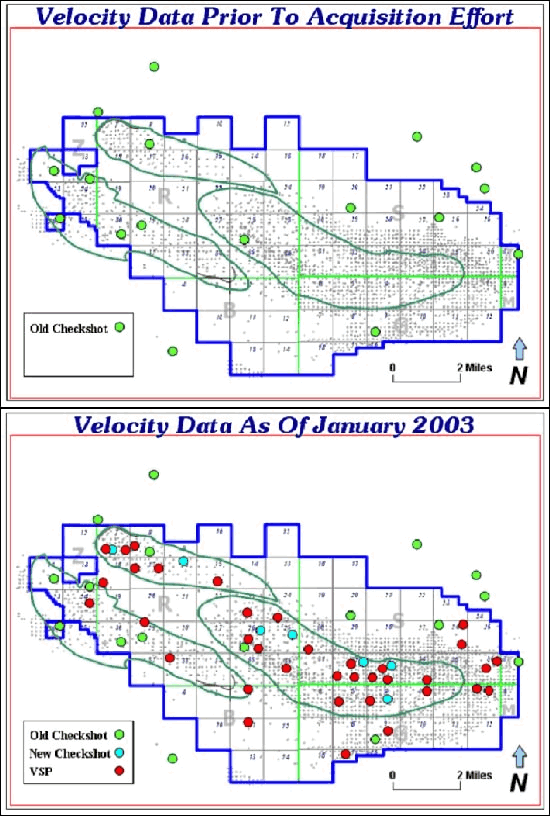
It has long been known that VSP data has the established advantage of being generally higher frequency and better quality than surface seismic. The VSP’s one-way travel path from energy source to receiver helps prevent dissipation of frequency and amplitude. Consequently, following the 3D seismic acquisition, a comprehensive wellbore velocity data acquisition program was initiated. Although there were nearly 5,000 wells within the Elk Hills field, prior to the checkshot/VSP acquisition program, there were only 11 checkshots within the Elk Hills Field and another 6 checkshots surrounding the field (Figure 5). During the 1980's, one or two VSPs had been acquired. However, no digital VSP records were extant; and only checkshot data remained.
|
|
The original acquisition plan called for at least one velocity point for each square mile. As the benefits of velocity data became apparent, the effort was increased. Velocity points exceeded one per square mile in many drilled areas of the field. The first phase of the project included both checkshots and VSPs while subsequent phases recorded virtually all VSPs. Zero offset VSP surveys utilizing a vibroseis energy source located as close as possible to the wellhead were acquired in selected, recently-drilled development wells as well as in key existing wells slated for workover. Of course, preference was given to deeper wells. VSPs were recorded in every exploration well. Acquisition was performed in open hole wells, cased hole wells, and both combination open/cased hole wells. Close coordination and cooperation between exploitation/exploration, drilling, field operations, and the contractor were essential for the ultimate success in the acquisition effort. Figure 6 shows the density and locations of checkshot and VSP surveys in the field area after implementation of the borehole seismic survey program. Acquisition through January 2003 provided seven new check shot velocity surveys and 36 new VSPs. While zero offset VSPs were the goal, many times vibrators had to be offset in order to suppress noise attributable to ground roll and "ringing" pipe. Every effort was made to keep offsets less than 500 feet. However, due to excessive noise and topographic problems, one VSP was acquired with a 1,000-foot offset. Although this offset was considered excessive, the survey was acquired to test the viability of the data. The resultant data were excellent. Whenever
possible, 50-foot level intervals were acquired with a dual station
downhole geophone tool assembly from TD to near surface. These 50-foot
intervals were chosen after careful modeling indicated that this spacing
would be sufficient to correlate with 3D surface seismic and avoid
aliasing. Dual tool deployment helped save as much as 40% rig time over
a single tool operation. Well depths typically ranged from 6,000 to
12,000 feet. Gamma ray acquisition combined with strip log correlation
was run on most surveys to tie the velocity data with original well log
suites, especially where a drilling rig was absent and a mast truck was
utilized. Slim (1-11/16-in.OD) downhole geophone In-field
data processing, to produce a corridor stack from the field records, was
employed on virtually every survey to give quick-look verification of
data quality at the wellsite and to expedite overall data integration
and At the beginning, postulated expenditures for the aggressive acquisition project were a concern. Monetary concerns were mitigated and cost reductions were made possible by competitive bidding along with an Oxy/contractor agreement that guaranteed an average number of VSPs per month in return for significant cost breaks. This agreement has thus far saved Oxy approximately 40% to 50% over individually contracted VSPs.
A
significant part of the exploration and development methodology employed
by Oxy involves being able to produce accurate time-depth functions at
any X-Y location encompassed by the surface seismic 3D and a time-depth
function and/or synthetic seismogram for every well in the field. This
criterion is made possible by the integration of the numerous checkshot
and VSP surveys recorded throughout the Elk Hills field and surrounding
area. The data integration and transformation to a 3D velocity volume
was accomplished by using the Keystone Natural Resources Velocity
Project (KNRVP) software suite. KNRVP allows nearly instantaneous
creation and update of a 3D velocity volume by incorporating all
checkshot, VSP, and 2D/3D seismic velocity information (such as stacking
or RMS velocities). KNRVP provides unique time-to-depth functions for
any XY location within the boundaries of the velocity volume and thereby
produces a unique time-depth function for every well. At Elk Hills, this
capability means immediate updating of the velocity functions for the
field's nearly 5,000 wells. The database feeding the computer aided
exploration
Utilizing a cost effective and aggressive velocity acquisition program along with innovative analysis has enabled interpreters to incorporate all geophysical and geological data into a comprehensive picture and to predict accurately drill depths to targeted horizons. A good example of this predictive capability is the 351-17G well. The 351-17G deep test well was drilled on the south side of the Elk Hills field and was programmed to test a previously undrilled subthrust fault block. Figure 8 shows the location of the 351-17G well with respect to Elk Hills. Figure 9 is a seismic backdrop cross section including the final drilled well. A predicted velocity function was derived from the KNRVP velocity volume created with the substantial checkshot and VSP data previously acquired. Figure 10 compares the pre-drill software velocity function with the post-drill velocity function from the VSP. The pre-drill predicted velocity function is remarkably close to the true velocity function defined by the VSP. Some practitioners have reportedly recommended that ideally one VSP survey be acquired for each 1-2 square miles of 3D surface seismic coverage. The Occidental of Elk Hills project has demonstrated that the recommendation is a good one. The elimination of drilling ambiguities is important to the optimization of a multi-well exploitation drilling program. |
 Figure 1:
Location map of Elk Hills Field, Kern County, San Joaquin Valley,
California.
Figure 1:
Location map of Elk Hills Field, Kern County, San Joaquin Valley,
California. Figure 2:
Digital terrain model showing extreme topographic variations. Yellow and
red denotes higher elevations and blue lower elevations.
Figure 2:
Digital terrain model showing extreme topographic variations. Yellow and
red denotes higher elevations and blue lower elevations. Figure 3:
Elk Hills Oil Field highlighting the locations of major
Figure 3:
Elk Hills Oil Field highlighting the locations of major  Figure 4:
Comparison of high effort, high quality 2D seismic data versus the high
effort 3D seismic data.
Figure 4:
Comparison of high effort, high quality 2D seismic data versus the high
effort 3D seismic data. Figure 5:
Velocity data prior to VSP/Checkshot acquisition program: 11 checkshots
in the field and 5 checkshots around the field. Several VSPs had
previously been acquired; but there were no digital data, and paper
records were poor.
Figure 5:
Velocity data prior to VSP/Checkshot acquisition program: 11 checkshots
in the field and 5 checkshots around the field. Several VSPs had
previously been acquired; but there were no digital data, and paper
records were poor. Figure
6: Velocity data after acquisition program: seven new check
shot velocity surveys and 36 new VSPs.
Figure
6: Velocity data after acquisition program: seven new check
shot velocity surveys and 36 new VSPs.  Figure 7:
VSP/3D seismic data correlation. VSP data was convolved with an
extracted wavelet from the 3D seismic and incorporated into the 3D
dataset to facilitate well tie formation correlations.
Figure 7:
VSP/3D seismic data correlation. VSP data was convolved with an
extracted wavelet from the 3D seismic and incorporated into the 3D
dataset to facilitate well tie formation correlations.  Figure 8:
Elk Hills south flank location, 351-17G.
Figure 8:
Elk Hills south flank location, 351-17G. Figure 9:
Seismic backdrop cross section through the 351-17G well.
Figure 9:
Seismic backdrop cross section through the 351-17G well. Figure 10:
Comparison of pre-drill velocity function (KNRVP generated from
substantial checkshot/VSP data) with actual velocity function from VSP
data shot in 351-17G well.
Figure 10:
Comparison of pre-drill velocity function (KNRVP generated from
substantial checkshot/VSP data) with actual velocity function from VSP
data shot in 351-17G well.