Print this page
 Click to view this article in PDF format.
Late Permian to Holocene Paleofacies Evolution of the Arabian Plate and its Hydrocarbon Occurrences
By
Martin A. Ziegler1
Search and Discovery Article #30009 (2002)
*Adapted for online presentation from article with the same title by the same authors published in GeoArabia, Vol. 6, No. 3, 2001, Gulf PetroLink, Bahrain (www.gulfpetrolink.com.bh). Appreciation is extended to the author and to Moujahed Al-Husseini, Gulf Petrolink, Editor-in-Chief of GeoArabia ([email protected]) for permission to present this article online.
1Consultant, Binningen, Switzerland ([email protected]).
A series of 19 paleofacies maps have been generated for
given time intervals between the Late Permian and Holocene to reconstruct the
depositional history of the Arabian Plate. The succession of changing
lithological sequences is controlled by the interplay of eustacy and sediment
supply with regional and local tectonic influences. The Mesozoic paleofacies
history of the Plate is, in its central and eastern portion  east
east of Riyadh,
strongly influenced by an older N-trending, horst and graben system that
reflects the grain of the Precambrian Amar Collision and successively younger
structural deformations. The late Paleozoic Hercynian orogenic event caused
block faulting and relative uplift and resulted in a marked paleorelief. This
jointed structural pattern dominated the entire Mesozoic and, to some extent,
the Cenozoic facies distribution. The relationship between producing fields and
the paleofacies maps illustrates the various petroleum systems of particular
times and regions.
of Riyadh,
strongly influenced by an older N-trending, horst and graben system that
reflects the grain of the Precambrian Amar Collision and successively younger
structural deformations. The late Paleozoic Hercynian orogenic event caused
block faulting and relative uplift and resulted in a marked paleorelief. This
jointed structural pattern dominated the entire Mesozoic and, to some extent,
the Cenozoic facies distribution. The relationship between producing fields and
the paleofacies maps illustrates the various petroleum systems of particular
times and regions.
|
|
Figure Captions (Late Permian-Triassic)
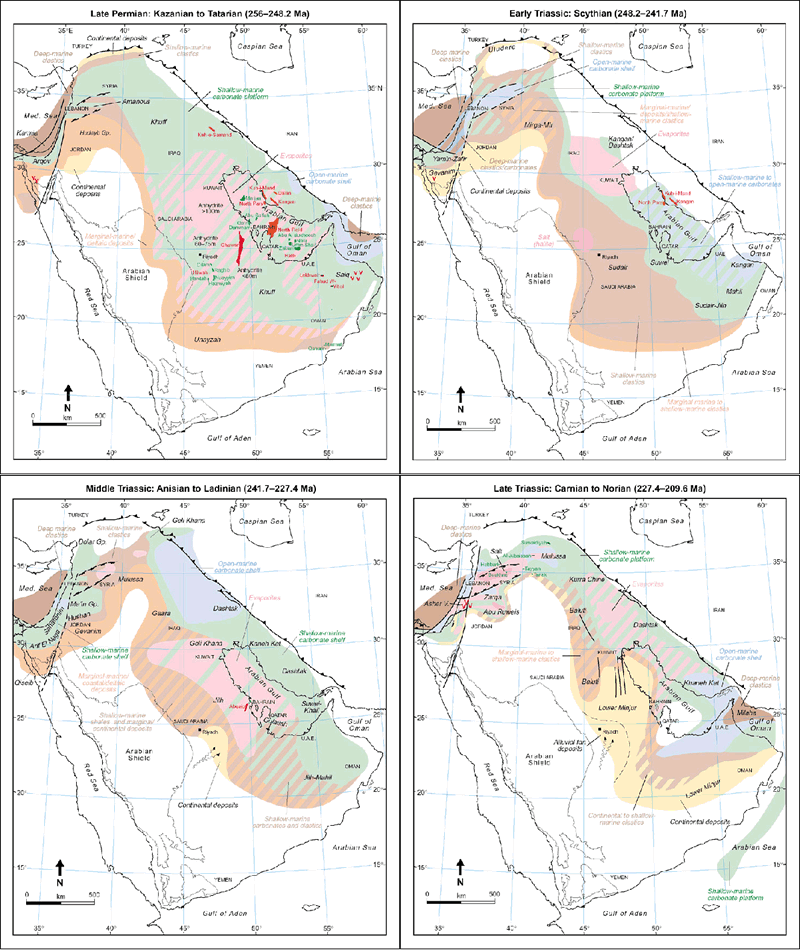
Click here for sequence of maps of Late Permian and Triassic facies.
INTRODUCTIONThe lithostratigraphic units of the Arabian Plate have been described in outcrop and subsurface from the Mediterranean to the Gulf of Oman and from the Red Sea to the Zagros Mountains. Serious variations in nomenclature exist regionally and between the surface and subsurface. Various authors, for example, Beydoun (1988), Alsharhan and Nairn (1997), and Christian (1997) have published regional lithostratigraphic reviews in attempts to comprehend this vast amount of stratigraphic information. Most recently, Sharland et al. (2001) published the first chronostratigraphic interpretation of the rock units of the Arabian Plate. Most of the previous lithostratigraphic studies have presented paleofacies, interpreted environments, and associated petroleum systems, in separate discussions. This study reconstructs paleofacies for time intervals from the Late Permian to the Holocene, each reconstruction being shown with its associated oil and gas fields. The study helps to illustrate the close relationship between lithofacies, depositional environments, and petroleum reservoirs. It also highlights active structural elements and the influence of relative sea-level changes interpreted from the paleofacies variations. This review of the Arabian Plate benefited from its association with the International Geological Correlation Program (IGCP) Project 369, ‘Comparative Evolution of the Peri-Tethyan Rift Basins’, which in turn is affiliated to the Peri-Tethys Program. The Project’s aim was to integrate geological and geophysical data in a study of the evolution of the rift and wrench basins located along the northern and southern Tethyan margins and adjacent platforms. Paleoenvironmental maps of the Peri-Tethyan domain from the Urals to the Atlantic Ocean and from the Baltic Shield to Equatorial Africa were produced. The Muséum National d’Histoire Naturelle, Paris published the results as Memoir No. 6 (Ziegler et al, 2001). The results are accessible on the Internet (http://www-sst.unil/igcp_369/default369.htm) and are also available as a CD-ROM (Stampfli et al., 2001). For ease of reference between this paper and the sequence stratigraphic study by Sharland et al. (2001) that describes the sedimentary architecture using Genetic Stratigraphic and Depositional Sequences, I have placed in square brackets equivalent dated surfaces referred to in their publication. These are interpreted Genetic Stratigraphic Sequences (GSS) bounded by Maximum Flooding Surfaces (MFS) identified by Period [Jurassic J10 dated at 185 Ma] and Arabian Plate (AP) Tectonostratigraphic Megasequences [base of AP7 dated at 182 Ma]. Figure 1 is a stratigraphic column from Late Permian to Holocene based on Figure 1.2 of Sharland et al. (2001). It shows the MFSs, AP boundaries and a representative selection of the major stratigraphic units mentioned in the text. STRUCTURAL TRENDSFigure 2 is a structural interpretation of the Arabian Plate as it relates to the distribution of the Upper Permian to Holocene paleofacies patterns. Their distribution appears to be influenced by N-, NW-and NE-trending fault systems.
• The regularly spaced, northerly trends that comprise the Central
Arabian Arch are interpreted as reflecting the Precambrian basement
architecture. The structures along the Arch may have originated during
the Amar Collision (640–620 Ma) of the Rayn Plate (in the • The northwesterly grain is visible in the Arabian Shield as the Najd Faults, and is interpreted as bounding the Arabian Plate along the Zagros Suture. • The northeasterly trend corresponds to the Dibba Fault, Oman salt basins, and the Wadi al Batin lineament, and appears to control the distribution of Infracambrian salt basins of the Arabian Gulf and Oman (Husseini, 1988; Husseini and Husseini, 1990; Loosveld et al., 1996; Al-Husseini, 2000). The intersection of these three fault trends results in a jointed basement fabric that has been reactivated by successively younger deformations governed by the interplay of local and far-field stresses related to large-scale plate tectonic processes. The different structural orientations of these faults resulted in marked mechanical inhomogenities that reacted differently to external plate events. Nearly all the paleofacies maps show evidence of these older structural grains, particularly in central Saudi Arabia.
Of particular relevance to this study is the late Paleozoic (?Late
Devonian to Late Carboniferous) structural uplift that followed a phase
of comparative stability during the early Paleozoic. This uplift is
evident from regional isochron thinning measured between the Lower
Silurian and Permian seismic reflections in central Saudi Arabia (McGillivray
and Husseini, 1992; Wender et al., 1998). The tectonic event is referred
to as the ‘Hercynian’ orogeny, a term more properly applied to Europe.
During this orogeny, the Arabian Plate was rotated through 90º in an
anticlockwise direction (Konert et al., 2001), and central Arabia was
uplifted, tilted down eastward, and deeply eroded. A series of
N-trending basement structures were uplifted along the Central Arabian
Arch (McGillivray and Husseini, 1992; Wender et al., 1998). Extensive
erosion of lower Paleozoic rocks took place over the Hercynian
paleohighs on the Arch during the mid-Carboniferous and Early Permian.
South of Riyadh, low relief structures formed due to Hercynian movements
(Simms, 1995, Evans et al., 1997) but erosion over their crests was less
than in the north over the Arch. Fluvial to alluvial clastics (e.g. the
Unayzah
During the Late Carboniferous and Early Permian, glaciation occurred in
Oman (Al Khlata With the exception of the Neogene Dead Sea Transform Fault, which formed in two phases as a left-lateral, strike-slip dislocation of about 100 km (Garfunkel, 1998, Walley, 1998b), and the Maradi fault zone in Oman, most of the tectonic features on the Arabian Plate show only minor wrench motion. Eustatic sea-level fluctuations combined with minor fault movements may have predisposed certain seaways that allowed deep-marine branches of the Neo-Tethys to penetrate into the Craton, forming intrashelf basins. Under restrictive conditions, such as during the Late Permian to Jurassic, these basins became anoxic or hypersaline (e.g. the Gotnia and Rub’ Al-Khali basins of the Middle and Late Jurassic). Subsequently, in the Early Cretaceous, the Mesopotamian Basin was a depositional site for continental clastics. The shelf basins were frequently rimmed by biogenic build-ups and coral reefs, as in the Arabian Basin (Powers et al., 1966; Le Nindre, Manivit and Vaslet 1990, 1990a), or rudist banks, as in the Rub’ Al-Khali Basin. Bahamas-type lime-sand belts and biogenic shoals were frequently developed on the platform-shelf margins. PALEOFACIES MAPSThe 19 time frames shown here are those proposed by the IGCP (Figure 1), according to the Geological Time Scale of Gradstein and Ogg (1996). The reservoir rocks of oil fields (green) and gas fields (red) on a particular figure belong to that time interval. The interpreted lithofacies definitions were selected by the ICGP project. They are based on an idealized bathymetric profile of a plate margin that differentiates the lateral sequence of depositional environments into the following four major groups: 1. Continental environments corresponding to dunes, lacustrine, fluviatile, alluvial, and coastal plain deposits (e.g. Continental deposits). 2. Neritic environments comprising supratidal and intertidal deposits, inner- and outer-shelf sediments, including deeper-water deposits that occur in association with significant intrashelf basins (e.g. Marginal-marine/coastal/deltaic deposits; Shallow-marine carbonate platform; Open marine carbonate shelf; Shallow-marine clastics). 3. Bathyal environments reflecting the continental slope and continental rise, and the resulting deposits characterized by hemipelagic sediments, turbidites and debris flows (e.g. Deep-marine carbonates; Deep-marine clastics). 4. Abyssal environments represented by the predominance of mudstones with a pelagic fauna (e.g. Deep-marine clastics).
These depositional environments are color-coded and distinguish between
predominantly siliciclastic and carbonate sediments. Late Permian: Kazanian to Tatarian (256–248.2 Ma) (Figure 3) Regional Setting This time period spanned the deposition of the lower and lower upper Khuff (Arabian Peninsula) [MFS P20 to intra-Tr10], Karmia (Levant), and Amanous (Syria) formations, and their regional equivalents. The Khuff was deposited on the new northeastern passive margin with Neo-Tethys. A major Late-Permian unconformity occurred within P20. In the Late Permian, continental rifting and spreading took place along the present-day Zagros Suture and Gulf of Oman as the Neo-Tethys Ocean started to form [base of AP6 at 255 Ma]. Short-term sea-level oscillations caused recurrent shoaling pulses that culminated in the establishment of evaporite sabkhas and salinas particularly over the Central Arabian Arch. The carbonates represent a shallow-shelf to a coastal-plain depositional environment. In general, a weakly prograding terrigenous to shallow-marine clastic shoreline existed. Sharland et al. (2001) interpreted three MFS in the Permian Khuff [P20, P30, and P40] and correlated them over most of the Arabian Plate. Paleofacies The Khuff sequence varies in thickness from 80 m near the onlap margin along the Arabian Shield, to over 800 m in the Arabian Gulf. Although no marked thinning of the Khuff units is evident over older structures, the cumulative thickness of coastal sabkha deposits over the Hercynian structures of the Central Arabian Arch suggests that they formed subtly positive blocks (Al-Jallal, 1995). In general, the lower Khuff in the Gulf region was transgressive before becoming regressive and culminating in a marked sea-level lowstand (Haq et al., 1988) toward the end of Khuff deposition [intra-Tr10 unconformity]. As a result of this lowstand, the sediments consisted of shallow-water carbonates and rapidly expanding coastal evaporite sabkhas in central Saudi Arabia and the Gulf. Coastal complexes that rimmed the western and southern uplands were lined with significant amounts of sandstones and shales. Le Nindre, Manivit, and Vaslet (1990) illustrated this transition between the western upland and the shallow-marine environments, west of Riyadh. At the Khuff locality, an embayment of at least 100 km extended southwestward from Neo-Tethys into the Arabian Shield. The western Gondwana hinterland appeared to have been drained by low-energy rivers that discharged siliciclastics onto the sabkhas and intertidal flats to form a mixed carbonate-clastic fringe. These mixed facies gave way eastward to shallow-marine carbonates (dolomites and dolomitic limestones), containing algal material. The location of the drainage system at the southern spur of the Arabian Shield was significant, specifically in the context of the Precambrian basement high beneath Riyadh (McGillivray and Husseini, 1992). Mainly shallow seas were widespread and true abyssal conditions in the Neo-Tethys developed only in southeastern Iran and the Gulf of Oman. Al-Jallal (1995) depicted a cyclic deposition of shallow-water carbonates that shoal upward and develop widespread, multiple evaporite sabkhas. In the Gulf region, the total evaporite thickness exceeds 100 m and is thickest in the Dibdibah Trough, possibly indicating increased subsidence. The main anhydrite accumulation appears to be confined to south of the Wadi al Batin Fault. This implies that the central Arabian horsts ceased to exist as positive, paleomorphological features.
Farther Offshore along the outer shelf break, higher energy calcarenites formed. The outer belt that marked the Arabian Plate margin was laced with reefoid, coral-algal, and detrital carbonates. Abyssal (hemipelagic) carbonates developed in Fars and on the Gulf of Oman-Makran slope. In the Late Permian, a shallow-marine carbonate platform (Khuff and Saiq formations) was established over most of Oman. This transgression was the result of subsidence of the northeastern Oman margin that resulted from Neo-Tethys protorifting. Near Muscat, a rifted shelf margin with horst and graben structures developed. Condensed carbonate successions are present on the horsts, whereas thick melanges of clastics, conglomerates, and olistoliths occur in the troughs (Le Métour et al., 1995). Volcanic rocks are present in two intervals. The lower one consists of tuff and tuffites at the base of the carbonate suite, whereas the younger interval (basalt, trachyandesite and rhyodacite) is in the middle of the carbonate succession (Le Métour, 1987; Béchennec et al., 1989).
In the Levant, transform faults controlled the coastline. Deep-water
carbonates (Karmia Early Triassic: Scythian (248.2–241.7 Ma) (Figure 4) Regional Setting
This time period spanned the deposition of the Sudair (Saudi Arabia,
United Arab Emirates, Oman), Mahil (Oman), Amanous (Jordan, Syria),
Beduh and Mirga Mir (Iraq) formations, and their regional equivalents [MFS
Tr10 to intra-Tr40]. The Arabian Plate persisted as a relatively
peneplaned ENE-sloping passive margin platform [AP6]. In the eastern
Mediterranean, faulting and rifting took place in the mid-Late Triassic,
and transform faults separated a narrow continental margin in the Paleofacies
The facies pattern represents the mid-Scythian [c.Tr30 at 245 Ma]
conditions of the Arabian Plate. A pronounced sea-level lowstand at the
end of the Khuff deposition is expressed by a wide apron of coastal and
shallow-marine clastics around the stable landmass of the Arabian
Shield, and an even wider belt of shallow-marine silty shales (Sudair
Shale) on the Arabian Shelf. West of Riyadh, evaporates are associated
with shallow-marine shales (Le Nindre, Manivit and Vaslet, 1990). A
shallow-water carbonate platform with localized paper shale and
evaporites also occurred in the northern Gulf and Zagros Mountains areas
(Szabo and Kheradpir, 1978). In the Rub’ Al-Khali, gypsiferous shales
predominated (Sudair
In the Levant, Hirsch (1991, 1992) described an Early Triassic
transgressive-regressive cycle that formed an alternating sequence of
shallow-marine sands containing plant remains, shales and marly
limestones (Yamin and Zafir formations) with a characteristic pelecypod
fauna of Pseudomonotis sp. (Claraia) and myophorids.
Hirsch interpreted this as an open-marine environment, typical of the
‘Werfen-type’ facies from the Austrian Alps. The same lithologies extend
into Jordan and Syria as the Amanous shales. Hirsch (1992) related the
two Scythian onlap cycles of the Yamin and Zafir formations to two
eustatic cycles and considers them as a probable response to a renewed
phase of Neo-Tethyan sea-floor spreading. The source of the clastic
influx during this time was probably from the Arabian-Nubian massif to
the southeast (Druckman, 1974). Hirsch compared the sands (Gevanim
Middle Triassic: Anisian to Ladinian (241.7–227.4 Ma) (Figure 5) Regional Setting This time period spanned the deposition of the Jilh (Arabian Peninsula), Gulailah (eastern Gulf) and Geli Khana (Iraq) formations, and their regional equivalents [MFS Tr40 to intra-Tr60]. In general, the Middle Triassic facies patterns in the Arabian Gulf region are a continuation of those of the Early Triassic, accentuated by a Ladinian subsidence event (Sharland et al., 2001). Paleofacies
Along the western outcrop belt of Saudi Arabia, the Jilh The area north of the Arabian Arch was relatively poor in siliciclastics. The Hercynian horst and graben structures appear to have had only a minor influence on the distribution of the evaporite flats in the northern Gulf region. The Rutbah-Khleissia High was poorly defined, but the presence of coastal to shallow-marine sands indicates the existence of the Ha’il Arch. The central and eastern Rub’ Al-Khali Basin was an area of restricted deposition of shallow-marine shales and carbonates that grade distally into shallow-marine platform dolomites. On the southeastern flank of the Arabian Shield, a flood of siliciclastics was carried into the shallow sea by a major fluvial system (Le Nindre, Manivit and Vaslet, 1990). The clastic discharge took a northeasterly direction and may reflect the buried horst/graben structure of the Central Arabian Arch.
In the Levant, platform carbonates (Ra’af and Saharonim formations) were
deposited (Hirsch, 1992) as an onlapping sequence of open-marine
Muschelkalk-type facies that existed until the end of the Ladinian. The
clastic-evaporitic, coastal to deltaic deposits of the Gevanim Late Triassic: Carnian to Norian (227.4–209.6 Ma) (Figure 6) Regional Setting This time period spanned the deposition of the Minjur (Arabian Peninsula), Mulussa (Syria), Kurra Chine (Iraq), Dashtak (Iran) formations, and their regional equivalents [MFS Tr60 to intra-J10]. These sediments were partly deposited during a second Triassic infilling-subsidence event. The early Carnian ‘Saharan salinity crisis’ is a clear indication of a sea-level lowstand at 223 Ma. Paleofacies
The most striking feature in the Gulf region is the continuation from
Middle Triassic times of the massive eastward spread across the Arabian
Arch of continental to deltaic clastics derived from the southern edge
of the Arabian Shield (Le Nindre, Manivit and Vaslet, 1990). The
clastics are a monotonous succession of light-colored, cross-bedded
sandstones with variegated shale intercalations and lenses of
conglomerates (lower Minjur
The Iranian Zagros region (Szabo and Kheradpir, 1978) was occupied by
shallow-marine carbonates, and multiple evaporite intervals occur in the
area northwest of the Qatar Arch. Szabo and Kheradpir (1978) and Koop
and Stoneley (1982) noted a marked erosional truncation of the Sefida
dolomite member in the Fars, central Arabian Gulf, and Qatar regions.
The Dashtak dolomite and evaporite sequence has been eroded in this
area, or may have changed facies across the Fars province. The Khaneh
Kat Le Métour et al. (1995) reported that a second phase of Neo-Tethyan extensional tectonics occurred in the eastern part of the Arabian Platform during this period. This caused drowning of the northeastern margin, and localized volcanic activity on the continental slope. This second subsidence event had an important effect on the restructuring of the Hawasina Basin and it is assumed that the basement of the Hawasina Basin was thinned continental crust rather than oceanic crust (Le Métour et al. 1995).
The northern and western parts of the Arabian Plate (Rutbah High and
Ha’il Arch), were exposed and a 200- to 300-km-wide shallow-marine
carbonate shelf surrounded the exposed Shield. Areas with tendencies for
preferential subsidence, such as the Sinjar and Palmyra troughs and the
Jordan Embayment (Harrat er Rujeila), accumulated large amounts of
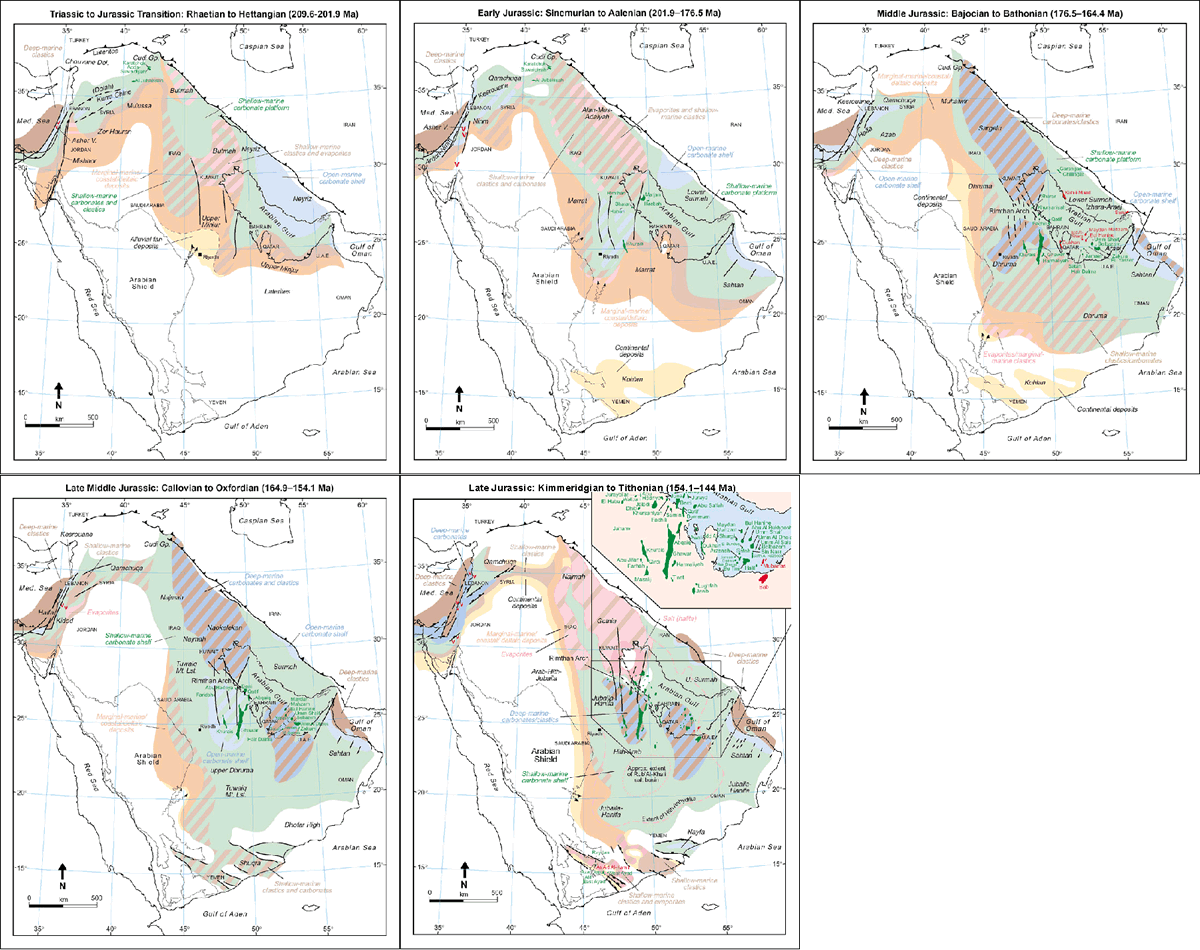
evaporites (e.g. Mulussa Early in the Carnian, a very pronounced relative drop in sea level was recorded throughout the circum-Mediterranean region. This ‘salinity crisis’ (Hirsch, 1992) expressed itself in the epicontinental regions as a typical lowstand evaporite sequence dominated by halite and sulfate deposition, continental sands, marls and shales. Concurrent with the opening of new Tethyan rift zones in the Eastern Mediterranean was the deposition of pillow lavas (Asher volcanics), continental sands, and deep-water radiolarites and Halobia-limestones. The facies and faunal distribution in late Carnian to Rhaetian allowed the distinction into continental platform and reef-bank and deeper-marine facies (Hirsch, 1992, 1995). This type of lateral facies substitution extended westward from the Arabian Plate toward the Helez uplift in the Levant. Click here for sequence of maps of Jurassic facies.
Triassic to Jurassic Transition: Rhaetian to Hettangian (209.6–201.9 Ma) (Figure 7) Regional Setting This time period spanned the deposition of the upper Minjur (Saudi Arabia, United Arab Emirates), Mulussa (Syria), and Butmah (Iraq) formations, and their regional equivalents [GSS J10]. Rocks of Hettangian age are generally absent from much of the Arabian Plate as are many of Rhaetian age. Erosion and non-deposition was caused by structural uplift (onset of Mediterranean rifting) combined with a lowstand in sea level. Paleofacies
The Arabian Gulf region was still influenced by the central Arabian
horst and graben system. The northerly directed supply of deltaic to
coastal sands (Minjur) gave way to evaporitic, shallow-marine shales
(e.g. the Butmah The facies distribution seems to have been controlled by deep-seated tectonic lineaments that had been in existence since the Permian. To the west, between the Arabian Shield and the horst and graben system, a mixed facies of carbonates and shallow-marine shales was deposited in a shallow-marine reentrant that probably corresponded to the Paleozoic Widyan Basin (Al-Laboun, 1986). The marine shales mixed with spill-over sands from a possible braided river system that drained the hinterland to the south and southwest. At this location, about 100 km south of Riyadh, ophiuroid remains were found (Le Nindre, Manivit and Vaslet, 1990; D. Vaslet, personal communication, 2000).
The top of the Hettangian is truncated and marks a stratigraphic gap
until the transgression of the lower to middle Toarcian [TST leading to
MFS J20]. The southern Qatar Arch was still exposed and upper Minjur
sands were eroded from its flanks. Laterally, a transition into shales
and mixed shelf carbonates (Neyriz The limestone sequence of the Cudi Group in southeastern Turkey has a poorly defined age ranging from Late Triassic to Jurassic, and possibly even Early Cretaceous. In general, the Hakkari area of easternmost southeastern Turkey belongs to the transition from the peri-Gotnia Basin to the Tethys. The succession starts with limestone/dolomite, passes up through phases of exposure and intense weathering into agitated shallow-marine, shelf-marginal carbonates. Arac and Yilmaz (1990) have reported evidence of slumping from the edge of the Mardin shelf.
Hirsch and Picard (1988) and Hirsch (1992) discussed in detail the
transition from the Triassic to the Lower Jurassic in the Levant. The
contact between the Triassic and Liassic corresponds to the globally
recognized drop in sea level (Haq et al., 1988) that left large areas of
the eastern Mediterranean and Arabian Plate exposed to lateritic
weathering (Mishhor
In Syria, shallow-marine carbonates containing dark, fetid limestones
and papery shales (Dolaa group) were deposited in the relic Palmyra
depression. The Zor Hauran
The Rub’ Al-Khali Basin was filled for the most part by a sand-shale
sequence of the upper Minjur Early Jurassic: Sinemurian to Aalenian (201.9–176.5 Ma) (Figure 8) Regional Setting This time period spanned the deposition of the Mus (Iraq), Marrat (Kuwait, Saudi Arabia, United Arab Emirates), Qamchuqa (Syria) and Nirim (Levant) formations, and their regional equivalents [MFS J10 to intra-J20; the late Toarcian unconformity marks the base of AP7 at 182 Ma]. The eastern Mediterranean opened during this period to create a new passive margin. Paleofacies
In the Arabian Gulf region, a reversal of the depositional pattern of
the Triassic to Jurassic transition occurred at this time. Where
previously there had been a structural uplift of the Arabian Arch
combined with a lowstand in sea level, there now appeared to have been
relaxation and the marked subsidence of the Summan Platform. The
pronounced northerly trend of the Platform and the observed facies
pattern suggest an underlying tectonic control that probably corresponds
to the Hercynian ‘basement grain’. These trends extend northward into
Iraq and toward the Plate margin. Argillaceous limestones and
shallow-marine shales were deposited, together with interbedded
vaporates (Alan, Mus and Adaiyah formations), on the edge of the
Mesopotamian (Gotnia?) Basin. South of the Arabian Arch, the lower
Marrat
In the United Arab Emirates, the Marrat is a mixed facies of terrigenous
clastics and shallow-marine, peloidal to bioclastic limestones in its
lower part, and an upper sequence of interbedded micritic sandstones and
sandy limestones and dolomites. These sediments represent a slowly
deepening sedimentary sequence from flood plains, through tidal flats to
shallow-marine, and finally to deeper, quieter-water environments. This
sequence is the Hamlah
In Oman, the long-lasting Sahtan group was a gradually shoaling
carbonate sequence that had a thin, basal transgressive succession of
mixed terrigenous clastics and carbonates of Pliensbachian age (Le
Nindre et al., in press). The lower Surmeh
In the southwestern quadrant of the Arabian Plate, erosional lows or
sags occur on a peneplaned topography. These depressions in southern
Yemen and the Hadramaut accumulated terrestrial and fluviatile
conglomerates and sands of the diachronous and transgressive Lower to
Middle Jurassic Kohlan
In southern Levant, the clastic upper Inmar
The Lower and Middle Jurassic rocks of Syria belong to the diachronous
Qamchuqa Middle Jurassic: Bajocian to Bathonian (176.5–164.4 Ma) (Figure 9) Regional Setting This time period spanned the deposition of the Izhara (Qatar), Araej (Qatar, United Arab Emirates) and Dhruma (Saudi Arabia) formations, and their regional equivalents [MFS J20 to intra-J40]. These sediments were deposited in an open-marine environment, as the Arabian Plate now had passive margins to Neo-Tethys to the northeast and north. Paleofacies This time slice represents a phase of general sea level rise (Haq et al., 1988) and with it the westward transgression of marine environments far onto the Arabian Craton. Coastal and nearshore environments are represented by coastal sands that pass eastward into shallow-marine shales and then into shallow-marine detrital carbonates. Examples are the Dhruma (Saudi Arabia, Oman), Izhara/Araej (Qatar and United Arab Emirates), and the lower Surmeh (Iran) formations. In Saudi Arabia, the area located over the Precambrian basement high at the southwestern end of the Central Arabian Arch, began to undergo a differentiated subsidence, as did the southern Summan horst-graben tract, to form the Arabian Basin of Ayres et al. (1982). Subsidence continued to collect shales and deeper-marine carbonates (‘Mid-Dhruma shales’) [J20 at 175 Ma]. The eastward clastic discharge from the hinterland seems to have been reduced and fed only the western Rub’ Al-Khali Basin; minor run-offs were mapped by Le Nindre, Manivit and Vaslet (1990) about 200 km northwest of Riyadh. The Arabian Basin and the Gotnia Basin were separated by an approximately 100 km-wide sill (the ‘Rimthan Arch’) cross-cut by a set of N-trending Hercynian faults. A northwesterly fault-trend appears to have vaporates the shape of the Sargelu (Gotnia Province) basin-sill. In Oman, the shallow-water limestones of the Middle to Late Jurassic Sahtan Group were deposited in the eastern part of the Rub’ Al-Khali Basin. The present-day shore of the Gulf of Oman, corresponds roughly to the Middle Jurassic paleoslope that passed into the Al Ayn subbasin (Hawasina Basin) off the continental margin (Cooper, 1990). The slope has a fringe of submarine-fan sands.
In Yemen, incipient graben systems (with typical Najd alignment) began
to form and were filled with terrestrial sand/shale sequences of the
Kohlan
A narrow marine shelf existed in the northwest of the Arabian Plate. It
was covered with shallow-water carbonates (Haifa Group) and with
deeper-water facies farther offshore. In Lebanon, the thick (1,500–2,000
m) cliff-forming limestones of the Kesrouane Late Middle Jurassic: Callovian to Oxfordian (164.4–154.1 Ma) (Figure 10) Regional Setting This time period spanned the deposition of the carbonate Upper Dhruma and Tuwaiq Mountain Limestone of Saudi Arabia, the Upper Araej of the Gulf (and equivalents in Lebanon), the clastic Hanifa, and Naokelekan formations of the Gulf, Syria and Iraq, and the Surmeh dolomite of Iran [MFS J40 to J60]. Differential intraplate subsidence led to the development of intrashelf basins. Paleofacies Although a relative lowstand in sea level prevailed during most of this time interval (Haq et al., 1988), widespread carbonate sediments indicate a shallow-marine environment. Four intrashelf basins have been identified in the southern Arabian Gulf (Rub’ Al Khali and Ras al Khaima basins), central Arabia (Arabian Basin) and at the head of the Arabian Gulf (the Gotnia Basin). The northward-trending extensions of the Arabian Arch fault blocks penetrated the ‘Rimthan Arch’ and controlled the architecture of the platform basins. Substantial amounts of organic-rich source-rock shales, which formed under anoxic conditions, accumulated in the basins. These are the rich source rocks analyzed by Ayres et al. (1982) and Bordenave and Burwood (1990) (e.g. the Hanifa and Naokelekan shales and the Diyab of Qatar and the southern Gulf). The creation of these intrashelf basins appears to have been based on rejuvenated N-trending Hercynian tectonic structures between the Arabian and Gotnia basins. The southern Gulf Basin, however, was probably vaporates by the Dibba fault zone. The ‘V’-shape of this basin partly reflects the trend of the Arabian Arch (Rayn trend of Al-Husseini, 2000) and partly that of the Dibba fault system.
The western platform between the Arabian Basin and the silty-shaly
coastal-fringe deposits was occupied by coral-algal and bioclastic lime
sand deposits. Clastic input derived from the southwestern hinterland
was still guided by the southern edge of the Arabian Shield toward the
Arabian Basin (LeNindre, Manivit and Vaslet, 1990). An unconformity at
the top of the Callovian Tuwaiq Mountain Limestone defined by hardground
and weathering phenomena, was overlain and onlapped by late Oxfordian
Hawtah shales at the base of the Hanifa
Jurassic volcanic rocks from the Batinah coastal plain and Sumayni area
of eastern Oman are interpreted as a sign of tectonic instability caused
by the incipient breakaway of India and Madagascar along the eastern
margin of the Afro-Arabian Plate. Volcanic activity also occurred on the
continental slope of the Hamrat Duru Basin, where the Buwayfah
During the Early Jurassic, extensional tectonism started in Yemen. The
developing troughs were characterized by shallow-marine carbonates of
the first marine transgression (transgressive system tract (TST) of
Toland et al., 1995). The J40 MFS of Sharland et al. (2001) occurs in
the upper part of the Shuqra
In the Levant, the shallow-marine carbonate shelf at the eastern end of
the Mediterranean became markedly smaller, and a more abrupt transition
into the Pleshet Basin occurred. Here, the Haifa
At the northern extremity of the Arabian Plate, a shallow seaway joined
the eastern Mediterranean with the northern extension of the Gotnia
Basin. The Qamchuqa Late Jurassic: Kimmeridgian to Tithonian (154.1–144 Ma) (Figure 11) Regional Setting This time period spanned the deposition of the Arab and Hith (Saudi Arabia, Qatar, United Arab Emirates) and Gotnia (Iraq, Kuwait) formations, and their regional equivalents [MFS J70 to K10; base of AP8 at 149 Ma]. Deposition of vaporates was widespread. According to Sharland et al. (2001), the base of AP8 corresponds to a plate-wide late-Jurassic unconformity. A new passive margin developed along the southeastern coast of Oman following continental rifting and sea-floor spreading between the Afro-Arabian and Indian plates. Paleofacies
This time interval corresponded to an overall progressive rise in sea
level, and a corresponding widespread deposition of predominantly
shallow-marine carbonates. With apparent regularity, shoaling-upward
cycles formed a complex system of infratidal carbonates to arid,
supratidal vaporates. These cycles represent the Arab The sediment types and distribution indicate a Bahamas-type depositional model. In such a model, shelf margins with high-energy regimes allowed for the production of calcarenites, whereas protected shelfs with pellet-grapestone sediments were associated with algal mats and the creation of spreading islands. These in turn accommodated beaches, tidal and evaporite flats, and other coastal environments. Alternatively, a model of brine concentration in an epeiric sea is possible. The shoaling-upward cycles show strong sulfate replacements that have totally obliterated the depositional textures in some places. Relic textures indicate typical shallow-marine shelf carbonates. The Arabian and southern Gulf basins with partly anoxic biotopes (Hanifa shales) still existed, but appear to have been filled-in progressively by actively prograding, interior shelf-edge calcarenites. The prograding units downlap into the Arabian Basin and change facies to argillaceous, deep-water deposits. The edge of the Arabian Basin was intensely dolomitized and locally shows evidence of subaerial exposure (karstification and brecciation) with geopetally arranged, internal silt deposits. These marked hiatus surfaces were formed during the late Tithonian. Canyons were incised along the Levant coast during this sea-level lowstand (Hirsch, 1991). In the Rimthan field on the northern extension of the Summan Platform, numerous stacked erosional surfaces and algal mats and crusts are present (M.A. Ziegler, unpublished Saudi Aramco Miscellaneous Report 911, 1982). Similar features are known from the Saudi offshore area around the Marjan field. On the Fuwaris trend there is pervasive dolomitization up to 1,000 m thick. It is likely that this diagenetic process in near-subaerial conditions occurred close to the major sequence boundary either at end Rayazanian or end Portlandian (Malm) (Haq et al., 1988). This corresponded to uplift relating to continental rifting and sea-floor spreading.
South of the ‘Gotnia Rim’, four shoaling cycles of interbedded
calcarenite and anhydrite units developed. They are the A to D Members
of the Arab
Detailed spectrochemical correlations in various transects from the
Arabian Basin into the Gotnia domain revealed that the Tuwaiq Mountain
Limestone is progressively missing northward, and even the Dhruma
Sadooni (1997) reported a wide areal distribution of the Najmah
The active hinge line that controlled the truncation may be located on the northern dip of the Summan Platform, near the Rimthan and Uhayrish fields in Saudi Arabia. The fault alignment relates to the Najd fault system and seems to correspond approximately to the Abu Jir Fault Zone of Iraq. It appears that the Abu Jifan trend has been affected by the N-trending Summan Platform lineament (M.A. Ziegler, unpublished Saudi Aramco Miscellaneous Reports 896 and 911, 1980, 1982). Similar fault interference patterns for central Arabia and the Gulf coast in the Kuwait-Saudi Arabia Partitioned Neutral Zone were suggested by Christian (1997) in the framework of the regional Cretaceous structure. Milner (1998) recognized comparable trends that provide the structural framework for the distribution of source rocks in the southern part of the Arabian Plate. In offshore Saudi Arabia and Kuwait, four halite cycles are recognized. The lowest salt layer appears to model the northern extension of the ‘Khafji Graben’ and the eastern boundary of the Gotnia Evaporite Province. The westerly salt pod follows the trend of the ‘Minagish Graben’ that is located between the Summan Platform and the Burgan trend. The half-grabens are shown on the pre-Unayzah (Upper Carboniferous to Lower Permian) subcrop map of McGillivray and Husseini (1992). The youngest Paleozoic strata within them are of Devonian age. Al-Husseini (2000) related the underlying basement grain to structures within the Rayn microplate that were caused by the Amar collision during the late Precambrian. Yousif and Nouman (1997) have recorded a similar salt distribution for onshore Kuwait. They located the onlap/downlap of the basal and second salt layer from the west against the Burgan Arch. Along the southern rim of the Gotnia, the remaining upper three salt layers can be correlated across the head of the Gulf. The well-defined cycles typically show repeating couplets commencing with fetid paper shales [high-frequency MFS of Sharland et al., 2001], followed upward by nodular anhydrite that gives way to pure halite before reverting to nodular anhydrite. The next cycle begins with paper shales. This kind of sequence repeats itself three times over the entire southern Gotnia Basin, and four times in the eastern and western parts of the southern basin (M.A. Ziegler, unpublished Saudi Aramco Miscellaneous Report 911, 1982). The salt distribution in the basin appears to be extremely fine-tuned with respect to the Hercynian lineaments branching out from the Arabian Arch. It is possible that distant plate motions may have reactivated fault-bounded rift blocks that locally appear to have undergone minor uplift and erosion, or tilting, in order to create local intrashelf basins or troughs. Pratt and Smewing (1993a,b) envisage these tectonic influences to be responsible for the flexing and blockfaulting of the eastern margin of the Arabian Plate. A general westward tilt of the Plate, as suggested by Murris (1980), could have triggered these events. In view of the basement grain, as indicated by Al-Husseini (2000), a complementary interaction of the Rayn, Batin and Abu Jifan fault sets may have occurred.
It seems probable that the marine replenishment of this ‘sink’ was from
the Neo-Tethys to the north. This contrasts with Al-Husseini’s (1997)
suggestion of a water source to the In Oman, the NE-trending Dibba Fault clearly separates the western Gulf province from the complexly structured margin of the Hamrat Duru and Umar basins to the southeast. Here, high-energy, well-oxygenated sediments such as reefs and detrital calcarenites, characterize the plate margin. Various types of debris flows covered the continental slopes of Neo-Tethys, typically majolica facies with tintinnids and radiolarian cherts, and Cooper (1990) recorded exotic limestones. The widespread occurrence of conglomerates in Oman at the end of the Jurassic indicates a regional destabilization of the shelf edge associated with the rifting of India from Arabia. With a possibly still moderately rising sea level, the rapid drowning of the northeast platform seems to have outpaced the vertical carbonate production and led to the accumulation of deeper-water, mud-dominated, chert-rich facies.
In Yemen, the synrift graben systems contain anoxic shales and vaporates
that are comparable with the eastern shelf of the Arabian Plate. The
greatest marine constriction seems to have occurred in the Marib-Shabwa
Basin (Madbi In the Levant and eastern Mediterranean region, intensive uplift, rifting, and volcanism correspond to the top of AP7 (Sharland et al., 2001) at 149 Ma (Tithonian). The earlier Jurassic paleogeographic pattern of highs and lows in the Negev and northern Levant was replaced by the Pleshet Basin (Cohen et al., 1988). This event subdivided the Levant region into a structured shelf with numerous fault blocks, generally parallel to the Mediterranean plate margin. Cohen et al. (1988) differentiated the plate margin in the following manner: 1. a western platform province along the Gevar-Am trough, related to the Pleshet Basin (subsiding along the present-day Levant coastline); and 2. an eastern platform province on the margin of the exposed and eroding Arabian-Nubian massif.
Fault activity is marked by ‘Tayasir’ volcanics (vitreous tuffs) at
Devorah (Hirsch and Picard, 1988). In Syria, a shallow seaway connected
the Syrian Platform with the Gotnia Basin to the southeast between the
Aleppo High (Mardin Shelf) and the Rutbah High. Along its western margin
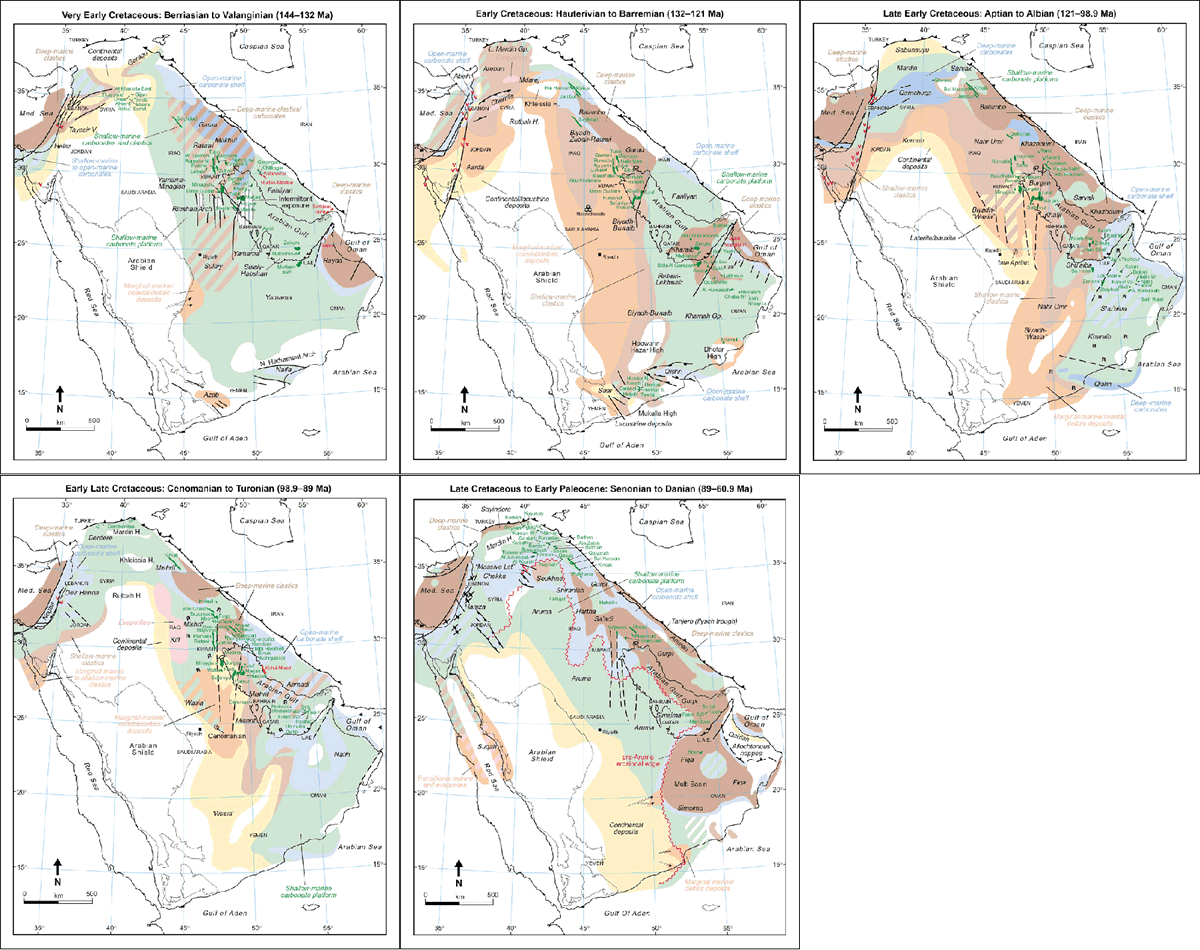
were deposited mainly shales (Qamchuqa Click here for sequence of maps of Cretaceous facies.
Very Early Cretaceous: Berriasian to Valanginian (144–132 Ma) (Figure 12) Regional Setting
This time period spanned the deposition of the Yamama, Minagish, Habshan,
and Rayda formations, and their regional equivalents [MFS intra-K20 to
intra-K40]. Relatively continuous sedimentation took place in Oman, but
most other parts of the Arabian Plate were affected by a late Valangian
unconformity. Al-Fares et al. (1998) related a major sedimentary hiatus
of Valanginian to early Hauterivian age in offshore Kuwait to far-field
stresses induced by the opening of the South Atlantic that may have
reactivated older structures. The sediments were deposited on open
platforms and within intrashelf basins of the Arabian Plate that was
surrounded to the north, Paleofacies
This interval is characterized by a moderately high, but falling,
eustatic sea level (Haq et al., 1988). The eastern shelf platform of the
Arabian Plate was covered by shallow-water carbonates Yamama, Minagish,
and Habshan formations), with the exception of the areas of the former
Gotnia Province and the residual Arabian Basin, where argillaceous
limestones of the Sulaiy/Makhul formations were deposited. However, from
the flanks of the now actively subsiding Gotnia Trough, shallow-water
pelletal and peloidal, mainly mud-supported limestones, prograde into
the basin eastward and accumulated as the Ratawi In the north of the Arabian Plate, a terrigenous, sand-dominated environment is suggestive of active uplifting, rifting, and volcanism (Tayasir Volcanics). West of the present-day coastline of the Levant, the Pleshet Basin opened through the subsidence of the northerly oriented Gevar-Am trough, which collected mainly clastic sediments. The source of the Helez sandstones was the land masses to the southeast, as well as a western basement high possibly on an old rift shoulder (Rosenfeld et al., 1998), about 50 km offshore from the present coastline.
A possible marine connection might have existed across Syria between the
eastern Mediterranean and northern Iraq where sediments indicate
shallow-marine to shoreline and coastal environments. In eastern Iraq
and adjacent Iran, a similar alternating shale-limestone sequence is
present (the Gadvan
The northern Rub’ Al-Khali/Ras al Khaimah Basin appears to have lost its
former expression as a result of infill by shelf carbonates and
evaporites. Pratt and Smewing (1993a,b) suggest the occurrence of Late
Jurassic block faulting along the northeastern Oman plate margin.
Variable rates of thermal subsidence and tranpressive forces were
translated onto this margin by oceanic plates in the Neo-Tethys. These
forces caused local minor uplift and erosion. With the termination of
this stress regime, the Hamrat Duru Basin came into existence as a large
downwarp. The platform sediments of the Arabian Plate withdrew
southwestward and pelagic-type sediments uniformably covered the old
continental slope and the drowned plate margin (Le Métour et al., 1995).
The clastic source was pushed back southwestward, so that an essentially
pelagic sediment regime covered both the old continental slope and the
Hamrat Duru Basin. In the proximal parts of the Basin, the turbiditic
succession of the Guwyza
In the interior of Oman, the Middle to Late Jurassic shallow-water
limestones of the Sahtan Group are overlain unconformably by
thin-bedded, cherty lime mudstones of the Rayda In the Hawasina Basin of northeastern Oman, cherty sediments characterize the sequence from Tithonian through Hauterivian. However, the Hamrat Duru Basin with a high carbonate generation rate contains hemipelagic limestones, whereas radiolarian cherts prevail predominantly in the proximal, shale-rich Al Ayn subbasin and the distal Duru subbasin (Cooper, 1990). The flanking platform of the Al Ayn sag had mainly shallow-shelf environments with reefs, winnowed oolitic and peloidal grain-limestone belts, and a lagoonal to platform interior environment with mud-supported lithologies (Alsharan and Nairn, 1997).
In Yemen and southern Oman, tectonic stresses caused not only flexuring
and drowning of the Jurassic platform but also uplift, such as the North
Hadramaut Arch. A shallow-marine carbonate province developed in the
Say’un-Masila and Jeza-Qamar basins whereas the Marib-Shabwa Basin
appears to have been more isolated from marine circulation. It
accumulated predominantly shallow- to transitional-marine shales (Azab
Early Cretaceous: Hauterivian to Barremian (132–121 Ma) (Figure 13) Regional Setting This time period spanned the deposition of the Aarda (Jordan), Zubair, Buwaib, and Biyadh (Iraq, Kuwait, Saudi Arabia), and Lekhwair, and Kharaib (United Arab Emirates, Oman) formations, and their regional equivalents [MFS K40 to intra-K70]. It was a period of low sea levels with minor subcycles and a later moderate rise of the sea (Haq et al., 1988). Sediments were deposited in shallow-marine shelf and intrashelf settings on the Arabian Plate passive margin with Neo-Tethys, and were influenced by the strong clastic sediment supply from the Zubair delta to the west. Paleofacies In the Levant, extensive freshwater (‘Wealden facies’) and continental deposits, interbedded with Tayasir basaltic volcanics, are reported by Rosenfeld et al. (1998) for the Negev, Galilee High and Mount Lebanon area (Walley, 1998b). This indicates a clear uplift of the northwestern plate margin concurrent with a marked marine regression. Offshore in the Gevar-Am Trough are deeper-marine shales and pelitic to chalky sediments of the Talme Yafe and Abeih formations. The northern part of the Arabian Plate was covered by shallow-marine shales and occasional evaporite sabkhas and salinas of the Areban, Cherrife, and Mdarej formations (Syria, Iraq) and of the lower Mardin Group of southeast Turkey. The interior-shelf, coastal-fringe shales grade northeastward toward the plate margin into sandy limestones, which by their faunal content (algae, oncoids and oysters) indicate some restriction in marine circulation. The wider Gulf Basin was fringed toward the Arabian Shield by an extensive transgressive sand-shale apron of the Biyadh, Buwaib, and Zubair formations. The lateral transition illustrates a gradual change from continental fluvial systems, through shallow-marine sandbars and subtidal shales to a carbonate ramp system farther offshore. West of the N-trending Dibdibah Trough, a shallow-marine embayment resulting from carbonate suppression may explain the nannofossil finds about 150 km northeast of Buraydah (Le Nindre, Manivit et al., 1990).
The Gotnia Basin contains about 800 m of dark, deep-marine shales and
fine-grained cherty limestones of the Balambo and Garau formations (van
Bellen et al., 1959; James and Wynd, 1965). In contrast, shallow-marine
Fahliyan limestones composed of oolitic, pelletal and brecciated
calcarenites, formed a shallow shoal passage from the Fars province of
Iran to the Ras al Khaima Basin in the southern Gulf and United Arab
Emirates. The Basin is marked by a predominantly deeper-marine,
fine-grained argillaceous mudstone, with pelletal, bioclastic lime
packstones in Qatar (Lekhwair
In the south of the Arabian Plate are located the large positive
structures of the Hoowarin-Hazar High in northern Hadramaut and the
Dhofar High in Oman. Shoreline and shallow-marine clastics fringe the
structures. In Yemen, the two eastern basins of Sayun-Masila and
Jeza-Qamar belong to the shallow-marine setting (Qishn Late Early Cretaceous: Aptian to Albian (121–98.9) (Figure 14) Regional Setting
This time period spanned the deposition of the Shu’aiba, Biyadh, Nahr
Umr, and Burgan (Arabian Penninsula), and Kazhdumi (Iraq, Iran)
formations, and their regional equivalents [MFS K70 to intra-K120]. A
marked late-Aptian regional unconformity and sedimentary hiatus
separates rocks of Aptian age (e.g. Shu’aiba Paleofacies The transgressive Albian deposits reflect a rise in sea level. The gradually rising sea level that followed the pre-Albian unconformity caused the oscillating deposition of shale and carbonate. In general, by late Albian times, the Arabian Platform was widely inundated by shallow seas in which were deposited shallow- to progressively deeper-marine carbonates in various subbasins around the plate margin. These are as follows: 1. The shallow Palmyra intrashelf basin in the north;
2. The Lurestan intrashelf basin,
3. The Khuzestan intrashelf basin, 4. The Rub’ Al-Khali, Ras al Khaimah and Fars intrashelf basins in the southern Gulf; 5. The Jeza-Qamar intrashelf basin of eastern Yemen (Hadramaut). Dark organic-rich shales and argillaceous limestones of the Kazhdumi and Balambo formations characterize the eastern plate intrashelf basins of Iraq and Iran. The presence of ammonites and a foraminiferal-oligosteginid fauna indicate a deeper-marine depositional setting and connection with Neo-Tethys.
Shallow-water platform limestones with fringing rudist reefs are present
along the hinge line of the eastern Mediterranean shelf margin (Bein,
1976). Westward, the platform sediments pass rapidly into thick,
fine-grained slope and cherty basinal facies. The platforms that
separate the various intrashelf basins are the sites of shallow-water
carbonate deposition (e.g. the Sarvak
Hughes (2000) subdivided the early Aptian Shu’aiba
In the Shaybah field, the Shu’aiba
Over the Arabian Arch, continental sands and conglomerates (Biyadh
Fluviatile and continental sands of the upper Kurnub Group occur in the vicinity of the Rutbah High. In the interior of the Arabian Plate, Andrews (1992b) described poorly dated fluviodeltaic environments in southeastern Jordan, typified by freshwater algae and coaly, wood fragments, that indicate deposition close to shore. Similar continental environments appear to have existed in the Al Jawf region of northern Saudi Arabia. Along the eastern plate margin, as far as the southern Gulf region, organic-rich Kazhdumi shales were deposited. They contain subordinate argillaceous limestone beds that have an open-marine basinal biota of planktonic foraminifera, radiolarians, and sponge spicules (James and Wynd, 1965). Southward, the Fars intrashelf basin extended into the lobate intracratonic Rub’ Al-Khali Basin whose filling is of an open-marine, off-bank nature containing planktonic foraminifera (Hedbergella ssp.) and skeletal debris that fines away from the bank/fore-bank sediment source areas (Hughes, 2000).
The Hoowarin-Hazar Ridge of Yemen and the southern Rub’ Al-Khali is a
prominent feature conspicuously aligned with the Dibba Fault. It shed
clastics into the Rub’ Al-Khali Basin as far as the southern United Arab
Emirates (Pascoe et al., 1995). The shelf Early Late Cretaceous: Cenomanian to Turonian (98.9–89 Ma (Figure 15) Regional Setting This time period spanned the deposition of the Mishrif, Ahmadi, and Rumaila (Arabian Peninsula), Natih (Oman), and Derdere (SE Turkey) formations, and their regional equivalents [MFS K120 to intra-K150; base of AP9 dated at 92 Ma]. Base AP9 corresponds to the Plate-wide mid-Turonian unconformity resulting from the start of ophiolite obduction along the eastern margin of the Arabian Plate. The sediments were deposited on platforms and within intrashelf basins on the passive margin of the Plate. Paleofacies
A maximum global coastal onlap for this time interval has been proposed
by Haq et al. (1988) and, in Arabia, the sedimentary record indicates
the presence of widespread shallow-marine platform carbonates (Mishrif
The shelf
Rudist facies are recorded from most of the fields west of Basra in
Iraq, and also from Majnoon and the Buzurgan area. Similar facies are
present all around the northern end of the Gulf. From the Rutbah High
westward, facies changes from shallow-marine carbonates to hypersaline
lagoons and continental deposits took place. Dunnington (1958) recorded
erosional truncations and weathering effects in northern Iraq. West of
Baghdad is an extensive evaporite pan (Kifl
On the northern edge of the Arabian Plate, shallow-marine conditions
prevailed in which carbonates were deposited. The lower part of the
Derdere In the Levant, a rudist-reef barrier marks the shelf break south of Mount Carmel and may be traced into northern Sinai according to Bein (1976) and Hirsch (1991). Open-marine Negba chalks characterize the Pleshet Basin in offshore Levant. Shallow-marine shales occur in the southern Negev and Sinai. The Azrak Graben in Jordan contains basal deep-water chalky limestones that are equivalent to the Deir Hanna and Negba formations of the Levant (Hirsch, 1991). The Fuluk and Siwaqa graben-bounding faults restricted the limestone development. Late Cretaceous to Early Paleocene: Senonian to Danian (89–60.9 Ma) (Figure 16) Regional Setting This time period spanned the deposition of the Shiranish, Gurpi (Iraq, Iran), Aruma and Simsima (Kuwait, Saudi Arabia, United Arab Emirates), and Fiqa (United Arab Emirates, Oman) formations, and their regional equivalents [MFS K150 to intra-Pg10]. It approximates to the interval of AP9 (92 to 63 Ma). The pre-Cenozoic unconformity at 63 Ma (Sharland et al., 2001) is the base of AP10 and marks the cessation of ophiolite obduction along the eastern margin of the Arabian Plate. The sediments were deposited within a compressive foreland basin setting following onset of mid-Turonian ophiolite obduction along the eastern margin of the Plate. Paleofacies Figure 16 illustrates the depositional features during the late Senonian (Campanian-Maastrichtian) and shows the approximate extent of the early Senonian erosional limit onto the shallow platform (Murris, 1980). Koop and Stonely (1982) indicated truncation and onlap on a pre-Late Cretaceous unconformity [middle Turonian unconformity, base AP9 dated at 92 Ma]. In the deeper intrashelf basins (such as the Lurestan Basin), continous sedimentation occurred across this marked hiatus. Tectonic uplift and the rejuvenation of former N-trending structures coupled with erosion occurred as far north as the Zagros range of Lurestan. A narrow NW-trending foredeep formed west of the rising orogen as a result of ophiolite obduction. The erosional products from the orogenic front were shed as flysch deposits into the foredeep where deeper-water marine conditions were present (e.g. Simsima and Shiranish formations). Oceanic sediments (radiolarites) and ophiolites were emplaced onto the Oman continental margin. At the same time, a shallow-water carbonate platform formed over the interior of the Arabian Shield. Haq et al. (1988) proposed a generally slow sea level fall during this period. In contrast, based on evidence from the Arabian Plate, Harris et al. (1984) consider a relative rise in sea level that was the highest of the whole Cretaceous. It is likely that a foundering of the eastern part of the Plate caused a widespread and progressive westward onlapping of a shallow sea. For the Levant area, however, an early Senonian uplift is postulated, with evidence of inversion of older structures and a first phase of Syrian Arc deformation. These movements were probably an effect of the closure of the Neo-Tethys (Guiraud and Bosworth, 1997; Walley, 2001).
A reduction in the exposed landmass occured during the late Senonian and
a broad shallow-marine shelf developed on which were deposited
limestones of the Aruma
The Levant underwent a radical change in the sedimentary regime at this
time (Hirsch, 1991). The Syrian Arc influenced the paleotopography so
that the crests of the anticlines formed a cluster of small islands,
whereas the synclines formed small basins in which chert and phosphate
sequences (Mishash The compressive stresses exerted on the Arabian Plate are evident in the en-echelon alignment of fold structures in the Levant (Walley, 1998), the accentuation of the Azraq Graben, and the complex structures of the Euphrates Graben. Additional evidence is the emplacement of the Campanian Tayarat basaltic extrusives in the Euphrates Graben (de Ruiter et al., 1995). At the same time, the Sinjar and Anah grabens were forming in Iraq. The easterly oriented graben system in the Sinjar-Abd el Aziz area of Syria began to subside in the late Campanian–Maastrichtian (Brew et al., 1999). The prominent Sinjar Basin was structurally related to the Palmyra Basin until the late Mesozoic. After the prerift uplift and concurrent erosion over the northern margin of the Arabian Plate, a brief magmatic event in the Euphrates Graben marked the maximum extension. This phase was followed by postrift subsidence during the late Cretaceous (Senonian) and Paleogene (de Ruiter et al., 1995). Consequently, the deposition of more than 1,600 m of marly limestones (Shiranish and Aaliji formations) took place in an open-marine setting. In the course of the collision of the Arabian Plate with Eurasia, the elongate Kastel Trench of southeast Turkey was formed at the northern extremity of the Plate and was rapidly filled with fine-grained, deep-water sediments containing planktonic foraminifera. Persistent tectonic movements ahead of the advancing ophiolite nappes changed the depositional conditions (Gilmour and Mäkel, 1997). In this new tectonic environment, large gravity-slide complexes of platform carbonates (Karadur Complex), ophiolites, and submarine lavas (Kocali Complex) from the Taurus fold belt were emplaced into the foredeep.
In southeast Turkey, the Karababa In the Gulf region, older Hercynian lineaments were reactivated: for example, the Burgan and Khafji arches. In Oman during the early Campanian, this compressive tectonic phase led to the overthrusting and emplacement of the Sumeini and Hawasina nappes and the obduction of the Semail Ophiolite Nappe onto the eastern margin of the Arabian Plate (Le Métour et al., 1995). Subsequently, the Oman Platform became submerged and a series of transgressions resulted. This setting lasted through the Maastrichtian with deposition of the Aruma and Simsima formations. The Aruma unconformably overlies early Turonian rocks [mid-Turonian unconformity; base AP9 dated at 92 Ma].
The emplacement of the nappes caused the downflexing of the Oman Margin
and the
The discovery of marine vertebrates from northern Saudi Arabia (Thomas
et al., 1999) led to an age revision of the Lina Member, previously the
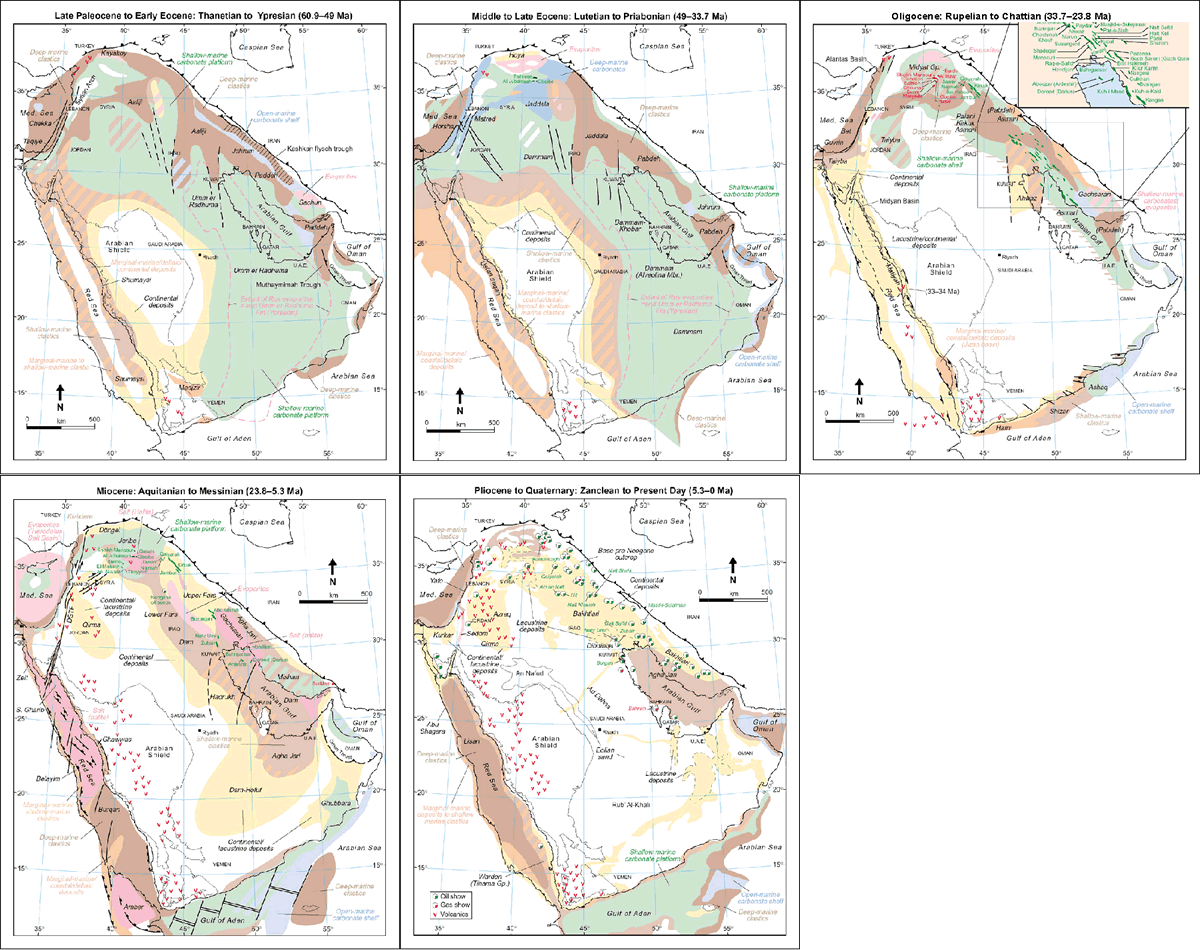
uppermost unit of the Aruma It is possible that the southeastward tilt of the Arabian Plate was a precursor to the rifting of the northern Red Sea. Only the downthrown and collapsed southeastern plate margin in Oman gives evidence (Aruma shales) for continous Danian deposition (Roger et al., 1992; Platel and Roger, 1989; Roger et al., 1989). Shallow-marine to intertidal marls and evaporite prerift deposits in the northern Red Sea trough (Suqah group) indicate an initial marine ingression from the north along the depression of the proto-Red Sea. Interbedded basalts occur locally. Click here for sequence of these facies maps of Cenozoic.
Late Paleocene to Early Eocene: Selandian to Ypresian (60.9–49 Ma) (Figure 17) Regional Setting This time period spanned the deposition of the Rus and Umm er Radhuma (Arabian Peninsula) and Pabdeh (Iran) formations, and their regional equivalents [MFS Pg10 to intra-Pg20]. Active compression ceased. Sediments were deposited within a ‘remnant’ foredeep-setting during rapid erosion, lowering, and subsidence of the emergent ophiolite and sedimentary structures along the eastern margin of the Plate. This time period essentially represents the first ‘second-order’ depositional sequence within AP10 of Sharland et al. (2001).
In the northern part of the Arabian Plate, the earlier Cretaceous
foredeep began to deform and generated structural inversion. It
coincided with the Paleofacies
During this time interval, eustatic sea level was generally high with
high-frequency regressive events (Haq et al. (1988. The Umm er Radhuma
On foraminiferal evidence, the Umm er Radhuma
Deeper-water environments within the remnant foredeep were only reached
close to the eastern Plate margin. The Aaliji
In the south, the Rub’ Al-Khali Basin had disappeared but the presence
of the Muthaymiah Trough, as a western foredeep of the Oman Mountains,
indicated ongoing extension that existed until the Early Eocene. In the
foredeep, debris flows and turbiditic slope sediments were mixed with
fine-grained basinal sediments. Basinal shales also accumulated in the
Mahdi Basin, southeast of the Haushi-Huqf uplift, and in the Abal Trough
(
The Hadramaut region of Yemen remained a depositional area for
shallow-marine carbonates whereas, to the south and west, shallow-marine
sands (Medjzir
In the Levant, a shallow shelf was the site of deposition of chalky and
cherty limestones and marls of the Taqiye Middle to Late Eocene: Lutetian to Priabonian (49–33.7 Ma) (Figure 18) Regional Setting This time period spanned deposition of the Jaddala (Syria, Iraq), Dammam (Arabian Peninsula), and Pabdeh (Iran) formations, and their regional equivalents [GSS Pg30]. It essentially represents the second ‘second-order’ depositional sequence within AP10 of Sharland et al. (2001). The sediments were deposited in a structural setting comparable to those of the underlying succession. Paleofacies The eustatic sea-level curve of Haq et al. (1988) indicates a gradually falling sea level. Consequently, it is possible that only a relatively small part of the Arabian Shield was exposed, at least at the beginning of the depositional sequence.
The Zagros foredeep and the Muthaymiah Trough of Oman appear almost
unchanged from the earlier time period and the sediment types (Pabdeh
The wide eastern shelf of the Plate was covered by the Dammam
In western Yemen, the Aden Oligocene: Rupelian to Chattian (33.7–23.8) Ma (Figure 19) Regional Setting This time period spanned the deposition of the Pabdeh-Chilou (Palani) formations (Iran, Iraq) and their regional equivalents [MFS Pg30 to Ng10]. A major unconformity and sedimentary hiatus [base of AP11 dated at 34 Ma] affected much of the Arabian Plate. The sediments were deposited in a compressive foreland setting during the early stages of continental collision between the Arabian and Eurasian plates. On the western side of the Plate, the Red Sea was in a rifting stage prior to the advent of sea-floor spreading and the splitting of the Afro-Arabian Plate. The late Paleogene-Neogene evolution of the south-central Turkey triple junction near Maras at the northwestern extremity of the Arabian Plate, represents a complex kinematic interplay between the Anatolian Plate (Tauride Arc) in the northwest and the Arabian Plate to the southeast. Kraig and Kozlu (1990) suggested that strike-slip motion rather than thrust tectonics was dominant. The strike-slips created extensional and compressional components that varied with time and space to form a series of small troughs that were mainly filled with clastic sediments. Paleofacies
The map reflects the pronounced fall in sea level during the Oligocene
to expose almost the entire Arabian Plate. The Neo-Tethys was closing
rapidly and the Zagros foredeep along the northeastern plate margin once
more became a narrow trench in which mainly limestones were deposited
along its margins. In the central part of the foredeep, Pabdeh-type
sedimentation (Palani In the
center of the Zagros foredeep, the lower Asmari limestones change to
calcareous sandstones (the Ahwaz sandstone member) that have a
subordinate marine shale component (James and Wynd, 1965). Alshahran and
Nairn (1997) considered the Asmari sandstone to be correlative with the
Ghar
In the south, the Gulf of Aden was about to rift. A series of small
E-trending troughs (Hasik and Ashawq grabens), opened in Dhofar during
the Rupelian (Platel and Roger, 1989; Roger et al., 1989; Roger et al.,
1992). Deeper-marine carbonates (Mughsayl
The Red Sea was in a thermal uplift prerift status. The entire protorift
was marked by terrestrial to fluviolacustrine sediments and coastal to
shallow-lacustrine clastics. Variegated siltstones interbedded with
basalt flows and lacustrine sediments with charophytes (Matiyah
Similar conditions are found in the Levant. The Dead Sea Transform Fault
was not yet active, as continental detritus (red beds of the Taiyba
Miocene: Aquitanian to Messinian (23.8–5.3 Ma) (Figure 20) Regional Setting This time period spanned deposition of the Hadrukh, Dam, Hofuf (Saudi Arabia), and Fars, Agha Jari and Gachsaran (Iran) formations, and their regional equivalents, together with massive salt deposits [MFS Ng10 to post-Ng40]. The sediments were deposited within the Zagros foredeep and foreland. Strong compression now occurred as Arabia separated from Africa and was driven into Eurasia. During this period the Burdigalian phase of the European Alpine Orogeny occurred. The Gulf of Aden had opened and the Red Sea rift began to separate Arabia from Africa. Complex strike-slip deformations along the Dead Sea Transform Fault resulted in uplift and faulting along the Syrian Arc. Through collision of Arabia with Eurasia, inversion in the Palmyrides and the Sinjar uplift occurred as well as minor transpression in the Euphrates Graben (de Ruiter et al., 1995; Brew et al., 1999; Sawaf et al., 2000). On the eastern flank of the Arabian Plate, the thrusting of the Sanandaj-Sirjan zone onto the Plate is evidence of the continental collision with Asia. As a result, a massive supply of continental to deltaic clastics occurred and shallow-marine shales accumulated in the rapidly subsiding Zagros foredeep. Post-Asmari Miocene to Recent sediments reached a thickness of over 5,000 m in the Dezful Embayment of the Zagros Basin (Koop and Stoneley, 1982). Volcanic activity was widespread and prolonged in western Arabia beginning at about 12 Ma (Camp and Roobol, 1991; Roobol and Camp, 1991). This was the second phase of volcanic activity associated with the opening of the Red Sea. Historical eruptions (e.g. at Al Madinah in AD1256) show that volcanism is still in progress. The basaltic lava fields (harrats) extend intermittently from Yemen, through western Saudi Arabia and Jordan, and as far north as southern Turkey. They have a total surface area of about 180,000 sq km and constitute one of the world’s largest basalt provinces. Paleofacies
The N-trending Hercynian lineaments of the Central Arabian Arch extend
far north into the Zagros foredeep. They separate on the western (Iraqi
side), the massive wedge of the Lower Fars clastics and evaporites from
the eastern Gachsaran salt marshes of the Khuzestan Province, (Agha Jari
and Dam formations) and shallow-marine carbonates (Guri
Around the Arabian Arch, a halo of mainly continental (Hadrukh
The Gulf of Aden was by now a shallow sea with carbonate deposition. The
Red Sea was periodically isolated and this resulted in the deposition of
thick evaporite deposits during the Middle Miocene in its northern half
(Zeit, South Gharib, and Belayim formations). A marine depositional
environment is indicated by the presence of dynoflagellate cysts in the
intra-evaporite shale units. In addition, the abundant
pyrite-impregnated amorphous kerogen suggests an anoxic setting. The
Early Miocene Burgan
The northern Arabian Plate was covered by shallow-marine sediments with
the exception of the tectonically affected zones along the northern and
eastern margins of the Plate. In the Maras area on the northwestern edge
of the Plate, red beds and basalt flows pass upward into terrestrial
conglomerates and sandstones of the Kizildere and Döngel formations. In
the Aslantas-Iskenderun Basin, the sedimentary sequence begins with
shales and turbidites, followed upward by shales and fine to coarse
clastics, comparable to the Kizildere Pliocene to Holocene: Zanclean to Present Day (5.3 Ma to 0 Ma) (Figure 21) Regional Setting
According to the eustatic sea-level chart of Haq et al. (1988), an
extreme lowstand with short-term cycles occurred during this period.
With the exception of the area of the Arabian Gulf (Agha Jari
At the end of the Pliocene, sea level was probably about 150 m higher
than at present (Haq et al., 1988), and the strandlines of this time are
visible on the Arabian mainland. During the Late Pleistocene glaciation,
the proto-Gulf basin was exposed due to glacial ‘drawdown’ of the
oceans. Drainage channels and erosional terraces can be mapped into the
Gulf of Oman (Sarntheim and Walger, 1973). After this drawdown, sea
level rose once again to about its present-day position (Kassler, 1973;
Seibold et al., 1973). Initially shallow-marine shales (Agha Jari) were
deposited in the Arabian Gulf basin, but as the climate became
increasingly arid a predominantly carbonate depositional environment
developed, particularly on the shallow southern margin of the Gulf.
Weijermars (1998) suggests that the Arabian Platform was under
significant collisional stress until the Quaternary, as expressed by the
NNE-trending Batin and W-trending Sahba strike-slip faults. The
Hercynian horst-graben structures seem to terminate within Weijermars
‘ Paleofacies The Zagros foredeep (or ‘Mesopotamian Basin’) roughly corresponds to the zone between the Mesozoic
unstable shelf to the west and the limit of the Zagros fold belt to the
poured a massive (2.5 to 3-km-thick) flood of terrigenous clastics and boulder conglomerates that
formed the Bakhtiari loading of Zagros thrust sheets. The pronounced area of subsidence lay to the west of the central Arabian N-trending lineaments of the Rayn anticlines (Al-Husseini, 2000). The lower contact of the
Bakhtiari
localization seems to be governed by the same structural trends. The
Dibdibba
Tectonic activity along the northwestern margin of the Plate formed
basins in which lacustrine deposits accumulated. A major basin evolved
into the Azraq Graben in present-day Jordan (Qirma
The Red Sea, in a renewed rift/drift phase (Hughes and Filatoff, 1995)
received sediments from a variety of coastal to marine transitional
environments. Collectively they make up the Lisan Fluvial and eolian processes are eroding the interior of the Arabian Plate. Some areas, particularly on the Arabian Shield, are bare windswept bedrock (hammada). Elsewhere, coarse sand and angular, up to pebble-sized, lag deposits remain. Major sand seas (Rub’ Al-Khali, An Nafud, Ad Dahna) have characteristic wind-sculpted morphologies. The coastal regions have extensive tidal flats characteristic of an arid climate. The Arabian Gulf, Red Sea, and Levant coasts are typical of mediterranean seas with low tidal-flooding influences other than by seasonal winds. Only the shores of Oman are influenced by significant oceanic tides and waves. Ephemeral lacustrine salt flats form in the eastern Rub’ Al-Khali (Umm as Samim) where the southerly monsoonal run-off from the Oman mountains annually transforms the interdune areas into salt marshes. Lacustrine deposits are also present in the mouth of the Euphrates (Shatt al Arab), where vertical tectonic movements are continuing (Kassler, 1973). REGIONAL SUMMARY
1. During the Late Permian to Middle Triassic (Figures 3,
4, and 5) a new
passive margin developed with Neo-Tethys. The Arabian Plate is
interpreted as an essentially peneplaned ENE-dipping platform. With the
northward drift of the Plate, low-latitude warming occurred.
Shallow-marine and arid-evaporitic environments developed and a regional
carbonate regime spread over the eastern Arabian Platform. This
deposited the Late Permian Khuff 2. During the Late Triassic to Early Jurassic, (Figures 6, 7, and 8), rifting occurred at the northern end of the Plate. A new northern passive margin with Neo-Tethys was created. The southern part of the Plate and the southeastern edge of the Arabian Shield were uplifted and contributed massive floods of terrigenous clastics toward the northeast (Minjur and equivalent). It is probable that the Hercynian horst-blocks and grabens channeled the sands into southern Iraq and as far as Khuzestan in Iran. West of the Summan Platform, a N-trending seaway developed, possibly a successor of the Paleozoic Widyan Basin.
3. During the Early to late Middle Jurassic (Figures 8,
9, and 10), the
N-trending Gotnia Basin became established across the head of the
Arabian Gulf, possibly separated by the ‘Rimthan Arch’ from its southern
extension, the Arabian Basin. The Gotnia Basin allowed direct access for
the open marine Neo-Tethys far across the Arabian Platform. The Rimthan
Arch has a northwesterly Najd trend, or an even older trend relating to
the Rayn microplate (Al-Husseini, 2000). In the late Middle Jurassic, a
carbonate regime was dominant throughout the region, and even the
western shelf of the Arabian Basin hosted reefal limestones and buildups
(upper Dhruma 4. The Late Jurassic (Figure 11) was a tectonically active period in southern Yemen, with clearly expressed rifting related to the separation of India from the Afro-Arabian Plate. Significant rift-shoulder uplift characterized the southeastern continental margin of Oman, whilst the northeastern margin remained remarkably stable and accumulated typical shelf-margin carbonate sediments. Instability only occurred in the distal Hawasina Basin. In central Arabia, slow but progressive infill of the intrashelf basins took place through repetitive shoaling-upward carbonate cycles. These cycles usually culminated in subaerially exposed evaporite flats (sabkhas). The Gotnia and Arabian basins may have been intermittently connected by Najd- and Hercynian-trending seaways across the southern Gotnia rim. The Levant region also shows uplift and rifting coincident with massive Tayasir volcanism. The Arabian-Nubian Shield was to a considerable extent exposed and eroded. Sedimentation was largely controlled by tectonocrustal influences. Similar conditions existed in the Arabian and Gotnia basins. 5. At the beginning of the Cretaceous (Figure 13), global sea level was relatively high and consequently most of the Arabian Plate accumulated almost exclusively shallow-marine carbonates. The major exception was the remnant of the Gotnia Basin that underwent rapid subsidence in the eastern part along Hercynian lineaments to form a narrow deeper-marine intrashelf basin in which the Balambo shales of Iraq and the Garau of Iran accumulated. The Arabian Basin was rapidly infilled, first by carbonates and later by terrigenous clastics (Buwaib and Biyadh formations). The southeast Oman plate-margin segment was foundering accompanied by the establishment of open-marine, deep-shelf deposits.
In the late Early Cretaceous (Figure 14), extensive rudist banks
colonized the shelf
In the early Late Cretaceous (Figure 15), a renewed spread of rudist
growth (Mishrif 6. Neo-Tethys became compressive and began to close during the Late Cretaceous (Turonian) to Early Paleocene (Figure 16). Ophiolite that was obducted onto the Arabian Plate margin may be observed in Oman, at many places along the NE Zagros margin, and in the Troodos Mountains of Cyprus. Flysch-type turbidites accumulated in the foredeep in front of the advancing allochthon along the eastern Plate margin. Hercynian-trend lineaments extended northward from the Central Arabian Arch into the Zagros foredeep. Early Senonian uplift and inversion of older structures occurred in the Levant. This caused deformations along the Syrian Arc and the onset of faulting in the Azraq Graben in Jordan. Shallow-marine carbonates were deposited southward across Sinai into the depression that marked the proto-Red Sea rift. The deposition of shallow-water and lacustrine sediments occurred as far south as the Jiddah region.
7. Global sea level during the Late Paleocene to Early Oligocene (Figures 17,
18, and 19) was relatively high and only in the Late Oligocene was
there a marked drop (Haq et al., 1988). At the time of high sea level, a
shallow epeiric sea inundated the eastern platform of the Arabian Plate.
The sea periodically shoaled to emergence, which caused the On the northern margin of the Arabian Plate, molasse and flysch-type clastics were discharged into the foredeep of the Taurus orogenic belt (the Aslantes-Iskenderun Basin) and onto the shallow shelf of the Mardin High. In the Levant, clastic detritus from the Arabian Craton was discharged onto the Sinai plains and indicates that the Dead Sea Transform Fault was not yet active, although basaltic extrusives are present along and adjacent to the incipient fault; volcanics were also extruded in the eastern Mediterranean. A new tectonic phase affected the Syrian Arc and Galilee, and the Palmyrids and Sinjar inversion structures.
8. The Miocene to Pliocene (Figures 20–21) was the time of maximum
compression between Arabia and Asia, coeval with the Late Alpine Orogeny
in Europe. During this period, the Arabian Plate began to separate from
Africa, the Gulf of Aden opened, and the Dead Sea Transform Fault acted
as a complex sinistral strike-slip fault. The second phase of sea-floor
spreading in the Red Sea began about 10 Ma and is continuing. The Syrian
Arc, through collision of the Arabian Plate with Eurasia, continued to
undergo inversion. Along the Red Sea margin of the Plate, basaltic lavas
were extruded to form a series of large lava fields (harrats).
Major N-trending faults appear to have controlled the emplacement of
these volcanics. Where this fault zone meets the Red Sea, the character
of the rift sediments changes from constricted marine salina evaporites
(Maqna Group) in the north, to globigerinid, deep-marine shales (Burqan
The N-trending Hercynian lineaments occur as far north as the Zagros
Foredeep, on the western side of which a great thickness (>4,000 m) of
continental sediments was discharged into the rapidly subsiding Lurestan
(foredeep) Province of Iran. To the 9. During the Pleistocene, sea level was low (Haq et al., 1988) and, as a consequence of uninterrupted collision and erosion along the northern Arabian Plate margin, a large thickness (>1,000 m) of conglomerates and sands was deposited at the northeastern edge of the Craton. Inversion and uplift continued in the Palmyrid and the Sinjar basins.
The axis of the Gulf changed from a central position in its Western
Basin (toward the head of the Gulf), to a northward-skewed position in
the Eastern Basin (Central Basin of Purser and Seibold, 1973). This
axial shift was due to the southward bulge of the Zagros fold belt, The Gulf of Aden continues to open and is underlain by oceanic crust. It reaches bathyal depths and is rimmed by a narrow marine shelf. The Red Sea is also a spreading center and now forms a 1,900-km-long trench that has a maximum depth of 2,220 m in the Discovery Deep. For the most part, an extremely narrow shelf parallels the rift. Subalkaline basalts are accumulating in the southern part of its inner trench. The Dead Sea Transform Fault is active and several ‘rhombochasms’ have formed, some of which became isolated basins, as evidenced by lacustrine and hypersaline depositional environments. The Mediterranean reestablished normal marine conditions following the Messinian salinity crisis, with bathyal depths close to the Levant shore. A striking feature has been the progressive desertification of much of the region during the Pleistocene-Holocene. Most parts of the Arabian Peninsula are strongly affected by wind erosion and the accumulation of wind-blown sand. Large areas are rock deserts or deflation plains (hammada or najd). Elswhere, huge volumes of loose sand are being piled up by the prevailing winds in the deserts of the Rub’ Al-Khali of eastern Arabia, An Nafud of northern Saudi Arabia, and Ad Dahna desert of eastern Saudi Arabia. In southeastern Arabia, monsoon influences result in sediment transport by seasonal flow in wadis. Similarly, ephemeral lacustrine conditions prevail in parts of the eastern Rub’ Al-Khali and Yemen due to monsoonal flow from the mountains. The Levant is influenced by seasonal winter rainfall. Under hot, arid conditions, and in wind-sheltered locations with a relatively stable sea level, the shorelines of the Arabian Gulf are prograding, and saline supratidal flats (sabkhas) are spreading basinward. HYDROCARBON OCCURRENCES1. The Permo-Triassic Khuff non-associated gas accumulations (Figure 3) are critically dependent on the distribution of Lower Silurian source rocks (Qusaiba ‘hot shale’) and the presence of an effective caprock in the form of Khuff evaporites and Lower to Middle Triassic shales (Sudair and Jilh formations). The primary reservoir lithology is microcrystalline dolomite.
Mahmoud et al. (1992) depicted a regional Qusaiba ‘hot shale’ isopach
map of central Arabia. It is thickest (>75 m) south of the Central
Arabian Arch and thins in a northeasterly direction toward Bahrain. The
isopach map illustrates a northerly grain. Toward the Kuwait-Saudi
Arabia Partitioned Neutral Zone, a more ‘layer cake’ shale thickness of
30 m is suggested although this is unconstrained by well penetrations.
In Iran, the equivalent Early Silurian Gahkum shale sources the
non-associated gas in equivalent Permian reservoirs (Alsharhan and Nairn,
1997). In the Fahud and Ghaba salt basins of Oman, Precambrian to
Cambrian carbonates and shales of the Huqf Supergroup (Terken, 2000), as
well as the Silurian Sahmah The Khuff evaporite intervals act as intraformational caprocks for the numerous gas fields that are mainly present south of the Arabian Arch. The Khuff contains the world’s largest accumulation of non-associated gas—the North Field/South Pars of Qatar and Iran (500–600 TCF). Notable accumulations are also found in Khurais and Ghawar in Saudi Arabia. 2. Petroleum production from Jurassic reservoirs (Figures 8, 9, 10, and 11) is mostly concentrated around the intrashelf basins (Arabian, Rub’ Al-Khali, and Ras al Kaimah basins), but is also derived from Late Jurassic sediments in the Marib and Sayun-Masila basins of southern Yemen.
The extent of the Late Jurassic Arab/Hith anhydrite (Figure
11) and the
presence of mature source rock in the intrashelf basins control the
present-day distribution of the many oil fields in the southern and
western Arabian Gulf region. The Dhruma, Arab, and Hith (Hanifa)
formations are the main producing units. The chief hydrocarbon source is
the anoxic shales of the intrashelf basins in central Arabia, or the
Sargelu and Naokelekan
In Saudi Arabia, the distribution of Middle Jurassic fields (Figure
9)
is controlled by the occurrence of shelf-calcarenite reservoirs,
exemplified by Ghawar the largest oil field in the world (80–100 billion
barrels total recoverable reserves). In Qatar, the Araej
In the Marib-Shabwa basin of Yemen (Figure 11), the Madbi
3. Production from Cretaceous reservoirs (Figures 12,
13, 14, 15,
and 16) shifted
northward and eastward to the Gotnia and Rub’ Al-Khali basins. During
the Early Cretaceous, widespread flooding of the Arabian Craton took
place and shallow-marine carbonates were deposited. The production is
again concentrated on the edges of the carbonate shelf, mainly in the
western ramp of the Gotnia Basin. During Hauterivian to Turonian time (Figure 13,
14, and 15), considerable amounts of clastics derived from the
western hinterland were shed into the Zagros (Gotnia) Basin. They make
up most of the oil reservoirs in Kuwait and southern Iraq. Beyond the
reach of clastic input, rudistid banks occupy the shelf The distribution of Early Cretaceous oil and gas fields in the Gulf region can be broadly subdivided into a shallow-marine shelf carbonates setting, and more intrashelf deposits (Figure 13).
Shallow-marine shelf-carbonate reservoirs are the upper Ratawi of Saudi
Arabia and Bahrain and the Habshan and Lekhwair formations of the United
Arab Emirates. In Iran, the corresponding reservoirs are in the Fahliyan
North of the Arabian Arch, notable Early Cretaceous reservoirs (Zubair
in Kuwait and southern Iraq) occur in the siliciclastic Hauterivian to
Barremain Biyadh
The Chia Gara and Makhul-Garau shales of the confined (Gotnia) Zagros
Basin are considered to be the source rocks for Early Cretaceous ramp
carbonate reservoirs, such as the Yamama
Late Early Cretaceous oil fields (Figure 14) are mainly localized in the
shallow-marine rudist and associated carbonates (Shu’aiba 4. Late Cretaceous and early Tertiary production (Figure 16) is clustered around the northern Zagros foredeep and the Sinjar Trough mainly in shallow-water neritic carbonates. Deep-marine shales of the Shiranish, Sa’adi and Gurpi formations in part represent source rocks (Gurpi) or caprock (Shiranish). Shoals at Garzan (southern Turkey) and the Kirkuk High host bioclastic to reefal limestones that accommodate small fields in the northern Zagros Basin.
Most of the production from southern Turkey is from fossiliferous,
shallow-water carbonates of the middle Mardin Group. Other production is
from fractured reefoidal limestones of the Late Cretaceous Raman
Production in Iraq is from the Kometan and Shiranish formations in the
Kirkuk and Mosul areas and from shallow-water carbonates of the Hartha
5. Oligocene to Early Miocene production (Figures 19–20) is from the
widely distributed Asmari The Early Miocene hydrocarbon development along the northern Zagros foredeep is to a large extent controlled by the distribution of evaporitic caprocks of the Lower Fars and Gachsaran formations. The extensive Gachsaran salt and evaporite deposits are the seal to the Asmari oil accumulations in the Khuzestan-western Fars region of southwestern Iran.
Miocene oil and gas accumulations in Syria are associated with the vast
foreland evaporite flats of the Lower Fars 6. Surface indications of natural oil and gas seeps (Figure 21) are often recognized by local names such as naft, which is Arabic for oil; for example, Naft Khaneh and Naft Shahr, in western Iran, and Ain an Nafat, west of Baghdad. Man has used the tar and oil seeps since early historical times.
Oil and gas seeps, as illustrated by Link (1952), are mostly located in
the frontal part of the Zagros fold belt. This area is the mobile belt
of the Mesopotamian Basin where folding and the destruction of earlier
oil pools took place (Beydoun et al., 1992). The seeps are related to
breached and faulted anticlines. Through crestal leakage of the
fractured Asmari limestone reservoir, the oil and gas have reached the
surface. In other cases, leakage is related to low-angle thrust faults
originating in ductile cover-rock sequences, such as salt and anhydrite
of the Lower Fars
Asphalt seeps occur over the Burgan structure of Kuwait and southern
Iraq on the Arabian Craton. The surface structures represent gentle
folds, but faults accommodating drape over underlying basement-induced
horsts acted as hydrocarbon migration pathways. A stringer of bitumen
about 5 cm thick occurs in the Late Jurassic anhydrite at Dahl Hit,
about 40 km southeast of Riyadh. This represents the only unroofed
pinch-out ACKNOWLEDGMENTSThe paper has been sustained by IGCP Project 369, ‘Comparative Evolution of Peri-Tethyan Rift Basins’. I wish to thank my IGCP colleagues W. Cavazza, P.A. Ziegler and A.H.F. Robertson. My thanks also go to M. Abdul-Baqi, I. A. Al-Jallal, G. Borel, W. Bosworth, R. Guiraud, F. Hirsch, M.A. Hiyari, J.F. Le Métour, Y.-M. Le Nindre, J.G. McGillivray, J. Roger, D. Vaslet, C.D. Walley and J.J. Youssef. The important suggestions of Pete Jeans and Peter Sharland of GeoArabia’s Editorial Board, and an anonymous referee, are greatly appreciated. I also thank David Grainger (Geoscience Editor) and Moujahed Al-Husseini (Editor-in-Chief) of GeoArabia for extensively editing the paper, and redesigning the graphics in collaboration with Gulf PetroLink’s graphics team. REFERENCESAl-Far, D.M. 1966. Geology and coal deposits of Gabal El Maghara (N. Sinai). Geological Survey of Egypt, 37, p. 1–59. Al-Fares, A.A., M. Bouman and P. Jeans 1998. A new look at the Middle to Lower Cretaceous stratigraphy, offshore Kuwait. GeoArabia, v. 3, no. 4, p. 543–560. Al-Husseini, M.I. 1997. Jurassic stratigraphy of western and southern Arabian Gulf. GeoArabia, v. 2, no. 4, p. 361–382. Al-Husseini, M.I. 2000. Origin of the Arabian Plate structures: Amar Collision and Najd Rift, GeoArabia, v. 5, no. 4, p. 527–542.
Al-Jallal, I.A. 1995. The Khuff Al-Laboun, A.A. 1986. Stratigraphy and hydrocarbon potential of the Paleozoic succession in both Tabuk and Widyan basins, Arabia. American Association of Petroleum Geologists Memoir 40, p. 373–397. Al-Naqib, K.M. 1967. Geology of the Arabian Peninsula, Southwest Iraq. U.S. Geological Survey, Professional Paper, no. 560-G, 54 p. Al-Sayari, S.S. and J.G. Zötl (Eds.) 1978. Quaternary Period in Saudi Arabia: 1. sedimentological, hydrological, hydrochemical, geomorphical and climatological investigations in Central and Eastern Saudi Arabia. Springer Verlag, 334 p. Alsharhan, A.S. 1989. Petroleum geology of the United Arab Emirates. Journal of Petroleum Geology, v. 12, no. 3, p. 253–288. Alsharhan, A.S. and A.E.M. Nairn 1993. Carbonate platform models of Arabian Cretaceous reservoirs. In, J.A.T. Simo, R.W. Scott and J.-P. Masse (Eds.), Cretaceous carbonate platforms. American Association of Petroleum Geologists Memoir 56, p. 173–148.
Alsharhan, A.S. and A.E.M. Nairn 1997. Sedimentary basins
and petroleum geology of the Middle Andrews, I.J. 1991. Paleozoic lithostratigraphy in the subsurface of Jordan. Jordanian Ministry of Energy and Mineral Resources, Natural Resources Authority, Subsurface Geology, Bulletin 2, 75 p. Andrews, I. J. 1992a. Permian, Triassic and Jurassic lithostratigraphy in the subsurface of Jordan. Ministry of Energy and Mineral Resources, Natural Resources Authority, Subsurface Geology, Bulletin 4, 60 p. Andrews, I.J. 1992b. Cretaceous and Palaeogene lithostratigraphy in the subsurface of Jordan. Ministry of Energy and Mineral Resources, Natural Resources Authority, Subsurface Geology, Bulletin 5, 60 p.
Arac, M. and E. Yilmaz 1990. Facies analysis of Bakuk
Ayres, M.G., M. Bilal, R.W. Jones, L.W. Slentz, M. Tartir and A.O. Wilson 1982. Hydrocarbon habitat in main producing areas, Saudi Arabia. American Association of Petroleum Geologists Bulletin, v. 66, no. 1, p. 1–9.
Azzam, I.N. 1995. Sequence stratigraphy of Middle
Cretaceous siliciclastic sandstone (Tuwayil Béchennec, F., J. Le Métour, D. Rabu, M. Beurrier, C. Bourdillon-Jeudry-de-Grissac, P. de Wever, M. Tegyey and M. Villey 1989. Géologie d’une chaîne issue de la Téthys: les montagnes d’Oman. Bulletin de la Société Géologique de France, 8, v. 2, p. 167–188.
Béchennec, F., J. Le Métour, J.-P. Platel and J. Roger
1995. Doming and down-warping of the Arabian Platform in Oman in
relation to Eoalpine tectonics. In, M.I. Al-Husseini (Ed.), Middle Geosciences Geo’94. Gulf PetroLink, Bahrain, v. 1, p. 167–178. Bein, A. 1976. Rudistid fringing reefs of Cretaceous shallow carbonate platform of Israel. American Association of Petroleum Geologists Bulletin, v. 60, no. 2, p. 258–272. Bender, F. 1968. Geologie von Jordanien. In, H.J. Martini (Ed.), Beiträge zur regionalen Geologie der Erde. 7 Borntraeger, Berlin, Stuttgart, 230 p.
Beydoun, Z.R. 1988. The Middle Beydoun, Z.R. 1991. Arabian Plate hydrocarbon geology and potential, a plate tectonic approach. American Association of Petroleum Geologists, Studies in Geology, 33, 77 p. Beydoun, Z.R. 1997. Introduction to the revised Mesozoic stratigraphy and nomenclature for Yemen. Marine and Petroleum Geology, v. 16, no. 6, p. 617–629. Beydoun, Z.R. and J.B. Habib 1995. Lebanon revisited: new insights into Triassic hydrocarbon prospects. Journal of Petroleum Geology, v. 18, 1, p. 75–90. Beydoun, Z.R. and A.H. Sikander 1992. The Red Sea-Gulf of Aden: re-assessment of hydrocarbon potential. Marine and Petroleum Geology, v. 9, p. 474–485. Beydoun, Z.R., M.W. Hughes Clarke and R. Stoneley 1992. Petroleum in the Zagros Basin: a late Tertiary foreland basin overprinted onto the outer edge of a vast hydocarbon-rich Paleozoic-Mesozoic passive margin shelf. In, R. Macqeen and D.A. Leckie (Eds.), Foreland basins and fold belts, American Association of Petroleum Geologists Memoir 55. Beydoun, Z.R., M.A.L. As Saruri, H. El Nakhal, I.N. Al Ganad, R.S. Barba, A.S.O. Nani and M.H. Al Aawah 1998. Republic of Yemen. International Lexicon of Stratigraphy, v. III, Asia, Fasc. 10 b2, International Union of Geological Sciences Publication 34, 245 p.
Boichard, R.A.P., A.S. Al Suwaidi and H. Karakhanian
1995. Sequence boundary types and related porosity evolutions: example
of the upper Thamama Group in Field ‘A’, offshore Abu Dhabi, United Arab
Emirates. In, M.I. Al-Husseini (Ed.), Middle Bordenave, M.L. and R. Burwood 1990. Source rock distribution and maturation in the Zagros orogenic belt: provenance of the Asmari and Bangestan reservoir oil accumulations. Organic Geochemistry, v. 16, p. 369–387. Brew, G., R. Litak, M. Barazangi and T. Sawaf 1999. Tectonic evolution of Northeast Syria: regional implications and hydrocarbon prospects. GeoArabia, v. 4, no. 3, p. 289–318. Buchbinder, L.G., M. Magaritz and M. Goldberg 1984. Stable isotope study of karstic related dolomitization: Jurassic rocks from the coastal plain, Israel. Journal of Sedimentary Petrology, v. 54, p. 236. Buday, T. 1980. The regional geology of Iraq, stratigraphy and paleontology. State Organization for Minerals, Baghdad, Iraq, 1, 445 p.
Burchette, T.P. 1993. Mishrif Camp, V.E. and M.J. Roobol 1991. Geologic map of the Cenozoic lava field of Harrat Rahat, Kingdom of Saudi Arabia. Saudi Arabian Directorate General of Mineral Resources Geoscience Map GM-123, scale 1:250,000, with text, 37 p. Cater, J.M.L. and J.R. Gillcrist 1994. Karstic reservoirs of the mid-Cretaceous Mardin Group, SE Turkey: tectonic and eustatic controls on the genesis, distribution and preservation. Journal of Petroleum Geology, v. 17, no. 3, p. 253–278.
Christian, L. 1997. Cretaceous subsurface geology of the
Middle Cohen, Z., A. Flexer and V. Kapstan 1988. The Pleshet Basin: a newly-discovered link in the peripheral chain of basins of the Arabian craton. Journal of Petroleum Geology, v. 11, p. 403–414. Collenette, P. and D.J. Grainger 1994. Mineral Resources of Saudi Arabia. Saudi Arabian Directorate General of Mineral Resources Special Publication SP-2, 322 p. Cooper, D.J.W. 1990. Sedimentary evolution and paleogeographical reconstruction of the Mesozoic continental rise in Oman: evidence from the Hamrat Duru Group. In, A.H.F. Robertson, M.P. Searle and A.C. Ries (Eds.), The geology and tectonics of the Oman region. Geological Society, London, Special Publication 49, p. 161–187. Dercourt, J., L.E. Ricou and B. Vrielynck (Eds.) 1993. Atlas Tethys, Paleoenvironmental Maps. Gauthier- Villars, Paris, 307 p.
de Ruiter, R.S.C., P.E.R. Lovelock and N. Nablusi 1995.
The Euphrates Graben of Eastern Syria: a new petroleum province in the
northern Middle Droste, H.H.J. 1997. Stratigraphy of the Lower Paleozoic Haima Supergroup of Oman. GeoArabia, v. 2, no. 4, p. 419–472. Druckman, Y. 1974. The stratigraphy of the Triassic sequence in southern Israel. Geological Survey of Israel, Bulletin 64, 94 p. Dunnington, H.V. 1958. Generation, migration, accumulation and dissipation of oil in Northern Iraq. In, G.L. Weeks (Ed.), Habitat of oil, a symposium. American Association of Petroleum Geologists, p. 1194–1251. Ellis, A.C., H.M. Kerr, C.P. Cornwell and D.O. Williams 1996. A tectono-stratigraphic framework for Yemen and its implication for hydrocarbon potential. Petroleum Geosciences, v. 2, p. 29–42.
Evans, D.S., B.H. Bahabri and A.M. Al-Otaibi 1997.
Stratigraphic Filbrandt, J.B., S.C. Nolan and A.C. Ries 1990. Late Cretaceous and early Tertiary evolution of Jebel Ja’alan and adjacent areas, NE Oman. In, A.H.F. Robertson, M.P. Searle and A.C. Ries (Eds.), The geology and tectonics of the Oman region. Geological Society, London, Special Publication 49, p. 697–714. Garfunkel, Z. 1998. Constraints on the origin and history of the Eastern Mediterranean basin. In, A.H.F. Robertson and M.C. Comas (Eds.), Collision-related processes in the Mediterranean region. Tectonophysics, v. 298, 1–3, p. 5–35.
Garfunkel, Z. and B. Derin 1985. Permian-Early Mesozoic
tectonism and continental margin Gilmour, N. and G. Mäkel 1996. 3D Geometry and kinematics of the N.V. Turkse Shell thrust belt oil fields, Southeast Turkey. In, P. Ziegler and F. Horvath (Eds.), Peri-Tethys Memoir 2: Structure and prospects of Alpine basins and forelands. Mémoires du Muséum National d’Histoire Naturelle, Paris, Peri-Tethys Mémoire 2, p. 524–547.
Goff, J.C., R.W. Jones and A.D. Horbury 1995. Cenozoic
basin evolution of the northern part of the Arabian Plate and its
control on hydrocarbon habitat. In, M.I. Al-Husseini (Ed.), Middle Gradstein, FM and J.G. Ogg 1996. A Phanerozoic time scale. Episodes, v. 19, p. 3–5. Guiraud, R. and W. Bosworth 1997. Senonian basin inversion and rejuvenation of rifting in Africa and Arabia: synthesis and implications to plate-scale tectonics. Tectonophysics, v. 282, p. 39–82. Guiraud, R., B. Issawi and W. Bosworth 2001. Phanerozoic history of Egypt and surrounding areas. In, P.A. Ziegler, W. Cavazza, A.H. Robertson and S. Crasquin-Soleau (Eds.), Peri-Tethyan rift/wrench basins and passive margins (IGCP 369 results). Mémoires du Muséum National d’Histoire Naturelle, Paris, Peri-Tethys Mémoire 6. Haq, B.U., J. Hardenbol and P.R. Vail 1988. Mesozoic and Cenozoic chronostratigraphy and cycles of sea-level change. In, C.K. Wilgus, B.S. Hastings, C.G. St. C. Kendall, H. Posamentier, J. Van Wagoner and C.A. Ross (Eds.), Sea-level changes: an integrated approach. Society of Economic Paleontologists and Mineralogists, Special Publication 42, p. 71–108. Harris, P.M., S.H. Frost, G.A. Seiglie and N. Schneidermann 1984. Regional unconformities and depositional cycles, Cretaceous of the Arabian Peninsula. In, J.S. Schlee (Ed.), Interregional unconformities and hydrocarbon accumulations. American Association of Petroleum Geologists Memoir 36, p. 67–79.
Hertig, S.P., J.D. Hooks, R.A. Christopher, D.R. Clowser
and P.R. Marshall 1995. Depositional and biostratigraphic framework of
potential calci-turbidite reservoirs in the Dubai (United Arab Emirates)
part of the Oman Mountain Cenozoic foreland basin. In, M.I. Al-Husseini
(Ed.), Middle Hirsch, F. 1991. Aperçu de l’histoire phanérozoique d’Israël. Journal of African Earth Sciences, v. 11, 1–2, p. 177–196. Hirsch, F. 1992. Circummediterranean Triassic eustatic cycles. Israeli Journal of Earth Sciences, v. 40, p. 29–33. Hirsch, F. and L. Picard 1988. The Jurassic facies in the Levant. Journal of Petroleum Geology, v. 11, 3, p. 277–308. Hirsch, F., A. Flexer, A. Rosenfeld and A. Yellin-Dror 1995. Palinspastic and crustal setting of the Eastern Mediterranean. Journal of Petroleum Geology, v, 18, 2, p. 149–170. Holden, A. and H.M. Kerr 1997. A subsurface lithostratigraphic division of the Hauterivian to Aptian, Furt (informal) and Qishn Formations, Yemen. Marine and Petroleum Geology, v. 14, 6, p. 631–642.
Hooper, R.J., I.R. Baron, S. Agah, R.D. Hatcher 1995. The
Cenomanian to Recent development of the southern Tethyan margin in Iran.
In, M.I. Al-Husseini (Ed.), Middle
Hughes, G.W. 2000, Biostratigraphy of the Shu’aiba
Hughes, G.W. and J. Filatoff 1995. New biostratigraphic
constraints on Saudi Arabian Red Sea pre-and syn-rift sequences. In, M.I.
Al-Husseini (Ed.), Middle Hughes Clarke, M.W. 1988. Stratigraphy and rock unit nomenclature in the oil producing area of interior Oman. Journal of Petroleum Geology, v. 11, p. 5–59. Husseini, M.I. 1988. The Arabian Infracambrian extensional system. Tectonophysics, v. 148, p. 93–103.
Husseini, M.I. and S.I. Husseini 1990. Origin of the
Infracambrian salt basins of the Middle James, G.A. and J.G. Wynd 1965. Stratigraphic nomenclature of Iranian oil consortium agreement area. American Association of Petroleum Geologists Bulletin, v. 49, 12, p. 2182–2245. Kassler, P. 1973. The structural and geomorphic evolution of the Persian Gulf. In, B.H. Purser (Ed.), The Persian Gulf. Springer Verlag, p. 11–32. Kent, W.N. and R.G. Hickman 1997. Structural development of Jebel Abd Al Aziz, northeast Syria. GeoArabia, v. 2, no. 3, p. 307–333. Konert, G., A.M. Al-Afifi and S.A. Al-Hajri 2001. Paleozoic stratigraphy and hydrocarbon habitat of the Arabian Plate. GeoArabia, v. 6, no. 3, p. 407–442.
Koop, W.J. and R. Stoneley 1982. Subsidence history of
the Middle Kraig, D.E. and H. Kozlu 1990. Late Paleogene-Neogene evolution of the triple junction region near Maras, south-central Turkey. Journal of the Geological Society, London, v. 147, p. 1023–1034. Le Métour 1987. Géologie de l’Autochtone des Montagnes d’Oman: la fenêtre du Saih Hatat. French Bureau de Recherches Géologiques et Minières, document 129, 420 p. Le Métour, J., J.C. Michel, F. Béchennec, J.-P. Platel and J. Roger 1995. Geology and mineral wealth of the Sultanate of Oman. Ministry of Petroleum and Minerals, Directorate General of Minerals, Oman, 285 p. Le Nindre, Y.-M., J. Manivit and D. Vaslet 1990. Géodynamique et Paléogeographie de la plateforme Arabe du Permien au Jurassique; histoire géologique de la bordure occidentale de la plateforme Arabe, v. 2. French Bureau de Recherches Géologiques et Minières, document 192, 280 p. Le Nindre, Y.-M., J. Manivit, H. Manivit and D. Vaslet, 1990. Stratigraphie séquentielle du Jurassique et du Crétace an Arabie Saoudite. Bulletin de la Société Géologique de France 8, v. 6, p. 1025–1034. Le Nindre, Y.-M., D. Vaslet, J. Le Métour, J. Bertrand and M. Halawani in press. Subsidence modeling of the Arabian Platform from Permian to Paleogene. Sedimentary Geology. Link, W.K. 1952. Significance of oil and gas seeps in world oil exploration. American Association of Petroleum Geologists Bulletin, v. 36, no. 8, p. 1505–1540. Litak, R.K., M. Barazangi, W. Beauchamp, D. Seber, G.E. Brew, T. Sawaf and W. Al Youssef 1997. Mesozoic-Cenozoic evolution of the intraplate Euphrates fault system, Syria: implications for regional tectonics. Journal of the Geological Society, London, v. 154, p. 653–666. Loosveld, R.J.H., A. Bell and J.J.M. Terken 1996. The tectonic evolution of interior Oman. GeoArabia, v. 1, no. 1, p. 28–51.
Lovelock, P.E.R. 1984. A review of the tectonics of the
northern Middle Lutfi, Abu Saad and M. Al Bashish 1996. Surface and subsurface lithostratigraphic relationships of the Kurnub Sandstone Group in Jordan. Ministry of Energy and Mineral Resources, Natural Resources Authority, Subsurface Geology, Bulletin 9, 76 p.
Mahmoud, M.D., D. Vaslet and M.I. Husseini. 1992. The
Lower Silurian Qalibah Makhlouf, I., M. Abu Azzam and A. Al Hiayri 1996. Surface and subsurface lithostratigraphic relationships of the Cretaceous Ajlun Group in Jordan. Ministry of Energy and Mineral Resources, Natural Resources Authority, Subsurface Geology, Bulletin 8, 95 p. Makhlouf, I., M. Al Bashish, A. Al Hiayri and H. Abu Azzam 1996. Sedimentology and lithostratigraphy of the Triassic strata of Jordan and in the subsurface. Ministry of Energy and Mineral Resources, Natural Resources Authority, Subsurface Geology, Bulletin 7, 96 p. McGillivray, J.G. and M.I. Husseini 1992. The Paleozoic petroleum geology of central Arabia. American Association of Petroleum Geologists Bulletin, v. 76, no. 10, p. 1473–1490.
McQuillan, H. 1985. Fracture-controlled production from
the Oligo-Miocene Asmari McQuillan, H. 1991. The role of basement tectonics in the control of sedimentary facies, structural pattern and salt plug emplacements in the Zagros fold belt of southwest Iran. Southeast Asian Earth Sciences Journal, v. 5, p. 453–463. Milner, P.A. 1998. Source rock distribution and thermal maturity in the southern Arabian Peninsula. GeoArabia, v. 3, no. 3, p. 339–356. Moore, T.A. and M.H. Al-Rehaili 1989. Geologic map of the Makkah quadrangle, sheet 21D, Kingdom of Saudi Arabia. Saudi Arabian Directorate General of Mineral Resources Geoscience Map GM-107, scale 1:250,000, with text, 62 p. Morrison, J., A. Brise, M.A. Samuel and S.M. Richardson 1997. The Cretaceous sequence stratigraphy of the Socotran Platform, the Republic of Yemen. Marine and Petroleum Geology, v. 14, no. 6, p. 685–699.
Murris, R.J. 1980. Middle Nolan, S.C., P.W. Skelton, B.P. Clissold and J.D. Smewing 1990. Maastrichtian to early Tertiary stratigraphy and paleogeography of the Central and Northern Oman Mountains. In, A.H.F. Robertson, M.P. Searle and A.C. Ries (Eds.), The geology and tectonics of the Oman region. Geological Society, London, Special Publications 49, p. 495–519.
Pascoe, R.P., N.P. Evans and T.L. Harland 1995. The
generation of unconformities within the Mishrif and Laffan Formations of
Dubai and adjacent areas: application to exploration and production. In,
M.I. Al-Husseini (Ed.), Middle Platel, J.-P. and J. Roger 1989. Evolution géodynamique du Dhofar (Sultanat d’Oman) pendant Crétacé et le Tertiaire en relation avec l’ouverture du golf d’Aden. Bulletin de la Société Géologique de France, 8, v. 2, p. 253–263. Ponikarov, V.P., V.G. Kazmin, I.A. Mikhailov, A.V. Razvaliayev, V.A. Krasheninnikov, V.V. Kozlov, E.D. Soulidi-Kondratiyew and V.A. Faradzhev 1966. The geological map of Syria. Syrian Arab Republic. Ministry of Industry, Map and Explanatory Notes, 111 p., scale 1: 1 million. Powers, R.W., L.F. Ramirez, C.D. Redmond and E.L. Elberg 1966. Geology of the Arabian Peninsula: sedimentary geology of Saudi Arabia. U.S. Geological Survey, Professional Paper 560D, 147 p. Pratt, B.R. and J.D. Smewing 1993a. Early Cretaceous platform margin, Oman, Eastern Arabian Peninsula. In, J.A.I. Simo, R.W. Scott and J.-P. Masse (Eds.), Cretaceous carbonate platforms. American Association of Petroleum Geologists Memoir 56, p. 201–212. Pratt, B.R. and J.D. Smewing 1993b. Early Cretaceous platform-margin configuration and evolution in Central Oman Mountain, Arabian Peninsula. American Association of Petroleum Geologists Bulletin, v. 77, no. 2, p. 225–244. Purser, B.H. and E. Seibold 1973. The principal environmental factors influencing Holocene sedimentation and diagenesis in the Persian Gulf. In B.H. Purser (Ed.), The Persian Gulf. Springer-Verlag, p. 1–9. Redfern, D. and J.A. Jones 1995. The interior rifts of the Yemen––analysis of basin structure and stratigraphy in a regional plate tectonic context. Basin Research, v. 7, p. 337–356.
Richardson, S.M., W.F. Bott, B.A. Smith, W.D. Hollar and
P.M. Bermingham 1995. Offshore Socotra, Republic of Yemen: potential for
a new hydrocarbon province? In, M.I. Al-Husseini (Ed.), Middle Roger, J., J.-P. Platel, C. Bourdillon-de-Grissac and C. Cavelier 1992. Geology of Dhofar (Sultanate of Oman): geology and geodynamic evolution during the Mesozoic and Cenozoic. French Bureau de Recherches Géologiques et Minières, 259 p. Roger, J., J.-P. Platel, C. Cavelier and C. Bourdillon-de-Grissac 1989. Données nouvelles sur la stratigraphie et l’histoire géologique du Dhofar (Sultanat d’Oman). Bulletin de la Société Géologique de France, 8, v. 2, p. 265–272. Roobol, M.J. and V.E. Camp 1991. Geology of the Cenozoic lava fields of Harrats Khaybar, Ithnayn and Kura, Kingdom of Saudi Arabia. Saudi Arabian Directorate General of Mineral Resources Geoscience Map GM-131, scale 1:250,000, with text, 40 p. Rosenfeld, A., F. Hirsch, A. Honigstein and M. Raab 1998. The palaeoenvironment of Early Cretaceous ostracodes in Israel. In, S. Crasquin-Solean, E. Braccini and F. Lethiers (Eds.), What about Ostracoda! Bulletin Centre de Recherche Elf Exploration et Production, Mémoire 20, p. 180–195. Sadooni, F.N. 1997. Stratigraphy and petroleum prospects of Upper Jurassic carbonates in Iraq. Petroleum Geoscience, v. 3, p. 233–243. Sarntheim, M. and E. Walger 1973. Classification of modern marl sediments in the Persian Gulf by factor analysis. In, B.H. Purser (Ed.), The Persian Gulf. Springer Verlag, p. 81–97. Sawaf, M.T. and Z. Tarek 1996. Paleozoic and Mesozoic litho-stratigraphy of the northern Arabian Platform, Syria. IGCP, project 343, Damascus Conference, 2 September, 1996, 8 p. Sawaf, T., G.E. Brew, R.K. Litak and M. Barazangi 2001. Geologic evolution of the intraplate Palmyrid Basin and Euphrates Fault System, Syria. In, P.A. Ziegler, W. Cavazza, A.H. Robertson and S. Crasquin-Soleau (Eds.), Peri-Tethyan rift/wrench basins and passive margins. Mémoires du Muséum National d’Histoire Naturelle, Paris, Peri-Tethys Mémoire 6. Seibold, E., L. Diester, D. Fütterer, H. Lange, P.Müller and F. Werner 1973. Holocene sediments and sedimentary processes in the Iranian part of the Persian Gulf. In, B.H. Purser (Ed.), The Persian Gulf. Springer Verlag, p. 57–80. Sharief, F.A.M. 1986. Depositional environments of the Triassic system in central Saudi Arabia. Geological Journal, 21, p. 403–420. Sharland, P.R., R. Archer, D.M. Casey, R.B. Davies, S.H. Hall, A.P. Heward, A.D. Horbury and M.D. Simmons 2001. Arabian Plate sequence stratigraphy. GeoArabia Special Publication 2, Gulf PetroLink, Bahrain, 371 p., with 3 charts.
Simms, S.C. 1995. Structural style of recently discovered
oil fields, central Saudi Arabia. In, Al-Husseini (Ed.), Middle Stampfli, G., G. Borel, W. Cavazza, J. Mosar and P.A. Ziegler (Eds.) 2001. The paleotectonic atlas of the PeriTethyan domain. European Geophysical Society, CD ROM, ISBN 3-9804862-6-5. Szabo, F. and A. Kheradpir 1978. Permian and Triassic stratigraphy, Zagros Basin, South-West Iran. Journal of Petroleum Geology, v. 1, no. 2, p. 57–82.
Thomas, H., J. Roger, M. Halawani, A. Memesh, P. Lebret,
C. Bouridllon, E. Buffetaut, H. Cappetta, C. Cavelier, D. Dutheil, H.
Tong, D. Vaslet 1999. Late Paleocene to Early Eocene marine vertebrates
from the uppermost Aruma Comptes Rendus de l’Academie des Sciences de Paris, Sciences de la Terre et des Planètes, 329, p. 905–912,
Toland, C., M.D. Simmons and G.M. Walkden 1995. A new
sequence stratigraphic reference section for the Upper Jurassic of
Southern Yemen. In, M.I. Al-Husseinei (Ed.), Middle van Bellen, R.C., H.V. Dunnington, R. Wetzel, and D.M. Morton 1959. Iraq: Lexique Stratigraphique International. Centre National de la Recherche Scientifique, III, Asie, Fasc. 10a, Paris, 333 p. Walley, C.D. 1997. The stratigraphy and geological history of Lebanon: an outline. IGCP project 369, workshop handout Barcelona, 25 p. Walley, C.D. 1998a. Some outstanding issues in the geology of Lebanon and their importance in the tectonic evolution of the Levantine region. In, A.H.F. Robertson and M.C. Comas (Eds.), Collision-related processes in the Mediterranean region. Tectonophysics, v. 298, 1-3, p. 37–62. Walley, C.D. 1998b. Mesozoic and Cenozoic paleogeographic maps of the Lebanon area: an introduction. IGCP project 369, workshop handout, Bologna. Walley, C.D. 2001. The Lebanon passive margin and the evolution of the Levantine Neotethys. In, P.A. Ziegler, W. Cavazza, A.H. Robertson and S. Crasquin-Soleau (Eds.), Peri-Tethya rift/wrench basins and passive margins (IGCP 369 results). Mémoires du Muséum National d’Histoire Naturelle, Paris, Peri-Tethys Mémoire 6.
Weijermars, R. 1998. Plio-Quaternary movement of the Wender, L.E., J.W. Bryant, M.F. Dickens, A.S. Neville and A.M. Al-Moqbel 1998. Paleozoic (Pre-Khuff) hydrocarbon geology of the Ghawar area, eastern Saudi Arabia. GeoArabia, v. 3, no. 2, p. 273–302. Yousif, S. and G. Nouman 1997. Jurassic geology of Kuwait. GeoArabia, v. 2, no. 1. p. 91–110. Ziegler, P.A., W. Cavazza, A.H.F. Robertson and S. Crasquin-Soleau 2001. (Eds.), Peri-Tethyan rift/wrench basins and passive margins (IGCP 369 results). Mémoires du Muséum National d’Histoire Naturelle, Paris, Peri-Tethys Mémoire 6. ABOUT THE AUTHOR
Martin A. Ziegler
retired in 1989 after a long
and distinguished career in Middle |
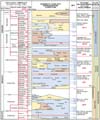 Figure 1: Stratigraphic column from the Late Permian to the Holocene
modified from Figure 1.2 of Sharland et al. (2001); with a
representative selection of the major stratigraphic units mentioned in
the text.
Figure 1: Stratigraphic column from the Late Permian to the Holocene
modified from Figure 1.2 of Sharland et al. (2001); with a
representative selection of the major stratigraphic units mentioned in
the text.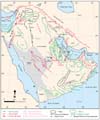 Figure 2: Structural interpretation of the Arabian Plate as it relates
to the distribution of the Late Permian to Holocene paleofacies.
Figure 2: Structural interpretation of the Arabian Plate as it relates
to the distribution of the Late Permian to Holocene paleofacies.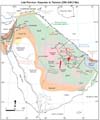 Figure 3: Paleofacies of the Late Permian. This time period spanned the
deposition of the Khuff, Karmia, and Amanous formations, and
their regional equivalents [MFS P20 to intra-Tr10].The Khuff was
deposited on the new northeastern passive margin with Neo-Tethys. A
major Late-Permian unconformity occurred within P20. With information
from: Al Jallal (1995); Andrews (1991, 1992a); Béchennec et al. (1989);
Garfunkel (1989); Guiraud et al. (2001); Koop and Stoneley (1982); Le
Métour et al. (1995); Le Nindre, Manivit et al. (1990); Murris (1980);
Szabo and Kheradpir (1978); and unpublished Saudi Aramco Miscellaneous
Report 913 (W.J. Koop, 1982).
Figure 3: Paleofacies of the Late Permian. This time period spanned the
deposition of the Khuff, Karmia, and Amanous formations, and
their regional equivalents [MFS P20 to intra-Tr10].The Khuff was
deposited on the new northeastern passive margin with Neo-Tethys. A
major Late-Permian unconformity occurred within P20. With information
from: Al Jallal (1995); Andrews (1991, 1992a); Béchennec et al. (1989);
Garfunkel (1989); Guiraud et al. (2001); Koop and Stoneley (1982); Le
Métour et al. (1995); Le Nindre, Manivit et al. (1990); Murris (1980);
Szabo and Kheradpir (1978); and unpublished Saudi Aramco Miscellaneous
Report 913 (W.J. Koop, 1982).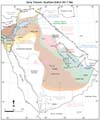 Figure 4: Paleofacies of the Early Triassic. This time period spanned
the deposition of the Sudair, Mahil, Amanous, Beduh, and Mirga Mir
formations, and their regional equivalents [MFS Tr10 to intra-Tr40].
With information from: Andrews (1992a); Guiraud et al. (2001); Makhlouf
et al. (1996); Murris (1980); Sawaf and Tarek (1996); Szabo and
Kheradpir (1978); Walley (2001).
Figure 4: Paleofacies of the Early Triassic. This time period spanned
the deposition of the Sudair, Mahil, Amanous, Beduh, and Mirga Mir
formations, and their regional equivalents [MFS Tr10 to intra-Tr40].
With information from: Andrews (1992a); Guiraud et al. (2001); Makhlouf
et al. (1996); Murris (1980); Sawaf and Tarek (1996); Szabo and
Kheradpir (1978); Walley (2001).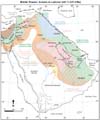 Figure 5: Paleofacies of the Middle Triassic. This time period spanned
the deposition of the Jilh, Gulailah, and Geli Khana formations, and
their regional equivalents [MFS Tr40 to intra- Tr60]. With information
from: Andrews (1992a); Guiraud et al. (2001); Koop and Stoneley (1982);
Le Nindre, Manivit et al. (1990); Makhlouf et al (1996); Murris (1980);
Sawaf et al. (2001); Szabo and Kheradpir (1978).
Figure 5: Paleofacies of the Middle Triassic. This time period spanned
the deposition of the Jilh, Gulailah, and Geli Khana formations, and
their regional equivalents [MFS Tr40 to intra- Tr60]. With information
from: Andrews (1992a); Guiraud et al. (2001); Koop and Stoneley (1982);
Le Nindre, Manivit et al. (1990); Makhlouf et al (1996); Murris (1980);
Sawaf et al. (2001); Szabo and Kheradpir (1978).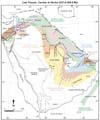 Figure
6: Paleofacies of the Late Triassic. This time period spanned the
deposition of the Minjur, Kurra Chine, and Dashtak formations, and their
regional equivalents [MFS Tr60 to intra-J10]. These sediments were
partly deposited during a second Triassic infilling-subsidence event.
The early Carnian ‘Saharan salinity crisis’ is a clear indication of a
sea-level lowstand at 232 Ma. With information from: Andrews (1992a); Béchennec et al. (1989); Beydoun and Habib (1995); Garfunkel (1989);
Makhlouf et al. (1996); Le Nindre, Manivit et al. (1990); Murris (1980);
Ponikarov et al. (1966); Sawaf and Tarek (1996); Sawaf et al. (2001);
Szabo and Kheradpir (1978); and unpublished Saudi Aramco Miscellaneous
Report 913 (W.J. Koop, 1982).
Figure
6: Paleofacies of the Late Triassic. This time period spanned the
deposition of the Minjur, Kurra Chine, and Dashtak formations, and their
regional equivalents [MFS Tr60 to intra-J10]. These sediments were
partly deposited during a second Triassic infilling-subsidence event.
The early Carnian ‘Saharan salinity crisis’ is a clear indication of a
sea-level lowstand at 232 Ma. With information from: Andrews (1992a); Béchennec et al. (1989); Beydoun and Habib (1995); Garfunkel (1989);
Makhlouf et al. (1996); Le Nindre, Manivit et al. (1990); Murris (1980);
Ponikarov et al. (1966); Sawaf and Tarek (1996); Sawaf et al. (2001);
Szabo and Kheradpir (1978); and unpublished Saudi Aramco Miscellaneous
Report 913 (W.J. Koop, 1982).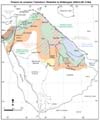 Figure 7: Paleofacies of the Triassic to Jurassic Transition. This time
period spanned the deposition of the upper Minjur, Mulussa, and Butmah
formations, and their regional equivalents [GSS J10]. Rocks of
Hettangian age are generally absent from much of the Arabian Plate as
are many of Rhaetian age. Erosion and non-depostion was caused by
structural uplift (onset of Mediterranean rifting) combined with a
lowstand in sea level. With information from: Andrews (1992a); Guiraud
et al. (2001); Hirsch and Picard (1988); Le Nindre, Manivit et al.
(1990); Le Métour et al. (1995); Murris (1980); Walley (2001).
Figure 7: Paleofacies of the Triassic to Jurassic Transition. This time
period spanned the deposition of the upper Minjur, Mulussa, and Butmah
formations, and their regional equivalents [GSS J10]. Rocks of
Hettangian age are generally absent from much of the Arabian Plate as
are many of Rhaetian age. Erosion and non-depostion was caused by
structural uplift (onset of Mediterranean rifting) combined with a
lowstand in sea level. With information from: Andrews (1992a); Guiraud
et al. (2001); Hirsch and Picard (1988); Le Nindre, Manivit et al.
(1990); Le Métour et al. (1995); Murris (1980); Walley (2001).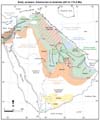 Figure 8: Paleofacies of the Early Jurassic.
This time period spanned the deposition of the Mus, Marrat, Qamchuqa,
and Nirim formations, and their regional equivalents [MFS J10 to
intra-J20; the late Toarcian unconformity marks the base of
Figure 8: Paleofacies of the Early Jurassic.
This time period spanned the deposition of the Mus, Marrat, Qamchuqa,
and Nirim formations, and their regional equivalents [MFS J10 to
intra-J20; the late Toarcian unconformity marks the base of 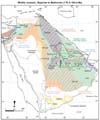 Figure 9: Paleofacies of the Middle Jurassic. This time period spanned
the deposition of the Izhara, Araej, and Dhruma formations, and their
regional equivalents [MFS J20 to intra-J40]. These sediments were
deposited in an open-marine environment, as the Arabian Plate now had
passive margins to Neo-Tethys to the northeast and north. With
information from: Andrews (1992a); Garfunkel (1998); Hirsch and Picard
(1988); Le Métour (1995); Le Nindre, Manivit et al. (1990); Murris
(1980); Walley (1998b); and unpublished Saudi Aramco Miscellaneous
Report 911 (M.A. Ziegler, 1982).
Figure 9: Paleofacies of the Middle Jurassic. This time period spanned
the deposition of the Izhara, Araej, and Dhruma formations, and their
regional equivalents [MFS J20 to intra-J40]. These sediments were
deposited in an open-marine environment, as the Arabian Plate now had
passive margins to Neo-Tethys to the northeast and north. With
information from: Andrews (1992a); Garfunkel (1998); Hirsch and Picard
(1988); Le Métour (1995); Le Nindre, Manivit et al. (1990); Murris
(1980); Walley (1998b); and unpublished Saudi Aramco Miscellaneous
Report 911 (M.A. Ziegler, 1982).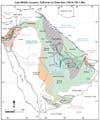 Figure 10: Paleofacies of the late Middle Jurassic. This time period
spanned the deposition of the upper Dhruma, Tuwaiq Mountain Limestone,
upper Araej, Hanifa, Naokelekan, and Surmeh formations, and their
regional equivalents [MFS J40 to J60]. Differential intraplate
subsidence led to the development of intrashelf basins on the Arabian
Plate. With information from: Andrews (1992a); Guiraud et al. (2001);
Hirsch and Picard (1988); Le Métour et al. (1995); Le Nindre, Manivit et
al. (1990b); Murris (1980); Walley (1998b); and unpublished Saudi Aramco
Miscellaneous Report 911 (M.A. Ziegler 1982) and 913 (W.J. Koop, 1982).
Figure 10: Paleofacies of the late Middle Jurassic. This time period
spanned the deposition of the upper Dhruma, Tuwaiq Mountain Limestone,
upper Araej, Hanifa, Naokelekan, and Surmeh formations, and their
regional equivalents [MFS J40 to J60]. Differential intraplate
subsidence led to the development of intrashelf basins on the Arabian
Plate. With information from: Andrews (1992a); Guiraud et al. (2001);
Hirsch and Picard (1988); Le Métour et al. (1995); Le Nindre, Manivit et
al. (1990b); Murris (1980); Walley (1998b); and unpublished Saudi Aramco
Miscellaneous Report 911 (M.A. Ziegler 1982) and 913 (W.J. Koop, 1982).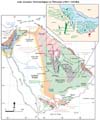 Figure 11: Paleofacies of the Late Jurassic.
This time period spanned the deposition of the Arab, Hith, and Gotnia
formations, and their regional equivalents [MFS J70 to K10; base of
Figure 11: Paleofacies of the Late Jurassic.
This time period spanned the deposition of the Arab, Hith, and Gotnia
formations, and their regional equivalents [MFS J70 to K10; base of 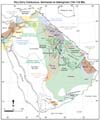 Figure 12: Paleofacies of the earliest Cretaceous spanning the
deposition of the Yamama, Minagish, Habshan, and Rayda formations, and
their regional equivalents [MFS intra-K20 to intra-K40]. Relatively
continuous sedimentation took place in Oman but most other parts of the
Arabian Plate were affected by a late Valangian unconformity. Sediments
were deposited on open platforms and within intrashelf basins of the
Arabian Plate. With information from: Béchennec et al. (1989); Ellis et
al. (1996); Hirsch (1990); James and Wynd (1965); Le Métour et al.
(1995); Murris (1980); Sawaf and Tarek (1996); Walley (1998b, 2001); and
unpublished Saudi Aramco Miscellaneous Report 911 (M.A. Ziegler, 1982)
and 913 (W.J. Koop, 1982).
Figure 12: Paleofacies of the earliest Cretaceous spanning the
deposition of the Yamama, Minagish, Habshan, and Rayda formations, and
their regional equivalents [MFS intra-K20 to intra-K40]. Relatively
continuous sedimentation took place in Oman but most other parts of the
Arabian Plate were affected by a late Valangian unconformity. Sediments
were deposited on open platforms and within intrashelf basins of the
Arabian Plate. With information from: Béchennec et al. (1989); Ellis et
al. (1996); Hirsch (1990); James and Wynd (1965); Le Métour et al.
(1995); Murris (1980); Sawaf and Tarek (1996); Walley (1998b, 2001); and
unpublished Saudi Aramco Miscellaneous Report 911 (M.A. Ziegler, 1982)
and 913 (W.J. Koop, 1982).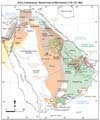 Figure 13: Paleofacies of the Early Cretaceous. This time period spanned
the deposition of the Aarda, Zubair, Buwaib, Biyadh, Lekhwair, and
Kharaib formations, and their regional equivalents [MFS K40 to
intra-K70]. Sediments were deposited in shallow-marine shelf and
intrashelf settings on the Arabian Plate passive margin with Neo-Tethys,
and were influenced by the strong clastic sediment supply of the Zubair
delta to the west. With information from: Andrews (1992b); Ellis et al.
(1996); Guiraud et al. (2001); Hirsch (1990); Holden and Kerr (1997);
Koop and Stoneley (1982); Murris (1980); Ponikarov, et al. (1966); Roger
et al. (1998); Sawaf et al. (2001); Walley (1998b); and unpublished
Saudi Aramco Miscellaneous Report 826 (D.W. Hagen, 1975), 849 and 911
(M.A. Ziegler, 1976, 1982).
Figure 13: Paleofacies of the Early Cretaceous. This time period spanned
the deposition of the Aarda, Zubair, Buwaib, Biyadh, Lekhwair, and
Kharaib formations, and their regional equivalents [MFS K40 to
intra-K70]. Sediments were deposited in shallow-marine shelf and
intrashelf settings on the Arabian Plate passive margin with Neo-Tethys,
and were influenced by the strong clastic sediment supply of the Zubair
delta to the west. With information from: Andrews (1992b); Ellis et al.
(1996); Guiraud et al. (2001); Hirsch (1990); Holden and Kerr (1997);
Koop and Stoneley (1982); Murris (1980); Ponikarov, et al. (1966); Roger
et al. (1998); Sawaf et al. (2001); Walley (1998b); and unpublished
Saudi Aramco Miscellaneous Report 826 (D.W. Hagen, 1975), 849 and 911
(M.A. Ziegler, 1976, 1982).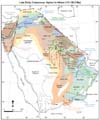 Figure 14: Paleofacies of the late Early Cretaceous spanning deposition
of the Shu’aiba, Biyadh, Nahr Umr, Burgan, and Kazhdumi formations,
and their regional equivalents [MFS K70 to intra-K120]. A marked
late-Aptian regional unconformity and sedimentary hiatus separates rocks
of Aptian age (e.g. Shu’aiba
Figure 14: Paleofacies of the late Early Cretaceous spanning deposition
of the Shu’aiba, Biyadh, Nahr Umr, Burgan, and Kazhdumi formations,
and their regional equivalents [MFS K70 to intra-K120]. A marked
late-Aptian regional unconformity and sedimentary hiatus separates rocks
of Aptian age (e.g. Shu’aiba 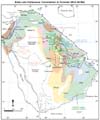 Figure 15: Paleofacies of the early Late
Cretaceous spanning deposition of the Mishrif, Ahmadi, Rumaila, Natih,
and Derdere formations, and their regional equivalents [MFS K120 to
intra-K150;
Figure 15: Paleofacies of the early Late
Cretaceous spanning deposition of the Mishrif, Ahmadi, Rumaila, Natih,
and Derdere formations, and their regional equivalents [MFS K120 to
intra-K150; 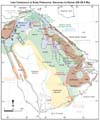 Figure 16: Paleofacies of the Late Cretaceous to Early Paleocene
spanning deposition of the Shiranish, Gurpi, Aruma, Simsima, and Fiqa
formations, and their regional equivalents [MFS K150 to intra-Pg10]. The
sediments were deposited within a compressive foreland basin setting
following onset of mid-Turonian ophiolite obduction along the eastern
margin of the Plate. With information from: Andrews (1992b); Azzam
(1995); Béchennec et al. (1995); Cater and Gillcrist (1994); Ellis et
al. (1996); Filbrandt et al. (1990); Gilmour and Mäkel (1996); Guiraud
and Bosworth (1997); Hirsch (1990); Koop and Stoneley (1982); Litak et
al. (1997); Murris (1980); Nolan et al. (1990); Ponikarov et al. (1966);
de Ruiter and Lovelock (1995); Roger et al. (1989); Sawaf and Tarek
(1996); Walley (1998b); and unpublished Saudi Aramco Miscellaneous
Report 913 (W.J. Koop, 1982).
Figure 16: Paleofacies of the Late Cretaceous to Early Paleocene
spanning deposition of the Shiranish, Gurpi, Aruma, Simsima, and Fiqa
formations, and their regional equivalents [MFS K150 to intra-Pg10]. The
sediments were deposited within a compressive foreland basin setting
following onset of mid-Turonian ophiolite obduction along the eastern
margin of the Plate. With information from: Andrews (1992b); Azzam
(1995); Béchennec et al. (1995); Cater and Gillcrist (1994); Ellis et
al. (1996); Filbrandt et al. (1990); Gilmour and Mäkel (1996); Guiraud
and Bosworth (1997); Hirsch (1990); Koop and Stoneley (1982); Litak et
al. (1997); Murris (1980); Nolan et al. (1990); Ponikarov et al. (1966);
de Ruiter and Lovelock (1995); Roger et al. (1989); Sawaf and Tarek
(1996); Walley (1998b); and unpublished Saudi Aramco Miscellaneous
Report 913 (W.J. Koop, 1982).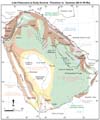 Figure 17: Paleofacies of the Late Paleocene to Early Eocene spanning
deposition of the Rus, Umm er Radhuma, and Pabdeh formations, and their
regional equivalents [MFS Pg10 to intra-Pg20]. Sediments were deposited
within a ‘remnant’ foredeep setting during rapid erosion, lowering, and
subsidence of the emergent ophiolite and sedimentary structures along
the eastern margin of the Plate. With information from: Andrews (1992b); Filbrandt et al. (1990); Gilmour and Mäkel (1996); Goff et al. (1995);
James and Wynd (1965); Koop and Stonely (1982); (Kraig and Kozlu (1990);
Le Métour et al. (1995); Nolan et al. (1990); Murris (1980); Ponikarov
(1966); Roger et al. (1989); and unpublished Saudi Aramco Miscellaneous
Report 913 (W.J. Koop, 1982).
Figure 17: Paleofacies of the Late Paleocene to Early Eocene spanning
deposition of the Rus, Umm er Radhuma, and Pabdeh formations, and their
regional equivalents [MFS Pg10 to intra-Pg20]. Sediments were deposited
within a ‘remnant’ foredeep setting during rapid erosion, lowering, and
subsidence of the emergent ophiolite and sedimentary structures along
the eastern margin of the Plate. With information from: Andrews (1992b); Filbrandt et al. (1990); Gilmour and Mäkel (1996); Goff et al. (1995);
James and Wynd (1965); Koop and Stonely (1982); (Kraig and Kozlu (1990);
Le Métour et al. (1995); Nolan et al. (1990); Murris (1980); Ponikarov
(1966); Roger et al. (1989); and unpublished Saudi Aramco Miscellaneous
Report 913 (W.J. Koop, 1982).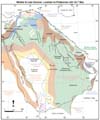 Figure 18: Paleofacies of the Middle to Late Eocene spanning deposition
of the Jaddala, Dammam, and Pabdeh formations, and their regional
equivalents [GSS intra-Pg30]. The sediments were deposited in a
structural setting comparable to those of the underlying succession.
With information from: Andrews (1992b); Filbrandt et al. (1990); Gilmour
and Mäkel (1996); Goff et al. (1995); Guiraud et al. (2001); Hertig et
al. (1995); Koop and Stoneley (1982); Kraig and Kozlu (1990); Le Métour
et al. (1995); Nolan et al. (1990); Ponikarov et al. (1966); Roger et
al. (1989); and unpublished Saudi Aramco Miscellaneous Report 913 (W.J.
Koop, 1982).
Figure 18: Paleofacies of the Middle to Late Eocene spanning deposition
of the Jaddala, Dammam, and Pabdeh formations, and their regional
equivalents [GSS intra-Pg30]. The sediments were deposited in a
structural setting comparable to those of the underlying succession.
With information from: Andrews (1992b); Filbrandt et al. (1990); Gilmour
and Mäkel (1996); Goff et al. (1995); Guiraud et al. (2001); Hertig et
al. (1995); Koop and Stoneley (1982); Kraig and Kozlu (1990); Le Métour
et al. (1995); Nolan et al. (1990); Ponikarov et al. (1966); Roger et
al. (1989); and unpublished Saudi Aramco Miscellaneous Report 913 (W.J.
Koop, 1982).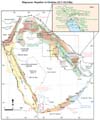 Figure 19: Paleofacies of the Oligocene
spanning deposition of the Pabdeh-Chilon (Palani) formations and their
regional equivalents [MFS Pg30 to intra-Ng10]. A major unconformity and
sedimentary hiatus
Figure 19: Paleofacies of the Oligocene
spanning deposition of the Pabdeh-Chilon (Palani) formations and their
regional equivalents [MFS Pg30 to intra-Ng10]. A major unconformity and
sedimentary hiatus 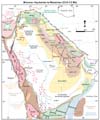 Figure 20: Paleofacies of the Miocene spanning deposition of the Hadrukh,
Dam, Hofuf, Fars, Agha Jari, and Gachsaran formations, and their
regional equivalents, together with massive salt deposits [MFS Ng10 to
post-Ng40]. The sediments were deposited within the Zagros foredeep and
foreland. Strong compression occurred as Arabia separated from Africa
and was driven into Eurasia. With information from: Gilmour and Mäkel
(1996); Goff et al. (1995); Guiraud et al. (2001); Hirsch (1990); James
and Wynd (1965); Koop and Stoneley (1982); Kraig and Kozlu (1990); Le
Métour et al. (1995); Nolan et al. (1990); Ponikarov et al. (1966);
Walley (1998b).
Figure 20: Paleofacies of the Miocene spanning deposition of the Hadrukh,
Dam, Hofuf, Fars, Agha Jari, and Gachsaran formations, and their
regional equivalents, together with massive salt deposits [MFS Ng10 to
post-Ng40]. The sediments were deposited within the Zagros foredeep and
foreland. Strong compression occurred as Arabia separated from Africa
and was driven into Eurasia. With information from: Gilmour and Mäkel
(1996); Goff et al. (1995); Guiraud et al. (2001); Hirsch (1990); James
and Wynd (1965); Koop and Stoneley (1982); Kraig and Kozlu (1990); Le
Métour et al. (1995); Nolan et al. (1990); Ponikarov et al. (1966);
Walley (1998b).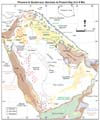 Figure 21: Paleofacies of the Pliocene to Holocene and location of oil
and gas seeps. An extreme lowstand with short-term cycles occurred
during this period. With the exception of the area of the Arabian Gulf (Agha
Jari
Figure 21: Paleofacies of the Pliocene to Holocene and location of oil
and gas seeps. An extreme lowstand with short-term cycles occurred
during this period. With the exception of the area of the Arabian Gulf (Agha
Jari