|
uAbstract
uFigure
captions
uIntroduction
uPore- pressure pressure gradients
uShallow
water-flow sands
uOverpressured
sands in ultradeep water
uConclusions
uReferences
uAcknowledgments
uAbstract
uFigure
captions
uIntroduction
uPore-pressure
gradients
uShallow
water-flow sands
uOverpressured
sands in ultradeep water
uConclusions
uReferences
uAcknowledgments
uAbstract
uFigure
captions
uIntroduction
uPore-pressure
gradients
uShallow
water-flow sands
uOverpressured
sands in ultradeep water
uConclusions
uReferences
uAcknowledgments
uAbstract
uFigure
captions
uIntroduction
uPore-pressure
gradients
uShallow
water-flow sands
uOverpressured
sands in ultradeep water
uConclusions
uReferences
uAcknowledgments
uAbstract
uFigure
captions
uIntroduction
uPore-pressure
gradients
uShallow
water-flow sands
uOverpressured
sands in ultradeep water
uConclusions
uReferences
uAcknowledgments
uAbstract
uFigure
captions
uIntroduction
uPore-pressure
gradients
uShallow
water-flow sands
uOverpressured
sands in ultradeep water
uConclusions
uReferences
uAcknowledgments
uAbstract
uFigure
captions
uIntroduction
uPore-pressure
gradients
uShallow
water-flow sands
uOverpressured
sands in ultradeep water
uConclusions
uReferences
uAcknowledgments
uAbstract
uFigure
captions
uIntroduction
uPore-pressure
gradients
uShallow
water-flow sands
uOverpressured
sands in ultradeep water
uConclusions
uReferences
uAcknowledgments
|
 Figure 1.
Deep-water (>1000 ft [305 m]) and ultradeep-water (>5000 ft [1524 m])
active leases in the Gulf of Mexico. Figure 1.
Deep-water (>1000 ft [305 m]) and ultradeep-water (>5000 ft [1524 m])
active leases in the Gulf of Mexico.
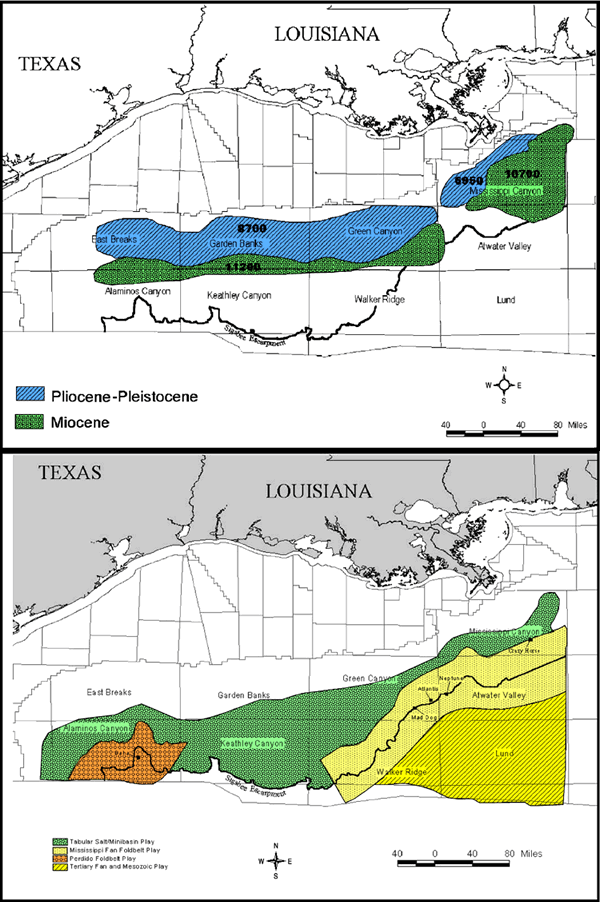
 Figure 2.
Average depth and stratigraphic interval for the occurrence of moderate
overpressures (12.5 ppg pore pressure), deep-water Gulf of Mexico. Figure 2.
Average depth and stratigraphic interval for the occurrence of moderate
overpressures (12.5 ppg pore pressure), deep-water Gulf of Mexico.
Click here
for sequence of Figure 2 and Figure 3.
 Figure 3.
Established and frontier deep-water Gulf of Mexico hydrocarbon plays. Figure 3.
Established and frontier deep-water Gulf of Mexico hydrocarbon plays.
Click here
for sequence of Figure 2 and Figure 3.
 Figure 4.
Ultradeep-water exploratory well that encountered rapid pore-pressure
buildup requiring extra shallow casing strings. Higher values in the
Total Gas track are marked with an x. Figure 4.
Ultradeep-water exploratory well that encountered rapid pore-pressure
buildup requiring extra shallow casing strings. Higher values in the
Total Gas track are marked with an x.
As exploration moves into deeper water in the Gulf of Mexico,
pore-pressure prediction and the correct anticipation of overpressured
sands becomes more and more critical to the effective evaluation of
federal outer continental shelf (OCS) lease blocks. Since 1992, the
growth in deep-water activity has been reflected in numerous leasing,
drilling, and production statistics. The number of exploratory wells
drilled and the number of Exploration Plans filed for deep-water lease
blocks have increased by about a factor of 5 since 1994, but many of
these leases will expire without being drilled. In addition, many
deep-water blocks, initially leased after the OCS Deep Water Royalty
Relief (DWRR) Act in 1996 provided economic incentives to develop
deepwater fields, will be available by 2006. During the last eight years
of the 1990s, the number of deep-water active leases increased from
about 1500 to nearly 3900 (Figure 1), about half of the active
present-day OCS blocks, including a record number of lease blocks since
1996 in ultradeep water (>5000 ft [1524 m]). Baud et al. (2000) noted
that, in the 1990s, the average Gulf of Mexico field size in more than
1500 ft (457 m) of water was 60 million BOE, 12 times the average
shallow-water discovery. Deep-water oil now provides more than half of
the region’s production, and increases in gas production have also
offset the shallow-water decline in recent years, with much of new
volume coming from subsea completions.
In this article, we look at the occurrence of geopressure in about 100
wells in deep water from Viosca Knoll to Alaminos Canyon, most of them
drilled in more than 2000 ft (610 m) of water during the last five
years. We also analyze shallow water-flow encounters and trends in these
areas. As exploratory drilling begins in previously untested geological
trends in ultradeep water, new technology and equipment will be needed
to control unique pressure-related drilling problems encountered in the
exploration and development of hydrocarbon resources in this emerging
province.
Pore-Pressure Gradients
Minerals Management Service (MMS) geological reviews of exploration and
development plans and applications for permit to drill on Gulf of Mexico
OCS leases include a discussion of possible abnormal pressure zones.
Geopressure is defined as the situation where pore fluid pressure
exceeds normal hydrostatic pressure (Fertl, 1976; Dutta, 1987). This
onset of moderate overpressure in continental shelf deltaic sediment
occurs where pore pressures are equivalent to 12.5 pound per gallon (ppg)
mud weights. In deep water, however, the fracture gradient and shallow
casing shoe tests are lower, and the onset of even mild overpressures of
9.5 to 12.0 ppg contributes to many drilling problems such as shallow
water flow. Burial rates, geothermal gradients, compaction, and
diagenetic reactions are the primary factors affecting the occurrence of
geopressure (Law et al., 1998). In deep-water wells, the large seawater
column also results in greater depths to abnormal pressure, so depths
below the mud line (bml) or sea floor were used in this study in place
of vertical subsea depths. Geological factors that control the
deposition of turbidite systems, sequence stratigraphy, major faults,
unconformities, and salt also affect pore pressure. In complexly faulted
structures, formation pressures may be compartmentalized and may vary
between different sands.
We analyzed predicted and actual pore pressures, sedimentation rates,
and formation temperatures in the deep-water Gulf of Mexico and prepared
trend maps of the occurrence of geopressure for this province. The top
of geopressure was defined as the depth at which pore-pressure
equivalent mud weights, referenced to kelly bushing elevation, exceeded
12.5 ppg. The wells in this study are located in four deep-water
sections that include, from east to west, Viosca Knoll/ Mississippi
Canyon/Atwater Valley, Green Canyon, Garden Banks, and East Breaks/Alaminos
Canyon. The upper slope (less than 1000 m of water) in Mississippi
Canyon has a thicker Pliocene section with a shallower top of
geopressure, an average of about 6950 ft (2118 m) bml, than the deeper
water parts of this area. In deeper water, the average top of
geopressure occurs in the Miocene at about 10,700 ft (3261 m) bml. In
the younger Pliocene-Pleistocene section to the west in Green Canyon,
Garden Banks, and East Breaks, the average top of geopressure occurs at
about 8700 ft (2652 m) bml. In the deeper water sections in Green
Canyon, Garden Banks, and Alaminos Canyon to the south and southeast,
however, the top of geopressure occurs in the Miocene at an average
depth of about 11,200 ft (3414 m) bml. Throughout the deep-water Gulf of
Mexico, as shown in Figure 2, it appears that older and more compacted
strata have a deeper top of geopressure than occurs in younger strata.
Except for the northeastern corner of Mississippi Canyon, the thermal
gradient in the eastern study area is lower than that of deep-water
areas to the west, generally about 1.05oF/100 ft (0.58oC/30.5
m). The thermal gradient falls from an average of 1.25oF/100
ft (0.69oC/30.5 m) in East Breaks to about 1.0oF/100
ft (0.555oC/30.5 m) in Garden Banks, and in Green Canyon the
temperature gradient appears to decrease from 1.3 to 0.8oF/100
ft (from 0.72 to 0.44oC/30.5 m) to the southeast with greater
water depths. These observations suggest that lower thermal gradients
may correspond to a deeper top of geopressure.
Salt domes and ridges that form the boundaries of salt-withdrawal
minibasins cause increased pore pressure in the surrounding sediment.
This fact results in anomalously high pore pressures in wells drilled on
the flanks of a salt dome relative to wells drilled through equivalent
strata toward the center of the basin. Pore-pressure ramps or steep
increases also occur adjacent to salt masses, and some deep-water
exploratory wells have had to be abandoned during attempts to drill
through overpressured fractured shale associated with a salt diapir
before the reservoir interval was reached. Below tabular salt sheets,
formations can be overpressured because of an effective seal, and in
some subsalt wells a pressure kick has been encountered in the rubble
zone below salt. In general, however, the top of subsalt geopressure
occurs at greater depths and deeper in the stratigraphic section than in
wells without salt.
Water flow from an overpressured shallow aquifer occurring above the
first pressure-containing casing string can significantly impact
drilling and cementing practices in addition to the setting depth and
number of shallow casing points. This shallow subsurface geohazard may
even cause an operator to change a surface location or lose a well.
Shallow water-flow sands were deposited as continental slope/fan
sequences during upper Pleistocene progradation, the building out of
prodelta sandy zones. Since 1984, shallow water-flow occurrences have
been reported in about 70 Gulf of Mexico lease blocks covering 55 oil
and gas fields or prospects. With a few exceptions, water-flow incidents
occur at water depths exceeding 1700 ft (518 m) with a mean value at
about 3000 ft (914 m) of water. Water-flow problem sands also typically
occur from 950 to 2000 ft (290-610 m) bml but have been reported from
450 to 3500 ft (137-1067 m) below the sea floor. Individual channel-sand
units display slumping zones or debris flows with a chaotic seismic
character and, in some cases, tilted and rotated slump blocks. In the
Mississippi Canyon and southern Viosca Knoll areas, some of the
shallowest channel sands can be identified as part of a particular
distributary system such as the old Timbalier Channel, Southwest Pass
Canyon, or Einstein levee/channel system. High-sedimentation rates and
an impermeable mud or clay seal from a condensed section are the main
factors contributing to overpressures in shallow water-flow sands (Alberty
et al., 1997). These sands occur in several depositional subbasins that
are generally bounded by salt ridges or walls. No significant water-flow
occurrence, however, is found over tabular
salt sills that are 1000 to 10,000 ft (305-3048 m) below the sea floor
in some areas. This fact may suggest that communication with the deeper
stratigraphic section contributes to abnormal pressures in shallow sands
or that the salt forms a positive sea floor topographic feature,
preventing sediment loading that might contribute to the generation of
overpressures. The integration of high-resolution multichannel and
reprocessed conventional two-dimensional (2-D) and three-dimensional
(3-D) seismic data for the top-hole section, further refined by seismic
facies analysis, can identify sand bodies with moderate or high shallow
water-flow potential. In assessing shallow water-flow risk, information
from surrounding wells and shallow borehole tests also provides
important data for drilling program design. The MMS Notice to Lessees
and Operators (NTL) on shallow hazards requirements for the Gulf of
Mexico OCS, NTL 98-20, is currently undergoing extensive revisions
(Stauffer et al., 1999). The updated NTL will accommodate the shifting
focus of drilling into deeper water and the improved technology and data
now available to mitigate deep-water geohazards such as shallow water
flow.
Mitigating approaches that have been used in the drilling of shallow
water-flow areas include measurement while drilling (MWD) logging plus
an annular pressure measurement while drilling (PWD) tool, monitoring
and confirming shallow water-flow occurrences with remotely operated
vehicles (ROV), and drilling the shallow section as a pilot hole.
Additional casing strings and quick-setting foam cements, borehole tests
to 1500 to 5000 ft (457-1524 m) bml before development drilling, and
other geophysical and engineering techniques that are currently under
development have also been employed. The loss of integrity plus buckling
or collapse of shallow casing strings in development wells has caused
serious economic loss in several cases. Establishing a database of known
shallow water-flow occurrences and the most effective methods for
controlling them will greatly advance the partnership between the MMS
and offshore operators in containing this critical deep-water hazard
(Smith, 1999).
In low-margin deep-water drilling areas with abruptly increasing pore
pressures and weak fracture gradients, extra casing strings are needed
to maintain control in the shallower part of the well. A conventional
single-gradient mud system and marine riser maintain bottom-hole
pressure with a single mud density from the rig to the bottom of the
well, which may require extra casing strings to prevent weaker
formations from fracturing. In addition, loop currents or other strong
deep-water currents might limit drilling at times because of high riser
loads. With a dual-gradient system, however, mud is diverted to separate
riser return lines with the effect of replacing the mud from the
drilling riser with seawater and referencing pressure gradients relative
to the sea floor (Smith and Gault, 2002). The larger hole size
maintained at total depth with this technology also allows more
completion and production options for deep-water reservoirs.
The northern Gulf of Mexico Basin can be divided into various arcuate
tectonic provinces that parallel the shelf/slope break (Diegel et al.,
1995; Karlo and Shoup, 1999). Salt-withdrawal minibasins on the
continental slope, such as those in the Green Canyon and Garden Banks
areas, are bounded by salt walls and filled with the ponded turbidite
sands that provide reservoirs for most of the earlier deep-water Gulf of
Mexico discoveries. A tabular salt canopy tectonic province occurs in a
basinward direction in Walker Ridge and Keathley Canyon, and the Sigsbee
Escarpment defines its extent. The middle to lower continental slope
contains fold/thrust belts with large prospective geological structures
that are the focus of current deep-water drilling and include several
recent discoveries (Peel, 1999; Rowan et al., 2000).
Figure 3 shows the
distribution of hydrocarbon plays in the deep-water Gulf of Mexico,
including untested plays in ultradeep water.
In the centroid concept, pore pressure in a reservoir sand at the crest
of a high-relief overpressured structure can exceed pore pressure in the
bounding shale. Deep-water areas with extensive shallow faulting are
particularly vulnerable to low-margin drilling conditions that require
extra casing strings. The top of a large, high-relief fold or anticlinal
structure at various depths in an exploratory well may contain fluid
pressures that approach the fracture gradient in adjacent shale (Traugott,
1997). The mud log from a 1996 ultradeep-water well (Figure 4) provides
an example of substantial pore-pressure increases that required closely
spaced additional casing strings in the shallow section. This
exploratory well was abandoned less than 3000 ft (914 m) bml because of
the narrow margin between pore-pressure and fracture gradient in
addition to its small hole size well above the prospective target
interval. The use of a dual-gradient/riserless drilling approach and
other innovative casing and diverter systems that are under development,
however, may contribute the new technologies required for successful
exploration in the deepest Gulf of Mexico leases.
Many of the serious and costly drilling problems in deep water are
related to the pore-pressure/fracture gradient relationship. Other
pressure-related hazards, such as shallow water flow, require better
predrill identification and quantification of overpressured problem
sands. In many Gulf of Mexico frontier deep-water areas, a lack of
offset wells mandates better pressure models that incorporate all
available geological data. Operations geologists and geophysicists in
the MMS are working with deep-water operators to establish databases and
methodologies that will improve industry’s success in dealing with
deep-water geohazards well into the new millennium.
Alberty, M.W., M.E. Hafle, J.C. Minge, and T.M. Byrd,
1997, Mechanisms of shallow waterflows and drilling practices for
intervention: Offshore Technology Conference Proceedings Paper OTC 8301,
p. 241-247.
Baud, R.D., R.H. Peterson, C. Doyle, and G.E. Richardson,
2000, Deepwater Gulf of Mexico: America’s emerging frontier: Minerals
Management Service Outer Continental Shelf Report 2000-022, 89 p.
Diegel, F.A., J.F. Karlo, D.C. Schuster, R.C. Shoup, and
P.R. Tauvers, 1995, Cenozoic structural evolution and
tectono-stratigraphic framework of the northern Gulf Coast continental
margin: AAPG Memoir 65, p. 109-151.
Dutta, N.C., ed., 1987, Geopressure: Society of
Exploration Geophysicists Reprint Series 7, 365 p.
Fertl, H.W., 1976, Abnormal formation pressures:
Amsterdam, Elsevier, 382 p.
Karlo, J.F., and R.C. Shoup, 1999, Large patterns become
predictive tools to define trends, reduce exploration risk: Offshore, v.
59, no. 7, p. 94-95, 156.
Law, B.E., G.F. Ulmishek, and V.I. Slavin, eds., 1998,
Abnormal pressures in hydrocarbon environments: AAPG Memoir 70, 264 p.
Peel, F., 1999, Structural styles of traps in deepwater
fold/thrust belts of the northern Gulf of Mexico (abs.): AAPG
International Conference, extended abstracts volume, p. 392.
Rowan, M.G., B.D. Trudgill, and J.C. Fiduk, 2000,
Deepwater, salt-cored foldbelts: lessons from the Mississippi Fan and
Perdido foldbelts, northern Gulf of Mexico: American Geophysical Union
Monograph 115, p. 173-191.
Smith, M.A., 1999, MMS regulatory approach to shallow
water flow mitigation: Proceedings of the 1999 International Forum on
Shallow Water Flows, paper 15, unpaginated.
Smith, K.L., and A.D. Gault, 2002, Subsea mudlift
drilling: a new technology for ultradeep-water environments, in A.R.
Huffman and G.L. Bowers, eds., Pressure regimes in sedimentary basins
and their prediction: AAPG Memoir 76, p. 171-175.
Stauffer, K.E., A. Ahmed, R.C. Kuzela, and M.A. Smith,
1999, Revised MMS regulations on shallow geohazards in the Gulf of
Mexico: Offshore Technology Conference Proceedings Paper OTC 10728, v.
1, p. 79-81.
Traugott, M., 1997, Pore/fracture pressure determinations
in deep water: World Oil, v. 218, no. 8, p. 68-70.
This
project was initiated as a result of excellent presentations at the 1998
American Association of Drilling Engineers Industry Forum on Pressure Regimes in Sedimentary Basins and their Prediction. Preliminary results
were presented at the 1998 MMS Information Transfer Meeting and the 1999
AAPG International Conference in Birmingham, England. I thank two
anonymous reviewers and, particularly, James C. Niemann for their
insightful comments, which greatly improved this chapter. Some of the
ideas presented here were clarified by discussions with Jim Bridges,
Matt Czerniak, Nader Dutta, Pete Harrison, Alan Huffman, Bob Peterson,
Paul Post, and Selim Shaker. Finally, I am grateful to the MMS Gulf of
Mexico Region, especially to Darcel Waguespack, Fred Times, and Wayne
Plaisance, for help and support in the preparation of this chapter.
Regimes in Sedimentary Basins and their Prediction. Preliminary results
were presented at the 1998 MMS Information Transfer Meeting and the 1999
AAPG International Conference in Birmingham, England. I thank two
anonymous reviewers and, particularly, James C. Niemann for their
insightful comments, which greatly improved this chapter. Some of the
ideas presented here were clarified by discussions with Jim Bridges,
Matt Czerniak, Nader Dutta, Pete Harrison, Alan Huffman, Bob Peterson,
Paul Post, and Selim Shaker. Finally, I am grateful to the MMS Gulf of
Mexico Region, especially to Darcel Waguespack, Fred Times, and Wayne
Plaisance, for help and support in the preparation of this chapter.
Return
to top.
|

 Print this page
 Click to view article in PDF format.