Print this page
 Click to view article in PDF format.
Geological Controls and Variability in Pore Pressure in the Deep-Water Gulf of Mexico*
By
Michael A. Smith1
Search and Discovery Article # 10029 (2002)
*Adapted for online presentation from article of the same title by the same author published in AAPG Memoir 76 (August, 2002), Pressure Regimes in Sedimentary Basins and Their Prediction, A. R. Huffman and G. L. Bowers, eds., p. 107-113. This publication may be purchased from AAPG Bookstore (http://bookstore.aapg.org).
1Minerals Management Service, New Orleans, Louisiana ([email protected]).
Abstract
In most areas of the world, pressure-related drilling problems are the leading cause for abandoning a deep-water well or else requiring expensive remedial changes in the drilling and casing programs to reach its targeted reservoir depths. This chapter discusses geological controls and trends in the onset of geopressure in the deep-water Gulf of Mexico, shallow water flow from overpressured sands in the top-hole section, and other pressure-related problems unique to deep water. Pore-pressure prediction has become a subject of intense current interest with several joint industry projects and predictive models now available for government and company participation.
|
uOverpressured sands in ultradeep water
uOverpressured sands in ultradeep water
uOverpressured sands in ultradeep water
uOverpressured sands in ultradeep water
uOverpressured sands in ultradeep water
uOverpressured sands in ultradeep water
uOverpressured sands in ultradeep water
uOverpressured sands in ultradeep water
|
Figure Captions
Click here for sequence of Figure 2 and Figure 3.
Click here for sequence of Figure 2 and Figure 3.
Introduction
As exploration moves into deeper water in the Gulf of Mexico, pore-pressure prediction and the correct anticipation of overpressured sands becomes more and more critical to the effective evaluation of federal outer continental shelf (OCS) lease blocks. Since 1992, the growth in deep-water activity has been reflected in numerous leasing, drilling, and production statistics. The number of exploratory wells drilled and the number of Exploration Plans filed for deep-water lease blocks have increased by about a factor of 5 since 1994, but many of these leases will expire without being drilled. In addition, many deep-water blocks, initially leased after the OCS Deep Water Royalty Relief (DWRR) Act in 1996 provided economic incentives to develop deepwater fields, will be available by 2006. During the last eight years of the 1990s, the number of deep-water active leases increased from about 1500 to nearly 3900 (Figure 1), about half of the active present-day OCS blocks, including a record number of lease blocks since 1996 in ultradeep water (>5000 ft [1524 m]). Baud et al. (2000) noted that, in the 1990s, the average Gulf of Mexico field size in more than 1500 ft (457 m) of water was 60 million BOE, 12 times the average shallow-water discovery. Deep-water oil now provides more than half of the region’s production, and increases in gas production have also offset the shallow-water decline in recent years, with much of new volume coming from subsea completions.
In this article, we look at the occurrence of geopressure in about 100 wells in deep water from Viosca Knoll to Alaminos Canyon, most of them drilled in more than 2000 ft (610 m) of water during the last five years. We also analyze shallow water-flow encounters and trends in these areas. As exploratory drilling begins in previously untested geological trends in ultradeep water, new technology and equipment will be needed to control unique pressure-related drilling problems encountered in the exploration and development of hydrocarbon resources in this emerging province.
Pore-Pressure Gradients
Minerals Management Service (MMS) geological reviews of exploration and
development plans and applications for permit to drill on Gulf of Mexico
OCS leases include a discussion of possible abnormal pressure zones.
Geopressure is defined as the situation where pore
We analyzed predicted and actual pore
Except for the northeastern corner of Mississippi Canyon, the thermal gradient in the eastern study area is lower than that of deep-water areas to the west, generally about 1.05oF/100 ft (0.58oC/30.5 m). The thermal gradient falls from an average of 1.25oF/100 ft (0.69oC/30.5 m) in East Breaks to about 1.0oF/100 ft (0.555oC/30.5 m) in Garden Banks, and in Green Canyon the temperature gradient appears to decrease from 1.3 to 0.8oF/100 ft (from 0.72 to 0.44oC/30.5 m) to the southeast with greater water depths. These observations suggest that lower thermal gradients may correspond to a deeper top of geopressure.
Salt domes and ridges that form the boundaries of salt-withdrawal
minibasins cause increased pore pressure in the surrounding sediment.
This fact results in anomalously high pore
Shallow Water-Flow Sands
Water flow from an overpressured shallow aquifer occurring above the first pressure-containing casing string can significantly impact drilling and cementing practices in addition to the setting depth and number of shallow casing points. This shallow subsurface geohazard may even cause an operator to change a surface location or lose a well. Shallow water-flow sands were deposited as continental slope/fan sequences during upper Pleistocene progradation, the building out of prodelta sandy zones. Since 1984, shallow water-flow occurrences have been reported in about 70 Gulf of Mexico lease blocks covering 55 oil and gas fields or prospects. With a few exceptions, water-flow incidents occur at water depths exceeding 1700 ft (518 m) with a mean value at about 3000 ft (914 m) of water. Water-flow problem sands also typically occur from 950 to 2000 ft (290-610 m) bml but have been reported from 450 to 3500 ft (137-1067 m) below the sea floor. Individual channel-sand units display slumping zones or debris flows with a chaotic seismic character and, in some cases, tilted and rotated slump blocks. In the Mississippi Canyon and southern Viosca Knoll areas, some of the shallowest channel sands can be identified as part of a particular distributary system such as the old Timbalier Channel, Southwest Pass Canyon, or Einstein levee/channel system. High-sedimentation rates and an impermeable mud or clay seal from a condensed section are the main factors contributing to overpressures in shallow water-flow sands (Alberty et al., 1997). These sands occur in several depositional subbasins that are generally bounded by salt ridges or walls. No significant water-flow occurrence, however, is found over tabular
salt sills that are 1000 to 10,000 ft (305-3048 m) below the sea floor
in some areas. This fact may suggest that communication with the deeper
stratigraphic section contributes to abnormal
Mitigating approaches that have been used in the drilling of shallow
water-flow areas include measurement while drilling (MWD) logging plus
an annular pressure measurement while drilling (PWD) tool, monitoring
and confirming shallow water-flow occurrences with remotely operated
vehicles (ROV), and drilling the shallow section as a pilot hole.
Additional casing strings and quick-setting foam cements, borehole tests
to 1500 to 5000 ft (457-1524 m) bml before development drilling, and
other geophysical and engineering techniques that are currently under
development have also been employed. The loss of integrity plus buckling
or collapse of shallow casing strings in development wells has caused
serious economic loss in several cases. Establishing a database of known
shallow water-flow occurrences and the most effective
Overpressured Sands in Ultradeep Water
In low-margin deep-water drilling areas with abruptly increasing pore
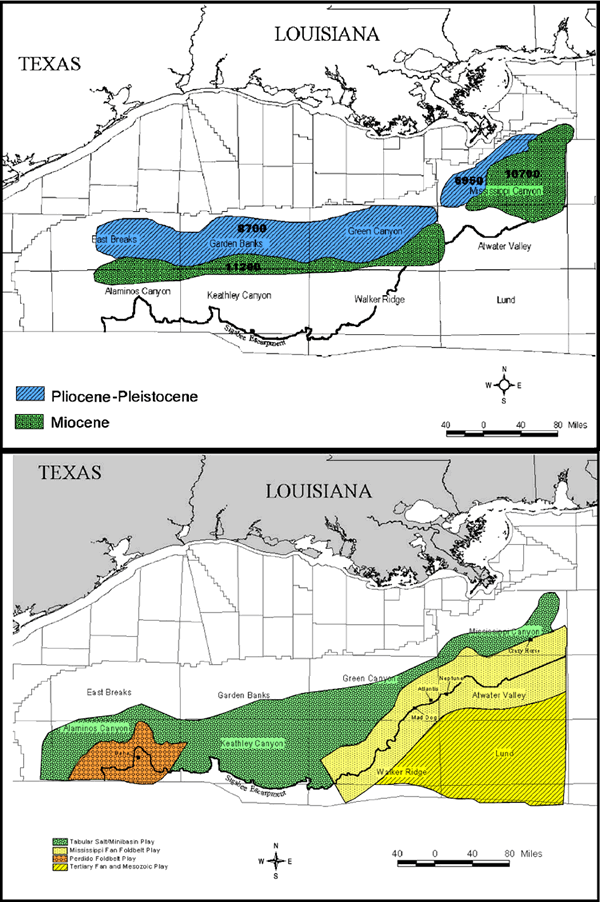
The northern Gulf of Mexico Basin can be divided into various arcuate tectonic provinces that parallel the shelf/slope break (Diegel et al., 1995; Karlo and Shoup, 1999). Salt-withdrawal minibasins on the continental slope, such as those in the Green Canyon and Garden Banks areas, are bounded by salt walls and filled with the ponded turbidite sands that provide reservoirs for most of the earlier deep-water Gulf of Mexico discoveries. A tabular salt canopy tectonic province occurs in a basinward direction in Walker Ridge and Keathley Canyon, and the Sigsbee Escarpment defines its extent. The middle to lower continental slope contains fold/thrust belts with large prospective geological structures that are the focus of current deep-water drilling and include several recent discoveries (Peel, 1999; Rowan et al., 2000). Figure 3 shows the distribution of hydrocarbon plays in the deep-water Gulf of Mexico, including untested plays in ultradeep water.
In the centroid concept, pore pressure in a reservoir sand at the crest
of a high-relief overpressured structure can exceed pore pressure in the
bounding shale. Deep-water areas with extensive shallow faulting are
particularly vulnerable to low-margin drilling conditions that require
extra casing strings. The top of a large, high-relief fold or anticlinal
structure at various depths in an exploratory well may contain
Conclusions
Many of the serious and costly drilling problems in deep water are related to the pore-pressure/fracture gradient relationship. Other pressure-related hazards, such as shallow water flow, require better predrill identification and quantification of overpressured problem sands. In many Gulf of Mexico frontier deep-water areas, a lack of offset wells mandates better pressure models that incorporate all available geological data. Operations geologists and geophysicists in the MMS are working with deep-water operators to establish databases and methodologies that will improve industry’s success in dealing with deep-water geohazards well into the new millennium.
References Cited
Alberty, M.W., M.E. Hafle, J.C. Minge, and T.M. Byrd, 1997, Mechanisms of shallow waterflows and drilling practices for intervention: Offshore Technology Conference Proceedings Paper OTC 8301, p. 241-247. Baud, R.D., R.H. Peterson, C. Doyle, and G.E. Richardson, 2000, Deepwater Gulf of Mexico: America’s emerging frontier: Minerals Management Service Outer Continental Shelf Report 2000-022, 89 p. Diegel, F.A., J.F. Karlo, D.C. Schuster, R.C. Shoup, and P.R. Tauvers, 1995, Cenozoic structural evolution and tectono-stratigraphic framework of the northern Gulf Coast continental margin: AAPG Memoir 65, p. 109-151. Dutta, N.C., ed., 1987, Geopressure: Society of Exploration Geophysicists Reprint Series 7, 365 p.
Fertl, H.W., 1976, Abnormal Karlo, J.F., and R.C. Shoup, 1999, Large patterns become predictive tools to define trends, reduce exploration risk: Offshore, v. 59, no. 7, p. 94-95, 156.
Law, B.E., G.F. Ulmishek, and V.I. Slavin, eds., 1998,
Abnormal Peel, F., 1999, Structural styles of traps in deepwater fold/thrust belts of the northern Gulf of Mexico (abs.): AAPG International Conference, extended abstracts volume, p. 392. Rowan, M.G., B.D. Trudgill, and J.C. Fiduk, 2000, Deepwater, salt-cored foldbelts: lessons from the Mississippi Fan and Perdido foldbelts, northern Gulf of Mexico: American Geophysical Union Monograph 115, p. 173-191. Smith, M.A., 1999, MMS regulatory approach to shallow water flow mitigation: Proceedings of the 1999 International Forum on Shallow Water Flows, paper 15, unpaginated. Smith, K.L., and A.D. Gault, 2002, Subsea mudlift drilling: a new technology for ultradeep-water environments, in A.R. Huffman and G.L. Bowers, eds., Pressure regimes in sedimentary basins and their prediction: AAPG Memoir 76, p. 171-175. Stauffer, K.E., A. Ahmed, R.C. Kuzela, and M.A. Smith, 1999, Revised MMS regulations on shallow geohazards in the Gulf of Mexico: Offshore Technology Conference Proceedings Paper OTC 10728, v. 1, p. 79-81. Traugott, M., 1997, Pore/fracture pressure determinations in deep water: World Oil, v. 218, no. 8, p. 68-70.
Acknowledgments
This project was initiated as a result of excellent presentations at the 1998 American Association of Drilling Engineers Industry Forum on Pressure Regimes in Sedimentary Basins and their Prediction. Preliminary results were presented at the 1998 MMS Information Transfer Meeting and the 1999 AAPG International Conference in Birmingham, England. I thank two anonymous reviewers and, particularly, James C. Niemann for their insightful comments, which greatly improved this chapter. Some of the ideas presented here were clarified by discussions with Jim Bridges, Matt Czerniak, Nader Dutta, Pete Harrison, Alan Huffman, Bob Peterson, Paul Post, and Selim Shaker. Finally, I am grateful to the MMS Gulf of Mexico Region, especially to Darcel Waguespack, Fred Times, and Wayne Plaisance, for help and support in the preparation of this chapter. |
 Figure 1.
Deep-water (>1000 ft [305 m]) and ultradeep-water (>5000 ft [1524 m])
active leases in the Gulf of Mexico.
Figure 1.
Deep-water (>1000 ft [305 m]) and ultradeep-water (>5000 ft [1524 m])
active leases in the Gulf of Mexico. Figure 2.
Average depth and stratigraphic interval for the occurrence of moderate
overpressures (12.5 ppg pore pressure), deep-water Gulf of Mexico.
Figure 2.
Average depth and stratigraphic interval for the occurrence of moderate
overpressures (12.5 ppg pore pressure), deep-water Gulf of Mexico. Figure 3.
Established and frontier deep-water Gulf of Mexico hydrocarbon plays.
Figure 3.
Established and frontier deep-water Gulf of Mexico hydrocarbon plays. Figure 4.
Ultradeep-water exploratory well that encountered rapid pore-pressure
buildup requiring extra shallow casing strings. Higher values in the
Total Gas track are marked with an x.
Figure 4.
Ultradeep-water exploratory well that encountered rapid pore-pressure
buildup requiring extra shallow casing strings. Higher values in the
Total Gas track are marked with an x.