
 Print this page
 Click to view article in PDF format.
Naturally Underpressured Reservoirs: Applying the Compartment Concept to the Safe Disposal of Liquid Waste*
By
Jim Puckette1 and Zuhair Al-Shaieb1
Search and Discovery Article #40071 (2003)
*Online adaptation of presentation at AAPG Southwest Section Meeting, Fort Worth, TX, March, 2003 (www.southwestsection.org)
1School of Geology, Oklahoma State University, Stillwater, OK 74078 ( [email protected] ) ( [email protected] )
The Oklahoma Panhandle region
contains abnormally low-pressure reservoirs that are isolated from the shallow
hydrostatic domain and overpressured reservoirs in the deep Anadarko basin.
These underpressured reservoirs, which can be identified and mapped using
available  petroleum
 industry data, are potential repositories for liquid waste.
They contain naturally low pore-fluid pressures and are completely sealed by
thick confining units. Many of these compartments contain oil and gas. Fluid
withdrawal during production has further reduced reservoir pressures,
facilitating disposal by lowering injection and displacement pressures.
industry data, are potential repositories for liquid waste.
They contain naturally low pore-fluid pressures and are completely sealed by
thick confining units. Many of these compartments contain oil and gas. Fluid
withdrawal during production has further reduced reservoir pressures,
facilitating disposal by lowering injection and displacement pressures.
Types and sizes of compartments were strongly influenced by depositional environment. Individual channel-filling sandstones within valley-fill sequences form small-compartments, whereas sandstone reservoirs formed from sediments reworked during marine transgressions became large ones. Within the carbonate domain, thick accumulations of grain-rich sediment, subsequently altered by dissolution and/or dolomitization, form large- to regional-sized compartments. Selected sandstone and carbonate reservoirs have calculated disposal volumes ranging from approximately 0.5 million barrels to 21 million barrels per well.
Compartmentalized reservoirs with
abnormally low fluid pressures offer an intriguing alternative for liquid waste
disposal. They exist as self-contained vessels whose seals have confined
pore-fluid pressures for durations of geologic time. Seal longevity and
integrity are evidenced by the very existence of naturally occurring subnormal
pressures that did not equalize with the normally pressured hydrostatic
environment. These reservoirs, by virtue of their compartmentalized nature,
fulfill two critical criteria for safe liquid waste disposal, (1) non-migration
and (2) total isolation from the sphere of human activities.
Naturally
underpressured reservoir compartments offer an intriguing option for the safe
disposal of liquid wastes. Pore pressures in underpressured reservoirs are often
lower than the hydrostatic pressure generated by a column of freshwater.
Compartmentalized reservoirs in sedimentary basins, by virtue of their
three-dimensional sealing, meet two critical criteria concerning the confinement
of liquid toxic waste, (1) isolation from the surficial environment and (2)
non-migration.
Abnormally low
fluid pressure is evidence that a proposed injection zone is a compartment and
isolated from its surroundings. In contrast, near-normal pressure suggests that
the reservoir is part of a larger hydrostatic or hydrodynamic system. Fluid type
is equally important. Underpressured oil- and gas-bearing compartments,
especially pressure-depleted ones, have injection and displacement pressures
that are much lower than water-filled, normally pressured reservoirs.
Pressure
data provided by the oil and gas industry are used to demonstrate that naturally
underpressured reservoir compartments are common in the Oklahoma and Texas
Panhandle area of the Southern Midcontinent region. These compartments, which
often contain pressures that are further reduced by oil and gas production, are
potential repositories for injected liquid waste.
|
uUnderpressured disposal zones uIntermediate-size compartment
uUnderpressured disposal zones uIntermediate-size compartment
uUnderpressured disposal zones uIntermediate-size compartment
uUnderpressured disposal zones uIntermediate-size compartment
uUnderpressured disposal zones uIntermediate-size compartment
uUnderpressured disposal zones uIntermediate-size compartment
uUnderpressured disposal zones uIntermediate-size compartment
uUnderpressured disposal zones uIntermediate-size compartment
uUnderpressured disposal zones uIntermediate-size compartment
|
Disposal Zones and the Compartment Concept The
discovery of abnormally pressured Abnormal
Bradley and
Powley (1994; 1987) presented evidence that sedimentary basins are
typically divided into a network of compartments that are isolated by
sealing rocks. Compartments are highly variable in size, ranging from
less than 1 mi2 (2.6 km2) to tens or hundreds of
mi2 in areal extent. Individual compartments are recognized
by their Large
Compartmentalization of Western Oklahoma and the Texas Panhandle The
subsurface rock column in western Oklahoma and the Texas Panhandle is
compartmentalized and divided into distinct pressure domains (Al-Shaieb
and others, 1994a; 1994b). Within the Anadarko basin (Figure
1), three
general The
significance of seals is illustrated by the change in pressure values
within the Morrowan interval across western Oklahoma. Morrowan
reservoirs in the deep Anadarko basin have abnormally high pore-
Stratigraphy and Pressure Architecture in the Oklahoma Panhandle Region The
Oklahoma Panhandle region contains underpressured, compartmentalized
reservoirs. They were identified using some two thousand measurements of
Pressure-depth profiles and potentiometric surface maps illustrate a significant vertical differentiation in pressure across the stratigraphic column in the Oklahoma Panhandle. In the western Panhandle near the Keyes Dome (Figure 4), six separate groupings or domains are recognized. They are separated by relatively flat-lying stratigraphic seals that correlate to evaporite or shale beds (Figure 5). Six regional seal zones subdivide the rock column in the panhandle region (Figure 5). Descending, the first seal occurs below the base of freshwater and separates it from gas- and brine-bearing reservoirs in the Tubb and Red Cave intervals. Important, low-permeability beds in this seal include the shale-rich Cloud Chief Formation, Whitehorse Group and Dog Creek Shale, the Blaine Gypsum, the shale- and salt- dominated Hennessey Shale and Cimarron Anhydrite (Figure 5). The second seal includes the lower part of the Hennessey Shale and the evaporite-rich Wellington Formation. This seal separates Tubb and Red Cave reservoirs from those in the underlying Chase and Council Grove Groups. The third seal zone is the shale-dominated interval below the Council Grove Group. It separates Permian-age Council Grove and Chase Group reservoirs from those in the deeper Pennsylvanian Virgilian and Missourian Series. The fourth regional seal separates Pennsylvanian Missourian and Desmoinesian reservoirs from those in the Morrowan interval. This seal coincides with the Desmoinesian ‘Cherokee’ and Atokan shales. Seal five is the upper Morrowan shale. It isolates upper Morrowan sandstone reservoirs from lower Morrowan and Mississippian Chesterian ones. The sixth seal (not shown on Figure 5) separates the lower Morrowan/Chesterian interval from reservoirs in the Ordovician Simpson Group and the Cambro-Ordovician Arbuckle Group. The shallowest pressure domain is near surface and associated with freshwater aquifers, including the Ogallala. This shallow hydrostatic domain extends to the Blaine Anhydrite/Gypsum (Figures 4 and 5). Pre-irrigation potentiometric surfaces in the fresh water aquifer approached or intersected the surface (Schoff and Stovall, 1943). The original pressure-depth gradient in the freshwater system (0.433 psi/ft) is reduced as a result of lowering of the water table (potentiometric surface) by irrigation. The second pressure domain starts beneath the Blaine seal and extends downward to the Wellington seal. Reservoirs in this interval have pressure-depth gradient values around 0.24 psi/ft (Figure 4) and potentiometric surfaces close to 2500 ft (760 m) above sea level. The third important pressure domain includes reservoirs of the Permian Chase Group that are located below the Wellington seal interval. In the Keyes area, these reservoirs have pressure-depth gradients around 0.15 psi/ft and potentiometric surfaces around 700 ft (210 m) above sea level. The highest-pressure values recorded in pre-Permian rocks are found in the Pennsylvanian upper Morrowan reservoirs. Upper Morrowan (Purdy) sandstone reservoirs have pressure-depth values that range from 0.25 to 0.29 psi/ft and a maximum potentiometric surface around 2600 ft (790 m). This value is still well below the average surface elevation of 3300 ft (1000 m). These Purdy values are considerably higher than pressure-depth gradient values of 0.20 and potentiometric surfaces of 1500 ft (460 m) measured for the underlying lower Morrowan (Keyes) sandstone and Mississippian reservoirs. The Keyes Sandstone is separated from the Purdy Sandstone by a shale seal. Pressure regimes below the Mississippian are not well defined, but pressure measurements from deeper Arbuckle reservoirs in the region suggest a return to near-hydrostatic pressure with depth.
Compartmentalization is apparent when distinct pressure measurements or
Localized
compartmentalization of the Morrow (an operational term for Morrowan) is
evident in the panhandle. In the Keyes area, lower Morrow Keyes
sandstone and Mississippian Chester (operational term for Chesterian)
reservoirs have pressure-depth gradients around 0.2 psi/ft, whereas
those in the upper Morrow ‘Purdy’ sandstone are 0.25 psi/ft (Figure
4).
In contrast, pressure measurements from Beaver County indicate Keyes and
Chester p-d gradients have increased to around 0.28 psi/ft and 0.36 psi/ft
respectively, whereas upper Morrow gradients remained around 0.23 to
0.25 psi/ft. Consequently, upper Morrow reservoirs, which were the
highest-pressured in the Keyes area, have the lowest p-d gradients in
the Beaver area (Figure 6). This switch in relative pressure is evidence
that the Purdy and Keyes/Chester reservoirs are independent
Sealed, three-dimensionally isolated pressure compartments offer a naturally occurring system that fits the no-migration criterion of an ideal disposal zone. Within the Oklahoma Panhandle region, example compartments were classified by type and size and systematically evaluated as potential disposal sites.
Potential Underpressured Disposal Zones Several underpressured reservoirs were characterized for geologic suitability as disposal zones. Specific criteria considered included porosity and permeability, thickness and areal extent, and confining seals. Porosity
measurements were taken from wire-line logs, thin-section petrography,
and the literature. Thickness and areal extent were established by
mapping.
Compartments were classified by host lithology and size. Once classified
as carbonate or siliciclastic, compartments were subdivided based on the
volume of liquid Types and sizes of compartments were strongly influenced by depositional environment. Individual channel-filling sandstones within valley-fill sequences form small compartments. On the other hand, sandstone bodies formed from sediments that were reworked and redistributed during marine transgression became large compartments. Within the carbonate domain, thick accumulations of grain-rich sediments that were subsequently dissolved and/or dolomitized form large, even regional compartments. In contrast, those formed from thin, grain-rich shoals in heterolithic assemblages are small.
Sandstone Example: Large Compartment The lower
Morrowan Keyes sandstone in Keyes field, Cimarron and Texas Counties
Oklahoma is used to illustrate a potential large siliciclastic disposal
zone. The sandstone forms thicker trends in valleys on the eroded
Mississippian topography and sheet-like deposits as a result of
reworking during a marine transgression. Sandstone thickness is highly
variable and net Thickness
maps were used to determine trends and thickness of the Keyes Porosity in the Keyes Sandstone is mostly secondary and resulted from dissolution of labile grains (Puckette, 1996; Gerken, 1992). Average porosity is approximately 15% and highly variable, primarily as a result of carbonate cement. Reported average permeability values range from 58 md to 100 md (Kansas Geological Survey, 1959; Stevens, 1960).
Sandstone Example: Intermediate-Size Compartment The NE Rice
field in T.3N., R.10ECM, Texas County Oklahoma, is used to illustrate an
intermediate size Porosity
values in the ‘lower’ Purdy sandstone range from 8 to 25% and average
21% (Harrison, 1990). Williams (1961) reported that typical permeability
in the ‘lower’ Purdy sandstone was 557 md. Net The ‘lower’
Purdy sandstone in NE Rice field is primarily an oil The total encasement of valley fill sandstones in drilling-defined low permeability clay-rich rocks may make these sandstones ideal repositories for extremely toxic liquid waste. Though these reservoirs are volumetrically smaller than other types, their well-defined three-dimensional confinement ensures their fulfilling the no-migration criterion of an ideal disposal zone.
Compartmentalized reservoirs with abnormally low
1. Original pore- 2. Mappable, three-dimensionally isolated or compartmentalized geometry, 3. Thick confining beds that are not folded or offset by transecting faults, and
4. Pore- injection and displacement pressures. These naturally underpressured reservoirs meet the no-migration criterion of an ideal liquid waste disposal zone. Their confining beds should remain intact as long as they are not repressured above original (pre-production) natural values. In addition, example reservoirs are delineated by oil and gas boreholes that could be converted to monitoring wells, thereby ensuring proper pressure maintenance. Depleted gas-bearing compartments in tectonically stable areas such as the Oklahoma Panhandle region could provide safe storage sites that remain confined for tens of millions of years.
REFERENCES
Al-Shaieb, Z., Puckette, J., and Close, A., 2002, Seal
characterization and Al-Shaieb, Z., J. Puckette, P. Ely, and V. Tigert, 1992, Pressure compartments and seals in the Anadarko basin, in Johnson, K. S., and Cardott, B. J. (eds.), Source Rocks in the Southern Midcontinent, Oklahoma Geological Survey Circular 93, p. 210-228.
Al-Shaieb, Z., J. Puckette, A. A. Abdalla, and P. Ely,
1994a, Mega compartment complex in the Anadarko basin: a completely
sealed overpressured phenomenon, in Ortoleva, P. J. (ed.) Basin
compartments and Seals: American Association of
Al-Shaieb, Z., J. Puckette, A. A. Abdalla, and P. Ely,
1994b, Three levels of compartmentation within the overpressured
interval of the Anadarko basin, in Ortoleva, P. J. (ed.) Basin
compartments and Seals: American Association of
Bradley, J. S., 1975, Abnormal Bradley, J. S., 1985, Safe disposal of toxic and radioactive liquid wastes: Geology v. 13, p. 328-329. Bradley, J. S., and D. E. Powley, 1987, Pressure compartments: unpublished manuscript.
Bradley, J. S., and D. E. Powley, 1994, Pressure
compartments in sedimentary basins: a review, in Ortoleva, P. J.
(ed.) Basin compartments and Seals: American Association of
Dahlberg, E. C., 1995, Applied hydrodynamics in Gerken, L. D., 1992, Morrowan sandstones in south-central Texas County, Oklahoma: Oklahoma State University unpublished M.S. thesis, 414 p. Harrison, J. C., 1990, “Upper” Morrow Purdy sandstones in parts of Texas and Cimarron Counties, Oklahoma: Oklahoma State University unpublished M.S. thesis, 95 p. Kansas Geological Survey, 1959, Taloga field, in Kansas Oil and Gas Fields, v. II, p. 182-186.
Powley, D. E., 1990, Pressures and hydrogeology in
Puckette, J. O., 1996, Evaluation of underpressured reservoirs as potential repositories for liquid waste: Oklahoma State University unpublished Ph.D. thesis, 273 p. Schoff, S. L., and J. W. Stovall, 1943, Geology and groundwater resources of Cimarron County, Oklahoma: Oklahoma Geological Survey Bulletin 64, 317 p.
Stevens, C. and D. Stevens, 1960, Hugoton
embayment-Anadarko basin handbook: National Stuart, C. A., 1970, Geopressures: Shell Oil Company, 121 p. Williams, W. W., 1961, Northwest Eva field, Texas County, Oklahoma, in Gas Fields of the Texas and Oklahoma Panhandles: Panhandle Geological Society, p. 250-252. |
 Figure 1.
Pressure-depth profile from western Anadarko Basin, Oklahoma that
illustrates the tiered pressure architecture. Three general pressure
tiers or domains are evident: (1) shallow normal, (2) overpressured
Mega-compartment complex (MCC) in basin center, and (3) deep normal
pressure.
Figure 1.
Pressure-depth profile from western Anadarko Basin, Oklahoma that
illustrates the tiered pressure architecture. Three general pressure
tiers or domains are evident: (1) shallow normal, (2) overpressured
Mega-compartment complex (MCC) in basin center, and (3) deep normal
pressure. Figure 2.
Map of pressure-depth (p-d) gradient values for upper Morrowan
reservoirs in the Anadarko basin and Oklahoma portion of the Hugoton
embayment. P-d gradient values range from extremely overpressured (>0.9
psi/ft) in the deep basin to abnormally underpressured in the Oklahoma
Panhandle (<0.3 psi/ft). This intrastratal change in pressure is
convincing evidence of regional pressure seals. The location of the
potentiometric surface cross section
Figure 2.
Map of pressure-depth (p-d) gradient values for upper Morrowan
reservoirs in the Anadarko basin and Oklahoma portion of the Hugoton
embayment. P-d gradient values range from extremely overpressured (>0.9
psi/ft) in the deep basin to abnormally underpressured in the Oklahoma
Panhandle (<0.3 psi/ft). This intrastratal change in pressure is
convincing evidence of regional pressure seals. The location of the
potentiometric surface cross section Figure 3.
Cross section composed of potentiometric surface or head values for
upper Morrowan reservoirs. The standard brine gradient (0.465 psi/ft)
was used for the head calculations. Head values for overpressured
reservoirs exceed the topographic elevation. In contrast, potentiometric
head values for underpressued reservoirs are less than topographic
elevation values. The disparity between these values is further evidence
to support the integrity and longevity of pressure seals in the Anadarko
basin.
Figure 3.
Cross section composed of potentiometric surface or head values for
upper Morrowan reservoirs. The standard brine gradient (0.465 psi/ft)
was used for the head calculations. Head values for overpressured
reservoirs exceed the topographic elevation. In contrast, potentiometric
head values for underpressued reservoirs are less than topographic
elevation values. The disparity between these values is further evidence
to support the integrity and longevity of pressure seals in the Anadarko
basin. Figure 4.
Pressure-depth profile from Keyes field, Cimarron County, Oklahoma. The
freshwater (0.43 psi/ft) and brine (0.465 psi/ft) gradients indicate the
underpressured nature of compartments below the shallow Ogallala
aquifer. Seal zones separate clusters of p-d values calculated from
Figure 4.
Pressure-depth profile from Keyes field, Cimarron County, Oklahoma. The
freshwater (0.43 psi/ft) and brine (0.465 psi/ft) gradients indicate the
underpressured nature of compartments below the shallow Ogallala
aquifer. Seal zones separate clusters of p-d values calculated from
 Figure 5.
Regional lithologic seals in the Oklahoma Panhandle. Seal zones 1 and 2
are dominantly shale and evaporites. Seal zones 3, 4 and 5 are shale
dominated. Seal zone 6 (not shown) is shale. These seals
compartmentalize the rock column, effectively isolating the intervening
pressure domains.
Figure 5.
Regional lithologic seals in the Oklahoma Panhandle. Seal zones 1 and 2
are dominantly shale and evaporites. Seal zones 3, 4 and 5 are shale
dominated. Seal zone 6 (not shown) is shale. These seals
compartmentalize the rock column, effectively isolating the intervening
pressure domains.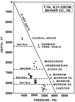 Figure 6.
Pressure-depth profile from Beaver County, Oklahoma that illustrates
obvious underpressured compartments in the upper and lower Morrow
stratigraphic interval. Upper Morrow p-d values are lower than values in
the deeper lower Morrow ‘Keyes’ and Chester compartments, which is a
reversal of the relative pressure values evident in the Keyes area
Figure 6.
Pressure-depth profile from Beaver County, Oklahoma that illustrates
obvious underpressured compartments in the upper and lower Morrow
stratigraphic interval. Upper Morrow p-d values are lower than values in
the deeper lower Morrow ‘Keyes’ and Chester compartments, which is a
reversal of the relative pressure values evident in the Keyes area Figure 7.
Net Keyes sandstone thickness map that delineates paleodrainage patterns
on the underlying eroded Mississippian surface. Net sandstone exceeds
100 ft (30 m) in paleovalleys. A disposal site in the thick Keyes trend
in Sections 9 and 16 has a calculated injectate capacity exceeding 21
million barrels.
Figure 7.
Net Keyes sandstone thickness map that delineates paleodrainage patterns
on the underlying eroded Mississippian surface. Net sandstone exceeds
100 ft (30 m) in paleovalleys. A disposal site in the thick Keyes trend
in Sections 9 and 16 has a calculated injectate capacity exceeding 21
million barrels. Figure 8.
Wireline log characteristics of the Keyes sandstone in T.5N., R.9ECM.,
Cimarron County, Oklahoma. Net sandstone is defined as having positive
filtercake accumulation, spontaneous potential (SP) deflection of > 60
millivolts (mv), density or neutron-density >10% and/or positive
separation (shaded) between microresistivity curves.
Figure 8.
Wireline log characteristics of the Keyes sandstone in T.5N., R.9ECM.,
Cimarron County, Oklahoma. Net sandstone is defined as having positive
filtercake accumulation, spontaneous potential (SP) deflection of > 60
millivolts (mv), density or neutron-density >10% and/or positive
separation (shaded) between microresistivity curves. Figure 9.
Distribution and thickness of net lower Purdy (upper Morrow) sandstone,
NE Rice Field, Texas County, Oklahoma (Harrison, 1990). Areas of sand
accumulation were isolated by mud and silt deposition in the incised
valley. These shale plugs separate fields and reservoirs. Shale valley
walls further confine these sandstones. This results in total encasement
of valley fill sandstone in clay-rich, sealing rock and creation of an
ideal disposal zone. Cross-section A-A’ is shown by
Figure 9.
Distribution and thickness of net lower Purdy (upper Morrow) sandstone,
NE Rice Field, Texas County, Oklahoma (Harrison, 1990). Areas of sand
accumulation were isolated by mud and silt deposition in the incised
valley. These shale plugs separate fields and reservoirs. Shale valley
walls further confine these sandstones. This results in total encasement
of valley fill sandstone in clay-rich, sealing rock and creation of an
ideal disposal zone. Cross-section A-A’ is shown by Figure 10.
Stratigraphic Cross-section A-A’ in NE Rice field (Harrison, 1990). This
section illustrates encasement of the Purdy sandstone
Figure 10.
Stratigraphic Cross-section A-A’ in NE Rice field (Harrison, 1990). This
section illustrates encasement of the Purdy sandstone 