Print this page
 Click to view this article in PDF format.
Geologic Study of the Miocene Rodador Field and its Exploitation Possibilities, Tabasco State, Southeastern Mexico*
By
Francisco Javier Martínez Castillo1
Search and Discovery Article #20008 (2002)
*Adapted for online presentation from article of the same title by the same author published in AAPG Memoir 75 (p. 433-441), which may be purchased from the AAPG Bookstore (http://bookstore.aapg.org). Published at the end of 2001, Memoir 75 is entitled The western Gulf of Mexico Basin: Tectonics, sedimentary basins, and petroleum systems; it was edited by C. Bartolini, R.T. Buffler, and A. Cantú-Chapa.
1PEMEX Exploración y Producción, Agua Dulce, Veracruz, Mexico.
Abstract
The interpretation and analysis of depositional systems played an important role in the definition of hydrocarbon reservoirs in the Rodador field of the Isthmian Saline Basin in southeastern Mexico. The two major sandstone reservoirs of the middle Miocene-lower Pliocene Encanto Formation, which are referred to as the 17-A and 18 sands, are located at depths ranging from 2873 m to 2995 m and 2877 m to 3031 m, respectively. The thickness of these two sands ranges from 8 m to 28 m (17-A) and from 7 m to 48 m (18).
The stratigraphic distribution of
the hydrocarbon reservoir units and  seal
seal rocks has been established, allowing
the identification of new potential areas for exploitation. The prograding
complex of the Encanto Formation is the most attractive from a petroleum
perspective, because it hosts the hydrocarbon-producing Rodador field. A
detailed analysis of sand-top maps in this study was used to estimate the
original hydrocarbon volume in place, to rank the potential areas for new
exploitation plans in the Rodador field. Calculated hydrocarbon reserves are not
included in this paper.
rocks has been established, allowing
the identification of new potential areas for exploitation. The prograding
complex of the Encanto Formation is the most attractive from a petroleum
perspective, because it hosts the hydrocarbon-producing Rodador field. A
detailed analysis of sand-top maps in this study was used to estimate the
original hydrocarbon volume in place, to rank the potential areas for new
exploitation plans in the Rodador field. Calculated hydrocarbon reserves are not
included in this paper.
|
tAbstracttPrevious studies
tAbstracttPrevious studies
tAbstracttPrevious studies
tAbstracttPrevious studies
tAbstracttPrevious studies
tAbstracttPrevious studies
tAbstracttPrevious studies
|
Click here for sequence of Figure 7a and Figure 8a.
IntroductionThe Rodador field is in the state of Tabasco, southeastern Mexico. This field is in the onshore portion of the Isthmian Saline Basin, part of the province known as the Southeastern Tertiary Basins (Figure 1). The purpose of this study is to estimate the original hydrocarbon volume in place, which will be used to rank the potential of the sands for new exploitation plans. The sequence-stratigraphic concepts and terminology used in this study are based on Van Wagoner et al. (1988, 1990) and Mitchum et al. (1993). Seismic line L-64/39 is crucial to the study, because it crosses through wells Rodador 173, 175, 177, 179, and 278 (Figures 2 and 3). The study includes 25 well logs (Figure 2), as well as the stratigraphic data from the Ají-1 well, located to the southwest of the field (1.4 km S29°W of the Rodador-1 well). The Ají-1 well was chosen because cutting samples from 1900 m to 3835 m contain fossils that were studied by Rodríguez (1999), who identified the species outlined in Table 1.
Based on well logs, the
Return
to Previous StudiesBy 1953, several unpublished gravity, refraction, and reflection seismology surveys had resulted in identification of several geologic blocks considered to be attractive for oil exploration. Jiménez (1976) interpreted the northern portion of the Rodador field to evaluate available commercial hydrocarbon reservoirs. His study defined the structure as a faulted anticline with a southeast-northwest-trending axis. The long axis of the structure measures 3 km, and the width measures about 2 km. It has a small closure dipping to the northwest. This study encompasses the southern area of the field and concurs with Jiménez (1976) in that the cumulative sand horizons in the southeastern part of the field appear to be better developed. The maps of sand tops provided in this study indicate that these sand bodies are potential reservoirs. Guerrero (1993) estimated the original hydrocarbon volume and reserves for the Rodador field. He proposed the existence of eight reservoirs divided into 18 blocks in the Encanto Formation. These reservoirs are at depths that range from 2400 m to 3450 m. The Discovery of the Rodador FieldThe Rodador field was discovered by wildcat Rodador-1 in 1971. This well was drilled to a depth of 3647 m and became a dual producer of oil and gas from intervals 3220-3228 m and 3458-3470 m. These intervals correspond to middle Miocene-lower Pliocene sand bodies of the Encanto Formation. The Rodador field was developed mainly to the south and southeast of the Rodador-1 well. Forty-six wells had been drilled by 1980, of which 36 were producers and 10 were dry (Figure 2). The spacing between wells was 400 m. Seismic AnalysisOnly seismic line L-64/39, which crosses the field in a southwest-northeast direction (Figure 2), was analyzed. This line ties to wells Rodador 173, 175, 177, 179, and 278 (Figure 3). The velocity survey used was that of the Magallanes-850 well, about 10 km southeast of Rodador field. This velocity survey was used to convert the seismic reflections from time to depth and to try to calibrate the seismic information with the wells, because the Rodador field does not have its own velocity survey.
Return
to Anhydrite and Salt in Rodador Field
Jurassic anhydrite and salt are common
in the Southeastern Tertiary Basins of southern Mexico. In Rodador
field, 10 wells (Rodador 1, 2, 6, 20, 31, 32, 43, 52, 54, and 173)
reached the anhydrite-salt Seismic Line L-64/39On seismic line L-64/39, at the position of wells 175 and 173 at approximately 2.1 to 2.3 s (equivalent to 2690 to 3010 m in depth), the following can be observed (Figure 3): 1) The pattern of imbricated turbiditic flows deposited on the slope forms stratigraphic traps in the Encanto Formation. 2) The line drawn across the lower part of wells Rodador 173, 175, 177, 179, and 278 corresponds to the base of the Encanto Formation at 2.48 s (3360 m) for Rodador-173 and at 2.55 s (3430 m) for Rodador-278. These lower sands are better developed than in the northern producing portion of the field. Below the base of the Encanto Formation, the section becomes more shaly. 3) Southwest of seismic line L-64/39 (Figure 3), from approximately 1.8 to 2.4 s, the seismic reflections are seen to rise upward, produced by the Cinco Presidentes salt dome to the southeast (Figure 1). 4) The main producing area with exploitation possibilities is located in the 2.0- to 2.5-s interval, from 2500 m to 3350 m deep. These producing intervals belong to the middle and lower part of the Encanto Formation, as illustrated on seismic line L-64/39 (Figure 3). Note that the 850-m thickness of the producing zone is a gross thickness, representing interbedded layers of sand and shale. GeologyDepositional Model of the Producing HorizonsThe Encanto Formation consists of interbedded sand and shale. Both lithologies have variable thickness through the formation. The thickness of the sand bodies ranges from 4 m to 65 m, and the thickness of shale horizons ranges from 3 m to 67 m. The sand is light to dark gray in color, fine- to coarse-grained, and the shale is soft to hard, green and dark gray.
The Concepción Inferior Formation
overlies the Encanto Formation and is characterized by interbedded
thick-shale and thin-sand bodies. This formation in the study area has
an average thickness of 260 m. Based on a correlation of electric logs,
the
The Encanto Formation in the study area
has a minimum thickness of 1205 m (Rodador-67 well) and a maximum
thickness of 1376 m (Rodador-177 well). The Ají-1 well, southwest of the
field and 1.4 km southwest of the Rodador-1 well (Figure
2), penetrated
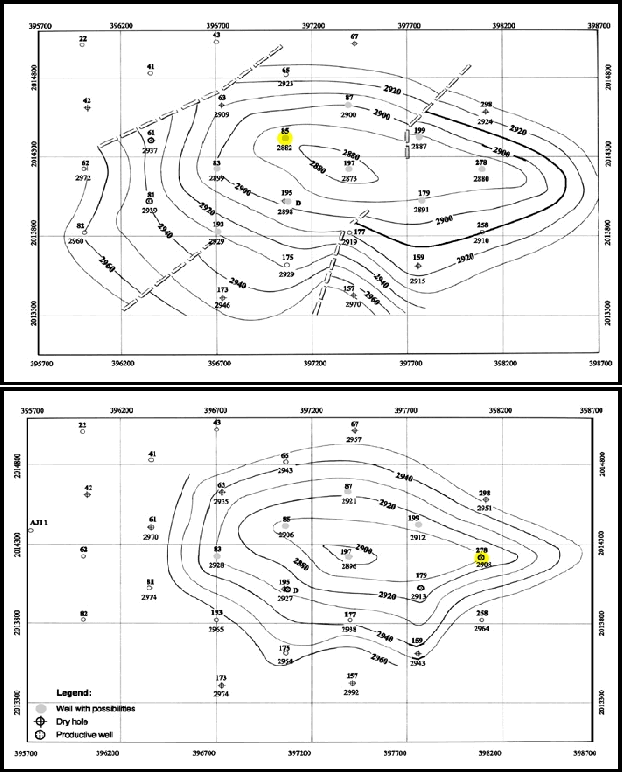
1468 m of Encanto Formation before encountering the Most of the oil produced from the Encanto Formation in southeastern Mexico is from shingled turbidites (PEP-BP Exploration Report, 1994). The producing and potential turbidite sands are found mainly in the middle and lower portions of the Encanto Formation. In the southern area of Rodador field, two prograding complexes, referred to as A and B, have been recognized as part of the Encanto Formation (Figures 5 and 6). Prograding complex A in the lower and middle portions of the Encanto Formation includes the 31 to 13 sands at depths ranging from 2700 m to 3450 m and whose thickness varies from 5 m to 69 m. Sands 22 to 17 (except 19) (Figure 5 and 6) show a good resistivity curve response because of the presence of hydrocarbons, and thus they have exploitation possibilities. Sand 17-A has been tested in wells 81, 82, and 175, and it also has good possibilities in nine more wells (83, 85, 87, 179, 193, 195D, 197, 199, and 278) (Figure 7). The 18 sand in wells 195D and 278 is the main producer in the field. The sand has a good response on the log resistivity curve (well 278), and has an average thickness of 33 m and an average porosity of 22%. It is considered a potential future producer in wells 83, 85, 87, 179, 197, and 199 (Figure 8). Prograding complex B comprises the sand bodies at depths of 2200 m to 2650 m. This is the shallowest complex, and it encompasses sands 12 to 8, whose thickness varies from 8 m to 65 m. Sand 12 in the Rodador-258 well has yielded good oil production and has exploitation possibilities in well 179 (Figure 9), as indicated by a high resistivity curve response. The 12 sand in well 179 reaches a gross thickness of 65 m. It is important to mention that in the Rodador field, there are intervals with exploitation possibilities, and they are shown with well logs in Figure 10. Figure 11 depicts a conceptual sedimentary model of the Rodador field, showing the approximate location of the field in the prograding complex.
Return
to Reservoir RocksHydrocarbon reservoirs are typically fine- to medium-grained gray sands, some of which are shaly. Coarse-grained sand rarely occurs in the formation. In the study area, sand reservoirs vary in thickness from 3 m to 33 m and have an average porosity of 20%.
|
 Figure 1. Location of the
study area, Rodador field in the state of Tabasco, southeastern Mexico.
Figure 1. Location of the
study area, Rodador field in the state of Tabasco, southeastern Mexico. Figure
 Figure
 Figure
 Figure
 Figure
 Figure
 Figure
 Figure
 Figure
 Figure
 Figure
 Table 1.
Time-stratigraphic
and biostratigraphic subdivision of the Ají-1 well. Modified after
Rodríguez (1999), using data from Berggren et al. (1995).
Table 1.
Time-stratigraphic
and biostratigraphic subdivision of the Ají-1 well. Modified after
Rodríguez (1999), using data from Berggren et al. (1995).