Print this page
 Click to view article in PDF format.
Hydrocarbon Systems Analysis of the Northern Gulf of Mexico: Delineation of Hydrocarbon Migration Pathways Using Seeps and Seismic Imaging*
By
Kenneth C. Hood1, L. M. Wenger2, O. P. Gross3, S.C. Harrison4
Search and Discovery Article #40061 (2002)
* *Adapted for online presentation from article of the same title by the same authors published in AAPG Studies in Geology 48 and SEG Geophysical References Series No. 11, Surface Exploration case Histories: Applications of Geochemistry, Magnetics, and Remote Sensing, D. Schumacher and LA. LeSchack, eds.,p. 25-40. This publication may be purchased from AAPG Bookstore (http://bookstore.aapg.org). Authors performed research and prepared manuscript while employed by Exxon Exploration Company, Houston, Texas, U.S.A.
1-4 Current addresses: 1ExxonMobil Exploration Company, Houston, Texas, U.S.A.; 2ExxonMobil Upstream Research Company, Houston, Texas, U.S.A.; 3Esso Production Malaysia Inc., Kuala Lumpur, Malaysia; 4Consultant, Houston, Texas, U.S.A.
Widespread oil and gas seepage in the offshore U.S. Gulf of Mexico has allowed the extension of hydrocarbon systems and maturity maps far beyond well control. Analysis of sea-bottom dropcores and imaging of sea-surface slicks have complemented Exxon’s integrated, multidisciplinary study of sources, maturation, and migration pathways. Our approach involved development of a regional geologic framework through interpretation of 2-D and 3-D seismic data, identification and mapping of potential source intervals, and delineation of likely migration pathways to reservoirs and seismic-amplitude anomalies. Hydrocarbon compositions from more than 2000 reservoired oils, 600 reservoired natural gases, and 3000 hydrocarbon-bearing, sea-bottom dropcores help constrain such source-rock characteristics as organic-matter type, depositional facies, level of maturation and, to some extent, age. East of the Mississippi River Delta, the complete stratigraphic section is visible on seismic sections, and wells have penetrated deep source intervals. To the west, correlative organic-rich rocks have been sampled onshore and from sheaths overlying salt diapirs offshore. Integration of these data into a regional geologic framework provides a strong basis for hyrocarbon-systems interpretations.
Major offshore hydrocarbon systems
are derived from lower Tertiary (centered on Eocene), Upper Cretaceous (centered
on Turonian), and Upper Jurassic (centered on Tithonian) source intervals. All
Eocene oil types (marine, intermediate, and terrestrial) have been
tied to source rocks and are consistent with
paleofacies distributions for the Eocene deltaic systems. Eocene oils and gases
are prevalent on the Texas and Louisiana shelves and extend both onshore and
onto the Texas Slope. Turonian oils have been tied to source rocks offshore
(east of the Mississippi River Delta) and onshore (e.g., Tuscaloosa and Giddings
trends). Based on seismic-image thinning of the interval and disappearance of
diagnostic oils, we interpret a basinward loss of this source type.
Elevated-sulfur oils and associated (cogenerated) gases on the upper Gulf of
Mexico Slope are interpreted to have originated from a Tithonian source.
High-maturity, organic-rich calcareous shales of this age have been penetrated
in the eastern Gulf of Mexico, and Tithonian oils occur in Cretaceous reservoirs
on the Florida Shelf where the Upper Cretaceous and Tertiary sections are
immature. Oxfordian carbonate-sourced oils are common across the northern Gulf
 basin
basin ’s rim, and lower-maturity hydrocarbons from this source occur in stains
and seeps in the deep central Gulf of Mexico.
’s rim, and lower-maturity hydrocarbons from this source occur in stains
and seeps in the deep central Gulf of Mexico.
Refinements in our understanding of Gulf of Mexico hydrocarbon systems have resulted
from this study.
They have helped us to improve our exploration methodologies and have provided
us with new play concepts
|
|
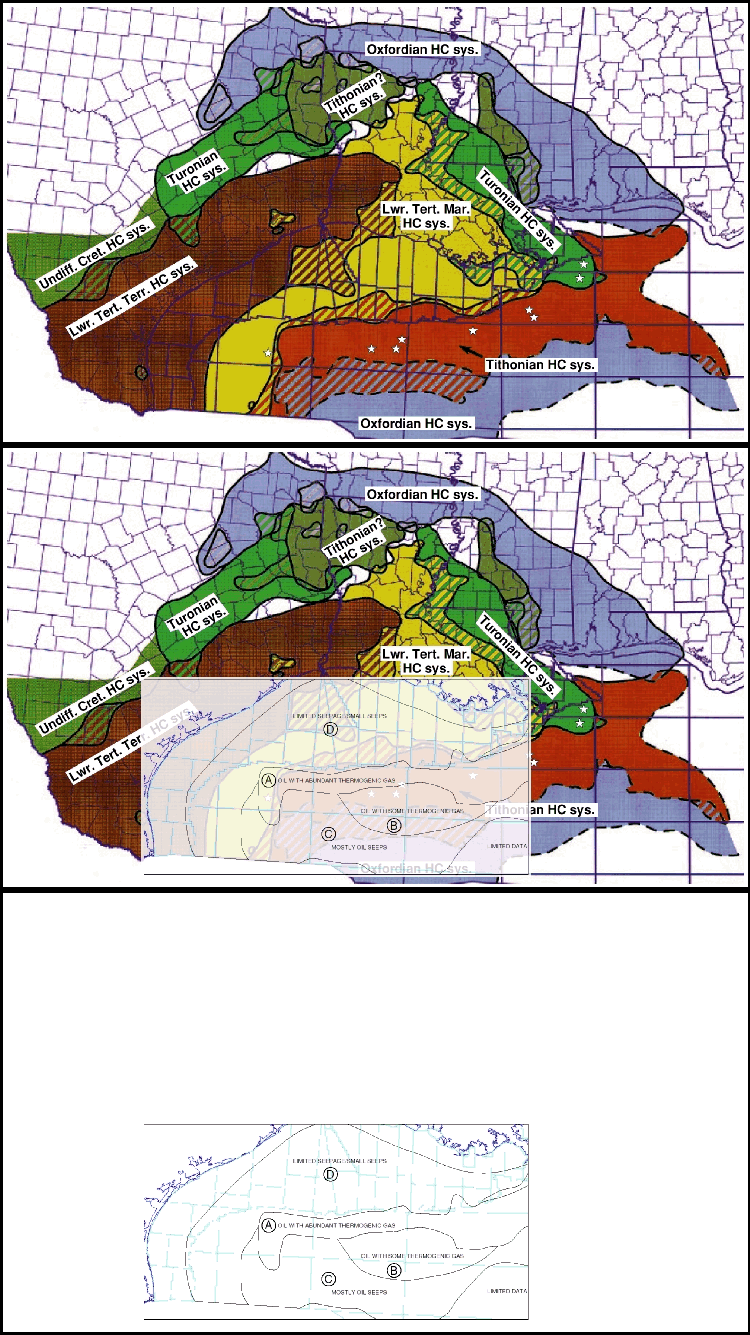
Click here for sequence of Figure 2 (hydrocarbon-systems map) and Figure 4 (seep-distribution map).
Table Caption
INTRODUCTION
Continued exploration success in the
northern U.S. Gulf of Mexico
The recognition of widespread, and often intense, oil and natural-gas seepage on the Gulf of Mexico Slope has contributed significantly to our understanding of the hydrocarbon systems. As part of this study, we analyzed a large number of sea-bottom dropcores (>5000) and identified surface slicks from remote-sensing data. The sea-bottom dropcores were obtained from existing proprietary dropcore programs, industry consortia, and geotechnical shallow-hazard surveys. Characterization of oils and natural gases in seeps has allowed us to extend our hydrocarbon-family and hydrocarbon-maturity maps far beyond well control. Moreover, abundant seepage documents active hydrocarbon migration on the Gulf of Mexico Slope and provides a means to identify effective migration pathways. Major hydrocarbon accumulations on the slope are commonly associated with intense seepage at the seafloor intersection of the corresponding cross-stratal migration pathways. Thus, seeps provide information that potentially can be used to help rank possible migration pathways to prospects. In addition, the geochemical composition of seep hydrocarbons (as interpreted from biomarkers) can provide important predrilling information about the likely properties of unbiodegraded oils (e.g., API gravity and sulfur content). Oil properties can have a significant impact on production and refinement costs and therefore on product value. By providing advance knowledge about the likely oil properties, seeps can make a major contribution to the economic evaluation of a potential hydrocarbon accumulation.
APPROACH AND GEOLOGIC FRAMEWORK
The sources for oils reservoired in the
young Tertiary section of the offshore Gulf of Mexico have been
enigmatic in the past, because of a paucity of source-rock penetrations
in offshore drilling. Many approaches have been used to infer source
intervals. For example, Nunn and Sassen (1986) used maturation modeling
to suggest that Cretaceous and lower Tertiary sediments were the
probable sources of oils in the offshore Louisiana continental-slope
area. Our approach was to focus on an initial study area east of the
present-day Mississippi River Delta where the Tertiary section thins and
wells have penetrated deep potential source rocks. This area was also
selected because the complete stratigraphic section can be imaged on
seismic sections, because of only limited interference from shallow
salt. To the west, where secondary and even tertiary salt features are
abundant in the shallow section, samples of organic-rich rock (dated by
microfossils) have been obtained from sheaths overlying salt diapirs.
These samples have provided access to source rocks in areas where they
typically lie far below current drilling depths. When combined with
known, effective source-rock penetrations from the onshore northern Gulf
Geochemical compositions
of reservoired and seep hydrocarbons provide a perspective on the
regional characteristics and maturity of their respective source rocks.
Oil and, to some extent, natural-gas compositions constrain such
source-rock characteristics as organic-matter type, clastic versus
carbonate facies, elevated versus normal salinity, level of maturation
and, to a lesser extent, age. In all, more than 2000 reservoired oils,
600 reservoired natural gases, and 3000 hydrocarbon-bearing sea-bottom
dropcores from the northern Gulf
To the east of the
present-day Mississippi River Delta, source intervals occur at depths
between about 16,000 and 35,000 ft (4900–10,700 m) and are generally
visible on seismic sections because of only limited interference by
small, simple salt bodies above source levels (Figure 1). In contrast,
to the west, the source intervals commonly occur at depths between
30,000 and 45,000+ ft (9200–13,700+ m), and seismic visibility is
hampered by the presence of multilayered salt sills and/or salt welds
with complex geometries formed by sediment loading. Interpretation of
hydrocarbon families and source intervals in this more complex setting
was guided by extending westward the observations and methodologies
developed in the east and north. Most 2-D seismic surveys designed to
image common reservoir intervals are generally inadequate to only
marginally adequate for imaging deeper source intervals and migration
pathways. These data are typically high (60–75) fold, acquired with
4000–4500 m of cable, and recorded to 8 seconds (s). Dramatic
improvements in imaging the total hydrocarbon GULF OF MEXICO HYDROCARBON SYSTEMS
Knowledge of the effective
source rocks for an area is critical to understanding the overall
hydrocarbon
Regional differences in the original organic-matter composition of the lower Tertiary source appear to explain much of the variation in the resulting hydrocarbon compositions (distribution of oil versus gas). The marine-source subtype appears to produce a greater proportion of oil, whereas the terrestrial-source subtype appears to be more gas prone. This conclusion contrasts with interpretations in which the prevalence of thermogenic natural gases and gas condensates on the Texas Shelf and onshore has been attributed to higher source maturity (e.g., Thompson et al., 1990).
The next-older source
interval identified is in Upper Cretaceous strata, centered on the
Turonian. Turonian source rocks are clay-rich shales with dominantly
marine organic matter that generates low-sulfur oils (Marine–Low
Sulfur–No Tertiary Influence). Direct oil-to-source-rock ties have been
made offshore, east of the present Mississippi River Delta, and onshore
in the Tuscaloosa trend of Louisiana and Mississippi and the Giddings
trend of Texas (see also Wagner et al., 1994). Offshore, we interpret a
basinward loss of Turonian source rocks based on seismically displayed
thinning of the interval and disappearance of the oil type. In south
Texas, a more calcareous (moderate-sulfur) oil type
(Calcareous–Undifferentiated Cretaceous) may result, in part from a
facies change in the Turonian, although this oil type has also been tied
directly to a Lower Cretaceous marine calcareous shale. High-sulfur oils
from the Sunniland trend
(Carbonate–Elevated Salinity–Lower Cretaceous) of the South Florida
The source for most reservoired
thermogenic hydrocarbons on the Gulf of Mexico Slope is interpreted to
be uppermost Jurassic, centered on the Tithonian. Organic-rich
calcareous shales of Tithonian age have been penetrated and sampled
within wells in the area east of the present Mississippi River Delta.
Although the high maturity level of these shales makes geochemical
correlation (using biomarkers) with early-mature hydrocarbons on the
slope difficult, extrapolation of source character from oils constrains
the age of the appropriate facies in the area of occurrence for this oil
type. Geographic variations in source facies are probably responsible
for differences in sulfur content and associated geochemical parameters
(Moderate Sulfur, Moderately High Sulfur, and High-sulfur oil subtypes)
of unbiodegraded oils. Oils and stains of these subtypes (distinct from
older Oxfordian oils) occur in Cretaceous reservoirs on the Florida
Shelf where the Tertiary and Upper Cretaceous sections are immature.
Hydrocarbons occurring in many uppermost Jurassic and Lower Cretaceous
reservoirs along the onshore northern rim of the Gulf
Upper Jurassic (Oxfordian)
carbonate-sourced oils (Carbonate–Elevated Salinity–Jurassic oil type)
are common across the northern rim of the Gulf
Finally, hydrocarbons from a Triassic
lacustrine source have been encountered along the bounding faults of the
northern Gulf
The four key source intervals in the offshore Gulf of Mexico (centered on lower Tertiary, Upper Cretaceous, Upper Jurassic–Tithonian, and Upper Jurassic–Oxfordian strata) coincide with second-order transgressions in a sequence-stratigraphic framework (Figure 3). Core and cuttings analyses indicate that source richness can vary considerably within an interval, possibly reflecting local or temporal variations in the environment. REMOTE SENSING OF SEA-SURFACE SLICKS
Remote-sensing (satellite)
techniques are useful screening tools for identifying potential
hydrocarbon seepage in a
Slick distributions provide an initial guide to areas that are candidates for site-specific, sea-bottom sediment coring surveys. Numerous factors can affect both the interpretation of authentic seepage and the location of surface slicks relative to source vents on the sea bottom. These factors include wind velocity and direction, currents, cloud cover, meteorologic conditions, marine vegetation, and anthropogenic pollution. After candidate areas have been identified, the next step is to verify the sea-bottom source of the hydrocarbons. High-resolution 2-D and 3-D seismic data, sometimes complemented by side-scan sonar surveys, are used to identify sea-bottom features from which dropcores can be collected. Potential targets include the surface expressions of deep-cutting faults and diapirs, as well as such other water-bottom features as mounds and pockmarks. Many such water-bottom features in the deep-water Gulf of Mexico contain small quantities of hydrocarbons that have migrated from depth. Dropcores collected over targeted water-bottom features are analyzed for the presence and geochemical characteristics of petroleum hydrocarbons.
SEA-BOTTOM HYDROCARBON SEEPS
The Gulf of Mexico Slope
contains widespread areas of oil and gas seepage (Figure 4) that have
allowed investigators to extend hydrocarbon-
Figure 5 illustrates the intense hydrocarbon biodegradation that can be encountered in dropcores collected on the Gulf of Mexico Slope. In this particular example, only about 5 ft (1.5 m) of sediments was recovered, although most Gulf of Mexico dropcores recover about 15 ft (4.6 m) of sediment. The limited penetration likely results from an authigenic carbonate hard-ground surface formed in response to hydrocarbon seepage. Canned headspace gas concentrations and whole-extract gas chromatograms (GCs) are shown for three sections sampled from the core. Oil concentrations are evaluated by the maximum fluorescence intensity (MFI) measured on sea-bottom sediment extracts (Brooks et al., 1983, 1986) and by the appearance of whole-extract gas chromatograms. MFIs in this core range from 230,000 to 414,000 using a Perkin-Elmer 650-40 spectrophotometer.
All three samples from the dropcore contained high levels of natural gas and oil, and a pronounced biodegradation profile is evident in both the oil and gas compositions over a depth range of less than 5 ft (1.5 m). Moderate to severe biodegradation of oil and gas has occurred in the upper 2.5 ft (0.8 m) of sediment. The extent of biodegradation is evident by depletion of n-alkanes, large unresolved complex mixture (UCM) humps on the GCs, and preferential removal of C3 and n-C 4 by microbial biodegradation of gas. Entry or preservation of some fresh, unbiodegraded oil and gas between 4.5 and 5 ft (1.4–1.5 m) is indicated by the unbiodegraded character of the GCs (n-alkanes intact) and the high proportion of n-C 4 to (i-C 4 + n-C 4) in the headspace gas. Figure 6 shows comparative GC and biomarker analyses for the seep and a nearby reservoired oil. Because the reservoired oil is not biodegraded, the deepest (unbiodegraded) sample from the dropcore is used for comparison. Biomarker compositions for the reservoired oil and the seep are comparable, suggesting that the oils belong to the same hydrocarbon family and originated from the same source.
To evaluate the hydrocarbons in sea-bottom sediments, the oil component is extracted with a solvent for analysis. Seeps with limited quantities of hydrocarbons commonly will show an overprint of recent organic components that are extracted by the solvent along with the oil. In large seeps, the signature of recent organic components is usually overwhelmed by high concentrations of oil. For seeps with lesser amounts of oil, the biological signature must be discounted in order to interpret the thermogenic signature correctly. This differentiation is crucial, because only the thermogenic signature provides information on the source and the thermal maturity of the petroleum hydrocarbons. One benefit of interpreting petroleum characteristics from lower-concentration seeps is that the biomarkers typically are less altered by biodegradation, and they better reflect primary petroleum signatures in those “windows” of the analyses where recent organic-matter components do not co-elute and interfere with oil components (Figure 7).
Seeps can be used to enhance our
understanding of several aspects of the hydrocarbon
Several lines of evidence support the interpretation that pervasive seepage on the Gulf of Mexico Slope results from active hydrocarbon generation and ongoing charge from the source. First, the apparent volume of seeping hydrocarbons appears to preclude the possibility that generation occurred in the past and that hydrocarbons are currently leaking out of known or unidentified deep reservoirs. For example, MacDonald et al. (1993) estimated that the volume of hydrocarbons in surface slicks exceeds 120,000 barrels (bbl) of oil per year. This estimate is conservative in that it includes only oil from seeps large enough to create surface slicks that can be identified using remote-sensing techniques. Lawrence and Anderson (1993) estimated the ultimate potential of the deep-water Gulf of Mexico to be between 8 billion and 10 billion bbl of oil equivalent (BBOE). Without recharge, continuous seepage of 120,000 bbl of oil per year would deplete this entire volume in less than 100,000 years. Second, large seeps can occur on migration pathways with no known or inferred (from seismic-amplitude anomalies) hydrocarbon accumulations at depth. Third, Exxon has documented examples where the reservoired hydrocarbons in a field are biodegraded, while seeps associated with the same migration pathway contain fresh oil. The interpretation of ongoing generation is interesting, given that seeps are abundant in areas where the source intervals are currently buried to depths of 30,000 ft (9 km) or more below mud line. Because it is an area of active generation and migration of early-mature oils, the Gulf of Mexico Slope affords a rare opportunity to calibrate maturation modeling methods.
Natural seeps contain varying mixtures of oil, thermogenic natural gas, and biogenic gas. Because the gas components are neither likely to be retained at the seafloor for an extended period of time nor transported away from the migration pathway and redistributed in sediments, we interpret an abundance of thermogenic natural gas to indicate active migration at the specific site of the dropcore. In contrast, modest amounts of oil imply hydrocarbon migration in the general area of the dropcore. Seep compositions document that both oils and natural gases are migrating simultaneously within individual pathways. Because both products are available, the hydrocarbon type contained within any particular trap (oil versus gas) appears to be controlled by local factors of hydrocarbon charge or retention in the reservoir. The composition of hydrocarbons in a seep (oil versus gas), therefore, cannot generally be used to predict whether a particular trap on the associated migration pathway will contain oil or gas. Biogenic gas in seeps is identified by large components of isotopically light (–60 to –80‰ d13C) methane (e.g., Rice, 1993). Much of the biogenic methane associated with seeps is probably formed at the seafloor by biodegradation of oil or from indigenous organic matter in recent sediments. Consequently, the presence of biogenic gas in a seep cannot be used as an indicator of the likely products trapped at depth.
A small dropcore program was designed to evaluate the use of seeps as direct indicators of the extent of a field (Figure 8). A grid of 41 dropcores was extended from presumed background, across the seismic-amplitude anomalies of a major discovery on the eastern Gulf of Mexico Slope, and across the interpreted migration pathway. Background MFI values were recorded in dropcores represented along the right and upper parts of the figure. Substantially higher MFI values were recorded near salt features and faults associated with the likely cross-stratal migration conduit. Fluorescence intensity generally decreases from right to left, away from cross-stratal migration pathways. Anomalously high values over the field but away from the principal cross-stratal migration conduit may suggest migration of oil through seismically unresolvable pathways. However, the distribution of MFI values across the grid in this example does not appear to closely define the limits of the hydrocarbon accumulation as defined by the seismic-amplitude anomaly. MIGRATION PATHWAY EVALUATION
An understanding of source intervals,
coupled with the ability to image known and potential hydrocarbon
accumulations (from seismic-amplitude anomalies), facilitates the
evaluation of potential migration pathways within a
In our study area, migration pathways with the fewest segments (individual faults or salt/sediment interfaces) and the greatest disruption between source and reservoir levels appear to be the most effective. Consequently, collapsed salt stocks appear to provide more effective migration conduits than faults do, in areas where both features are present. Vertical salt movement from the Middle Jurassic Louann Salt (autochthonous salt) to allochthonous salt sills within the Tertiary section rovides a strong disruption of the overlying sources and younger strata. The disruption appears to be enhanced when the salt stock pinches off from the mother salt, and the surrounding strata collapse as the salt evacuates. Figure 9 illustrates several potential as well as some unlikely migration pathways on the eastern Gulf of Mexico Slope. Notice how the salt stock on the right part of the seismic line penetrates all potential source intervals and provides a strong focus of hydrocarbons into the cross-stratal conduit. Several seismic-amplitude anomalies shallower in the section appear to connect to this pathway extending below the shallow salt. The large fault on the lower left part of the seismic line also cuts the potential source intervals, but the dip of the source on the downthrown side of the fault appears to provide less migration focus into the cross-stratal conduit in this 2-D view. A somewhat smaller seismic-amplitude anomaly connects to the conduit shallower in the section. Many other shallow faults on this part of the line do not intersect the source intervals and thus would have limited potential as effective migration conduits.
In many areas of the Gulf of Mexico, the source intervals cannot be imaged on seismic sections, making it difficult to evaluate the viability of potential migration pathways. Fortunately, many of the potential migration pathways reach the seafloor and can be evaluated for direct evidence of hydrocarbon migration. Even so, the relationship between seafloor hydrocarbon indicators and hydrocarbon accumulations at depth is complex. Most large hydrocarbon accumulations on the Gulf of Mexico Slope have large seeps at or near the intersection of the cross-stratal migration conduit with the seafloor. However, some migration pathways with large seeps at the seafloor do not have known or inferred hydrocarbon accumulations at depth. Thus, a large seep at the seafloor would be considered a positive indicator of hydrocarbon migration, thereby reducing the risk for an associated seismic-amplitude anomaly, but it would not be considered a definitive indicator of a hydrocarbon accumulation.
Figure 10 illustrates the
interpreted migration pathway for a major discovery on the Gulf of
Mexico Slope. The interpreted collapsed salt stock is labeled
“salt-ascension zone” under the salt body. The collapsed salt stock
appears to be the main conduit connecting the uppermost Jurassic (Tithonian)
source interval to Miocene reservoirs. Figure 11 shows high-resolution,
shallow seismic data across a seafloor mound near the intersection of
the cross-stratal migration
conduit with the sea bottom. The seafloor mound is 200+ ft (60+ m) high
and more than 8000 ft (2500 m) wide. MFI values exceeding 2.5 million
indicate that the mound is a site of substantial oil and gas seepage.
The mound likely supports a chemosynthetic biological community that
lives off seeping oil and gas far below the photic zone. A wipeout zone
is present on the seismic line under the mound, probably the result of
large amounts of migrating gas. Oil collected in sea-bottom dropcores
from the intense seep over the migration pathway was geochemically
analyzed rior to drilling the discovery well. Geochemical
characteristics reflecting source depositional environment, facies, and
level of maturity, as interpreted from the seep nalysis, allowed
successful prediction of API gravity and sulfur content of the oil in
the reservoir prior to drilling the discovery well. This prediction was
especially significant because biomarker analysis of the seep suggested
that the oil would have a high sulfur content (2–3% S), whereas earlier
calculations had used the more highly valued “south Louisiana sweet”
bench-mark in economic models. Figure 12 shows a representative example
of oils eventually discovered at this CONCLUSIONS
An integrated-study approach to
understanding regional source distribution, hydrocarbon maturation
levels, and effective migration pathways in the deep-water Gulf of
Mexico has resulted in development of new
Major offshore hydrocarbon systems are
derived from lower Tertiary (centered on Eocene), Upper Cretaceous
(centered on Turonian), and Upper Jurassic (centered on Tithonian)
source intervals. Regional variations in source facies result in
subfamilies within these hydrocarbon systems. Oxfordian
carbonate-sourced oils are common across the northern Gulf
Satellite-based tools for seep detection have proved useful for screening large tracts of offshore acreage for evidence of active hydrocarbon systems in a cost-effective manner. Piston-core sampling of features imaged on the seafloor has provided samples of oil that have been characterized geochemically. These samples allow hydrocarbon-systems maps and prediction of hydrocarbon properties to be extended far beyond well control.
Analysis of many sea-bottom sediments by such high-resolution techniques as GC/MS and GC/MS/MS has allowed us to place samples within a regional interpretive framework. This framework has enabled us to understand complex signatures that included heavily biodegraded petroleum compounds and the overprint of recent organic matter. The regional framework has allowed estimation of likely characteristics of reservoired oils over virtually the entire offshore Gulf of Mexico.
Integration of seep data with geophysical imaging of source rocks and potential migration pathways, such as diapiric salt and major faults, has improved our understanding of effective migration pathways. This understanding can be used to risk the migration pathways associated with amplitude anomalies, which may represent hydrocarbon accumulations, or any other trap. Potential pathways that provide the greatest disruption and fewest segments between source and reservoir levels (e.g., salt diapirs) appear to provide the most effective migration conduits. The collection of dropcores and analysis of seeps have been major contributors to our current understanding of hydrocarbon migration on the Gulf of Mexico Slope.
ACKNOWLEDGMENTSWe thank Exxon Exploration Company (now Exxon-Mobil) for permission to publish this paper. We would like to acknowledge the contributions of many coworkers in the Gulf of Mexico, and particularly Marilyn Smith for encouraging this publication. We also thank Roger Sassen for many Gulf of Mexico discussions and for permission to use selected analytical data from the Geochemical and Environmental Research Group at Texas A & M University. The paper has benefited from critical reviews by Jerry Atkinson, Flip Koch, Mark Beeunas, Joe Curiale, and Kate Weissenburger. REFERENCES CITEDBrooks, J. M., M. C. Kennicutt, and B. D. Carey, 1986, Offshore surface geochemical exploration: Oil & Gas Journal, v. 84, no. 42, p. 66–72. Brooks, J. M., M. C. Kennicutt, L. A. Barnard, G. J. Denoux, and B. D. Carey, 1983, Application of total scanning fluorescence to exploration geochemistry: Proceedings of the 15th Offshore Technology Conference, Houston, Texas, v. 3, p. 393–400. Connan, J., 1984, Biodegradation of crude oils in reservoirs, in J. Brooks and D. Welte, eds., Advances in Petroleum Geochemistry, v. 1: Academic Press (London) Ltd., p. 299–335. González-García, R., and N. Holguin-Quiñones, 1992, Geology of the source rocks of Mexico: Proceedings of the 13th World Petroleum Congress, v. 2, p. 95–104.
Gross, O. P., K. C. Hood, L. M. Wenger, and S. C.
Harrison, 1995, Seismic imaging and analysis of source and migration
within an integrated hydrocarbon Haq, B. U., J. Hardenbol, and P. R. Vail, 1988, Mesozoic and Cenozoic chronostratigraphy and cycles of sea-level change, in C. K. Wilgus et al., eds., Sea-level changes: An integrated approach: SEPM Special Publication no. 42, p. 71–108.
James, A. T., L. M. Wenger, M. B. Melia, A. H. Ross, and
C. P. Kuminez, 1993, Recognition of a new hydrocarbon Kornacki, A. S., J. W. Kendrick, and J. L. Berry, 1994, Impact of oil and gas vents and slicks on petroleum exploration in the deep water Gulf of Mexico: Geo-Marine Letters, v. 14, no. 2/3, p. 160–169.
Lawrence, D. T., and R. N. Anderson, 1993, Details
confirm Gulf of Mexico deepwater as significant MacDonald. I. R., J. F. Reilly Jr., S. E. Best, R. Venkataramaiah, R. Sassen, N.L. Guinasso, and J. F. Amos, 1996, Remote sensing inventory of active oil seeps and chemosynthetic communities in the northern Gulf of Mexico, in D. Schumacher and M. A. Abrams, eds., Hydrocarbon migration and its near-surface expression: AAPG Memoir 66, p. 27–37. MacDonald, I. R., N. L. Guinasso, S. G. Ackleson, J. F. Amos, R. Duckworth, R. Sassen, and J. M. Brooks, 1993, Natural oil slicks in the Gulf of Mexico visible from space: Journal of Geophysical Research, v. 98, p. 351–364. MacGregor, D. S., 1993, A new look at an old tool: The exploration significance of surface seeps: AAPG Bulletin, v. 77, p. 1644. McDade, E. C., R. Sassen, L. M. Wenger, and G. A. Cole, 1993, Identification of organic-rich Lower Tertiary shales as petroleum source rocks, south Louisiana: Gulf Coast Association of Geological Societies Transactions, v. 43, p. 257–267. Nunn, J. A., and R. Sassen, 1986, The framework of hydrocarbon generation and migration, Gulf of Mexico Slope: Gulf Coast Association of Geological Societies Transactions, v. 36, p. 257–262. Oehler, J. H, 1984, Carbonate source rocks in the Jurassic Smackover trend of Mississippi, Alabama, and Florida, in J. G. Palacas, ed., Petroleum geochemistry and source rock potential of carbonate rocks: AAPG Studies in Geology no. 18, p. 63–69. Peters, K. E., and J. M. Moldowan, 1993, The biomarker guide: Englewood Cliffs, New Jersey, Prentice-Hall, 363 p. Rice, D. D, 1993, Biogenic gas: Controls, habitats, and resource potential: USGS Professional Paper 1570, p. 58–606. Schumacher, D., and R. M. Parker, 1990, Possible pre-Jurassic origin for some Jurassic-reservoired oil, Cass Co., Texas, in D. Schumacher and B.F. Perkins, eds., Gulf Coast oils and gases—Their characteristics, origin, distribution, and exploration and production significance: Gulf Coast Section SEPM Foundation Ninth Research Conference, p. 59–68. Thompson, K. F. M., M. C. Kennicutt II, and J. M. Brooks, 1990, Classification of offshore Gulf of Mexico oils and gas condensates: AAPG Bulletin, v. 74, p. 187–198. Wagner, B. E., Z. Sofer, and B. L. Claxton, 1994, Source rock in the Lower Tertiary and Cretaceous, deep-water Gulf of Mexico: Gulf Coast Association of Geological Societies Transactions, v. 44, p. 729–736. Wenger, L. M., L. R. Goodoff, O. P. Gross, S. C. Harrison, and K. C. Hood, 1994, Northern Gulf of Mexico: An integrated approach to source, maturation, and migration, in N. Scheidermann, P. Cruz, and R. Sanchez, eds., Geologic aspects of petroleum systems: First Joint AAPG-AMGP Hedberg Research Conference, 5 p. Wenger, L. M., R. Sassen, and D. Schumacher, 1990, Molecular characteristics of Smackover, Tuscaloosa and Wilcox reservoired oils in the eastern Gulf Coast, in D. Schumacher, ed., Geochemistry of Gulf Coast oils and gases: Gulf Coast Section SEPM Foundation Ninth Research Conference, p. 37–57. |
 Figure
1. Example of a regional seismic line from the eastern Gulf of Mexico
that illustrates limited disruption, by salt, of the shallow
stratigraphic section. Note that deep wells have penetrated several of
the potential source intervals.
Figure
1. Example of a regional seismic line from the eastern Gulf of Mexico
that illustrates limited disruption, by salt, of the shallow
stratigraphic section. Note that deep wells have penetrated several of
the potential source intervals. Figure
2. Interpreted hydrocarbon-systems map for the northern Gulf of Mexico
Figure
2. Interpreted hydrocarbon-systems map for the northern Gulf of Mexico
 Figure
3. Stratigraphic column showing the Mesozoic source intervals (arrows)
for the offshore Gulf of Mexico. Note that source intervals coincide
with second-order transgressions in a sequence-stratigraphic framework
(e.g., Haq et al., 1988).
Figure
3. Stratigraphic column showing the Mesozoic source intervals (arrows)
for the offshore Gulf of Mexico. Note that source intervals coincide
with second-order transgressions in a sequence-stratigraphic framework
(e.g., Haq et al., 1988). Figure
4. Gulf of Mexico regional seep-distribution map based on more than 5200
sea-bottom dropcores plus sea-surface slicks identified on
remote-sensing data. (A) abundant/large oil seeps with prevalent thermogenic gas; (B) abundant/large oil seeps with less thermogenic gas;
(C) abundant/large oil seeps with only limited thermogenic gas; and (D)
limited hydrocarbon seepage. Within areas A, B, and C, nearly 75% of the
sea-bottom dropcores contain moderate or substantial quantities of oil,
compared with only about 12% within area D. Within area A, more than 25%
of the oil-bearing sea-bottom dropcores also contain substantial
quantities of thermogenic (headspace) gas, compared with less than 5% in
area C.
Figure
4. Gulf of Mexico regional seep-distribution map based on more than 5200
sea-bottom dropcores plus sea-surface slicks identified on
remote-sensing data. (A) abundant/large oil seeps with prevalent thermogenic gas; (B) abundant/large oil seeps with less thermogenic gas;
(C) abundant/large oil seeps with only limited thermogenic gas; and (D)
limited hydrocarbon seepage. Within areas A, B, and C, nearly 75% of the
sea-bottom dropcores contain moderate or substantial quantities of oil,
compared with only about 12% within area D. Within area A, more than 25%
of the oil-bearing sea-bottom dropcores also contain substantial
quantities of thermogenic (headspace) gas, compared with less than 5% in
area C. Figure
5. Example of a biodegradation profile within a single sea-bottom
dropcore from Ewing Banks. Total depth of the core is about 5 ft (1.5
m).
Figure
5. Example of a biodegradation profile within a single sea-bottom
dropcore from Ewing Banks. Total depth of the core is about 5 ft (1.5
m). Figure
6. Comparison of deepest oil sample from sea-bottom dropcore in Figure 5
with a nearby reservoired oil sample. Although the GC indicates that the
seep oil has undergone a markedly higher degree of biodegradation, the
more biodegradation-resistant terpane and triaromatic steroid biomarkers
are quite similar, indicating that both samples
Figure
6. Comparison of deepest oil sample from sea-bottom dropcore in Figure 5
with a nearby reservoired oil sample. Although the GC indicates that the
seep oil has undergone a markedly higher degree of biodegradation, the
more biodegradation-resistant terpane and triaromatic steroid biomarkers
are quite similar, indicating that both samples Figure
7. Whole-oil gas chromatogram and terpane bio-marker (m/z 191) scan of a
sea-bottom sediment extract from offshore Florida containing the
signature of carbonate-sourced oil (peaks highlighted in green)
overprinted with recent organic matter (peaks highlighted in blue).
Interpretations of source family and hydrocarbon maturity for the
petroleum can be made in “windows” in which the interference by recent
organic matter is limited.
Figure
7. Whole-oil gas chromatogram and terpane bio-marker (m/z 191) scan of a
sea-bottom sediment extract from offshore Florida containing the
signature of carbonate-sourced oil (peaks highlighted in green)
overprinted with recent organic matter (peaks highlighted in blue).
Interpretations of source family and hydrocarbon maturity for the
petroleum can be made in “windows” in which the interference by recent
organic matter is limited. Figure
8. Sea-bottom dropcore grid within Viosca Knoll, designed to evaluate
the utility of seeps for defining the limit of field extent as indicated
by seismic-amplitude anomalies (shaded area).
Figure
8. Sea-bottom dropcore grid within Viosca Knoll, designed to evaluate
the utility of seeps for defining the limit of field extent as indicated
by seismic-amplitude anomalies (shaded area). Figure
9. Example of a seismic line showing the source intervals and several
potential hydrocarbon migration pathways (compliments of Veritas Marine
Services).
Figure
9. Example of a seismic line showing the source intervals and several
potential hydrocarbon migration pathways (compliments of Veritas Marine
Services). Figure
10. Example of a seismic line showing the interpreted cross-stratal
migration pathway to a large discovery in the southern Mississippi
Canyon.
Figure
10. Example of a seismic line showing the interpreted cross-stratal
migration pathway to a large discovery in the southern Mississippi
Canyon. Figure
11. Example of a seismic line showing a close-up of a seafloor mound
interpreted to represent a chemosynthetic community over the cross-stratal
migration pathway illustrated in
Figure
11. Example of a seismic line showing a close-up of a seafloor mound
interpreted to represent a chemosynthetic community over the cross-stratal
migration pathway illustrated in Figure
12. Comparison of a seep oil with the oil from a nearby discovery.
Figure
12. Comparison of a seep oil with the oil from a nearby discovery. Table
1. Northern Gulf of Mexico
Table
1. Northern Gulf of Mexico